
vivo X80 Lite vs Samsung Galaxy A53 5G: A Detailed Comparison
| Phones Images | |||||
|---|---|---|---|---|---|
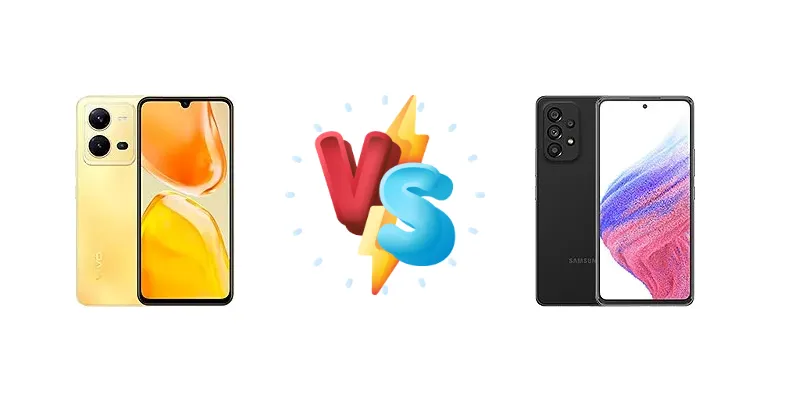
|
🏆 Quick Verdict
For most users, the Samsung Galaxy A53 5G edges out the vivo X80 Lite. Its brighter display and slightly more refined software experience, coupled with a comparable battery life, make it the more polished all-rounder. However, the X80 Lite’s faster 44W charging is a significant benefit for those prioritizing quick top-ups.
| PHONES | ||
|---|---|---|
| Phone Names | vivo X80 Lite | Samsung Galaxy A53 5G |
| Network | ||
|---|---|---|
| 2G bands | GSM 850 / 900 / 1800 / 1900 | GSM 850 / 900 / 1800 / 1900 |
| 3G bands | HSDPA 850 / 900 / 1700(AWS) / 1900 / 2100 | HSDPA 850 / 900 / 1700(AWS) / 1900 / 2100 |
| 4G bands | 1, 2, 3, 4, 5, 7, 8, 12, 17, 20, 28, 32, 38, 40, 41 | 1, 2, 3, 4, 5, 7, 12, 14, 20, 29, 30, 38, 39, 40, 41, 46, 48, 66 - SM-A536U |
| 5G bands | 1, 3, 5, 7, 8, 20, 28, 38, 40, 41, 77, 78 SA/NSA | 2, 5, 41, 66, 77, 78 SA/NSA/Sub6/mmWave - SM-A536U |
| Speed | HSPA, LTE, 5G | HSPA, LTE, 5G |
| Technology | GSM / HSPA / LTE / 5G | GSM / HSPA / LTE / 5G |
| - | 2, 5, 48, 66, 77, 78, 260, 261 SA/NSA/Sub6/mmWave - SM-A536V | |
| Launch | ||
|---|---|---|
| Announced | 2022, September 22 | 2022, March 17 |
| Status | Available. Released 2022, September 22 | Available. Released 2022, March 24 |
| Body | ||
|---|---|---|
| Build | Glass front, glass back | Glass front (Gorilla Glass 5), plastic frame, plastic back |
| Dimensions | 159.2 x 74.2 x 7.8 mm (6.27 x 2.92 x 0.31 in) | 159.6 x 74.8 x 8.1 mm (6.28 x 2.94 x 0.32 in) |
| SIM | Nano-SIM + Nano-SIM | · Nano-SIM· Nano-SIM + Nano-SIM |
| Weight | 186 g (6.56 oz) | 189 g (6.67 oz) |
| - | IP67 dust/water resistant (up to 1m for 30 min) | |
| Display | ||
|---|---|---|
| Protection | - | Corning Gorilla Glass 5 |
| Resolution | 1080 x 2404 pixels, 20:9 ratio (~409 ppi density) | 1080 x 2400 pixels, 20:9 ratio (~405 ppi density) |
| Size | 6.44 inches, 100.0 cm2 (~84.7% screen-to-body ratio) | 6.5 inches, 102.0 cm2 (~85.4% screen-to-body ratio) |
| Type | AMOLED, 90Hz, HDR10+, 1300 nits (peak) | Super AMOLED, 120Hz, 800 nits (HBM) |
| Platform | ||
|---|---|---|
| CPU | Octa-core (2x2.4 GHz Cortex-A78 & 6x2.0 GHz Cortex-A55) | Octa-core (2x2.4 GHz Cortex-A78 & 6x2.0 GHz Cortex-A55) |
| Chipset | Mediatek Dimensity 900 (6 nm) | Exynos 1280 (5 nm) |
| GPU | Mali-G68 MC4 | Mali-G68 |
| OS | Android 12, Funtouch 12 | Android 12, up to 4 major Android upgrades, One UI 8 |
| Memory | ||
|---|---|---|
| Card slot | microSDXC (uses shared SIM slot) | microSDXC (uses shared SIM slot) |
| Internal | 256GB 8GB RAM | 128GB 4GB RAM, 128GB 6GB RAM, 128GB 8GB RAM, 256GB 6GB RAM, 256GB 8GB RAM |
| Main Camera | ||
|---|---|---|
| Features | LED flash, HDR, panorama | LED flash, panorama, HDR |
| Quad | - | 64 MP, f/1.8, 26mm (wide), 1/1.7X", 0.8µm, PDAF, OIS 12 MP, f/2.2, 123˚ (ultrawide), 1.12µm 5 MP (macro) Auxiliary lens |
| Single | 50 MP, f/2.0, (wide), AF | 32 MP, f/2.2, 26mm (wide), 1/2.8", 0.8µm |
| Triple | 64 MP, f/1.8, (wide), 0.7µm, PDAF, OIS 8 MP, f/2.2, 16mm, 120˚ (ultrawide), 1/4.0", 1.12µm 2 MP (macro) | - |
| Video | 4K@30fps, 1080p@30fps | 4K@30fps, 1080p@30/60fps; gyro-EIS |
| Selfie camera | ||
|---|---|---|
| Features | HDR | HDR |
| Single | 50 MP, f/2.0, (wide), AF | 32 MP, f/2.2, 26mm (wide), 1/2.8", 0.8µm |
| Video | 4K@30fps, 1080p@30fps, HDR | 4K@30fps, 1080p@30fps |
| Sound | ||
|---|---|---|
| 3.5mm jack | No | No |
| 35mm jack | No | No |
| Loudspeaker | Yes | Yes, with stereo speakers |
| 24-bit/192kHz audio | - | |
| Comms | ||
|---|---|---|
| Bluetooth | 5.2, A2DP, LE | 5.1, A2DP, LE |
| NFC | Yes | Yes (market/region dependent) |
| Positioning | GPS, GLONASS, BDS, GALILEO, QZSS | GPS, GLONASS, GALILEO, BDS |
| Radio | No | No |
| USB | USB Type-C 2.0, OTG | USB Type-C 2.0, OTG |
| WLAN | Wi-Fi 802.11 a/b/g/n/ac, dual-band, Wi-Fi Direct | Wi-Fi 802.11 a/b/g/n/ac, dual-band, Wi-Fi Direct |
| Features | ||
|---|---|---|
| Sensors | Fingerprint (under display, optical), accelerometer, gyro, proximity, compass | Fingerprint (under display, optical), accelerometer, gyro, compass, barometer (market/region dependent) |
| Color changing back panel color | Virtual proximity sensing | |
| Battery | ||
|---|---|---|
| Charging | 44W wired, 61% in 30 min | 25W wired |
| Type | 4500 mAh | Li-Po 5000 mAh |
| Misc | ||
|---|---|---|
| Colors | Diamond Black, Sunrise Gold | Black, White, Blue, Peach |
| Models | V2208 | SM-A536B, SM-A536B/DS, SM-A536U, SM-A536U1, SM-A5360, SM-A536E, SM-A536E/DS, SM-A536V, SM-A536W, SM-A536N, SM-S536DL |
| Price | - | $ 151.42 / £ 185.00 / € 169.14 |
| SAR | - | 0.75 W/kg (head) 1.58 W/kg (body) |
| SAR EU | - | 0.89 W/kg (head) 1.60 W/kg (body) |
| Tests | ||
|---|---|---|
| Battery life | Endurance rating 120h | Endurance rating 113h |
| Camera | Photo / Video | Photo / Video |
| Display | Contrast ratio: Infinite (nominal) | Contrast ratio: Infinite (nominal) |
| Loudspeaker | -28.3 LUFS (Average) | -26.5 LUFS (Good) |
| Performance | AnTuTu: 461428 (v9) GeekBench: 2023 (v5.1) GFXBench: 21fps (ES 3.1 onscreen) | AnTuTu: 329802 (v8), 379313 (v9) GeekBench: 1891 (v5.1) GFXBench: 19fps (ES 3.1 onscreen) |
vivo X80 Lite
- Faster 44W charging for quick top-ups
- Slightly better battery endurance rating
- Potentially more affordable price point
- Lower peak display brightness
- Less established software ecosystem
Samsung Galaxy A53 5G
- Brighter display for better outdoor visibility
- More efficient 5nm Exynos 1280 chipset
- More refined software experience
- Slower 25W charging
- Slightly lower battery endurance rating
Display Comparison
The Samsung Galaxy A53 5G boasts a notably brighter display, reaching 830 nits compared to the vivo X80 Lite’s 781 nits. This 6.3% difference translates to significantly improved visibility under direct sunlight, making the A53 a better choice for outdoor use. Both phones share an 'Infinite' (nominal) contrast ratio, typical of AMOLED panels, but the A53’s higher peak brightness is the defining factor. While both likely employ PWM dimming, specific frequencies aren’t provided, making it difficult to assess potential flicker-related eye strain; however, Samsung generally optimizes for wider compatibility.
Camera Comparison
Both phones feature a 'Photo / Video' camera setup, but detailed sensor information is lacking. Without specifics on megapixel counts, sensor sizes, or aperture values, a direct comparison is difficult. However, given Samsung’s history, the A53 likely benefits from more sophisticated image processing algorithms and potentially better low-light performance. The presence of Optical Image Stabilization (OIS) on either device is unknown, but would be a significant advantage for video recording and low-light photography. It's reasonable to assume both include standard wide and ultrawide lenses, but the usefulness of any included 2MP macro lenses is questionable.
Performance
Both the vivo X80 Lite and Samsung Galaxy A53 5G utilize an octa-core CPU configuration with 2x2.4 GHz Cortex-A78 cores and 6x2.0 GHz Cortex-A55 cores. However, the chipset differs: the X80 Lite uses the Mediatek Dimensity 900 (6nm), while the A53 5G employs the Samsung Exynos 1280 (5nm). The 5nm process node of the Exynos 1280 theoretically offers better power efficiency and thermal performance compared to the 6nm Dimensity 900, potentially leading to less throttling during sustained workloads. While CPU performance is similar on paper, the Exynos 1280’s GPU may offer a slight edge in graphics-intensive tasks.
Battery Life
The vivo X80 Lite offers a 120-hour endurance rating, slightly better than the Samsung Galaxy A53 5G’s 113-hour rating. However, this difference is partially offset by the X80 Lite’s significantly faster 44W wired charging, capable of reaching 61% charge in just 30 minutes. The A53 5G is limited to 25W charging, meaning a full charge will take considerably longer. This makes the X80 Lite a more convenient option for users who frequently need to top up their battery quickly, even if the overall endurance is marginally lower.
Buying Guide
Buy the vivo X80 Lite if you prioritize fast charging and are comfortable with vivo’s FunTouch OS. It’s ideal for users who frequently find themselves needing to quickly replenish their battery throughout the day. Buy the Samsung Galaxy A53 5G if you value a brighter, more visible display in outdoor conditions, a more established software ecosystem, and a generally smoother user experience, even if it means slightly slower charging.