
vivo X80 Lite vs Nothing Phone (1): Which Mid-Range Phone Reigns Supreme?
| Phones Images | |||||
|---|---|---|---|---|---|
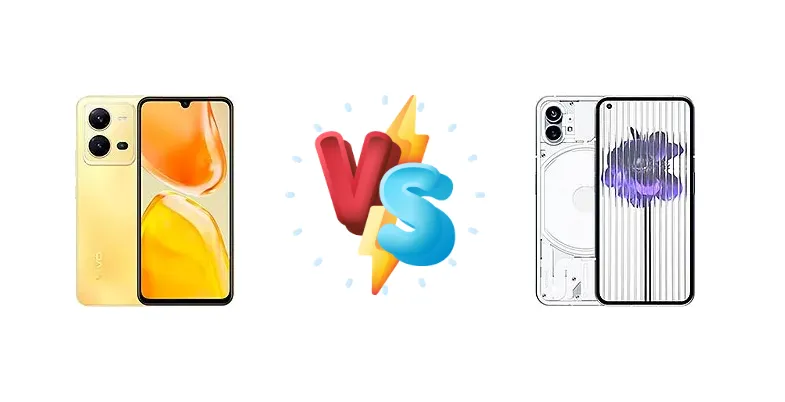
|
🏆 Quick Verdict
For most users, the vivo X80 Lite offers a more practical package. Its superior endurance rating of 120 hours, coupled with faster 44W charging, makes it ideal for those prioritizing battery life. While the Nothing Phone (1) boasts a distinctive design and wireless charging, its shorter battery life and slower wired charging are significant drawbacks.
| PHONES | ||
|---|---|---|
| Phone Names | vivo X80 Lite | Nothing Phone (1) |
| Network | ||
|---|---|---|
| 2G bands | GSM 850 / 900 / 1800 / 1900 | GSM 850 / 900 / 1800 / 1900 |
| 3G bands | HSDPA 850 / 900 / 1700(AWS) / 1900 / 2100 | HSDPA 800 / 850 / 900 / 1700(AWS) / 1900 / 2100 |
| 4G bands | 1, 2, 3, 4, 5, 7, 8, 12, 17, 20, 28, 32, 38, 40, 41 | 1, 2, 3, 4, 5, 7, 8, 12, 17, 18, 19, 20, 26, 28, 32, 34, 38, 39, 40, 41, 66 |
| 5G bands | 1, 3, 5, 7, 8, 20, 28, 38, 40, 41, 77, 78 SA/NSA | 1, 3, 5, 7, 8, 20, 28, 38, 40, 41, 77, 78 SA/NSA |
| Speed | HSPA, LTE, 5G | HSPA, LTE, 5G |
| Technology | GSM / HSPA / LTE / 5G | GSM / HSPA / LTE / 5G |
| Launch | ||
|---|---|---|
| Announced | 2022, September 22 | 2022, July 12 |
| Status | Available. Released 2022, September 22 | Available. Released 2022, July 16 |
| Body | ||
|---|---|---|
| Build | Glass front, glass back | Glass front (Gorilla Glass 5), glass back (Gorilla Glass 5), aluminum frame |
| Dimensions | 159.2 x 74.2 x 7.8 mm (6.27 x 2.92 x 0.31 in) | 159.2 x 75.8 x 8.3 mm (6.27 x 2.98 x 0.33 in) |
| SIM | Nano-SIM + Nano-SIM | Nano-SIM + Nano-SIM |
| Weight | 186 g (6.56 oz) | 193.5 g (6.84 oz) |
| Display | ||
|---|---|---|
| Protection | - | Corning Gorilla Glass 5 |
| Resolution | 1080 x 2404 pixels, 20:9 ratio (~409 ppi density) | 1080 x 2400 pixels, 20:9 ratio (~402 ppi density) |
| Size | 6.44 inches, 100.0 cm2 (~84.7% screen-to-body ratio) | 6.55 inches, 103.6 cm2 (~85.8% screen-to-body ratio) |
| Type | AMOLED, 90Hz, HDR10+, 1300 nits (peak) | OLED, 1B colors, 120Hz, 1440Hz PWM, HDR10+, 500 nits (typ), 1200 nits (peak) |
| Platform | ||
|---|---|---|
| CPU | Octa-core (2x2.4 GHz Cortex-A78 & 6x2.0 GHz Cortex-A55) | Octa-core (1x2.5 GHz Cortex-A78 & 3x2.4 GHz Cortex-A78 & 4x1.9 GHz Cortex-A55) |
| Chipset | Mediatek Dimensity 900 (6 nm) | Qualcomm SM7325-AE Snapdragon 778G+ 5G (6 nm) |
| GPU | Mali-G68 MC4 | Adreno 642L |
| OS | Android 12, Funtouch 12 | Android 12, upgradable to Android 15, up to 3 major Android upgrades, Nothing OS 3.0 |
| Memory | ||
|---|---|---|
| Card slot | microSDXC (uses shared SIM slot) | No |
| Internal | 256GB 8GB RAM | 128GB 8GB RAM, 256GB 8GB RAM, 256GB 12GB RAM |
| Main Camera | ||
|---|---|---|
| Dual | - | 50 MP, f/1.9, 24mm (wide), 1/1.56", 1.0µm, PDAF, OIS 50 MP, f/2.2, 114˚ (ultrawide), 1/2.76", 0.64µm, AF |
| Features | LED flash, HDR, panorama | LED flash, panorama, HDR |
| Single | 50 MP, f/2.0, (wide), AF | - |
| Triple | 64 MP, f/1.8, (wide), 0.7µm, PDAF, OIS 8 MP, f/2.2, 16mm, 120˚ (ultrawide), 1/4.0", 1.12µm 2 MP (macro) | - |
| Video | 4K@30fps, 1080p@30fps | 4K@30fps, 1080p@30/60fps, gyro-EIS, live HDR |
| Selfie camera | ||
|---|---|---|
| Features | HDR | - |
| Single | 50 MP, f/2.0, (wide), AF | 16 MP, f/2.5, (wide), 1/3.1", 1.0µm |
| Video | 4K@30fps, 1080p@30fps, HDR | 1080p@30fps |
| Sound | ||
|---|---|---|
| 3.5mm jack | No | - |
| 35mm jack | No | No |
| Loudspeaker | Yes | Yes, with stereo speakers |
| 24-bit/192kHz audio | - | |
| Comms | ||
|---|---|---|
| Bluetooth | 5.2, A2DP, LE | 5.2, A2DP, LE |
| NFC | Yes | Yes |
| Positioning | GPS, GLONASS, BDS, GALILEO, QZSS | GPS (L1), GLONASS (L1), BDS (B1I+B1c), GALILEO (E1), QZSS (L1) |
| Radio | No | No |
| USB | USB Type-C 2.0, OTG | USB Type-C 2.0, OTG |
| WLAN | Wi-Fi 802.11 a/b/g/n/ac, dual-band, Wi-Fi Direct | Wi-Fi 802.11 a/b/g/n/ac/6, dual-band |
| Features | ||
|---|---|---|
| Sensors | Fingerprint (under display, optical), accelerometer, gyro, proximity, compass | Fingerprint (under display, optical), accelerometer, proximity, gyro, compass |
| Color changing back panel color | - | |
| Battery | ||
|---|---|---|
| Charging | 44W wired, 61% in 30 min | 33W wired, PD3.0, QC4, 50% in 30 min, 100% in 70 min 15W wireless 5W reverse wireless |
| Type | 4500 mAh | Li-Ion 4500 mAh (17.42 Wh) |
| Misc | ||
|---|---|---|
| Colors | Diamond Black, Sunrise Gold | White, Black |
| Models | V2208 | A063 |
| Price | - | $ 539.00 / £ 234.77 / € 249.95 / ₹ 17,990 |
| SAR | - | 1.29 W/kg (head) 1.09 W/kg (body) |
| SAR EU | - | 0.99 W/kg (head) 1.48 W/kg (body) |
| Tests | ||
|---|---|---|
| Battery life | Endurance rating 120h | - |
| Camera | Photo / Video | - |
| Display | Contrast ratio: Infinite (nominal) | - |
| Loudspeaker | -28.3 LUFS (Average) | - |
| Performance | AnTuTu: 461428 (v9) GeekBench: 2023 (v5.1) GFXBench: 21fps (ES 3.1 onscreen) | - |
vivo X80 Lite
- Superior battery life (120h endurance)
- Faster wired charging (44W)
- Brighter display (781 nits)
- Less distinctive design
- Potentially less refined software experience
Nothing Phone (1)
- Unique and eye-catching design
- Wireless charging support
- More powerful GPU for gaming
- Shorter battery life (108h endurance)
- Slower wired charging (33W)
- Lower peak display brightness
Display Comparison
The vivo X80 Lite boasts a brighter display, reaching 781 nits compared to the Nothing Phone (1)’s 663 nits. This translates to better visibility outdoors under direct sunlight. While both utilize AMOLED panels for vibrant colors, the difference in peak brightness is noticeable. Neither manufacturer specifies refresh rates or PWM dimming frequencies, but the X80 Lite’s higher brightness suggests a potentially more aggressive power profile, which could impact battery life. The Nothing Phone (1)'s flat display is a plus for some, minimizing edge distortion, while the X80 Lite's display shape isn't specified.
Camera Comparison
Both phones offer capable camera systems, but details are limited to 'Photo / Video' capabilities. Without specific sensor sizes or megapixel counts, a direct comparison is difficult. However, the Snapdragon 778G+’s image signal processor (ISP) is generally considered more advanced, potentially resulting in better image processing and low-light performance on the Nothing Phone (1). The absence of information regarding optical image stabilization (OIS) on either device makes it impossible to assess video stabilization capabilities. The usefulness of any included macro cameras (likely 2MP on both) is questionable, offering limited detail and dynamic range.
Performance
Under the hood, the Nothing Phone (1) features the Qualcomm Snapdragon 778G+ 5G, while the vivo X80 Lite utilizes the MediaTek Dimensity 900. The Snapdragon 778G+ has a slightly more refined CPU configuration with 1x2.5 GHz Cortex-A78 core and 3x2.4 GHz Cortex-A78 cores, compared to the Dimensity 900’s 2x2.4 GHz Cortex-A78 & 6x2.0 GHz Cortex-A55. Both are built on a 6nm process, offering good efficiency. However, the Snapdragon 778G+ generally demonstrates superior GPU performance, making it a better choice for gaming. The Nothing Phone (1) benefits from Qualcomm’s optimized software integration, potentially leading to smoother overall performance. Thermal management is unknown for both, but the Snapdragon’s architecture is generally more efficient.
Battery Life
The vivo X80 Lite’s endurance rating of 120 hours significantly surpasses the Nothing Phone (1)’s 108 hours. This suggests the X80 Lite can last considerably longer on a single charge. While the Nothing Phone (1) offers the convenience of 33W wired charging with PD3.0 and QC4, plus 15W wireless and 5W reverse wireless charging, it takes 70 minutes to reach 100%. The X80 Lite’s 44W wired charging achieves 61% charge in 30 minutes, indicating a faster initial charging speed. The Nothing Phone (1)'s wireless charging is a unique advantage, but the slower overall charging speed and lower endurance rating are notable drawbacks.
Buying Guide
Buy the vivo X80 Lite if you need exceptional battery life and fast charging, prioritizing practicality and a reliable experience. It’s the better choice for users who frequently travel or heavily use their phones throughout the day. Buy the Nothing Phone (1) if you value a unique design aesthetic, wireless charging convenience, and a cleaner, near-stock Android experience, and are willing to compromise on battery endurance.