
Google Pixel 6a vs. vivo X80 Lite: A Detailed Comparison
| Phones Images | |||||
|---|---|---|---|---|---|
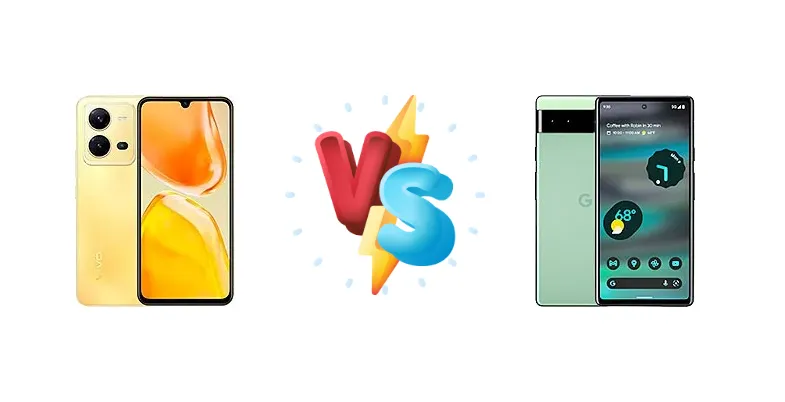
|
🏆 Quick Verdict
For most users, the Google Pixel 6a is the superior choice. Its Google Tensor chip delivers significantly better performance and future-proofs the device with advanced AI capabilities. While the vivo X80 Lite boasts faster 44W charging, the Pixel 6a’s superior processing power and camera experience justify the trade-off.
| PHONES | ||
|---|---|---|
| Phone Names | vivo X80 Lite | Google Pixel 6a |
| Network | ||
|---|---|---|
| 2G bands | GSM 850 / 900 / 1800 / 1900 | GSM 850 / 900 / 1800 / 1900 |
| 3G bands | HSDPA 850 / 900 / 1700(AWS) / 1900 / 2100 | HSDPA 800 / 850 / 900 / 1700(AWS) / 1900 / 2100 |
| 4G bands | 1, 2, 3, 4, 5, 7, 8, 12, 17, 20, 28, 32, 38, 40, 41 | 1, 2, 3, 4, 5, 7, 8, 12, 13, 14, 17, 18, 19, 20, 25, 26, 28, 29, 30, 38, 39, 40, 41, 42, 48, 66, 71 - GX7AS, GB62Z (USA/Canada) |
| 5G bands | 1, 3, 5, 7, 8, 20, 28, 38, 40, 41, 77, 78 SA/NSA | 1, 2, 3, 5, 7, 8, 12, 20, 25, 28, 30, 38, 40, 41, 48, 66, 71, 77, 78 SA/NSA/Sub6 - GX7AS (USA/Canada) |
| Speed | HSPA, LTE, 5G | HSPA, LTE, 5G |
| Technology | GSM / HSPA / LTE / 5G | GSM / HSPA / LTE / 5G |
| - | 1, 2, 3, 5, 7, 8, 12, 20, 25, 28, 30, 40, 48, 66, 71, 77, 78 SA/NSA/Sub6 - G1AZG (International) | |
| Launch | ||
|---|---|---|
| Announced | 2022, September 22 | 2022, May 11 |
| Status | Available. Released 2022, September 22 | Available. Released 2022, July 21 |
| Body | ||
|---|---|---|
| Build | Glass front, glass back | Glass front (Gorilla Glass 3), aluminum frame, plastic back |
| Dimensions | 159.2 x 74.2 x 7.8 mm (6.27 x 2.92 x 0.31 in) | 152.2 x 71.8 x 8.9 mm (5.99 x 2.83 x 0.35 in) |
| SIM | Nano-SIM + Nano-SIM | Nano-SIM + eSIM |
| Weight | 186 g (6.56 oz) | 178 g (6.28 oz) |
| - | IP67 dust/water resistant (up to 1m for 30 min) | |
| Display | ||
|---|---|---|
| Protection | - | Corning Gorilla Glass 3 |
| Resolution | 1080 x 2404 pixels, 20:9 ratio (~409 ppi density) | 1080 x 2400 pixels, 20:9 ratio (~429 ppi density) |
| Size | 6.44 inches, 100.0 cm2 (~84.7% screen-to-body ratio) | 6.1 inches, 90.7 cm2 (~83.0% screen-to-body ratio) |
| Type | AMOLED, 90Hz, HDR10+, 1300 nits (peak) | OLED, HDR |
| - | Always-on display | |
| Platform | ||
|---|---|---|
| CPU | Octa-core (2x2.4 GHz Cortex-A78 & 6x2.0 GHz Cortex-A55) | Octa-core (2x2.80 GHz Cortex-X1 & 2x2.25 GHz Cortex-A76 & 4x1.80 GHz Cortex-A55) |
| Chipset | Mediatek Dimensity 900 (6 nm) | Google Tensor (5 nm) |
| GPU | Mali-G68 MC4 | Mali-G78 MP20 |
| OS | Android 12, Funtouch 12 | Android 12, upgradable to Android 15, up to 5 major Android upgrades |
| Memory | ||
|---|---|---|
| Card slot | microSDXC (uses shared SIM slot) | No |
| Internal | 256GB 8GB RAM | 128GB 6GB RAM |
| - | UFS 3.1 | |
| Main Camera | ||
|---|---|---|
| Dual | - | 12.2 MP, f/1.7, 27mm, (wide), 1/2.55", 1.4µm, dual pixel PDAF, OIS 12 MP, f/2.2, 17mm, 114˚ (ultrawide), 1.25µm |
| Features | LED flash, HDR, panorama | Dual-LED flash, Pixel Shift, Auto-HDR, panorama |
| Single | 50 MP, f/2.0, (wide), AF | 8 MP, f/2.0, 24mm (wide), 1.12µm |
| Triple | 64 MP, f/1.8, (wide), 0.7µm, PDAF, OIS 8 MP, f/2.2, 16mm, 120˚ (ultrawide), 1/4.0", 1.12µm 2 MP (macro) | - |
| Video | 4K@30fps, 1080p@30fps | 4K@30/60fps, 1080p@30/60/120/240fps; gyro-EIS, OIS |
| Selfie camera | ||
|---|---|---|
| Features | HDR | HDR, panorama |
| Single | 50 MP, f/2.0, (wide), AF | 8 MP, f/2.0, 24mm (wide), 1.12µm |
| Video | 4K@30fps, 1080p@30fps, HDR | 1080p@30fps |
| Sound | ||
|---|---|---|
| 3.5mm jack | No | No |
| 35mm jack | No | No |
| Loudspeaker | Yes | Yes, with stereo speakers |
| 24-bit/192kHz audio | - | |
| Comms | ||
|---|---|---|
| Bluetooth | 5.2, A2DP, LE | 5.2, A2DP, LE |
| NFC | Yes | Yes |
| Positioning | GPS, GLONASS, BDS, GALILEO, QZSS | GPS, GLONASS, GALILEO, QZSS |
| Radio | No | No |
| USB | USB Type-C 2.0, OTG | USB Type-C 3.1 |
| WLAN | Wi-Fi 802.11 a/b/g/n/ac, dual-band, Wi-Fi Direct | Wi-Fi 802.11 a/b/g/n/ac/6e, dual-band, Wi-Fi Direct |
| Features | ||
|---|---|---|
| Sensors | Fingerprint (under display, optical), accelerometer, gyro, proximity, compass | Fingerprint (under display, optical), accelerometer, gyro, proximity, compass, barometer |
| Color changing back panel color | - | |
| Battery | ||
|---|---|---|
| Charging | 44W wired, 61% in 30 min | 18W wired, PD3.0 |
| Type | 4500 mAh | Li-Po 4410 mAh |
| Misc | ||
|---|---|---|
| Colors | Diamond Black, Sunrise Gold | Chalk, Charcoal, Sage |
| Models | V2208 | GX7AS, GB62Z, G1AZG, GB17L |
| Price | - | $ 138.99 / C$ 228.74 / ₹ 23,999 |
| Tests | ||
|---|---|---|
| Battery life | Endurance rating 120h | Endurance rating 94h |
| Camera | Photo / Video | - |
| Display | Contrast ratio: Infinite (nominal) | Contrast ratio: Infinite (nominal) |
| Loudspeaker | -28.3 LUFS (Average) | - |
| Performance | AnTuTu: 461428 (v9) GeekBench: 2023 (v5.1) GFXBench: 21fps (ES 3.1 onscreen) | - |
vivo X80 Lite
- Superior processing power with Google Tensor
- Exceptional camera quality and software features
- Long-term software support from Google
- Slower charging speed (18W)
- Lower battery endurance rating compared to X80 Lite
Google Pixel 6a
- Faster 44W wired charging
- Brighter display for outdoor visibility
- Competitive price point
- Less powerful Mediatek Dimensity 900 chipset
- Inferior image processing compared to Pixel 6a
Display Comparison
The Pixel 6a features a display capable of reaching 876 nits of peak brightness, noticeably exceeding the vivo X80 Lite’s 781 nits. This translates to better visibility in direct sunlight for the Pixel 6a. Both displays share an infinite (nominal) contrast ratio, typical for OLED panels. While neither device boasts a high refresh rate, the Pixel 6a’s higher peak brightness provides a more vibrant and usable experience in bright environments. The X80 Lite’s brightness is still respectable, but the Pixel 6a has a clear advantage.
Camera Comparison
Both phones offer capable camera systems, but Google’s computational photography gives the Pixel 6a a significant edge. While both devices are listed as having Photo/Video capabilities, the Pixel 6a leverages the Tensor chip’s image signal processor (ISP) for superior noise reduction, dynamic range, and detail in photos and videos. The Pixel 6a’s software algorithms, like Magic Eraser, further enhance the camera experience. Without specific sensor size details, it’s difficult to make a direct comparison, but Google’s image processing is a known strength. The X80 Lite likely relies more on hardware and less on software for image quality.
Performance
The core difference lies in the chipsets. The Google Pixel 6a is powered by the Google Tensor (5nm), while the vivo X80 Lite utilizes the Mediatek Dimensity 900 (6nm). The Tensor chip, with its Cortex-X1 prime core clocked at 2.80 GHz, offers a substantial performance advantage over the Dimensity 900’s Cortex-A78 core at 2.4 GHz. The 5nm fabrication process of the Tensor also contributes to better power efficiency. This means the Pixel 6a will handle demanding tasks like video editing and gaming with greater ease and potentially less thermal throttling. The Dimensity 900 is still a capable chip for everyday tasks, but it falls behind in raw processing power.
Battery Life
The vivo X80 Lite boasts a 120-hour endurance rating, while the Pixel 6a manages 94 hours. However, this doesn’t tell the whole story. The X80 Lite achieves this partly through its 44W wired charging, capable of reaching 61% charge in just 30 minutes. The Pixel 6a’s 18W charging with PD3.0 is considerably slower. While the Pixel 6a’s Tensor chip is more power-hungry, the difference in endurance is partially offset by the efficiency gains from the 5nm process. The X80 Lite is the clear winner for users who prioritize quick top-ups, but the Pixel 6a’s battery life is still adequate for a full day of moderate use.
Buying Guide
Buy the vivo X80 Lite if you prioritize rapid charging and a very bright display for outdoor visibility, and are less concerned with demanding gaming or extensive photo editing. Buy the Google Pixel 6a if you value a smoother, more responsive user experience, exceptional camera capabilities powered by Google’s image processing, and long-term software support.