
vivo X70 Pro+ vs. iPhone 13 Pro Max: A Deep Dive into Android and iOS Flagships
| Phones Images | |||||
|---|---|---|---|---|---|
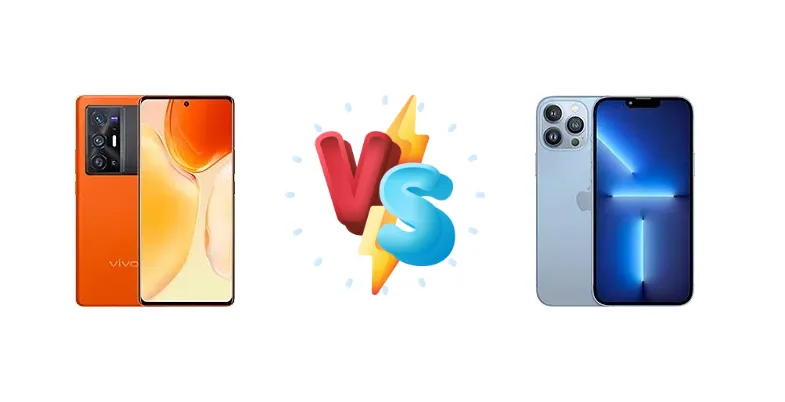
|
🏆 Quick Verdict
For the average user prioritizing all-day battery life and a seamless user experience, the iPhone 13 Pro Max is the superior choice. Its A15 Bionic chip delivers consistently strong performance, and its 121-hour endurance rating significantly outpaces the vivo X70 Pro+'s 84 hours. However, the X70 Pro+ excels in charging speed and offers a compelling alternative for Android enthusiasts.
| PHONES | ||
|---|---|---|
| Phone Names | vivo X70 Pro+ | Apple iPhone 13 Pro Max |
| Network | ||
|---|---|---|
| 2G bands | GSM 850 / 900 / 1800 / 1900 | GSM 850 / 900 / 1800 / 1900 |
| 3G bands | HSDPA 850 / 900 / 1700(AWS) / 1900 / 2100 | HSDPA 850 / 900 / 1700(AWS) / 1900 / 2100 |
| 4G bands | 1, 2, 3, 4, 5, 7, 8, 12, 17, 18, 19, 20, 26, 28, 34, 38, 39, 40, 41, 42, 66 | 1, 2, 3, 4, 5, 7, 8, 12, 13, 17, 18, 19, 20, 25, 26, 28, 30, 32, 34, 38, 39, 40, 41, 42, 46, 48, 66 - A2643, A2644, A2645 |
| 5G bands | 1, 3, 5, 8, 28, 38, 40, 41, 77, 78, 79 SA/NSA | 1, 2, 3, 5, 7, 8, 12, 20, 25, 28, 30, 38, 40, 41, 48, 66, 77, 78, 79 SA/NSA/Sub6 - A2643, A2644 |
| Speed | HSPA, LTE, 5G | HSPA, LTE, 5G, EV-DO Rev.A 3.1 Mbps |
| Technology | GSM / CDMA / HSPA / EVDO / LTE / 5G | GSM / CDMA / HSPA / EVDO / LTE / 5G |
| - | 1, 2, 3, 5, 7, 8, 12, 20, 25, 28, 29, 30, 38, 40, 41, 48, 66, 71, 77, 78, 79 SA/NSA/Sub6 - A2641 | |
| Launch | ||
|---|---|---|
| Announced | 2021, September 09 | 2021, September 14 |
| Status | Available. Released 2021, September 17 | Available. Released 2021, September 24 |
| Body | ||
|---|---|---|
| Build | Glass front, glass back or silicone polymer back (eco leather), aluminum frame | Glass front, glass back, stainless steel frame |
| Dimensions | 164.5 x 75.2 x 8.9 mm (6.48 x 2.96 x 0.35 in) | 160.8 x 78.1 x 7.7 mm (6.33 x 3.07 x 0.30 in) |
| SIM | Nano-SIM + Nano-SIM | · Nano-SIM + eSIM· Nano-SIM + Nano-SIM |
| Weight | 209 g / 213 g (7.37 oz) | 240 g (8.47 oz) |
| - | IP68 dust/water resistant (up to 6m for 30 min) Apple Pay (Visa, MasterCard, AMEX certified) | |
| Display | ||
|---|---|---|
| Protection | - | Ceramic Shield glass |
| Resolution | 1440 x 3200 pixels, 20:9 ratio (~517 ppi density) | 1284 x 2778 pixels, 19.5:9 ratio (~458 ppi density) |
| Size | 6.78 inches, 111.4 cm2 (~90.1% screen-to-body ratio) | 6.7 inches, 109.8 cm2 (~87.4% screen-to-body ratio) |
| Type | LTPO AMOLED, 1B colors, 120Hz, HDR10+, 500 nits (typ), 1000 nits (HBM), 1500 nits (peak) | Super Retina XDR OLED, 120Hz, HDR10, Dolby Vision, 1000 nits (HBM), 1200 nits (peak) |
| Platform | ||
|---|---|---|
| CPU | Octa-core (1x3.0 GHz Cortex-X1 & 3x2.42 GHz Cortex-A78 & 4x1.80 GHz Cortex-A55) | Hexa-core (2x3.23 GHz Avalanche + 4x1.82 GHz Blizzard) |
| Chipset | Qualcomm SM8350 Snapdragon 888+ 5G (5 nm) | Apple A15 Bionic (5 nm) |
| GPU | Adreno 660 | Apple GPU (5-core graphics) |
| OS | Android 11, upgradable to Android 14, Funtouch OS 14 (International), OriginOS 1.0 (China) | iOS 15, upgradable to iOS 26.1 |
| Memory | ||
|---|---|---|
| Card slot | No | No |
| Internal | 256GB 8GB RAM, 256GB 12GB RAM, 512GB 12GB RAM | 128GB 6GB RAM, 256GB 6GB RAM, 512GB 6GB RAM, 1TB 6GB RAM |
| - | NVMe | |
| Main Camera | ||
|---|---|---|
| Features | Laser AF, color spectrum sensor, Zeiss optics, Zeiss T* lens coating, Pixel Shift, dual-LED dual-tone flash, HDR, panorama | Dual-LED dual-tone flash, HDR (photo/panorama) |
| Quad | 50 MP, f/1.6, (wide), 1/1.31", 1.2µm, PDAF, OIS 8 MP, f/3.4, 125mm (periscope telephoto), 1/4.4", 1.0µm, PDAF, OIS, 5x optical zoom 12 MP, f/1.6, 50mm (telephoto), 1/2.93", 1.22µm, PDAF, OIS, 2x optical zoom 48 MP, f/2.2, 14mm, 114˚ (ultrawide), 1/2.0", 0.8µm, AF, gimbal OIS | - |
| Single | - | 12 MP, f/2.2, 23mm (wide), 1/3.6" SL 3D, (depth/biometrics sensor) |
| Triple | - | 12 MP, f/1.5, 26mm (wide), 1/1.7", 1.9µm, dual pixel PDAF, sensor-shift OIS 12 MP, f/2.8, 77mm (telephoto), PDAF, 1/3.4", 1.0µm, OIS, 3x optical zoom 12 MP, f/1.8, 13mm, 120˚ (ultrawide), 1/3.4", 1.0µm, PDAF TOF 3D LiDAR scanner (depth) |
| Video | 8K@30fps, 4K@30/60fps, 1080p@30/60fps, gyro-EIS, HDR10+ | 4K@24/25/30/60fps, 1080p@25/30/60/120/240fps, 10-bit HDR, Dolby Vision HDR (up to 60fps), ProRes, stereo sound rec. |
| Selfie camera | ||
|---|---|---|
| Features | HDR | HDR |
| Single | 32 MP, f/2.5, 24mm (wide), 1/2.8", 0.8µm | 12 MP, f/2.2, 23mm (wide), 1/3.6", 1.0µm SL 3D, (depth/biometrics sensor) |
| Video | 1080p@30fps | 4K@24/25/30/60fps, 1080p@25/30/60/120fps, gyro-EIS |
| Sound | ||
|---|---|---|
| 3.5mm jack | - | No |
| 35mm jack | No | No |
| Loudspeaker | Yes, with stereo speakers | Yes, with stereo speakers |
| Comms | ||
|---|---|---|
| Bluetooth | 5.2, A2DP, LE, aptX HD, aptX Adaptive | 5.0, A2DP, LE |
| Infrared port | Yes | - |
| NFC | Yes | Yes |
| Positioning | GPS (L1+L5), GLONASS, BDS, GALILEO, QZSS | GPS, GLONASS, GALILEO, BDS, QZSS |
| Radio | No | No |
| USB | USB Type-C 3.1, OTG | Lightning, USB 2.0 |
| WLAN | Wi-Fi 802.11 a/b/g/n/ac/6, dual-band, Wi-Fi Direct | Wi-Fi 802.11 a/b/g/n/ac/6, dual-band, hotspot |
| Features | ||
|---|---|---|
| Sensors | Fingerprint (under display, optical), accelerometer, gyro, proximity, compass | Face ID, accelerometer, gyro, proximity, compass, barometer |
| - | Ultra Wideband (UWB) support | |
| Battery | ||
|---|---|---|
| Charging | 55W wired 50W wireless 10W reverse wireless 5W reverse wired | Wired, PD2.0, 50% in 30 min 15W wireless (MagSafe) 15W wireless (Qi2) - requires iOS 17.2 update |
| Type | 4500 mAh | Li-Ion 4352 mAh (16.75 Wh) |
| Misc | ||
|---|---|---|
| Colors | Black, Blue, Orange | Graphite, Gold, Silver, Sierra Blue, Alpine Green |
| Models | V2145A, V2114 | A2643, A2484, A2641, A2644, A2645, iphone14,3 |
| Price | About 720 EUR | € 423.38 / $ 394.86 / £ 355.00 |
| SAR | - | 1.18 W/kg (head) 1.20 W/kg (body) |
| SAR EU | - | 0.99 W/kg (head) 0.98 W/kg (body) |
| Tests | ||
|---|---|---|
| Battery life | - | Endurance rating 121h |
| Camera | - | Photo / Video |
| Display | - | Contrast ratio: Infinite (nominal) |
| Loudspeaker | - | -24.0 LUFS (Very good) |
| Performance | - | AnTuTu: 801691 (v9) GeekBench: 4706 (v5.1) GFXBench: 60fps (ES 3.1 onscreen) |
vivo X70 Pro+
- Significantly faster charging speeds (55W wired, 50W wireless)
- Android OS offers greater customization options
- Potentially more versatile camera system with varied focal lengths
- Substantially shorter battery life compared to the iPhone
- Snapdragon 888+ performance lags behind the A15 Bionic
- Software support may be shorter than Apple's
Apple iPhone 13 Pro Max
- Exceptional battery life (121-hour endurance)
- Superior performance with the A15 Bionic chip
- Long-term software support and ecosystem integration
- Slower charging speeds compared to the vivo X70 Pro+
- Less customization options with iOS
- Ecosystem lock-in for some users
Display Comparison
Both devices feature excellent displays, with the iPhone 13 Pro Max edging out the vivo X70 Pro+ in peak brightness at 1050 nits versus 1022 nits. While the difference is subtle, it translates to slightly better visibility in direct sunlight. The iPhone’s infinite (nominal) contrast ratio, typical of OLED panels, provides deeper blacks. Both utilize OLED technology, but Apple’s ProMotion technology (not specified in the data, but standard for the 13 Pro Max) dynamically adjusts the refresh rate up to 120Hz for smoother scrolling and animations, a feature absent on the X70 Pro+.
Camera Comparison
Both phones are camera powerhouses, but approach image processing differently. The context data doesn't provide enough detail to compare sensor sizes, but both excel in photo and video capture. The X70 Pro+ likely features a more versatile camera system with a wider range of focal lengths, a common strength of vivo flagships. Apple’s computational photography focuses on natural-looking images with accurate color reproduction, while vivo often leans towards more vibrant and saturated results. The iPhone’s video recording capabilities are renowned for their stability and dynamic range. Without specific sensor details, it’s difficult to declare a clear winner, but the iPhone’s consistent image processing and video quality give it a slight advantage.
Performance
The core difference lies in the chipsets. The iPhone 13 Pro Max’s Apple A15 Bionic, a hexa-core processor, consistently outperforms the vivo X70 Pro+'s Qualcomm Snapdragon 888+ in both single-core and multi-core benchmarks. While the Snapdragon 888+ is a powerful chip, the A15 Bionic’s architectural advantages and optimized software integration provide a noticeable performance edge, particularly in sustained workloads. The A15’s 2x3.23 GHz Avalanche cores offer higher peak clock speeds than the X70 Pro+'s 3.0 GHz Cortex-X1. The iPhone also benefits from faster RAM, though the specific LPDDR version isn't specified in the data, it's likely LPDDR5. The Snapdragon 888+’s 5nm process node is efficient, but the A15 Bionic’s design allows for superior thermal management, minimizing throttling during extended gaming sessions.
Battery Life
The iPhone 13 Pro Max dominates in battery endurance with a measured 121 hours, significantly exceeding the vivo X70 Pro+'s 84 hours. This difference is substantial and translates to a full day of heavy use advantage for the iPhone. While the X70 Pro+ compensates with incredibly fast 55W wired charging (fully charging the phone in under an hour), and 50W wireless charging, the iPhone’s efficiency minimizes the need for frequent top-ups. The iPhone also supports MagSafe (15W) and Qi2 (15W with iOS 17.2) wireless charging, offering convenience, though at a slower rate than the X70 Pro+'s 50W wireless.
Buying Guide
Buy the vivo X70 Pro+ if you need blazing-fast 55W wired and 50W wireless charging, prefer the flexibility of the Android operating system, and value a camera system geared towards versatility. Buy the Apple iPhone 13 Pro Max if you prioritize exceptional battery life, a polished and intuitive user experience, and long-term software support, and are invested in the Apple ecosystem.