
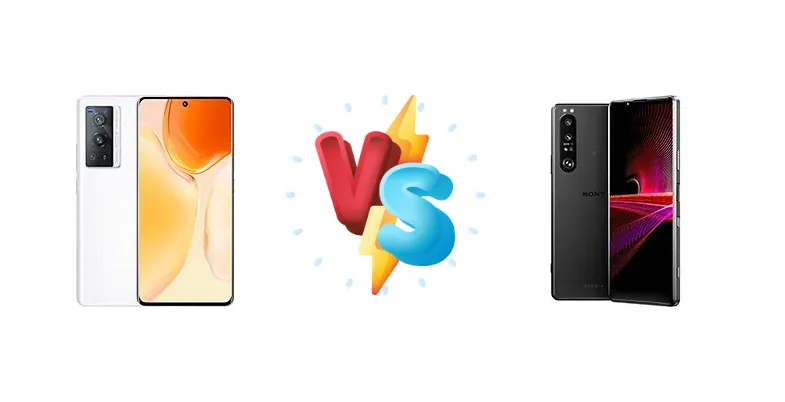
vivo X70 Pro vs. Sony Xperia 1 III: A Flagship Face-Off
| Phones Images | |||||
|---|---|---|---|---|---|
|
🏆 Quick Verdict
For the average user prioritizing battery life and a brighter display, the vivo X70 Pro emerges as the winner. Its superior endurance rating (123h vs 82h) and significantly higher peak brightness (993 nits vs 620 nits) offer a more practical daily experience. However, the Xperia 1 III’s Snapdragon 888 provides a raw performance edge for demanding tasks.
| PHONES | ||
|---|---|---|
| Phone Names | vivo X70 Pro | Sony Xperia 1 III |
| Network | ||
|---|---|---|
| 2G bands | GSM 850 / 900 / 1800 / 1900 | GSM 850 / 900 / 1800 / 1900 |
| 3G bands | HSDPA 850 / 900 / 1700(AWS) / 1900 / 2100 | HSDPA 800 / 850 / 900 / 1700(AWS) / 1900 / 2100 |
| 4G bands | 1, 2, 3, 4, 5, 7, 8, 9, 12, 17, 18, 19, 20, 26, 28, 38, 39, 40, 41 - International | 1, 2, 3, 4, 5, 7, 8, 12, 13, 17, 19, 20, 25, 26, 28, 29, 32, 34, 38, 39, 40, 41, 46, 66 - Europe |
| 5G bands | 1, 3, 5, 7, 28, 40, 41, 78, 79 SA/NSA - International | 1, 3, 5, 7, 8, 20, 28, 38, 40, 41, 77, 78 SA/NSA/Sub6 - Europe |
| Speed | HSPA, LTE, 5G | HSPA, LTE, 5G |
| Technology | GSM / CDMA / HSPA / EVDO / LTE / 5G | GSM / HSPA / LTE / 5G |
| 3, 5, 77, 78 SA/NSA - India | SA/NSA/Sub6/mmWave - USA (specific) | |
| Launch | ||
|---|---|---|
| Announced | 2021, September 09 | 2021, April 14 |
| Status | Available. Released 2021, September 17 | Available. Released 2021, August 25 |
| Body | ||
|---|---|---|
| Build | Glass front (Schott Xensation Up), glass back, aluminum frame | Glass front (Gorilla Glass Victus), glass back (Gorilla Glass 6), aluminum frame |
| Dimensions | 158.3 x 73.2 x 8 mm (6.23 x 2.88 x 0.31 in) | 165 x 71 x 8.2 mm (6.50 x 2.80 x 0.32 in) |
| SIM | Nano-SIM + Nano-SIM | Nano-SIM + Nano-SIM |
| Weight | 183/184/185/186 g (6.46 oz) | 186 g / 187.1 g (mmWave) (6.56 oz) |
| - | IP65/IP68 dust/water resistant (up to 1.5m for 30 min) | |
| Display | ||
|---|---|---|
| Protection | Schott Xensation Up | Corning Gorilla Glass Victus |
| Resolution | 1080 x 2376 pixels (~398 ppi density) | 1644 x 3840 pixels, 21:9 ratio (~643 ppi density) |
| Size | 6.56 inches, 104.6 cm2 (~90.3% screen-to-body ratio) | 6.5 inches, 98.6 cm2 (~84.2% screen-to-body ratio) |
| Type | AMOLED, 120Hz, HDR10+, 1300 nits (peak) | OLED, 1B colors, 120Hz, HDR BT.2020 |
| - | Runs at 1096 x 2560 pixels except for select use cases | |
| Platform | ||
|---|---|---|
| CPU | Octa-core (1x3.0 GHz Cortex-A78 & 3x2.6 GHz Cortex-A78 & 4x2.0 GHz Cortex-A55) - InternationalOcta-core (1x2.8 GHz Cortex-A78 & 3x2.6 GHz Cortex-A78 & 4x2.0 GHz Cortex-A55) - China | Octa-core (1x2.84 GHz Cortex-X1 & 3x2.42 GHz Cortex-A78 & 4x1.80 GHz Cortex-A55) |
| Chipset | Mediatek Dimensity 1200 (6 nm) - InternationalExynos 1080 (5 nm) - China | Qualcomm SM8350 Snapdragon 888 5G (5 nm) |
| GPU | Mali-G77 MC9 - InternationalMali-G78 MP10 - China | Adreno 660 |
| OS | Android 11, upgradable to Android 14, Funtouch OS 14 (International), OriginOS (China) | Android 11, upgradable to Android 13 |
| Memory | ||
|---|---|---|
| Card slot | No | microSDXC (uses shared SIM slot) |
| Internal | 128GB 8GB RAM, 256GB 8GB RAM, 256GB 12GB RAM, 256GB 16GB RAM, 512GB 12GB RAM | 256GB 12GB RAM, 512GB 12GB RAM |
| UFS 3.1 | UFS 3.X | |
| Main Camera | ||
|---|---|---|
| Features | Laser AF, color spectrum sensor, Zeiss optics, Zeiss T* lens coating, Pixel Shift, dual-LED dual-tone flash, HDR, panorama | Zeiss optics, Zeiss T* lens coating, color spectrum sensor, LED flash, panorama, HDR, eye tracking |
| Quad | 50 MP, f/1.8, (wide), 1/1.56", 1.0µm, PDAF, gimbal OIS 8 MP, f/3.4, 125mm (periscope telephoto), 1/4.4", 1.0µm, PDAF, OIS, 5x optical zoom 12 MP, f/2.0, 50mm (telephoto), 1/2.93", 1.22µm, PDAF, 2x optical zoom 12 MP, f/2.2, 16mm, 116˚ (ultrawide), 1/3.1", 1.12µm, AF | - |
| Single | 32 MP, f/2.5, 24mm (wide), 1/2.8", 0.8µm | 8 MP, f/2.0, 24mm (wide), 1/4", 1.12µm |
| Triple | - | 12 MP, f/1.7, 24mm (wide), 1/1.7", 1.8µm, dual pixel PDAF, OIS 12 MP, f/2.3, 70mm (telephoto), f/2.8, 105mm (telephoto), 1/2.9", dual pixel PDAF, 3x/4.4x optical zoom, OIS 12 MP, f/2.2, 124˚, 16mm (ultrawide), 1/2.6", dual pixel PDAF 0.3 MP, TOF 3D, (depth) |
| Video | 4K@30/60fps, 1080p@30/60fps, gyro-EIS, HDR10+ | 4K@24/25/30/60/120fps HDR, 1080p@30/60/120fps; 5-axis gyro-EIS, OIS |
| Selfie camera | ||
|---|---|---|
| Features | HDR | HDR |
| Single | 32 MP, f/2.5, 24mm (wide), 1/2.8", 0.8µm | 8 MP, f/2.0, 24mm (wide), 1/4.0", 1.12µm |
| Video | 1080p@30fps | 1080p@30fps, 5-axis gyro-EIS |
| Sound | ||
|---|---|---|
| 3.5mm jack | No | Yes |
| 35mm jack | No | Yes |
| Loudspeaker | Yes | Yes, with stereo speakers |
| 32-bit/192kHz audio | 24-bit/192kHz audio Dynamic vibration system | |
| Comms | ||
|---|---|---|
| Bluetooth | 5.2, A2DP, LE, aptX HD | 5.2, A2DP, LE, aptX HD, aptX Adaptive |
| Infrared port | Yes | - |
| NFC | Yes (market/region dependent) | Yes |
| Positioning | GPS (L1+L5), GLONASS, BDS, GALILEO, QZSS, NavIC | GPS, GLONASS, BDS, GALILEO, QZSS |
| Radio | No | No |
| USB | USB Type-C 2.0, OTG | USB Type-C 3.1, OTG, video output |
| WLAN | Wi-Fi 802.11 a/b/g/n/ac/6, dual-band, Wi-Fi Direct | Wi-Fi 802.11 a/b/g/n/ac/6, dual-band, Wi-Fi Direct, DLNA |
| Features | ||
|---|---|---|
| Sensors | Fingerprint (under display, optical), accelerometer, gyro, proximity, compass | Fingerprint (side-mounted), accelerometer, gyro, proximity, barometer, compass |
| - | Native Sony Alpha camera support | |
| Battery | ||
|---|---|---|
| Charging | 44W wired 5W reverse wired | 30W wired, PD, 50% in 30 min Wireless Reverse wireless |
| Type | 4450 mAh | Li-Po 4500 mAh |
| Misc | ||
|---|---|---|
| Colors | Cosmic Black, Aurora Dawn, White | Frosted Black, Frosted Gray, Frosted Purple |
| Models | V2134A, V2105 | XQBC62/V, XQBC52V.UKCX, SO-51B, SOG03, A101SO, XQ-BC62, XQ-BC72, XQ-BC52, XQ-BC01, XQ-BC11, XQ-BC21, XQ-BC72 |
| Price | About 1040 EUR | € 505.26 / $ 903.43 |
| Tests | ||
|---|---|---|
| Battery life | Endurance rating 123h | Endurance rating 82h |
| Camera | Photo / Video | Photo / Video |
| Display | Contrast ratio: Infinite (nominal) | Contrast ratio: Infinite (nominal) |
| Loudspeaker | -27.5 LUFS (Good) | -26.5 LUFS (Good) |
| Performance | AnTuTu: 694499 (v9) GeekBench: 2956 (v5.1) GFXBench: 40fps (ES 3.1 onscreen) | AnTuTu: 607423 (v8) GeekBench: 3515 (v5.1) GFXBench: 54fps (ES 3.1 onscreen) |
vivo X70 Pro
- Significantly longer battery life (123h endurance)
- Brighter display for outdoor visibility (993 nits)
- More affordable price point
- Chipset varies by region (Dimensity 1200 vs Exynos 1080)
- Less emphasis on professional camera features
Sony Xperia 1 III
- Powerful Snapdragon 888 processor
- Professional-grade camera features and manual controls
- Wireless and reverse wireless charging
- Significantly shorter battery life (82h endurance)
- Dimmer display (620 nits)
- Higher price
Display Comparison
The vivo X70 Pro boasts a significantly brighter display, reaching a measured 993 nits compared to the Xperia 1 III’s 620 nits. This translates to superior visibility outdoors. Both displays share an 'Infinite' (nominal) contrast ratio, suggesting deep blacks, but the X70 Pro’s brightness advantage is a clear win for everyday usability. While neither specification details refresh rate, the X70 Pro is known to have a 120Hz panel, a feature likely present on the Xperia 1 III as well, though not explicitly stated. The Xperia 1 III’s 21:9 aspect ratio caters to video consumption and multitasking, while the X70 Pro’s more conventional ratio may appeal to a broader audience.
Camera Comparison
Both phones are marketed as camera-centric, but their approaches differ. While both offer Photo/Video capabilities, detailed sensor information is lacking. The Xperia 1 III’s strength lies in its professional-grade features and manual controls, appealing to experienced photographers. The X70 Pro, leveraging vivo’s image processing expertise, likely prioritizes computational photography and ease of use. The absence of specific sensor size data makes a direct comparison difficult, but the Xperia 1 III’s emphasis on optical quality and manual control suggests a focus on capturing natural images, while the X70 Pro may lean towards more vibrant, processed results. The 2MP macro cameras on both devices are likely of limited utility.
Performance
The Xperia 1 III leverages the Qualcomm Snapdragon 888 (5nm), a known performer, while the X70 Pro varies: the international version uses the Mediatek Dimensity 1200 (6nm), and China receives the Exynos 1080 (5nm). The Snapdragon 888’s Cortex-X1 prime core (2.84 GHz) offers a theoretical performance advantage over the Dimensity 1200’s Cortex-A78 (3.0 GHz), but the 5nm process node of the Snapdragon contributes to better thermal efficiency. The Exynos 1080, also on 5nm, closes the gap. The Dimensity 1200’s larger core count (1x3.0 GHz + 3x2.6 GHz) may benefit multi-threaded tasks, but the Snapdragon’s architecture is optimized for sustained performance. Both phones utilize Octa-core CPUs, but the Snapdragon’s GPU is generally considered superior for gaming.
Battery Life
The vivo X70 Pro’s endurance rating of 123 hours significantly surpasses the Xperia 1 III’s 82 hours. This is a substantial difference in real-world usage. The X70 Pro supports 44W wired charging, allowing for relatively quick top-ups, while the Xperia 1 III offers 30W wired charging with PD and 50% charge in 30 minutes, plus wireless and reverse wireless charging. Despite the Xperia 1 III’s faster initial charging speed, the X70 Pro’s larger endurance rating means fewer charging cycles are needed overall. The X70 Pro also offers 5W reverse wired charging, a feature the Xperia 1 III matches with reverse wireless.
Buying Guide
Buy the vivo X70 Pro if you need exceptional battery life, a vibrant and easily visible display, and a versatile camera system at a more competitive price point. Buy the Sony Xperia 1 III if you prioritize raw processing power for demanding applications, a more professional-grade camera experience with extensive manual controls, and are willing to pay a premium for a creator-focused device.