
vivo X70 Pro vs Samsung Galaxy S21 Ultra 5G: Which Flagship Reigns Supreme?
| Phones Images | |||||
|---|---|---|---|---|---|
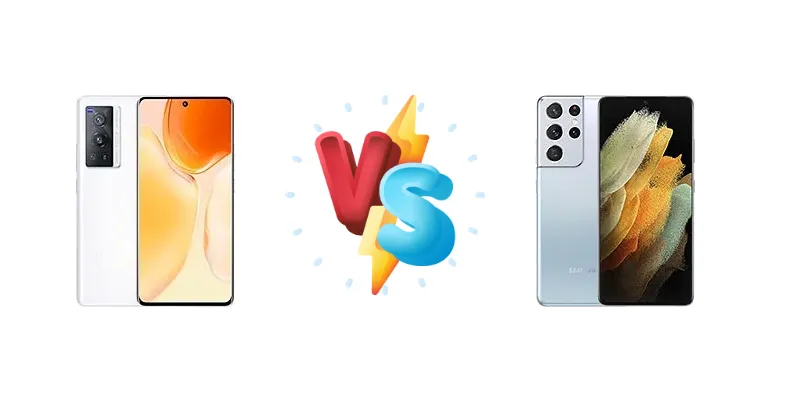
|
🏆 Quick Verdict
For the average user prioritizing camera versatility and a smoother software experience, the vivo X70 Pro emerges as the winner. While the Galaxy S21 Ultra boasts a brighter display and potentially faster performance with the Snapdragon variant, the X70 Pro’s consistent camera performance and efficient Dimensity 1200 chipset offer a compelling package.
| PHONES | ||
|---|---|---|
| Phone Names | vivo X70 Pro | Samsung Galaxy S21 Ultra 5G |
| Network | ||
|---|---|---|
| 2G bands | GSM 850 / 900 / 1800 / 1900 | GSM 850 / 900 / 1800 / 1900 |
| 3G bands | HSDPA 850 / 900 / 1700(AWS) / 1900 / 2100 | HSDPA 850 / 900 / 1700(AWS) / 1900 / 2100 |
| 4G bands | 1, 2, 3, 4, 5, 7, 8, 9, 12, 17, 18, 19, 20, 26, 28, 38, 39, 40, 41 - International | 1, 2, 3, 4, 5, 7, 8, 12, 13, 14, 18, 19, 20, 25, 26, 28, 30, 38, 39, 40, 41, 46, 48, 66, 71 - SM-G998U1 |
| 5G bands | 1, 3, 5, 7, 28, 40, 41, 78, 79 SA/NSA - International | 2, 5, 25, 41, 66, 71, 260, 261 SA/NSA/Sub6/mmWave - SM-G998U1 |
| Speed | HSPA, LTE, 5G | HSPA 42.2/5.76 Mbps, LTE (7CA) Cat20 2000/200 Mbps, 5G (5+ Gbps DL) |
| Technology | GSM / CDMA / HSPA / EVDO / LTE / 5G | GSM / CDMA / HSPA / EVDO / LTE / 5G |
| 3, 5, 77, 78 SA/NSA - India | 1, 3, 5, 7, 8, 20, 28, 38, 40, 41, 66, 77, 78 SA/NSA/Sub6 - SM-G998B | |
| Launch | ||
|---|---|---|
| Announced | 2021, September 09 | 2021, January 14 |
| Status | Available. Released 2021, September 17 | Available. Released 2021, January 29 |
| Body | ||
|---|---|---|
| Build | Glass front (Schott Xensation Up), glass back, aluminum frame | Glass front (Gorilla Glass Victus), glass back (Gorilla Glass Victus), aluminum frame |
| Dimensions | 158.3 x 73.2 x 8 mm (6.23 x 2.88 x 0.31 in) | 165.1 x 75.6 x 8.9 mm (6.5 x 2.98 x 0.35 in) |
| SIM | Nano-SIM + Nano-SIM | · Nano-SIM + eSIM· Nano-SIM + Nano-SIM + eSIM (max 2 at a time) |
| Weight | 183/184/185/186 g (6.46 oz) | 227 g (Sub6), 229 g (mmWave) (8.01 oz) |
| - | IP68 dust/water resistant (up to 1.5m for 30 min) Stylus support | |
| Display | ||
|---|---|---|
| Protection | Schott Xensation Up | Corning Gorilla Glass Victus |
| Resolution | 1080 x 2376 pixels (~398 ppi density) | 1440 x 3200 pixels, 20:9 ratio (~515 ppi density) |
| Size | 6.56 inches, 104.6 cm2 (~90.3% screen-to-body ratio) | 6.8 inches, 112.1 cm2 (~89.8% screen-to-body ratio) |
| Type | AMOLED, 120Hz, HDR10+, 1300 nits (peak) | Dynamic AMOLED 2X, 120Hz, HDR10+, 1500 nits (peak) |
| - | Always-on display | |
| Platform | ||
|---|---|---|
| CPU | Octa-core (1x3.0 GHz Cortex-A78 & 3x2.6 GHz Cortex-A78 & 4x2.0 GHz Cortex-A55) - InternationalOcta-core (1x2.8 GHz Cortex-A78 & 3x2.6 GHz Cortex-A78 & 4x2.0 GHz Cortex-A55) - China | Octa-core (1x2.9 GHz Cortex-X1 & 3x2.80 GHz Cortex-A78 & 4x2.2 GHz Cortex-A55) - InternationalOcta-core (1x2.84 GHz Cortex-X1 & 3x2.42 GHz Cortex-A78 & 4x1.80 GHz Cortex-A55) - USA/China |
| Chipset | Mediatek Dimensity 1200 (6 nm) - InternationalExynos 1080 (5 nm) - China | Exynos 2100 (5 nm) - InternationalQualcomm SM8350 Snapdragon 888 5G (5 nm) - USA/China |
| GPU | Mali-G77 MC9 - InternationalMali-G78 MP10 - China | Mali-G78 MP14 - InternationalAdreno 660 - USA/China |
| OS | Android 11, upgradable to Android 14, Funtouch OS 14 (International), OriginOS (China) | Android 11, up to 4 major Android upgrades, One UI 6.1 |
| Memory | ||
|---|---|---|
| Card slot | No | No |
| Internal | 128GB 8GB RAM, 256GB 8GB RAM, 256GB 12GB RAM, 256GB 16GB RAM, 512GB 12GB RAM | 128GB 8GB RAM, 128GB 12GB RAM, 256GB 12GB RAM, 256GB 16GB RAM, 512GB 12GB RAM, 512GB 16GB RAM |
| UFS 3.1 | UFS 3.1 | |
| Main Camera | ||
|---|---|---|
| Features | Laser AF, color spectrum sensor, Zeiss optics, Zeiss T* lens coating, Pixel Shift, dual-LED dual-tone flash, HDR, panorama | Laser AF, LED flash, auto-HDR, panorama |
| Quad | 50 MP, f/1.8, (wide), 1/1.56", 1.0µm, PDAF, gimbal OIS 8 MP, f/3.4, 125mm (periscope telephoto), 1/4.4", 1.0µm, PDAF, OIS, 5x optical zoom 12 MP, f/2.0, 50mm (telephoto), 1/2.93", 1.22µm, PDAF, 2x optical zoom 12 MP, f/2.2, 16mm, 116˚ (ultrawide), 1/3.1", 1.12µm, AF | 108 MP, f/1.8, 24mm (wide), 1/1.33", 0.8µm, PDAF, OIS 10 MP, f/2.4, 72mm (telephoto), 1/3.24", 1.22µm, dual pixel PDAF, OIS, 3x optical zoom 10 MP, f/4.9, 240mm (periscope telephoto), 1/3.24", 1.22µm, dual pixel PDAF, OIS, 10x optical zoom 12 MP, f/2.2, 13mm (ultrawide), 1/2.55", 1.4µm, dual pixel PDAF, Super Steady video |
| Single | 32 MP, f/2.5, 24mm (wide), 1/2.8", 0.8µm | - |
| Video | 4K@30/60fps, 1080p@30/60fps, gyro-EIS, HDR10+ | 8K@24fps, 4K@30/60fps, 1080p@30/60/120/240fps, HDR10+, stereo sound rec., gyro-EIS |
| Selfie camera | ||
|---|---|---|
| Features | HDR | HDR |
| Single | 32 MP, f/2.5, 24mm (wide), 1/2.8", 0.8µm | 40 MP, f/2.2, 26mm (wide), 1/2.8", 0.7µm, PDAF |
| Video | 1080p@30fps | 4K@30/60fps, 1080p@30fps |
| Sound | ||
|---|---|---|
| 3.5mm jack | No | No |
| 35mm jack | No | No |
| Loudspeaker | Yes | Yes, with stereo speakers |
| 32-bit/192kHz audio | 32-bit/384kHz audio Tuned by AKG | |
| Comms | ||
|---|---|---|
| Bluetooth | 5.2, A2DP, LE, aptX HD | 5.2, A2DP, LE |
| Infrared port | Yes | - |
| NFC | Yes (market/region dependent) | Yes |
| Positioning | GPS (L1+L5), GLONASS, BDS, GALILEO, QZSS, NavIC | GPS, GLONASS, BDS, GALILEO |
| Radio | No | FM radio (Snapdragon model only; market/operator dependent) |
| USB | USB Type-C 2.0, OTG | USB Type-C 3.2, OTG |
| WLAN | Wi-Fi 802.11 a/b/g/n/ac/6, dual-band, Wi-Fi Direct | Wi-Fi 802.11 a/b/g/n/ac/6e, dual-band, Wi-Fi Direct |
| Features | ||
|---|---|---|
| Sensors | Fingerprint (under display, optical), accelerometer, gyro, proximity, compass | Fingerprint (under display, ultrasonic), accelerometer, gyro, proximity, compass, barometer |
| - | Samsung DeX, Samsung Wireless DeX (desktop experience support) Bixby natural language commands and dictation Samsung Pay (Visa, MasterCard certified) Ultra Wideband (UWB) support | |
| Battery | ||
|---|---|---|
| Charging | 44W wired 5W reverse wired | 25W wired, PD3.0 15W wireless (Qi) 4.5W reverse wireless |
| Type | 4450 mAh | Li-Ion 5000 mAh |
| Misc | ||
|---|---|---|
| Colors | Cosmic Black, Aurora Dawn, White | Phantom Black, Phantom Silver, Phantom Titanium, Phantom Navy, Phantom Brown, Navy |
| Models | V2134A, V2105 | SM-G998B, SM-G998B/DS, SM-G998U, SM-G998U1, SM-G998W, SM-G998N, SM-G9980 |
| Price | About 1040 EUR | $ 240.01 / C$ 353.20 / £ 202.99 / € 264.99 |
| SAR | - | 0.77 W/kg (head) 1.02 W/kg (body) |
| SAR EU | - | 0.71 W/kg (head) 1.58 W/kg (body) |
| Pricing | ||
|---|---|---|
| 128GB 12GB RAM | - | $ 384.99 |
| 256GB 12GB RAM | - | $ 998.00 |
| 512GB 12GB RAM | - | $ 1,179.99 |
| RENEWED | - | $ 459.00 |
| Tests | ||
|---|---|---|
| Battery life | Endurance rating 123h | Endurance rating 114h |
| Camera | Photo / Video | Photo / Video |
| Display | Contrast ratio: Infinite (nominal) | Contrast ratio: Infinite (nominal) |
| Loudspeaker | -27.5 LUFS (Good) | -25.5 LUFS (Very good) |
| Performance | AnTuTu: 694499 (v9) GeekBench: 2956 (v5.1) GFXBench: 40fps (ES 3.1 onscreen) | AnTuTu: 657150 (v8) GeekBench: 3518 (v5.1) GFXBench: 33fps (ES 3.1 onscreen) |
vivo X70 Pro
- Superior battery endurance (123h rating)
- Faster 44W wired charging
- Excellent camera performance, especially in portrait and low-light
- Slightly less bright display than the S21 Ultra
- Chipset performance may be slightly lower than Snapdragon 888
Samsung Galaxy S21 Ultra 5G
- Brighter display (1023 nits)
- Potentially faster performance with Snapdragon 888 variant
- Versatile camera system with multiple lenses
- Slower 25W wired charging
- Lower battery endurance (114h rating)
- Exynos variant may exhibit thermal throttling
Display Comparison
Both phones feature 'Infinite' contrast ratio displays, but the Samsung Galaxy S21 Ultra edges out the vivo X70 Pro in peak brightness, reaching 1023 nits compared to the X70 Pro’s 993 nits. This difference is noticeable in direct sunlight. While both offer excellent viewing experiences, the S21 Ultra’s higher brightness and potentially higher refresh rate (depending on settings) provide a slight advantage for outdoor visibility and smoother scrolling. The S21 Ultra also benefits from a variable refresh rate (LTPO) which can dynamically adjust to save battery, a feature not explicitly mentioned for the X70 Pro.
Camera Comparison
Both phones excel in photography, but approach it differently. The Galaxy S21 Ultra’s camera system is known for its versatility, offering multiple lenses and high-resolution sensors. The X70 Pro, however, prioritizes image quality and computational photography. While specific sensor details are missing for the X70 Pro, its focus on portraiture and low-light performance is a key selling point. The S21 Ultra’s larger main sensor likely captures more light, but the X70 Pro’s image processing algorithms may produce more pleasing results in certain scenarios. Both phones offer video recording capabilities, but the X70 Pro’s gimbal stabilization system provides superior video smoothness, especially when shooting handheld.
Performance
The chipset is a key differentiator. The Galaxy S21 Ultra ships with either the Exynos 2100 (international) or the Snapdragon 888 (USA/China), both built on a 5nm process. The vivo X70 Pro utilizes the Mediatek Dimensity 1200 (international) or the Exynos 1080 (China), the Dimensity being on a 6nm node and the Exynos 1080 on a 5nm node. The Snapdragon 888 and Exynos 2100 generally offer higher peak CPU and GPU performance, particularly in sustained workloads, due to their more advanced architectures (Cortex-X1 core in the Samsung phones). However, the Dimensity 1200 is a very capable chip, and its 6nm process may offer better thermal efficiency, potentially reducing throttling during extended gaming sessions. The S21 Ultra’s LPDDR5 RAM is standard, while the X70 Pro’s RAM type isn’t specified, but is likely LPDDR4X. This could contribute to a slight performance edge for the S21 Ultra in memory-intensive tasks.
Battery Life
The Galaxy S21 Ultra has an endurance rating of 114 hours, while the vivo X70 Pro achieves 123 hours. This suggests the X70 Pro offers slightly better battery life despite having a smaller battery capacity (not specified in the data). This is likely due to the more efficient Dimensity 1200 chipset and potentially more aggressive power management. The S21 Ultra supports 25W wired charging, 15W wireless, and 4.5W reverse wireless, while the X70 Pro offers 44W wired and 5W reverse wired. The X70 Pro’s faster wired charging significantly reduces charging times, reaching a full charge much quicker than the S21 Ultra.
Buying Guide
Buy the vivo X70 Pro if you need a consistently excellent camera system, particularly for portrait and low-light photography, and prefer a more refined, less bloated software experience. Buy the Samsung Galaxy S21 Ultra 5G if you prioritize a brighter, more vibrant display for media consumption, demand the absolute fastest performance (especially with the Snapdragon variant), and value the broader ecosystem of Samsung features and accessories.