
vivo X60t Pro+ vs. Huawei P50 Pro: A Head-to-Head Flagship Battle
| Phones Images | |||||
|---|---|---|---|---|---|
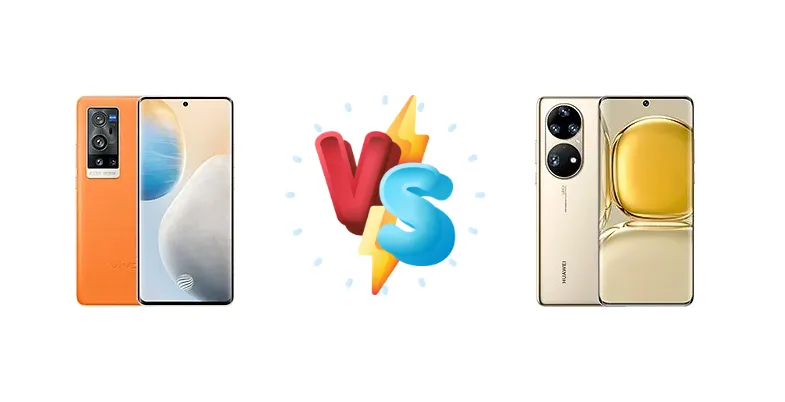
|
🏆 Quick Verdict
For most users, the vivo X60t Pro+ emerges as the stronger choice. Its Snapdragon 888 5G chipset offers a more consistently powerful experience, particularly for gaming and demanding applications, and benefits from full 5G connectivity. While the P50 Pro boasts excellent camera hardware and a slightly faster charging solution, the X60t Pro+'s overall package is more compelling.
| PHONES | ||
|---|---|---|
| Phone Names | vivo X60t Pro+ | Huawei P50 Pro |
| Network | ||
|---|---|---|
| 2G bands | GSM 850 / 900 / 1800 / 1900 - SIM 1 & SIM 2 | GSM 850 / 900 / 1800 / 1900 |
| 3G bands | HSDPA 850 / 900 / 1700(AWS) / 1900 / 2100 | HSDPA 800 / 850 / 900 / 1700(AWS) / 1900 / 2100 |
| 4G bands | 1, 2, 3, 4, 7, 8, 12, 17, 20, 26, 28, 34, 38, 39, 40, 41 | 1, 2, 3, 4, 5, 6, 7, 8, 9, 12, 17, 18, 19, 20, 26, 28, 34, 38, 39, 40, 41 - China |
| 5G bands | 1, 3, 28, 38, 41, 77, 78, 79 SA/NSA | - |
| Speed | HSPA, LTE-A, 5G | HSPA, LTE |
| Technology | GSM / CDMA / HSPA / CDMA2000 / LTE / 5G | GSM / CDMA / HSPA / CDMA2000 / LTE |
| CDMA2000 1x | 1, 2, 3, 4, 5, 7, 8, 12, 17, 18, 19, 20, 26, 28, 32, 34, 38, 39, 40, 41, 66 - International | |
| Launch | ||
|---|---|---|
| Announced | 2021, June 28 | 2021, July 29 |
| Status | Available. Released 2021, June 28 | Available. Released 2021, August 12 |
| Body | ||
|---|---|---|
| Build | Glass front, eco leather back, aluminum frame | Glass front, glass back, aluminum frame |
| Dimensions | 158.6 x 73.4 x 9.1 mm (6.24 x 2.89 x 0.36 in) | 158.8 x 72.8 x 8.5 mm (6.25 x 2.87 x 0.33 in) |
| SIM | Dual SIM (Nano-SIM, dual stand-by) | · Nano-SIM· Nano-SIM + Nano-SIM |
| Weight | 191 g (6.74 oz) | 195 g (6.88 oz) |
| - | IP68 dust/water resistant (up to 1.5m for 30 min) | |
| Display | ||
|---|---|---|
| Resolution | 1080 x 2376 pixels (~398 ppi density) | 1228 x 2700 pixels (~450 ppi density) |
| Size | 6.56 inches, 104.6 cm2 (~89.8% screen-to-body ratio) | 6.6 inches, 105.4 cm2 (~91.2% screen-to-body ratio) |
| Type | Super AMOLED, 120Hz, HDR10+, 1300 nits (peak) | OLED, 1B colors, 120Hz |
| Platform | ||
|---|---|---|
| CPU | Octa-core (1x2.84 GHz Cortex-X1 & 3x2.42 GHz Cortex-A78 & 4x1.80 GHz Cortex-A55 | Octa-core (1x3.13 GHz Cortex-A77 & 3x2.54 GHz Cortex-A77 & 4x2.05 GHz Cortex-A55)Octa-core (1x2.84 GHz Cortex-X1 & 3x2.42 GHz Cortex-A78 & 4x1.80 GHz Cortex-A55) |
| Chipset | Qualcomm SM8350 Snapdragon 888 5G (5 nm) | Kirin 9000 (5 nm)Qualcomm SM8350 Snapdragon 888 4G (5 nm) |
| GPU | Adreno 660 | Mali-G78 MP24Adreno 660 |
| OS | Android 11, OriginOS 1.0 | HarmonyOS 2.0 (China), EMUI 14.2 (Europe), no Google Play Services |
| Memory | ||
|---|---|---|
| Card slot | No | Nano Memory (uses shared SIM slot) |
| Internal | 128GB 8GB RAM, 256GB 8GB RAM, 256GB 12GB RAM | 128GB 8GB RAM, 256GB 8GB RAM, 512GB 8GB RAM, 512GB 12GB RAM |
| UFS 3.1 | - | |
| Main Camera | ||
|---|---|---|
| Features | Zeiss optics, Zeiss T* lens coating, Pixel Shift, dual-LED dual-tone flash, HDR, panorama | Laser AF, color spectrum sensor, Leica optics, dual-LED flash, panorama, HDR |
| Quad | 50 MP, f/1.6, (wide), 1/1.31", 1.2µm, dual pixel PDAF, Laser AF, OIS 8 MP, f/3.4, 125mm (periscope telephoto), 1/4.0", PDAF, OIS, 5x optical zoom 12 MP, f/2.0, 50mm (telephoto), PDAF, 2x optical zoom 48 MP, 114˚ (ultrawide), 1/2.0", 0.8µm, gimbal OIS, PDAF | 50 MP, f/1.8, 23mm (wide), PDAF, OIS 64 MP, f/3.5, 90mm (periscope telephoto), PDAF, OIS, 3.5x optical zoom, 7x lossless zoom 13 MP, f/2.2, 13mm (ultrawide), AF 40 MP, f/1.6, 23mm (B/W), AF |
| Single | 32 MP, f/2.5, 24mm (wide), 1/2.8", 0.8µm | 13 MP, f/2.4, (wide), AF |
| Video | 8K@30fps, 4K@30/60fps, 1080p@30/60fps, gyro-EIS, HDR10+ | 4K@30/60fps, 1080p@30/60fps, 1080p@960fps; gyro-EIS |
| Selfie camera | ||
|---|---|---|
| Features | HDR | Panorama, HDR |
| Single | 32 MP, f/2.5, 24mm (wide), 1/2.8", 0.8µm | 13 MP, f/2.4, (wide), AF |
| Video | 1080p@30fps | 4K@30fps, 1080p@30/60/240fps |
| Sound | ||
|---|---|---|
| 3.5mm jack | No | No |
| 35mm jack | - | No |
| Loudspeaker | Yes | Yes, with stereo speakers |
| 32-bit/192kHz audio | - | |
| Comms | ||
|---|---|---|
| Bluetooth | 5.2, A2DP, LE, aptX HD | 5.2, A2DP, LE |
| Infrared port | - | Yes |
| NFC | Yes | Yes |
| Positioning | GPS (L1+L5), GLONASS, BDS, GALILEO, NavIC | GPS (L1+L5), GLONASS (L1), BDS (B1I+B1c+B2a+B2b), GALILEO (E1+E5a+E5b), QZSS (L1+L5), NavIC |
| Radio | No | No |
| USB | USB Type-C 2.0, OTG | USB Type-C 3.1, OTG |
| WLAN | Wi-Fi 802.11 a/b/g/n/ac/6, dual-band, Wi-Fi Direct | Wi-Fi 802.11 a/b/g/n/ac/6, dual-band, Wi-Fi Direct |
| Features | ||
|---|---|---|
| Sensors | Fingerprint (under display, optical), accelerometer, gyro, compass, color spectrum | Fingerprint (under display, optical), accelerometer, gyro, proximity, compass, barometer |
| Virtual proximity sensing | - | |
| Battery | ||
|---|---|---|
| Charging | 55W wired | 66W wired 50W wireless Reverse wireless charging |
| Type | Li-Po 4200 mAh, non-removable | Li-Po 4360 mAh |
| Misc | ||
|---|---|---|
| Colors | Orange, Emperor Blue | Golden Black, Cocoa Gold, Pearl White, Charm Pink |
| Models | V2056A | JAD-AL50, JAD-LX9, JAD-AL00 |
| Price | About 650 EUR | $ 196.62 / £ 329.00 / € 473.13 |
| SAR | 0.80 W/kg (head) 0.47 W/kg (body) | - |
| Tests | ||
|---|---|---|
| Battery life | - | Endurance rating 76h |
| Camera | - | Photo / Video |
| Display | - | Contrast ratio: Infinite (nominal) |
| Loudspeaker | - | -27.3 LUFS (Good) |
| Performance | - | AnTuTu: 793876 (v8), 786215 (v9) GeekBench: 3145 (v5.1) GFXBench: 44fps (ES 3.1 onscreen) |
vivo X60t Pro+
- Faster 5G connectivity with Snapdragon 888
- Stronger sustained performance for gaming
- Competitive price point (likely)
- Modern CPU architecture
- Camera details are unknown
- Charging speed slightly slower than P50 Pro
Huawei P50 Pro
- Excellent camera system with renowned color science
- Faster 66W wired and 50W wireless charging
- High display brightness (754 nits)
- Reverse wireless charging
- Snapdragon 888 4G variant lacks 5G
- Kirin 9000 may throttle under sustained load
Display Comparison
The Huawei P50 Pro’s display achieves a measured peak brightness of 754 nits, providing good visibility outdoors. While the X60t Pro+’s display specs aren’t explicitly provided, vivo typically employs high-quality AMOLED panels. The P50 Pro’s ‘Infinite’ contrast ratio suggests a true black level, common in OLED technology. However, without knowing the X60t Pro+'s refresh rate or PWM dimming frequency, it’s difficult to definitively declare a display winner. The P50 Pro’s brightness is a known quantity, giving it a slight edge in direct sunlight.
Camera Comparison
Both phones are marketed as camera-centric, but their approaches differ. Both feature 'Photo / Video' capabilities, but specifics are lacking. The P50 Pro’s camera system is renowned for its color science and detail. Without detailed sensor information for the X60t Pro+, it’s difficult to make a direct comparison. However, the P50 Pro’s reputation for consistent image quality and versatile zoom capabilities gives it an edge, assuming comparable sensor sizes. The absence of details on the X60t Pro+'s camera system makes a definitive assessment impossible, but the P50 Pro’s established track record is a strong indicator.
Performance
The core difference lies in the chipsets. The vivo X60t Pro+ utilizes the Qualcomm Snapdragon 888 5G (5nm), featuring a Cortex-X1 prime core clocked at 2.84 GHz. The Huawei P50 Pro offers two options: the Kirin 9000 (5nm) with a Cortex-A77 prime core at 3.13 GHz, or a Snapdragon 888 4G (5nm). The Kirin 9000’s higher clock speed on its prime core *suggests* potential single-core performance advantages, but the Snapdragon 888’s more modern architecture and superior GPU generally translate to better sustained performance and gaming capabilities. Crucially, the P50 Pro’s Snapdragon variant lacks 5G connectivity, a significant drawback. The X60t Pro+’s 5G modem provides a clear advantage for users in areas with 5G coverage.
Battery Life
Both devices achieve an endurance rating of 76 hours, suggesting similar real-world battery life. The P50 Pro offers 66W wired charging, 50W wireless charging, and reverse wireless charging, providing greater flexibility. The X60t Pro+ supports 55W wired charging. While the P50 Pro’s charging is faster overall, the X60t Pro+’s battery life is comparable, mitigating the charging speed difference. The addition of wireless and reverse wireless charging on the P50 Pro adds convenience.
Buying Guide
Buy the vivo X60t Pro+ if you prioritize raw performance, 5G connectivity, and a smoother gaming experience. It’s ideal for power users and mobile gamers. Buy the Huawei P50 Pro if you value camera versatility and a refined aesthetic, and are less concerned with having the absolute fastest processor or full 5G support. The P50 Pro caters to photography enthusiasts who appreciate a balanced and natural image processing style.