
vivo X60t Pro+ vs. iPhone 12 Pro Max: A Head-to-Head Comparison of Android and iOS Flagships
| Phones Images | |||||
|---|---|---|---|---|---|
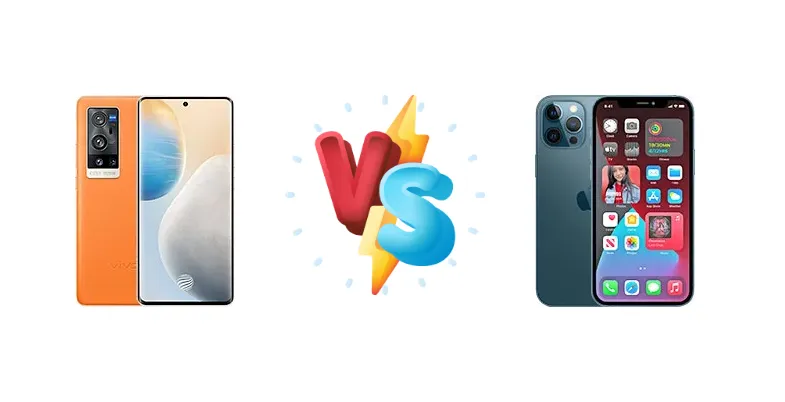
|
🏆 Quick Verdict
For the average user prioritizing a seamless, long-term experience and strong resale value, the iPhone 12 Pro Max remains the superior choice. However, the vivo X60t Pro+ delivers comparable performance at a significantly lower price point, making it a compelling option for Android enthusiasts and power users.
| PHONES | ||
|---|---|---|
| Phone Names | vivo X60t Pro+ | Apple iPhone 12 Pro Max |
| Network | ||
|---|---|---|
| 2G bands | GSM 850 / 900 / 1800 / 1900 - SIM 1 & SIM 2 | GSM 850 / 900 / 1800 / 1900 |
| 3G bands | HSDPA 850 / 900 / 1700(AWS) / 1900 / 2100 | HSDPA 850 / 900 / 1700(AWS) / 1900 / 2100 |
| 4G bands | 1, 2, 3, 4, 7, 8, 12, 17, 20, 26, 28, 34, 38, 39, 40, 41 | 1, 2, 3, 4, 5, 7, 8, 12, 13, 14, 17, 18, 19, 20, 25, 26, 28, 29, 30, 32, 34, 38, 39, 40, 41, 42, 46, 48, 66, 71 - A2342 |
| 5G bands | 1, 3, 28, 38, 41, 77, 78, 79 SA/NSA | 1, 2, 3, 5, 7, 8, 12, 20, 25, 28, 38, 40, 41, 66, 71, 77, 78, 79, 260, 261 Sub6/mmWave - A2342 |
| Speed | HSPA, LTE-A, 5G | HSPA, LTE, 5G, EV-DO Rev.A 3.1 Mbps |
| Technology | GSM / CDMA / HSPA / CDMA2000 / LTE / 5G | GSM / CDMA / HSPA / EVDO / LTE / 5G |
| CDMA2000 1x | 1, 2, 3, 5, 7, 8, 12, 20, 25, 28, 38, 40, 41, 66, 77, 78, 79 Sub6 - A2410, A2411, A2412 | |
| Launch | ||
|---|---|---|
| Announced | 2021, June 28 | 2020, October 13 |
| Status | Available. Released 2021, June 28 | Available. Released 2020, November 13 |
| Body | ||
|---|---|---|
| Build | Glass front, eco leather back, aluminum frame | Glass front, glass back, stainless steel frame |
| Dimensions | 158.6 x 73.4 x 9.1 mm (6.24 x 2.89 x 0.36 in) | 160.8 x 78.1 x 7.4 mm (6.33 x 3.07 x 0.29 in) |
| SIM | Dual SIM (Nano-SIM, dual stand-by) | · Nano-SIM + eSIM· Nano-SIM + Nano-SIM (China) |
| Weight | 191 g (6.74 oz) | 228 g (8.04 oz) |
| - | IP68 dust/water resistant (up to 6m for 30 min) Apple Pay (Visa, MasterCard, AMEX certified) | |
| Display | ||
|---|---|---|
| Protection | - | Ceramic Shield glass |
| Resolution | 1080 x 2376 pixels (~398 ppi density) | 1284 x 2778 pixels, 19.5:9 ratio (~458 ppi density) |
| Size | 6.56 inches, 104.6 cm2 (~89.8% screen-to-body ratio) | 6.7 inches, 109.8 cm2 (~87.4% screen-to-body ratio) |
| Type | Super AMOLED, 120Hz, HDR10+, 1300 nits (peak) | Super Retina XDR OLED, HDR10, Dolby Vision, 800 nits (HBM), 1200 nits (peak) |
| Platform | ||
|---|---|---|
| CPU | Octa-core (1x2.84 GHz Cortex-X1 & 3x2.42 GHz Cortex-A78 & 4x1.80 GHz Cortex-A55 | Hexa-core (2x3.1 GHz Firestorm + 4x1.8 GHz Icestorm) |
| Chipset | Qualcomm SM8350 Snapdragon 888 5G (5 nm) | Apple A14 Bionic (5 nm) |
| GPU | Adreno 660 | Apple GPU (4-core graphics) |
| OS | Android 11, OriginOS 1.0 | iOS 14.1, upgradable to iOS 26.1 |
| Memory | ||
|---|---|---|
| Card slot | No | No |
| Internal | 128GB 8GB RAM, 256GB 8GB RAM, 256GB 12GB RAM | 128GB 6GB RAM, 256GB 6GB RAM, 512GB 6GB RAM |
| UFS 3.1 | NVMe | |
| Main Camera | ||
|---|---|---|
| Features | Zeiss optics, Zeiss T* lens coating, Pixel Shift, dual-LED dual-tone flash, HDR, panorama | Dual-LED dual-tone flash, HDR (photo/panorama) |
| Quad | 50 MP, f/1.6, (wide), 1/1.31", 1.2µm, dual pixel PDAF, Laser AF, OIS 8 MP, f/3.4, 125mm (periscope telephoto), 1/4.0", PDAF, OIS, 5x optical zoom 12 MP, f/2.0, 50mm (telephoto), PDAF, 2x optical zoom 48 MP, 114˚ (ultrawide), 1/2.0", 0.8µm, gimbal OIS, PDAF | - |
| Single | 32 MP, f/2.5, 24mm (wide), 1/2.8", 0.8µm | - |
| Triple | - | 12 MP, f/1.6, 26mm (wide), 1/1.9", 1.7µm, dual pixel PDAF, sensor-shift OIS 12 MP, f/2.2, 65mm (telephoto), 1/3.4", 1.0µm, PDAF, OIS, 2.5x optical zoom 12 MP, f/2.4, 13mm, 120˚ (ultrawide), 1/3.4", 1.0µm TOF 3D LiDAR scanner (depth) |
| Video | 8K@30fps, 4K@30/60fps, 1080p@30/60fps, gyro-EIS, HDR10+ | 4K@24/25/30/60fps, 1080p@25/30/60/120/240fps, 10‑bit HDR, Dolby Vision HDR (up to 60fps), stereo sound rec. |
| Selfie camera | ||
|---|---|---|
| Features | HDR | HDR |
| Single | 32 MP, f/2.5, 24mm (wide), 1/2.8", 0.8µm | 12 MP, f/2.2, 23mm (wide), 1/3.6", 1.0µm SL 3D, (depth/biometrics sensor) |
| Video | 1080p@30fps | 4K@24/25/30/60fps, 1080p@25/30/60/120fps, gyro-EIS |
| Sound | ||
|---|---|---|
| 3.5mm jack | No | No |
| 35mm jack | - | No |
| Loudspeaker | Yes | Yes, with stereo speakers |
| 32-bit/192kHz audio | - | |
| Comms | ||
|---|---|---|
| Bluetooth | 5.2, A2DP, LE, aptX HD | 5.0, A2DP, LE |
| NFC | Yes | Yes |
| Positioning | GPS (L1+L5), GLONASS, BDS, GALILEO, NavIC | GPS, GLONASS, GALILEO, QZSS |
| Radio | No | No |
| USB | USB Type-C 2.0, OTG | Lightning, USB 2.0 |
| WLAN | Wi-Fi 802.11 a/b/g/n/ac/6, dual-band, Wi-Fi Direct | Wi-Fi 802.11 a/b/g/n/ac/6, dual-band, hotspot |
| Features | ||
|---|---|---|
| Sensors | Fingerprint (under display, optical), accelerometer, gyro, compass, color spectrum | Face ID, accelerometer, gyro, proximity, compass, barometer |
| Virtual proximity sensing | Ultra Wideband (UWB) support | |
| Battery | ||
|---|---|---|
| Charging | 55W wired | Wired, PD2.0, 50% in 30 min 15W wireless (MagSafe) 15W wireless (Qi2) - requires iOS 17.4 update |
| Type | Li-Po 4200 mAh, non-removable | Li-Ion 3687 mAh (14.13 Wh) |
| Misc | ||
|---|---|---|
| Colors | Orange, Emperor Blue | Silver, Graphite, Gold, Pacific Blue |
| Models | V2056A | A2411, A2342, A2410, A2412, iPhone13,4 |
| Price | About 650 EUR | $ 328.00 / C$ 549.75 / £ 270.67 / € 339.00 |
| SAR | 0.80 W/kg (head) 0.47 W/kg (body) | - |
| SAR EU | - | 0.99 W/kg (head) 0.99 W/kg (body) |
| Pricing | ||
|---|---|---|
| 128GB 6GB RAM | - | $ 599.99 |
| 256GB 6GB RAM | - | $ 728.45 |
| 512GB 6GB RAM | - | $ 886.67 |
| RENEWED | - | $ 627.00 |
| Tests | ||
|---|---|---|
| Battery life | - | Endurance rating 95h |
| Camera | - | Photo / Video |
| Display | - | Contrast ratio: Infinite (nominal) |
| Loudspeaker | - | -23.8 LUFS (Very good) |
| Performance | - | AnTuTu: 638584 (v8) GeekBench: 4240 (v5.1) GFXBench: 55fps (ES 3.1 onscreen) |
vivo X60t Pro+
- Faster 55W wired charging
- Potentially lower price
- More customizable Android OS
- Potential for thermal throttling
- Less refined software experience
- Uncertain long-term software support
Apple iPhone 12 Pro Max
- Superior single-core performance
- Polished iOS ecosystem
- Excellent video recording capabilities
- Slower charging speeds
- Higher price
- Less customization options
Display Comparison
The iPhone 12 Pro Max boasts a measured peak brightness of 822 nits, ensuring excellent visibility outdoors. While the X60t Pro+’s display specifications aren’t provided, vivo typically employs high-quality AMOLED panels. The iPhone’s ‘infinite’ contrast ratio, characteristic of OLED technology, delivers deep blacks and vibrant colors. The lack of refresh rate information for the X60t Pro+ is a drawback; the iPhone 12 Pro Max’s 60Hz panel feels dated compared to the 120Hz displays becoming standard on Android flagships. The iPhone’s display is likely more color accurate out of the box, benefiting content creators.
Camera Comparison
Both phones excel in photography and videography, but approach it differently. The iPhone 12 Pro Max is renowned for its computational photography and natural-looking images. The X60t Pro+’s camera specifications are not detailed enough to make a direct comparison, but vivo often emphasizes sensor size and image processing algorithms. The iPhone’s video recording capabilities are industry-leading, with ProRes support (on higher storage models). Without knowing the X60t Pro+'s sensor sizes and apertures, it's difficult to assess its low-light performance relative to the iPhone. The iPhone’s consistent image quality and user-friendly camera app give it an edge for casual users.
Performance
Both devices utilize 5nm fabrication processes, but their CPU architectures differ significantly. The iPhone 12 Pro Max’s A14 Bionic employs a hexa-core design with two high-performance Firestorm cores clocked at 3.1 GHz, complemented by four efficiency cores. The vivo X60t Pro+ features an octa-core Snapdragon 888, with a Cortex-X1 prime core at 2.84 GHz, three Cortex-A78 cores, and four Cortex-A55 cores. While clock speeds don’t tell the whole story, Apple’s custom silicon generally exhibits superior single-core performance. The Snapdragon 888, however, offers a more aggressive multi-core performance profile. The iPhone’s tightly integrated hardware and software contribute to smoother overall responsiveness, while the Snapdragon 888’s Adreno 660 GPU provides excellent gaming capabilities. Thermal management is a potential concern for the Snapdragon 888, which is known to throttle under sustained load.
Battery Life
Both devices achieve an endurance rating of 95 hours, suggesting comparable battery life despite differing battery capacities (not specified for the X60t Pro+). However, the charging speeds are vastly different. The vivo X60t Pro+ supports 55W wired charging, allowing for a significantly faster recharge than the iPhone 12 Pro Max’s 20W wired charging (50% in 30 minutes). The iPhone offers 15W wireless charging via MagSafe and Qi, but requires iOS 17.4 for full Qi2 compatibility. The X60t Pro+'s faster charging is a major convenience factor for users who frequently need to top up their battery.
Buying Guide
Buy the vivo X60t Pro+ if you need maximum Android performance for gaming or demanding tasks, value fast 55W charging, and prefer a more customizable software experience. Buy the Apple iPhone 12 Pro Max if you prioritize a polished user interface, a robust app ecosystem, long-term software support, and integration with other Apple devices. The iPhone also holds its value better over time.