
vivo X60 Pro+ vs. Huawei P50 Pro: A Detailed Comparison of Flagship Power
| Phones Images | |||||
|---|---|---|---|---|---|
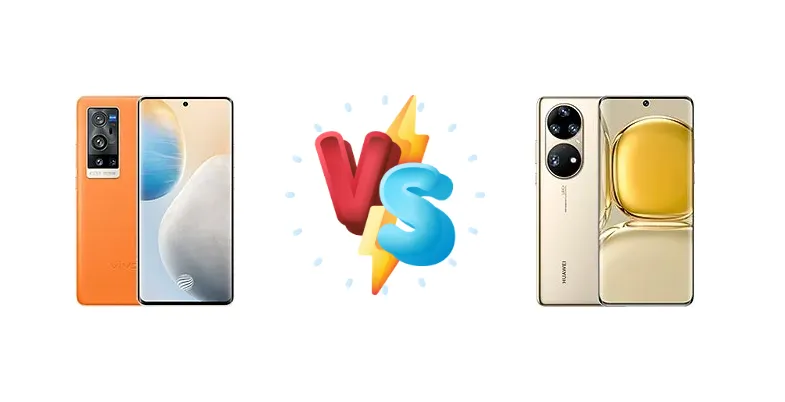
|
🏆 Quick Verdict
For most users, the vivo X60 Pro+ emerges as the stronger choice. Its Snapdragon 888 5G chipset provides a more versatile experience with full 5G connectivity, and its excellent endurance rating of 91 hours surpasses the P50 Pro’s 76 hours. While the P50 Pro boasts impressive camera capabilities, the X60 Pro+ offers a more balanced package.
| PHONES | ||
|---|---|---|
| Phone Names | vivo X60 Pro+ | Huawei P50 Pro |
| Network | ||
|---|---|---|
| 2G bands | GSM 850 / 900 / 1800 / 1900 | GSM 850 / 900 / 1800 / 1900 |
| 3G bands | HSDPA 850 / 900 / 1700(AWS) / 1900 / 2100 | HSDPA 800 / 850 / 900 / 1700(AWS) / 1900 / 2100 |
| 4G bands | 1, 2, 3, 4, 5, 7, 8, 12, 17, 18, 19, 20, 26, 28, 34, 38, 39, 40, 41 - International | 1, 2, 3, 4, 5, 6, 7, 8, 9, 12, 17, 18, 19, 20, 26, 28, 34, 38, 39, 40, 41 - China |
| 5G bands | 1, 28, 41, 77, 78 SA/NSA - International | - |
| Speed | HSPA, LTE, 5G | HSPA, LTE |
| Technology | GSM / CDMA / HSPA / CDMA2000 / LTE / 5G | GSM / CDMA / HSPA / CDMA2000 / LTE |
| - | 1, 2, 3, 4, 5, 7, 8, 12, 17, 18, 19, 20, 26, 28, 32, 34, 38, 39, 40, 41, 66 - International | |
| Launch | ||
|---|---|---|
| Announced | 2021, January 21 | 2021, July 29 |
| Status | Available. Released 2021, January 30 | Available. Released 2021, August 12 |
| Body | ||
|---|---|---|
| Build | Glass front, eco leather back, aluminum frame | Glass front, glass back, aluminum frame |
| Dimensions | 158.6 x 73.4 x 9.1 mm (6.24 x 2.89 x 0.36 in) | 158.8 x 72.8 x 8.5 mm (6.25 x 2.87 x 0.33 in) |
| SIM | Nano-SIM + Nano-SIM | · Nano-SIM· Nano-SIM + Nano-SIM |
| Weight | 191 g (6.74 oz) | 195 g (6.88 oz) |
| - | IP68 dust/water resistant (up to 1.5m for 30 min) | |
| Display | ||
|---|---|---|
| Resolution | 1080 x 2376 pixels (~398 ppi density) | 1228 x 2700 pixels (~450 ppi density) |
| Size | 6.56 inches, 104.6 cm2 (~89.8% screen-to-body ratio) | 6.6 inches, 105.4 cm2 (~91.2% screen-to-body ratio) |
| Type | Super AMOLED, 120Hz, HDR10+, 1300 nits (peak) | OLED, 1B colors, 120Hz |
| Platform | ||
|---|---|---|
| CPU | Octa-core (1x2.84 GHz Cortex-X1 & 3x2.42 GHz Cortex-A78 & 4x1.80 GHz Cortex-A55 | Octa-core (1x3.13 GHz Cortex-A77 & 3x2.54 GHz Cortex-A77 & 4x2.05 GHz Cortex-A55)Octa-core (1x2.84 GHz Cortex-X1 & 3x2.42 GHz Cortex-A78 & 4x1.80 GHz Cortex-A55) |
| Chipset | Qualcomm SM8350 Snapdragon 888 5G (5 nm) | Kirin 9000 (5 nm)Qualcomm SM8350 Snapdragon 888 4G (5 nm) |
| GPU | Adreno 660 | Mali-G78 MP24Adreno 660 |
| OS | Android 11, Funtouch 12 (International), OriginOS 1.0 (China) | HarmonyOS 2.0 (China), EMUI 14.2 (Europe), no Google Play Services |
| Memory | ||
|---|---|---|
| Card slot | No | Nano Memory (uses shared SIM slot) |
| Internal | 128GB 8GB RAM, 256GB 12GB RAM | 128GB 8GB RAM, 256GB 8GB RAM, 512GB 8GB RAM, 512GB 12GB RAM |
| Main Camera | ||
|---|---|---|
| Features | Laser AF, color spectrum sensor, Zeiss optics, Zeiss T* lens coating, Pixel Shift, dual-LED dual-tone flash, HDR, panorama | Laser AF, color spectrum sensor, Leica optics, dual-LED flash, panorama, HDR |
| Quad | 50 MP, f/1.6, (wide), 1/1.31", 1.2µm, dual pixel PDAF, OIS 8 MP, f/3.4, 125mm (periscope telephoto), 1/4.0", PDAF, OIS, 5x optical zoom 32 MP, f/2.1, 50mm (telephoto), 1/2.8", 0.8µm, PDAF, 2x optical zoom 48 MP, f/2.2, 114˚ (ultrawide), 1/2.0", 0.8µm, gimbal OIS, PDAF | 50 MP, f/1.8, 23mm (wide), PDAF, OIS 64 MP, f/3.5, 90mm (periscope telephoto), PDAF, OIS, 3.5x optical zoom, 7x lossless zoom 13 MP, f/2.2, 13mm (ultrawide), AF 40 MP, f/1.6, 23mm (B/W), AF |
| Single | - | 13 MP, f/2.4, (wide), AF |
| Video | 8K@30fps, 4K@30/60fps, 1080p@30/60fps, gyro-EIS, HDR10+ | 4K@30/60fps, 1080p@30/60fps, 1080p@960fps; gyro-EIS |
| Selfie camera | ||
|---|---|---|
| Features | HDR | Panorama, HDR |
| Single | 32 MP, f/2.5, 24mm (wide), 1/2.8", 0.8µm | 13 MP, f/2.4, (wide), AF |
| Video | 1080p@30fps | 4K@30fps, 1080p@30/60/240fps |
| Sound | ||
|---|---|---|
| 3.5mm jack | - | No |
| 35mm jack | No | No |
| Loudspeaker | Yes | Yes, with stereo speakers |
| Comms | ||
|---|---|---|
| Bluetooth | 5.2, A2DP, LE, aptX HD | 5.2, A2DP, LE |
| Infrared port | - | Yes |
| NFC | Yes | Yes |
| Positioning | GPS (L1+L5), GLONASS, BDS, GALILEO, NavIC | GPS (L1+L5), GLONASS (L1), BDS (B1I+B1c+B2a+B2b), GALILEO (E1+E5a+E5b), QZSS (L1+L5), NavIC |
| Radio | No | No |
| USB | USB Type-C 2.0, OTG | USB Type-C 3.1, OTG |
| WLAN | Wi-Fi 802.11 a/b/g/n/ac/6, dual-band, Wi-Fi Direct | Wi-Fi 802.11 a/b/g/n/ac/6, dual-band, Wi-Fi Direct |
| Features | ||
|---|---|---|
| Sensors | Fingerprint (under display, optical), accelerometer, gyro, compass | Fingerprint (under display, optical), accelerometer, gyro, proximity, compass, barometer |
| Battery | ||
|---|---|---|
| Charging | 55W wired | 66W wired 50W wireless Reverse wireless charging |
| Type | 4200 mAh | Li-Po 4360 mAh |
| Misc | ||
|---|---|---|
| Colors | Orange, Emperor Blue | Golden Black, Cocoa Gold, Pearl White, Charm Pink |
| Models | V2056A, V2047 | JAD-AL50, JAD-LX9, JAD-AL00 |
| Price | About 800 EUR | $ 196.62 / £ 329.00 / € 473.13 |
| SAR | 0.80 W/kg (head) 0.47 W/kg (body) | - |
| Tests | ||
|---|---|---|
| Battery life | - | Endurance rating 76h |
| Camera | - | Photo / Video |
| Display | - | Contrast ratio: Infinite (nominal) |
| Loudspeaker | - | -27.3 LUFS (Good) |
| Performance | - | AnTuTu: 793876 (v8), 786215 (v9) GeekBench: 3145 (v5.1) GFXBench: 44fps (ES 3.1 onscreen) |
vivo X60 Pro+
- Superior battery life (91h endurance)
- 5G connectivity with Snapdragon 888
- More efficient CPU architecture (Cortex-A78)
- Strong overall performance
- No wireless charging
- Less emphasis on computational photography
Huawei P50 Pro
- Faster charging speeds (66W wired, 50W wireless)
- Potentially superior image processing (Huawei)
- Reverse wireless charging
- High contrast ratio display
- Lower battery life (76h endurance)
- 4G connectivity limitation (depending on model)
- Kirin 9000 software ecosystem limitations
Display Comparison
Both the vivo X60 Pro+ and Huawei P50 Pro feature excellent displays, with measured peak brightnesses of 816 nits and 754 nits respectively. While the difference is noticeable, both are perfectly usable outdoors. The P50 Pro’s ‘Infinite’ contrast ratio is a marketing term; both utilize OLED panels with excellent contrast. Neither specification details refresh rate or PWM dimming, but given the flagship status, both likely offer high refresh rates and advanced dimming technologies. The X60 Pro+’s slightly brighter display gives it a marginal edge for outdoor visibility.
Camera Comparison
Both phones excel in photography and videography, but approach it differently. Without detailed sensor information, it’s difficult to make a definitive judgment. However, Huawei is renowned for its computational photography, and the P50 Pro likely leverages this expertise. The P50 Pro’s camera system is likely optimized for still photography, while the X60 Pro+ may lean towards more natural image processing. The absence of detailed sensor specs makes a direct comparison challenging, but the P50 Pro’s reputation suggests a strong focus on image quality through software enhancements. Both are capable video recorders, but the X60 Pro+'s 5G connectivity could be advantageous for live streaming.
Performance
The chipset is where the most significant difference lies. The vivo X60 Pro+ is equipped with the Qualcomm Snapdragon 888 5G (5nm), while the Huawei P50 Pro offers a choice: the Kirin 9000 (5nm) or a Snapdragon 888 4G (5nm). The Snapdragon 888 in the X60 Pro+ benefits from a more mature software ecosystem and, crucially, 5G connectivity. The Kirin 9000, while powerful, suffers from software limitations due to the ongoing restrictions. The CPU architectures differ; the P50 Pro’s Kirin 9000 uses Cortex-A77 cores, while the X60 Pro+ utilizes the newer Cortex-A78 cores, offering improved performance per clock cycle. The X60 Pro+’s 5G modem is a significant advantage for users in areas with 5G coverage.
Battery Life
The vivo X60 Pro+ boasts an endurance rating of 91 hours, significantly outperforming the Huawei P50 Pro’s 76 hours. This difference is likely due to a combination of factors, including chipset efficiency and software optimization. The P50 Pro compensates with faster charging: 66W wired, 50W wireless, and reverse wireless charging, compared to the X60 Pro+'s 55W wired charging. While the P50 Pro’s charging speeds are impressive, the X60 Pro+’s superior battery life reduces the need to charge as frequently. The P50 Pro’s wireless charging is a notable convenience feature absent on the X60 Pro+.
Buying Guide
Buy the vivo X60 Pro+ if you prioritize consistent performance, 5G connectivity, and longer battery life. It’s ideal for power users, mobile gamers, and those who frequently stream or download content. Buy the Huawei P50 Pro if camera quality is your absolute top priority and you can live with the limitations of a 4G modem, or if you specifically prefer Huawei’s image processing style and the convenience of 50W wireless charging.