
vivo X60 Pro+ vs Google Pixel 6 Pro: A Head-to-Head Flagship Battle
| Phones Images | |||||
|---|---|---|---|---|---|
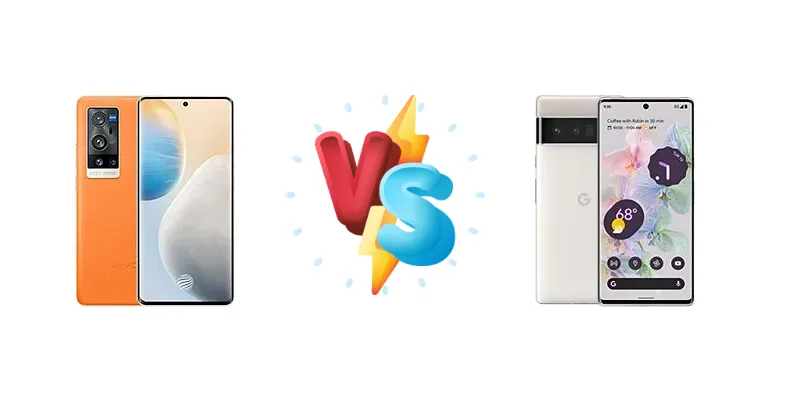
|
🏆 Quick Verdict
For most users, the Google Pixel 6 Pro offers a more compelling package. While the vivo X60 Pro+ boasts a slightly brighter display and comparable performance, the Pixel 6 Pro’s superior software experience, versatile camera system, and faster charging (including wireless) provide a more well-rounded experience.
| PHONES | ||
|---|---|---|
| Phone Names | vivo X60 Pro+ | Google Pixel 6 Pro |
| Network | ||
|---|---|---|
| 2G bands | GSM 850 / 900 / 1800 / 1900 | GSM 850 / 900 / 1800 / 1900 |
| 3G bands | HSDPA 850 / 900 / 1700(AWS) / 1900 / 2100 | HSDPA 800 / 850 / 900 / 1700(AWS) / 1900 / 2100 |
| 4G bands | 1, 2, 3, 4, 5, 7, 8, 12, 17, 18, 19, 20, 26, 28, 34, 38, 39, 40, 41 - International | 1, 2, 3, 4, 5, 7, 8, 12, 13, 14, 17, 18, 19, 20, 25, 26, 28, 29, 30, 32, 38, 39, 40, 41, 42, 46, 48, 66, 71 - GLUOG, G8VOU |
| 5G bands | 1, 28, 41, 77, 78 SA/NSA - International | 1, 2, 3, 5, 7, 8, 12, 14, 20, 25, 28, 30, 38, 40, 41, 48, 66, 71, 77, 78, 257, 258, 260, 261 SA/NSA/Sub6/mmWave - G8VOU |
| Speed | HSPA, LTE, 5G | HSPA, LTE, 5G |
| Technology | GSM / CDMA / HSPA / CDMA2000 / LTE / 5G | GSM / CDMA / HSPA / EVDO / LTE / 5G |
| - | 1, 2, 3, 5, 7, 8, 12, 14, 20, 25, 28, 30, 38, 40, 41, 48, 66, 71, 77, 78 SA/NSA/Sub6 - GLUOG | |
| Launch | ||
|---|---|---|
| Announced | 2021, January 21 | 2021, October 19 |
| Status | Available. Released 2021, January 30 | Available. Released 2021, October 28 |
| Body | ||
|---|---|---|
| Build | Glass front, eco leather back, aluminum frame | Glass front (Gorilla Glass Victus), glass back (Gorilla Glass Victus), aluminum frame |
| Dimensions | 158.6 x 73.4 x 9.1 mm (6.24 x 2.89 x 0.36 in) | 163.9 x 75.9 x 8.9 mm (6.45 x 2.99 x 0.35 in) |
| SIM | Nano-SIM + Nano-SIM | Nano-SIM + eSIM |
| Weight | 191 g (6.74 oz) | 210 g (7.41 oz) |
| - | IP68 dust/water resistant (up to 1.5m for 30 min) | |
| Display | ||
|---|---|---|
| Protection | - | Corning Gorilla Glass Victus |
| Resolution | 1080 x 2376 pixels (~398 ppi density) | 1440 x 3120 pixels, 19.5:9 ratio (~512 ppi density) |
| Size | 6.56 inches, 104.6 cm2 (~89.8% screen-to-body ratio) | 6.7 inches, 110.6 cm2 (~88.9% screen-to-body ratio) |
| Type | Super AMOLED, 120Hz, HDR10+, 1300 nits (peak) | LTPO AMOLED, 120Hz, HDR10+ |
| - | Always-on display | |
| Platform | ||
|---|---|---|
| CPU | Octa-core (1x2.84 GHz Cortex-X1 & 3x2.42 GHz Cortex-A78 & 4x1.80 GHz Cortex-A55 | Octa-core (2x2.80 GHz Cortex-X1 & 2x2.25 GHz Cortex-A76 & 4x1.80 GHz Cortex-A55) |
| Chipset | Qualcomm SM8350 Snapdragon 888 5G (5 nm) | Google Tensor (5 nm) |
| GPU | Adreno 660 | Mali-G78 MP20 |
| OS | Android 11, Funtouch 12 (International), OriginOS 1.0 (China) | Android 12, upgradable to Android 15, up to 5 major Android upgrades |
| Memory | ||
|---|---|---|
| Card slot | No | No |
| Internal | 128GB 8GB RAM, 256GB 12GB RAM | 128GB 12GB RAM, 256GB 12GB RAM, 512GB 12GB RAM |
| - | UFS 3.1 | |
| Main Camera | ||
|---|---|---|
| Features | Laser AF, color spectrum sensor, Zeiss optics, Zeiss T* lens coating, Pixel Shift, dual-LED dual-tone flash, HDR, panorama | Laser AF, Dual-LED flash, Pixel Shift, Auto-HDR, panorama |
| Quad | 50 MP, f/1.6, (wide), 1/1.31", 1.2µm, dual pixel PDAF, OIS 8 MP, f/3.4, 125mm (periscope telephoto), 1/4.0", PDAF, OIS, 5x optical zoom 32 MP, f/2.1, 50mm (telephoto), 1/2.8", 0.8µm, PDAF, 2x optical zoom 48 MP, f/2.2, 114˚ (ultrawide), 1/2.0", 0.8µm, gimbal OIS, PDAF | - |
| Single | - | 11.1 MP, f/2.2, 20mm (ultrawide), 1.22µm |
| Triple | - | 50 MP, f/1.9, 25mm (wide), 1/1.31", 1.2µm, dual pixel PDAF, OIS 48 MP, f/3.5, 104mm (periscope telephoto), 1/2.0", 0.8µm, PDAF, OIS, 4x optical zoom 12 MP, f/2.2, 17mm, 114˚ (ultrawide), 1.25µm |
| Video | 8K@30fps, 4K@30/60fps, 1080p@30/60fps, gyro-EIS, HDR10+ | 4K@30/60fps, 1080p@30/60/120/240fps; gyro-EIS, OIS |
| Selfie camera | ||
|---|---|---|
| Features | HDR | HDR, panorama |
| Single | 32 MP, f/2.5, 24mm (wide), 1/2.8", 0.8µm | 11.1 MP, f/2.2, 20mm (ultrawide), 1.22µm |
| Video | 1080p@30fps | 4K@30fps, 1080p@30/60fps |
| Sound | ||
|---|---|---|
| 3.5mm jack | - | No |
| 35mm jack | No | No |
| Loudspeaker | Yes | Yes, with stereo speakers |
| Comms | ||
|---|---|---|
| Bluetooth | 5.2, A2DP, LE, aptX HD | 5.2, A2DP, LE, aptX HD |
| NFC | Yes | Yes |
| Positioning | GPS (L1+L5), GLONASS, BDS, GALILEO, NavIC | GPS (L1+L5), GLONASS (G1), BDS (B1I+B1c+B2a), GALILEO (E1+E5a), QZSS (L1+L5) |
| Radio | No | No |
| USB | USB Type-C 2.0, OTG | USB Type-C 3.1 |
| WLAN | Wi-Fi 802.11 a/b/g/n/ac/6, dual-band, Wi-Fi Direct | Wi-Fi 802.11 a/b/g/n/ac/6e, dual-band, Wi-Fi Direct |
| Features | ||
|---|---|---|
| Sensors | Fingerprint (under display, optical), accelerometer, gyro, compass | Fingerprint (under display, optical), accelerometer, gyro, proximity, compass, barometer |
| - | Ultra Wideband (UWB) support | |
| Battery | ||
|---|---|---|
| Charging | 55W wired | 23W wired, PD3.0, 50% in 30 min 23W wireless Reverse wireless |
| Type | 4200 mAh | Li-Ion 5003 mAh |
| Misc | ||
|---|---|---|
| Colors | Orange, Emperor Blue | Cloudy White, Sorta Sunny, Stormy Black |
| Models | V2056A, V2047 | GLUOG, G8VOU, GF5KQ |
| Price | About 800 EUR | € 199.99 / $ 204.99 / £ 275.00 / ₹ 29,699 |
| SAR | 0.80 W/kg (head) 0.47 W/kg (body) | - |
| Tests | ||
|---|---|---|
| Battery life | - | Endurance rating 84h |
| Display | - | Contrast ratio: Infinite (nominal) |
| Performance | - | AnTuTu: 585485 (v8), 719815 (v9) GeekBench: 2831 (v5.1) GFXBench: 39 fps (ES 3.1 onscreen) |
vivo X60 Pro+
- Slightly brighter display (816 nits)
- Potentially higher raw processing power with Snapdragon 888
- Faster wired charging (55W)
- Lacks wireless charging
- Less advanced camera software
- Potentially less efficient power management
Google Pixel 6 Pro
- Superior camera software and computational photography
- Wireless charging and reverse wireless charging
- Google Tensor chip optimized for AI tasks
- Slightly lower battery endurance rating
- Slower wired charging (23W)
- Potentially less raw CPU power for specific tasks
Display Comparison
Both devices feature excellent displays, with the Pixel 6 Pro edging out the vivo X60 Pro+ in overall quality. The Pixel 6 Pro achieves a measured peak brightness of 846 nits, slightly surpassing the X60 Pro+'s 816 nits. While both are bright enough for outdoor visibility, the Pixel 6 Pro’s ‘infinite’ contrast ratio (nominal) delivers deeper blacks and a more immersive viewing experience. Neither specification details PWM dimming rates, a critical factor for users sensitive to flicker, requiring further investigation. Both displays are likely 120Hz, though this isn't explicitly stated, and are geared towards smooth scrolling and gaming.
Camera Comparison
The Pixel 6 Pro’s camera system is a significant strength. While detailed sensor specs are missing for the X60 Pro+, the Pixel 6 Pro’s computational photography prowess, driven by the Tensor chip, delivers consistently excellent results. Google’s image processing excels in dynamic range, detail preservation, and low-light performance. The Pixel 6 Pro’s software features, like Magic Eraser, further enhance its photographic capabilities. The X60 Pro+ likely relies more on hardware capabilities, potentially offering a different aesthetic, but without the same level of software refinement. The absence of detailed sensor information for the X60 Pro+ makes a direct comparison difficult, but the Pixel 6 Pro’s software advantage is substantial.
Performance
The core difference lies in the chipsets. The vivo X60 Pro+ utilizes the Qualcomm Snapdragon 888 (5nm), while the Pixel 6 Pro is powered by Google’s in-house Tensor (also 5nm). Both CPUs feature an octa-core configuration with Cortex-X1 prime cores, but the Pixel 6 Pro’s 2x Cortex-X1 setup (vs 1x on the vivo) suggests a potential advantage in sustained multi-core performance. The Snapdragon 888 is known for its raw power, while the Tensor chip prioritizes AI and machine learning tasks. Real-world performance will be similar for most tasks, but the Tensor’s dedicated TPU will excel in areas like voice recognition and image processing. Both phones utilize LPDDR5 RAM, but the speed isn't specified, impacting overall system responsiveness.
Battery Life
The vivo X60 Pro+ boasts an endurance rating of 91 hours, slightly better than the Pixel 6 Pro’s 84 hours. However, this doesn’t tell the whole story. The Pixel 6 Pro offers significantly faster charging with 23W wired (and 50% charge in 30 minutes via PD3.0), 23W wireless, and reverse wireless charging – features absent on the X60 Pro+, which is limited to 55W wired. While the X60 Pro+ may last slightly longer on a single charge, the Pixel 6 Pro’s charging versatility provides greater convenience. The difference in endurance is likely attributable to the Tensor chip’s more efficient power management.
Buying Guide
Buy the vivo X60 Pro+ if you prioritize raw processing power for demanding tasks and prefer a slightly brighter display. It’s a strong choice for users who frequently edit videos or play graphically intensive games. Buy the Google Pixel 6 Pro if you value a seamless software experience, exceptional computational photography, and the convenience of wireless charging and Google’s unique AI features. It’s ideal for everyday users and photography enthusiasts.