
vivo X60 Pro+ vs. iPhone 12 Pro Max: A Head-to-Head Comparison of Flagship Power
| Phones Images | |||||
|---|---|---|---|---|---|
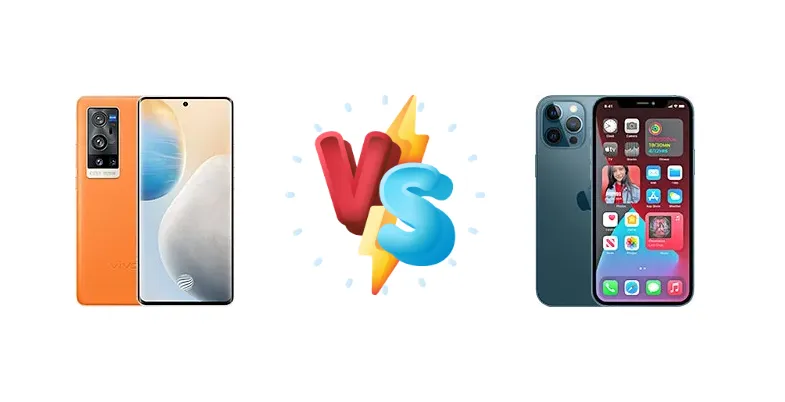
|
🏆 Quick Verdict
For the average user prioritizing a seamless ecosystem and long-term software support, the iPhone 12 Pro Max remains a strong choice. However, the vivo X60 Pro+ delivers comparable performance with significantly faster charging and a competitive camera system, making it a compelling value proposition for Android enthusiasts.
| PHONES | ||
|---|---|---|
| Phone Names | vivo X60 Pro+ | Apple iPhone 12 Pro Max |
| Network | ||
|---|---|---|
| 2G bands | GSM 850 / 900 / 1800 / 1900 | GSM 850 / 900 / 1800 / 1900 |
| 3G bands | HSDPA 850 / 900 / 1700(AWS) / 1900 / 2100 | HSDPA 850 / 900 / 1700(AWS) / 1900 / 2100 |
| 4G bands | 1, 2, 3, 4, 5, 7, 8, 12, 17, 18, 19, 20, 26, 28, 34, 38, 39, 40, 41 - International | 1, 2, 3, 4, 5, 7, 8, 12, 13, 14, 17, 18, 19, 20, 25, 26, 28, 29, 30, 32, 34, 38, 39, 40, 41, 42, 46, 48, 66, 71 - A2342 |
| 5G bands | 1, 28, 41, 77, 78 SA/NSA - International | 1, 2, 3, 5, 7, 8, 12, 20, 25, 28, 38, 40, 41, 66, 71, 77, 78, 79, 260, 261 Sub6/mmWave - A2342 |
| Speed | HSPA, LTE, 5G | HSPA, LTE, 5G, EV-DO Rev.A 3.1 Mbps |
| Technology | GSM / CDMA / HSPA / CDMA2000 / LTE / 5G | GSM / CDMA / HSPA / EVDO / LTE / 5G |
| - | 1, 2, 3, 5, 7, 8, 12, 20, 25, 28, 38, 40, 41, 66, 77, 78, 79 Sub6 - A2410, A2411, A2412 | |
| Launch | ||
|---|---|---|
| Announced | 2021, January 21 | 2020, October 13 |
| Status | Available. Released 2021, January 30 | Available. Released 2020, November 13 |
| Body | ||
|---|---|---|
| Build | Glass front, eco leather back, aluminum frame | Glass front, glass back, stainless steel frame |
| Dimensions | 158.6 x 73.4 x 9.1 mm (6.24 x 2.89 x 0.36 in) | 160.8 x 78.1 x 7.4 mm (6.33 x 3.07 x 0.29 in) |
| SIM | Nano-SIM + Nano-SIM | · Nano-SIM + eSIM· Nano-SIM + Nano-SIM (China) |
| Weight | 191 g (6.74 oz) | 228 g (8.04 oz) |
| - | IP68 dust/water resistant (up to 6m for 30 min) Apple Pay (Visa, MasterCard, AMEX certified) | |
| Display | ||
|---|---|---|
| Protection | - | Ceramic Shield glass |
| Resolution | 1080 x 2376 pixels (~398 ppi density) | 1284 x 2778 pixels, 19.5:9 ratio (~458 ppi density) |
| Size | 6.56 inches, 104.6 cm2 (~89.8% screen-to-body ratio) | 6.7 inches, 109.8 cm2 (~87.4% screen-to-body ratio) |
| Type | Super AMOLED, 120Hz, HDR10+, 1300 nits (peak) | Super Retina XDR OLED, HDR10, Dolby Vision, 800 nits (HBM), 1200 nits (peak) |
| Platform | ||
|---|---|---|
| CPU | Octa-core (1x2.84 GHz Cortex-X1 & 3x2.42 GHz Cortex-A78 & 4x1.80 GHz Cortex-A55 | Hexa-core (2x3.1 GHz Firestorm + 4x1.8 GHz Icestorm) |
| Chipset | Qualcomm SM8350 Snapdragon 888 5G (5 nm) | Apple A14 Bionic (5 nm) |
| GPU | Adreno 660 | Apple GPU (4-core graphics) |
| OS | Android 11, Funtouch 12 (International), OriginOS 1.0 (China) | iOS 14.1, upgradable to iOS 26.1 |
| Memory | ||
|---|---|---|
| Card slot | No | No |
| Internal | 128GB 8GB RAM, 256GB 12GB RAM | 128GB 6GB RAM, 256GB 6GB RAM, 512GB 6GB RAM |
| - | NVMe | |
| Main Camera | ||
|---|---|---|
| Features | Laser AF, color spectrum sensor, Zeiss optics, Zeiss T* lens coating, Pixel Shift, dual-LED dual-tone flash, HDR, panorama | Dual-LED dual-tone flash, HDR (photo/panorama) |
| Quad | 50 MP, f/1.6, (wide), 1/1.31", 1.2µm, dual pixel PDAF, OIS 8 MP, f/3.4, 125mm (periscope telephoto), 1/4.0", PDAF, OIS, 5x optical zoom 32 MP, f/2.1, 50mm (telephoto), 1/2.8", 0.8µm, PDAF, 2x optical zoom 48 MP, f/2.2, 114˚ (ultrawide), 1/2.0", 0.8µm, gimbal OIS, PDAF | - |
| Triple | - | 12 MP, f/1.6, 26mm (wide), 1/1.9", 1.7µm, dual pixel PDAF, sensor-shift OIS 12 MP, f/2.2, 65mm (telephoto), 1/3.4", 1.0µm, PDAF, OIS, 2.5x optical zoom 12 MP, f/2.4, 13mm, 120˚ (ultrawide), 1/3.4", 1.0µm TOF 3D LiDAR scanner (depth) |
| Video | 8K@30fps, 4K@30/60fps, 1080p@30/60fps, gyro-EIS, HDR10+ | 4K@24/25/30/60fps, 1080p@25/30/60/120/240fps, 10‑bit HDR, Dolby Vision HDR (up to 60fps), stereo sound rec. |
| Selfie camera | ||
|---|---|---|
| Features | HDR | HDR |
| Single | 32 MP, f/2.5, 24mm (wide), 1/2.8", 0.8µm | 12 MP, f/2.2, 23mm (wide), 1/3.6", 1.0µm SL 3D, (depth/biometrics sensor) |
| Video | 1080p@30fps | 4K@24/25/30/60fps, 1080p@25/30/60/120fps, gyro-EIS |
| Sound | ||
|---|---|---|
| 3.5mm jack | - | No |
| 35mm jack | No | No |
| Loudspeaker | Yes | Yes, with stereo speakers |
| Comms | ||
|---|---|---|
| Bluetooth | 5.2, A2DP, LE, aptX HD | 5.0, A2DP, LE |
| NFC | Yes | Yes |
| Positioning | GPS (L1+L5), GLONASS, BDS, GALILEO, NavIC | GPS, GLONASS, GALILEO, QZSS |
| Radio | No | No |
| USB | USB Type-C 2.0, OTG | Lightning, USB 2.0 |
| WLAN | Wi-Fi 802.11 a/b/g/n/ac/6, dual-band, Wi-Fi Direct | Wi-Fi 802.11 a/b/g/n/ac/6, dual-band, hotspot |
| Features | ||
|---|---|---|
| Sensors | Fingerprint (under display, optical), accelerometer, gyro, compass | Face ID, accelerometer, gyro, proximity, compass, barometer |
| - | Ultra Wideband (UWB) support | |
| Battery | ||
|---|---|---|
| Charging | 55W wired | Wired, PD2.0, 50% in 30 min 15W wireless (MagSafe) 15W wireless (Qi2) - requires iOS 17.4 update |
| Type | 4200 mAh | Li-Ion 3687 mAh (14.13 Wh) |
| Misc | ||
|---|---|---|
| Colors | Orange, Emperor Blue | Silver, Graphite, Gold, Pacific Blue |
| Models | V2056A, V2047 | A2411, A2342, A2410, A2412, iPhone13,4 |
| Price | About 800 EUR | $ 328.00 / C$ 549.75 / £ 270.67 / € 339.00 |
| SAR | 0.80 W/kg (head) 0.47 W/kg (body) | - |
| SAR EU | - | 0.99 W/kg (head) 0.99 W/kg (body) |
| Pricing | ||
|---|---|---|
| 128GB 6GB RAM | - | $ 599.99 |
| 256GB 6GB RAM | - | $ 728.45 |
| 512GB 6GB RAM | - | $ 886.67 |
| RENEWED | - | $ 627.00 |
| Tests | ||
|---|---|---|
| Battery life | - | Endurance rating 95h |
| Camera | - | Photo / Video |
| Display | - | Contrast ratio: Infinite (nominal) |
| Loudspeaker | - | -23.8 LUFS (Very good) |
| Performance | - | AnTuTu: 638584 (v8) GeekBench: 4240 (v5.1) GFXBench: 55fps (ES 3.1 onscreen) |
vivo X60 Pro+
- Significantly faster 55W wired charging
- Android OS offers greater customization
- Competitive performance with Snapdragon 888
- Long-term software support is less guaranteed than Apple
- Camera details are lacking, making a direct comparison difficult
Apple iPhone 12 Pro Max
- Excellent ecosystem integration and software support
- Industry-leading video recording capabilities
- Strong single-core performance with A14 Bionic
- Slower charging speeds compared to the X60 Pro+
- Less customization options with iOS
Display Comparison
Both the vivo X60 Pro+ and iPhone 12 Pro Max boast excellent displays, achieving measured peak brightnesses of 816 nits and 822 nits respectively – virtually indistinguishable to the naked eye. The iPhone 12 Pro Max’s ‘infinite’ (nominal) contrast ratio, typical of OLED panels, provides deep blacks. While both offer a premium viewing experience, the X60 Pro+’s display technology isn’t specified, potentially lacking features like LTPO for variable refresh rates found in some competing Android flagships. This could impact power consumption during dynamic content viewing.
Camera Comparison
Both devices excel in photography and videography, but approach it differently. While both are capable of excellent results, detailed sensor information for the X60 Pro+ is missing. The iPhone 12 Pro Max is known for its cinematic mode and excellent video stabilization. The X60 Pro+ likely relies heavily on computational photography to enhance image quality, a common trait among vivo’s flagship devices. Without specific sensor size details for the X60 Pro+, it’s difficult to definitively declare a camera winner, but the iPhone’s consistent video performance and established image processing pipeline give it an edge for video-centric users.
Performance
The core battle lies between the Qualcomm Snapdragon 888 5G in the X60 Pro+ and the Apple A14 Bionic in the iPhone 12 Pro Max. The A14’s hexa-core architecture, with its 3.1 GHz Firestorm cores, generally outperforms the Snapdragon 888’s octa-core setup in single-core tasks. However, the Snapdragon 888’s Cortex-X1 prime core offers strong multi-core performance. Both chips are fabricated on a 5nm process, but Apple’s chip design and optimization typically yield superior efficiency. The iPhone 12 Pro Max’s 6GB of RAM is matched by the X60 Pro+, but Apple’s memory management is renowned for its efficiency, potentially mitigating the impact of identical RAM capacity.
Battery Life
Both phones achieve an endurance rating of approximately 95 hours, indicating similar overall battery life despite differing battery capacities (not specified for the X60 Pro+). However, the charging experience is where the X60 Pro+ truly shines. Its 55W wired charging dramatically outperforms the iPhone 12 Pro Max’s 20W wired charging (50% in 30 minutes) and 15W wireless charging (MagSafe/Qi2). This means the X60 Pro+ can replenish its battery significantly faster, minimizing downtime. The iPhone 12 Pro Max’s wireless charging convenience is offset by its slower speeds.
Buying Guide
Buy the vivo X60 Pro+ if you need blazing-fast 55W charging, prefer the flexibility of Android, and prioritize raw performance in demanding applications. Buy the Apple iPhone 12 Pro Max if you value a tightly integrated ecosystem, guaranteed software updates for years to come, and a refined user experience with a focus on video recording.