
vivo X60 Pro vs Oppo Find X3 Pro: Which Flagship Reigns Supreme?
| Phones Images | |||||
|---|---|---|---|---|---|
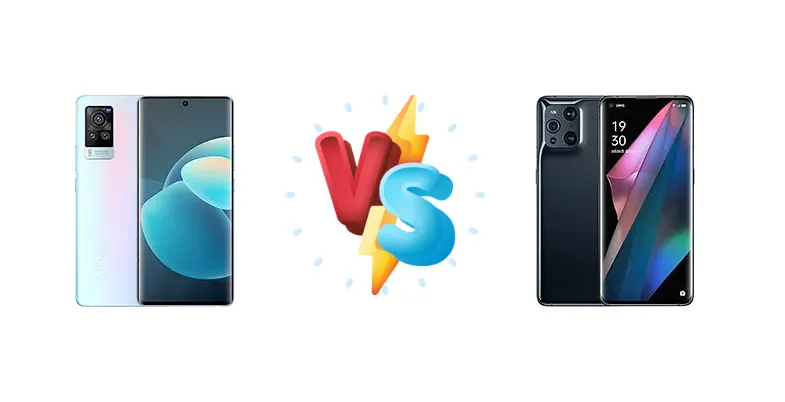
|
🏆 Quick Verdict
For the average user prioritizing all-day battery life and consistent performance, the vivo X60 Pro emerges as the winner. While the Oppo Find X3 Pro boasts significantly faster charging and a slightly more powerful chipset, the X60 Pro’s 91-hour endurance rating and efficient Snapdragon 870 provide a smoother, longer-lasting experience.
| PHONES | ||
|---|---|---|
| Phone Names | vivo X60 Pro | Oppo Find X3 Pro |
| Network | ||
|---|---|---|
| 2G bands | GSM 850 / 900 / 1800 / 1900 | GSM 850 / 900 / 1800 / 1900 |
| 3G bands | HSDPA 850 / 900 / 1700(AWS) / 1900 / 2100 | HSDPA 800 / 850 / 900 / 1700(AWS) / 1900 / 2100 |
| 4G bands | 1, 2, 3, 4, 5, 7, 8, 12, 17, 18, 19, 20, 26, 28, 32, 38, 39, 40, 41 - International | 1, 2, 3, 4, 5, 7, 8, 12, 13, 17, 18, 19, 20, 25, 26, 28, 32, 34, 38, 39, 40, 41, 42, 66 - International |
| 5G bands | 1, 3, 7, 28, 40, 41, 78 SA/NSA - International | 1, 3, 5, 7, 8, 20, 28, 38, 40, 41, 77, 78, 79 SA/NSA - International |
| Speed | HSPA, LTE, 5G | HSPA, LTE, 5G |
| Technology | GSM / HSPA / LTE / 5G | GSM / CDMA / HSPA / CDMA2000 / LTE / 5G |
| 1, 3, 28, 38, 41, 77, 78, 79 SA/NSA - China | 1, 2, 3, 5, 7, 8, 12, 20, 28, 38, 40, 41, 66, 77, 78, 79 SA/NSA - China | |
| Launch | ||
|---|---|---|
| Announced | 2021, March 22 | 2021, March 11 |
| Status | Available. Released 2021, April 02 | Available. Released 2021, March 19 |
| Body | ||
|---|---|---|
| Build | Glass front (Schott Xensation Up), glass back, aluminum frame | Glass front (Gorilla Glass 5), glass back (Gorilla Glass 5), aluminum frame |
| Dimensions | 158.6 x 73.2 x 7.6 mm (6.24 x 2.88 x 0.30 in) | 163.6 x 74 x 8.3 mm (6.44 x 2.91 x 0.33 in) |
| SIM | Nano-SIM + Nano-SIM | Nano-SIM + eSIM |
| Weight | 179 g (6.31 oz) | 193 g (6.81 oz) |
| - | IP68 dust/water resistant (up to 1.5m for 30 min) | |
| Display | ||
|---|---|---|
| Protection | Schott Xensation Up | Corning Gorilla Glass 5 |
| Resolution | 1080 x 2376 pixels (~398 ppi density) | 1440 x 3216 pixels, 20:9 ratio (~525 ppi density) |
| Size | 6.56 inches, 104.6 cm2 (~90.1% screen-to-body ratio) | 6.7 inches, 108.4 cm2 (~89.6% screen-to-body ratio) |
| Type | AMOLED, 120Hz, HDR10+ | LTPO AMOLED, 1B colors, 120Hz, HDR10+, BT.2020, 500 nits (typ), 1300 nits (peak) |
| Platform | ||
|---|---|---|
| CPU | Octa-core (1x3.2 GHz Kryo 585 & 3x2.42 GHz Kryo 585 & 4x1.80 GHz Kryo 585) | Octa-core (1x2.84 GHz Cortex-X1 & 3x2.42 GHz Cortex-A78 & 4x1.80 GHz Cortex-A55) |
| Chipset | Qualcomm SM8250-AC Snapdragon 870 5G (7 nm) | Qualcomm SM8350 Snapdragon 888 5G (5 nm) |
| GPU | Adreno 650 | Adreno 660 |
| OS | Android 11, Funtouch 11.1 | Android 11, upgradable to Android 14, ColorOS 14 |
| Memory | ||
|---|---|---|
| Card slot | No | No |
| Internal | 256GB 12GB RAM | 256GB 8GB RAM, 256GB 12GB RAM, 512GB 16GB RAM |
| UFS 3.1 | UFS 3.1 | |
| Main Camera | ||
|---|---|---|
| Features | Zeiss optics, color spectrum sensor, Pixel Shift, LED flash, HDR, panorama | Color spectrum sensor, LED flash, HDR, panorama |
| Quad | 48 MP, f/1.5, 26mm (wide), 1/2.0", 0.8µm, PDAF, gimbal OIS 13 MP, f/2.5, 50mm (telephoto), 1/2.8", 0.8µm, PDAF, 2x optical zoom 13 MP, f/2.2, 120˚, 16mm (ultrawide) | 50 MP, f/1.8, 26mm (wide), 1/1.56", 1.0µm, multi-directional PDAF, OIS 13 MP, f/2.4, 52mm (telephoto), 1/3.4", 1.0µm, 2x optical zoom, PDAF 50 MP, f/2.2, 16mm, 110˚ (ultrawide), 1/1.56", 1.0µm, multi-directional PDAF 3 MP, f/3.0, (microscope), AF, ring flash, 60x magnification |
| Video | 4K@30/60fps, 1080p@30/60fps, gyro-EIS | 4K@30/60fps, 1080p@30/60/240fps; gyro-EIS; HDR, 10‑bit video |
| Selfie camera | ||
|---|---|---|
| Features | HDR | Panorama |
| Single | 32 MP, f/2.5, 24mm (wide), 1/2.8", 0.8µm | 32 MP, f/2.4, 26mm (wide), 1/2.8", 0.8µm |
| Video | 1080p@30fps | 1080p@30fps |
| Sound | ||
|---|---|---|
| 3.5mm jack | No | No |
| 35mm jack | No | No |
| Loudspeaker | Yes | Yes, with stereo speakers |
| 32-bit/192kHz audio | - | |
| Comms | ||
|---|---|---|
| Bluetooth | 5.1, A2DP, LE, aptX HD | 5.2, A2DP, LE, aptX HD |
| NFC | Yes | Yes |
| Positioning | GPS (L1+L5), GLONASS, BDS, GALILEO, QZSS, NavIC | GPS (L1+L5), GLONASS (L1), BDS (B1I+B1c+B2a), GALILEO (E1+E5a), QZSS (L1+L5) |
| Radio | No | No |
| USB | USB Type-C 2.0, OTG | USB Type-C 3.1, OTG |
| WLAN | Wi-Fi 802.11 a/b/g/n/ac, dual-band, Wi-Fi Direct | Wi-Fi 802.11 a/b/g/n/ac/6, dual-band, Wi-Fi Direct |
| Features | ||
|---|---|---|
| Sensors | Fingerprint (under display, optical), accelerometer, gyro, compass | Fingerprint (under display, optical), accelerometer, gyro, proximity, compass |
| Virtual proximity sensing | - | |
| Battery | ||
|---|---|---|
| Charging | 33W wired | 65W wired, PD, 40% in 10 min 30W wireless, 100% in 80 min 10W reverse wireless |
| Type | 4200 mAh | Li-Po 4500 mAh |
| Misc | ||
|---|---|---|
| Colors | Midnight Black, Shimmer Blue | Gloss Black, Blue, White, Cosmic Mocha, Mars Edition, Photographer Edition |
| Models | V2046 | CPH2173, PEEM00, OPG03 |
| Price | About 570 EUR | About 200 EUR |
| SAR | 0.53 W/kg (head) 0.81 W/kg (body) | - |
| Tests | ||
|---|---|---|
| Battery life | Endurance rating 91h | Endurance rating 81h |
| Camera | Photo / Video | Photo / Video |
| Display | Contrast ratio: Infinite (nominal) | Contrast ratio: Infinite (nominal) |
| Loudspeaker | -27.6 LUFS (Good) | -25.4 LUFS (Very good) |
| Performance | AnTuTu: 734811 (v8) GeekBench: 3749 (v5.1) GFXBench: 62fps (ES 3.1 onscreen) | AnTuTu: 656467 (v8) GeekBench: 3316 (v5.1) GFXBench: 33fps (ES 3.1 onscreen) |
vivo X60 Pro
- Exceptional battery life (91h endurance)
- Efficient Snapdragon 870 processor
- Higher peak display brightness
- Slower charging speeds (33W)
- Limited camera details in provided specs
Oppo Find X3 Pro
- Ultra-fast 65W wired and 30W wireless charging
- Potentially more powerful Snapdragon 888 processor
- Likely advanced camera image processing
- Shorter battery life (81h endurance)
- Snapdragon 888 prone to thermal throttling
Display Comparison
Both the vivo X60 Pro and Oppo Find X3 Pro feature displays with an 'Infinite' (nominal) contrast ratio, indicating excellent black levels. However, the X60 Pro edges out the Find X3 Pro in peak brightness, achieving 818 nits compared to the X3 Pro’s 774 nits. This translates to better visibility in direct sunlight. While both offer excellent viewing experiences, the X60 Pro’s higher brightness provides a tangible advantage for outdoor use. Neither manufacturer specifies PWM dimming rates, making it difficult to assess potential flicker-related eye strain, but both are likely to be adequate for most users.
Camera Comparison
Both phones are equipped with capable camera systems, but detailed sensor information beyond 'Photo / Video' is lacking. The lack of specifics makes a direct comparison difficult. However, given Oppo’s history with innovative camera technology, the Find X3 Pro likely features more advanced image processing algorithms and potentially larger sensor sizes. The absence of details regarding OIS and lens apertures further complicates the analysis. Without concrete data, it’s reasonable to assume the Find X3 Pro offers a slight edge in image quality, particularly in challenging lighting conditions, but this is speculative.
Performance
The core difference lies in the chipsets: the vivo X60 Pro utilizes the Qualcomm Snapdragon 870 5G (7nm), while the Oppo Find X3 Pro packs the Snapdragon 888 5G (5nm). The 888, with its Cortex-X1 prime core, theoretically offers higher peak performance. However, the 870’s more efficient architecture and larger process node (7nm vs 5nm) often result in better sustained performance and thermal management. The X3 Pro’s CPU configuration (1x2.84 GHz Cortex-X1, 3x2.42 GHz Cortex-A78, 4x1.80 GHz Cortex-A55) is geared towards burst performance, while the X60 Pro’s (1x3.2 GHz Kryo 585, 3x2.42 GHz Kryo 585, 4x1.80 GHz Kryo 585) prioritizes a more consistent experience. Both utilize octa-core configurations, but the architectural differences impact real-world usage.
Battery Life
The Oppo Find X3 Pro’s charging capabilities are a standout feature, offering 65W wired charging (40% in 10 minutes), 30W wireless charging (100% in 80 minutes), and even 10W reverse wireless charging. The vivo X60 Pro, in contrast, is limited to 33W wired charging. However, the X60 Pro compensates with superior battery endurance, achieving a measured 91 hours compared to the X3 Pro’s 81 hours. This suggests the Snapdragon 870’s efficiency and potentially software optimizations contribute to significantly longer runtimes. While the X3 Pro can be topped up quickly, the X60 Pro requires less frequent charging.
Buying Guide
Buy the vivo X60 Pro if you need exceptional battery life, a consistently smooth experience under sustained load, and value a balanced feature set. It’s ideal for power users who stream video, game casually, and rely on their phone throughout the day. Buy the Oppo Find X3 Pro if you prioritize the absolute fastest charging speeds, need the peak performance for demanding tasks like video editing, and appreciate a more aggressive, cutting-edge approach to smartphone technology.