
vivo X60 Pro vs iPhone 13 Pro Max: A Detailed Comparison of Flagship Power
| Phones Images | |||||
|---|---|---|---|---|---|
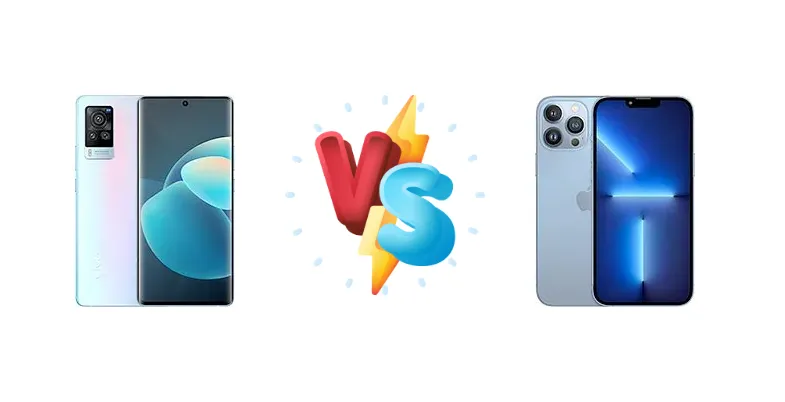
|
🏆 Quick Verdict
For the average user prioritizing longevity and a polished ecosystem, the iPhone 13 Pro Max is the superior choice, boasting significantly better battery life (121h vs 91h) and a more refined software experience. However, the vivo X60 Pro delivers excellent performance and camera capabilities at a potentially lower price point, making it a strong contender for value-conscious buyers.
| PHONES | ||
|---|---|---|
| Phone Names | vivo X60 Pro | Apple iPhone 13 Pro Max |
| Network | ||
|---|---|---|
| 2G bands | GSM 850 / 900 / 1800 / 1900 | GSM 850 / 900 / 1800 / 1900 |
| 3G bands | HSDPA 850 / 900 / 1700(AWS) / 1900 / 2100 | HSDPA 850 / 900 / 1700(AWS) / 1900 / 2100 |
| 4G bands | 1, 2, 3, 4, 5, 7, 8, 12, 17, 18, 19, 20, 26, 28, 32, 38, 39, 40, 41 - International | 1, 2, 3, 4, 5, 7, 8, 12, 13, 17, 18, 19, 20, 25, 26, 28, 30, 32, 34, 38, 39, 40, 41, 42, 46, 48, 66 - A2643, A2644, A2645 |
| 5G bands | 1, 3, 7, 28, 40, 41, 78 SA/NSA - International | 1, 2, 3, 5, 7, 8, 12, 20, 25, 28, 30, 38, 40, 41, 48, 66, 77, 78, 79 SA/NSA/Sub6 - A2643, A2644 |
| Speed | HSPA, LTE, 5G | HSPA, LTE, 5G, EV-DO Rev.A 3.1 Mbps |
| Technology | GSM / HSPA / LTE / 5G | GSM / CDMA / HSPA / EVDO / LTE / 5G |
| 1, 3, 28, 38, 41, 77, 78, 79 SA/NSA - China | 1, 2, 3, 5, 7, 8, 12, 20, 25, 28, 29, 30, 38, 40, 41, 48, 66, 71, 77, 78, 79 SA/NSA/Sub6 - A2641 | |
| Launch | ||
|---|---|---|
| Announced | 2021, March 22 | 2021, September 14 |
| Status | Available. Released 2021, April 02 | Available. Released 2021, September 24 |
| Body | ||
|---|---|---|
| Build | Glass front (Schott Xensation Up), glass back, aluminum frame | Glass front, glass back, stainless steel frame |
| Dimensions | 158.6 x 73.2 x 7.6 mm (6.24 x 2.88 x 0.30 in) | 160.8 x 78.1 x 7.7 mm (6.33 x 3.07 x 0.30 in) |
| SIM | Nano-SIM + Nano-SIM | · Nano-SIM + eSIM· Nano-SIM + Nano-SIM |
| Weight | 179 g (6.31 oz) | 240 g (8.47 oz) |
| - | IP68 dust/water resistant (up to 6m for 30 min) Apple Pay (Visa, MasterCard, AMEX certified) | |
| Display | ||
|---|---|---|
| Protection | Schott Xensation Up | Ceramic Shield glass |
| Resolution | 1080 x 2376 pixels (~398 ppi density) | 1284 x 2778 pixels, 19.5:9 ratio (~458 ppi density) |
| Size | 6.56 inches, 104.6 cm2 (~90.1% screen-to-body ratio) | 6.7 inches, 109.8 cm2 (~87.4% screen-to-body ratio) |
| Type | AMOLED, 120Hz, HDR10+ | Super Retina XDR OLED, 120Hz, HDR10, Dolby Vision, 1000 nits (HBM), 1200 nits (peak) |
| Platform | ||
|---|---|---|
| CPU | Octa-core (1x3.2 GHz Kryo 585 & 3x2.42 GHz Kryo 585 & 4x1.80 GHz Kryo 585) | Hexa-core (2x3.23 GHz Avalanche + 4x1.82 GHz Blizzard) |
| Chipset | Qualcomm SM8250-AC Snapdragon 870 5G (7 nm) | Apple A15 Bionic (5 nm) |
| GPU | Adreno 650 | Apple GPU (5-core graphics) |
| OS | Android 11, Funtouch 11.1 | iOS 15, upgradable to iOS 26.1 |
| Memory | ||
|---|---|---|
| Card slot | No | No |
| Internal | 256GB 12GB RAM | 128GB 6GB RAM, 256GB 6GB RAM, 512GB 6GB RAM, 1TB 6GB RAM |
| UFS 3.1 | NVMe | |
| Main Camera | ||
|---|---|---|
| Features | Zeiss optics, color spectrum sensor, Pixel Shift, LED flash, HDR, panorama | Dual-LED dual-tone flash, HDR (photo/panorama) |
| Quad | 48 MP, f/1.5, 26mm (wide), 1/2.0", 0.8µm, PDAF, gimbal OIS 13 MP, f/2.5, 50mm (telephoto), 1/2.8", 0.8µm, PDAF, 2x optical zoom 13 MP, f/2.2, 120˚, 16mm (ultrawide) | - |
| Single | - | 12 MP, f/2.2, 23mm (wide), 1/3.6" SL 3D, (depth/biometrics sensor) |
| Triple | - | 12 MP, f/1.5, 26mm (wide), 1/1.7", 1.9µm, dual pixel PDAF, sensor-shift OIS 12 MP, f/2.8, 77mm (telephoto), PDAF, 1/3.4", 1.0µm, OIS, 3x optical zoom 12 MP, f/1.8, 13mm, 120˚ (ultrawide), 1/3.4", 1.0µm, PDAF TOF 3D LiDAR scanner (depth) |
| Video | 4K@30/60fps, 1080p@30/60fps, gyro-EIS | 4K@24/25/30/60fps, 1080p@25/30/60/120/240fps, 10-bit HDR, Dolby Vision HDR (up to 60fps), ProRes, stereo sound rec. |
| Selfie camera | ||
|---|---|---|
| Features | HDR | HDR |
| Single | 32 MP, f/2.5, 24mm (wide), 1/2.8", 0.8µm | 12 MP, f/2.2, 23mm (wide), 1/3.6", 1.0µm SL 3D, (depth/biometrics sensor) |
| Video | 1080p@30fps | 4K@24/25/30/60fps, 1080p@25/30/60/120fps, gyro-EIS |
| Sound | ||
|---|---|---|
| 3.5mm jack | No | No |
| 35mm jack | No | No |
| Loudspeaker | Yes | Yes, with stereo speakers |
| 32-bit/192kHz audio | - | |
| Comms | ||
|---|---|---|
| Bluetooth | 5.1, A2DP, LE, aptX HD | 5.0, A2DP, LE |
| NFC | Yes | Yes |
| Positioning | GPS (L1+L5), GLONASS, BDS, GALILEO, QZSS, NavIC | GPS, GLONASS, GALILEO, BDS, QZSS |
| Radio | No | No |
| USB | USB Type-C 2.0, OTG | Lightning, USB 2.0 |
| WLAN | Wi-Fi 802.11 a/b/g/n/ac, dual-band, Wi-Fi Direct | Wi-Fi 802.11 a/b/g/n/ac/6, dual-band, hotspot |
| Features | ||
|---|---|---|
| Sensors | Fingerprint (under display, optical), accelerometer, gyro, compass | Face ID, accelerometer, gyro, proximity, compass, barometer |
| Virtual proximity sensing | Ultra Wideband (UWB) support | |
| Battery | ||
|---|---|---|
| Charging | 33W wired | Wired, PD2.0, 50% in 30 min 15W wireless (MagSafe) 15W wireless (Qi2) - requires iOS 17.2 update |
| Type | 4200 mAh | Li-Ion 4352 mAh (16.75 Wh) |
| Misc | ||
|---|---|---|
| Colors | Midnight Black, Shimmer Blue | Graphite, Gold, Silver, Sierra Blue, Alpine Green |
| Models | V2046 | A2643, A2484, A2641, A2644, A2645, iphone14,3 |
| Price | About 570 EUR | € 423.38 / $ 394.86 / £ 355.00 |
| SAR | 0.53 W/kg (head) 0.81 W/kg (body) | 1.18 W/kg (head) 1.20 W/kg (body) |
| SAR EU | - | 0.99 W/kg (head) 0.98 W/kg (body) |
| Tests | ||
|---|---|---|
| Battery life | Endurance rating 91h | Endurance rating 121h |
| Camera | Photo / Video | Photo / Video |
| Display | Contrast ratio: Infinite (nominal) | Contrast ratio: Infinite (nominal) |
| Loudspeaker | -27.6 LUFS (Good) | -24.0 LUFS (Very good) |
| Performance | AnTuTu: 734811 (v8) GeekBench: 3749 (v5.1) GFXBench: 62fps (ES 3.1 onscreen) | AnTuTu: 801691 (v9) GeekBench: 4706 (v5.1) GFXBench: 60fps (ES 3.1 onscreen) |
vivo X60 Pro
- Potentially lower price point
- Fast 33W wired charging
- Versatile camera system (based on brand reputation)
- Significantly shorter battery life
- Less powerful chipset compared to A15 Bionic
- Android OS fragmentation and update concerns
Apple iPhone 13 Pro Max
- Exceptional battery life (121h endurance)
- Powerful A15 Bionic chipset
- Seamless iOS ecosystem integration
- Higher price tag
- Slower wired charging compared to vivo X60 Pro
- Less customization options compared to Android
Display Comparison
The iPhone 13 Pro Max’s display boasts a peak brightness of 1050 nits, significantly exceeding the vivo X60 Pro’s 818 nits. This translates to better visibility in direct sunlight. Both displays share an infinite (nominal) contrast ratio, typical of OLED panels, but the iPhone’s higher brightness provides a more vibrant and punchy image. While neither specification details refresh rate, the iPhone 13 Pro Max features ProMotion (adaptive refresh rate up to 120Hz) which the X60 Pro lacks, resulting in smoother scrolling and animations. This is a key advantage for users who consume a lot of video content or play fast-paced games.
Camera Comparison
Both phones are equipped with sophisticated camera systems, but their approaches differ. While both offer photo and video capabilities, detailed sensor information for the X60 Pro is missing. However, vivo is known for its computational photography prowess, particularly in low-light conditions. The iPhone 13 Pro Max excels in video recording, offering Cinematic mode and ProRes video capture. The iPhone’s image processing tends towards natural colors, while vivo often boosts saturation for a more visually appealing look. Without specific sensor size data for the X60 Pro, it’s difficult to definitively declare a camera winner, but the iPhone’s video capabilities and consistent image quality give it an edge.
Performance
The core difference lies in the chipsets: the Apple A15 Bionic (5nm) versus the Qualcomm Snapdragon 870 5G (7nm). The A15’s 5nm process provides greater transistor density and improved power efficiency compared to the 870’s 7nm node. While the Snapdragon 870 is a capable performer with its octa-core CPU, the A15’s hexa-core architecture, optimized for iOS, delivers superior single-core and multi-core performance. This difference is most noticeable in demanding tasks like video editing and graphically intensive games. The iPhone’s advantage isn’t just raw power; Apple’s tight hardware-software integration further optimizes performance and responsiveness.
Battery Life
The iPhone 13 Pro Max dominates in battery endurance, achieving a remarkable 121-hour rating compared to the vivo X60 Pro’s 91 hours. This substantial difference is due to a combination of the A15 Bionic’s power efficiency and a larger battery capacity (though the exact mAh isn’t specified). The iPhone also supports faster charging with 30-minute 50% charge via PD2.0, alongside 15W wireless charging (MagSafe and Qi2). The vivo X60 Pro offers 33W wired charging, which is faster than the iPhone’s wired charging, but the overall battery life advantage remains firmly with the iPhone.
Buying Guide
Buy the vivo X60 Pro if you need a versatile camera system with excellent low-light performance and prefer the flexibility of the Android operating system, all while potentially saving money. Buy the Apple iPhone 13 Pro Max if you prioritize all-day battery life, seamless integration with the Apple ecosystem, and a consistently smooth user experience, even if it comes at a premium.