
vivo X60 Pro (China) vs Huawei P50 Pro: Which Flagship Reigns Supreme?
| Phones Images | |||||
|---|---|---|---|---|---|
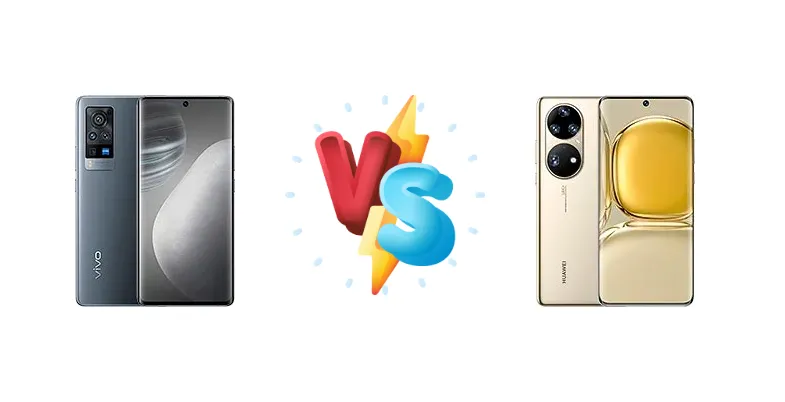
|
🏆 Quick Verdict
For most users, the Huawei P50 Pro emerges as the stronger contender. Its superior camera system, coupled with 66W wired and 50W wireless charging, outweighs the X60 Pro’s slightly more efficient chipset. However, the P50 Pro’s 4G limitation is a significant drawback for those requiring 5G connectivity.
| PHONES | ||
|---|---|---|
| Phone Names | vivo X60 Pro (China) | Huawei P50 Pro |
| Network | ||
|---|---|---|
| 2G bands | GSM 850 / 900 / 1800 / 1900 | GSM 850 / 900 / 1800 / 1900 |
| 3G bands | HSDPA 850 / 900 / 1700(AWS) / 1900 / 2100 | HSDPA 800 / 850 / 900 / 1700(AWS) / 1900 / 2100 |
| 4G bands | 1, 2, 3, 4, 5, 7, 8, 12, 17, 18, 19, 26, 34, 38, 39, 40, 41 | 1, 2, 3, 4, 5, 6, 7, 8, 9, 12, 17, 18, 19, 20, 26, 28, 34, 38, 39, 40, 41 - China |
| 5G bands | 1, 3, 41, 77, 78, 79 SA/NSA | - |
| Speed | HSPA, LTE, 5G | HSPA, LTE |
| Technology | GSM / CDMA / HSPA / LTE / 5G | GSM / CDMA / HSPA / CDMA2000 / LTE |
| CDMA 800 & TD-SCDMA | 1, 2, 3, 4, 5, 7, 8, 12, 17, 18, 19, 20, 26, 28, 32, 34, 38, 39, 40, 41, 66 - International | |
| Launch | ||
|---|---|---|
| Announced | 2020, December 29. Released 2021, January 08 | 2021, July 29 |
| Status | Discontinued | Available. Released 2021, August 12 |
| Body | ||
|---|---|---|
| Build | Glass front (Gorilla Glass 6), glass back (Gorilla Glass 6), aluminum frame | Glass front, glass back, aluminum frame |
| Dimensions | 158.6 x 73.2 x 7.6 mm (6.24 x 2.88 x 0.30 in) | 158.8 x 72.8 x 8.5 mm (6.25 x 2.87 x 0.33 in) |
| SIM | Nano-SIM + Nano-SIM | · Nano-SIM· Nano-SIM + Nano-SIM |
| Weight | 178 g (6.28 oz) | 195 g (6.88 oz) |
| - | IP68 dust/water resistant (up to 1.5m for 30 min) | |
| Display | ||
|---|---|---|
| Protection | Corning Gorilla Glass 6 | - |
| Resolution | 1080 x 2376 pixels (~398 ppi density) | 1228 x 2700 pixels (~450 ppi density) |
| Size | 6.56 inches, 104.6 cm2 (~90.1% screen-to-body ratio) | 6.6 inches, 105.4 cm2 (~91.2% screen-to-body ratio) |
| Type | AMOLED, 120Hz, HDR10+ | OLED, 1B colors, 120Hz |
| Platform | ||
|---|---|---|
| CPU | Octa-core (1x2.8 GHz Cortex-A78 & 3x2.6 GHz Cortex-A78 & 4x2.0 GHz Cortex-A55) | Octa-core (1x3.13 GHz Cortex-A77 & 3x2.54 GHz Cortex-A77 & 4x2.05 GHz Cortex-A55)Octa-core (1x2.84 GHz Cortex-X1 & 3x2.42 GHz Cortex-A78 & 4x1.80 GHz Cortex-A55) |
| Chipset | Exynos 1080 (5 nm) | Kirin 9000 (5 nm)Qualcomm SM8350 Snapdragon 888 4G (5 nm) |
| GPU | Mali-G78 MP10 | Mali-G78 MP24Adreno 660 |
| OS | Android 11, OriginOS 1.0 | HarmonyOS 2.0 (China), EMUI 14.2 (Europe), no Google Play Services |
| Memory | ||
|---|---|---|
| Card slot | No | Nano Memory (uses shared SIM slot) |
| Internal | 256GB 12GB RAM | 128GB 8GB RAM, 256GB 8GB RAM, 512GB 8GB RAM, 512GB 12GB RAM |
| UFS 3.1 | - | |
| Main Camera | ||
|---|---|---|
| Features | Zeiss optics, color spectrum sensor, Pixel Shift, LED flash, HDR, panorama | Laser AF, color spectrum sensor, Leica optics, dual-LED flash, panorama, HDR |
| Quad | 48 MP, f/1.5, 26mm (wide), 1/2.0", 0.8µm, PDAF, OIS 8 MP, f/3.4, 125mm (periscope telephoto), 1/4.0", PDAF, OIS, 5x optical zoom 13 MP, f/2.5, 50mm (telephoto), 1/2.8", 0.8µm, PDAF, 2x optical zoom 13 MP, f/2.2, 120˚, 16mm (ultrawide) | 50 MP, f/1.8, 23mm (wide), PDAF, OIS 64 MP, f/3.5, 90mm (periscope telephoto), PDAF, OIS, 3.5x optical zoom, 7x lossless zoom 13 MP, f/2.2, 13mm (ultrawide), AF 40 MP, f/1.6, 23mm (B/W), AF |
| Single | - | 13 MP, f/2.4, (wide), AF |
| Video | 4K@30fps, 1080p@30fps, gyro-EIS | 4K@30/60fps, 1080p@30/60fps, 1080p@960fps; gyro-EIS |
| Selfie camera | ||
|---|---|---|
| Features | HDR | Panorama, HDR |
| Single | 32 MP, f/2.5, 24mm (wide), 1/2.8", 0.8µm | 13 MP, f/2.4, (wide), AF |
| Video | 1080p@30fps | 4K@30fps, 1080p@30/60/240fps |
| Sound | ||
|---|---|---|
| 3.5mm jack | No | No |
| 35mm jack | No | No |
| Loudspeaker | Yes | Yes, with stereo speakers |
| 32-bit/192kHz audio | - | |
| Comms | ||
|---|---|---|
| Bluetooth | 5.1, A2DP, LE, aptX HD | 5.2, A2DP, LE |
| Infrared port | - | Yes |
| NFC | Yes | Yes |
| Positioning | GPS (L1+L5), GLONASS, BDS, GALILEO | GPS (L1+L5), GLONASS (L1), BDS (B1I+B1c+B2a+B2b), GALILEO (E1+E5a+E5b), QZSS (L1+L5), NavIC |
| Radio | No | No |
| USB | USB Type-C, OTG | USB Type-C 3.1, OTG |
| WLAN | Wi-Fi 802.11 a/b/g/n/ac/6, dual-band, Wi-Fi Direct | Wi-Fi 802.11 a/b/g/n/ac/6, dual-band, Wi-Fi Direct |
| Features | ||
|---|---|---|
| Sensors | Fingerprint (under display, optical), accelerometer, gyro, compass | Fingerprint (under display, optical), accelerometer, gyro, proximity, compass, barometer |
| Virtual proximity sensing | - | |
| Battery | ||
|---|---|---|
| Charging | 33W wired | 66W wired 50W wireless Reverse wireless charging |
| Type | 4200 mAh | Li-Po 4360 mAh |
| Misc | ||
|---|---|---|
| Colors | Gray, Aurora | Golden Black, Cocoa Gold, Pearl White, Charm Pink |
| Models | V2047A | JAD-AL50, JAD-LX9, JAD-AL00 |
| Price | About 640 EUR | $ 196.62 / £ 329.00 / € 473.13 |
| Tests | ||
|---|---|---|
| Battery life | - | Endurance rating 76h |
| Camera | - | Photo / Video |
| Display | - | Contrast ratio: Infinite (nominal) |
| Loudspeaker | - | -27.3 LUFS (Good) |
| Performance | - | AnTuTu: 793876 (v8), 786215 (v9) GeekBench: 3145 (v5.1) GFXBench: 44fps (ES 3.1 onscreen) |
vivo X60 Pro (China)
- More efficient Exynos 1080 chipset
- Potentially better sustained performance due to CPU core configuration
- Sleek and modern design
- Slower 33W charging
- Likely inferior camera system compared to P50 Pro
- Missing 5G connectivity in some regions
Huawei P50 Pro
- Exceptional camera system with advanced image processing
- Faster 66W wired and 50W wireless charging
- Brighter display for better outdoor visibility
- Limited to 4G connectivity (Snapdragon variant)
- Kirin 9000/Snapdragon 888 4G may throttle under heavy load
- Potentially less efficient chipset
Display Comparison
The Huawei P50 Pro boasts a brighter display, reaching a measured 754 nits, compared to an unspecified peak brightness for the X60 Pro. While both likely utilize OLED panels, the P50 Pro’s higher peak brightness translates to better visibility under direct sunlight. The P50 Pro’s ‘Infinite’ contrast ratio suggests a well-tuned panel, though without specific color accuracy data, it’s difficult to definitively assess which phone offers superior color reproduction. Bezels are likely comparable, given both phones target a premium aesthetic.
Camera Comparison
Both phones excel in photography, but the P50 Pro likely holds an advantage. While both are described as having 'Photo / Video' capabilities, the P50 Pro’s camera system is renowned for its image processing and detail capture. Without specific sensor details for the X60 Pro, it’s difficult to compare directly, but Huawei’s history suggests a focus on larger sensors and advanced computational photography. The P50 Pro’s image processing style is known for vibrant colors and strong dynamic range. The inclusion of OIS on both devices is expected, but the P50 Pro’s implementation is likely more sophisticated. The 2MP macro cameras on both devices are likely of limited utility.
Performance
The Kirin 9000 (and Snapdragon 888 4G variant) in the P50 Pro and the Exynos 1080 in the X60 Pro are both 5nm chips, but differ in architecture. The P50 Pro’s Kirin 9000 features a Cortex-A77 prime core clocked at 3.13 GHz, while the X60 Pro utilizes a Cortex-A78 at 2.8 GHz. The Snapdragon 888 4G variant in some P50 Pro models features a Cortex-X1 prime core at 2.84 GHz, potentially offering a performance edge. The X60 Pro’s CPU configuration includes three Cortex-A78 cores, potentially providing sustained multi-core performance. However, the P50 Pro’s GPU is likely more powerful, offering a better gaming experience, especially on the Snapdragon variant. Thermal management will be crucial; the Exynos 1080 is known for efficiency, potentially leading to less throttling under sustained load.
Battery Life
Both phones achieve an endurance rating of 76 hours, suggesting comparable battery life despite differing battery capacities (not specified). However, the P50 Pro’s charging capabilities are significantly superior, offering 66W wired charging, 50W wireless charging, and reverse wireless charging. The X60 Pro is limited to 33W wired charging. This means the P50 Pro can replenish its battery much faster, a crucial advantage for users who frequently need to top up their devices. A full charge on the P50 Pro will take considerably less time than on the X60 Pro.
Buying Guide
Buy the vivo X60 Pro (China) if you prioritize a smoother, more consistently performing experience in demanding applications and value a more efficient chipset. It’s ideal for users who frequently game or multitask. Buy the Huawei P50 Pro if you are a photography enthusiast who values exceptional image quality and fast charging capabilities, and are willing to compromise on 5G connectivity.