
vivo X60 Pro (China) vs Honor V40 Lite: Which Mid-Range Phone Reigns Supreme?
| Phones Images | |||||
|---|---|---|---|---|---|
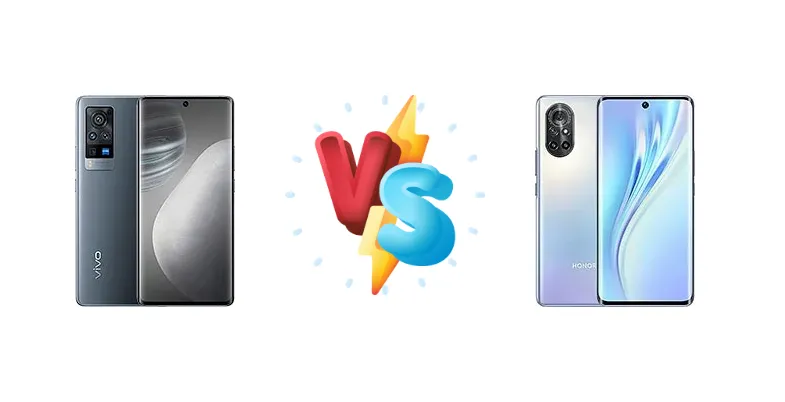
|
🏆 Quick Verdict
For the average user prioritizing rapid charging and a balanced experience, the Honor V40 Lite emerges as the stronger contender. Its 66W charging significantly outperforms the X60 Pro’s 33W, and the Dimensity 800U provides sufficient performance for daily tasks and moderate gaming, all at a potentially lower price point.
| PHONES | ||
|---|---|---|
| Phone Names | vivo X60 Pro (China) | Honor V40 Lite |
| Network | ||
|---|---|---|
| 2G bands | GSM 850 / 900 / 1800 / 1900 | GSM 850 / 900 / 1800 / 1900 |
| 3G bands | HSDPA 850 / 900 / 1700(AWS) / 1900 / 2100 | HSDPA 800 / 850 / 900 / 1700(AWS) / 1900 / 2100 |
| 4G bands | 1, 2, 3, 4, 5, 7, 8, 12, 17, 18, 19, 26, 34, 38, 39, 40, 41 | 1, 2, 3, 4, 5, 8, 18, 19, 26, 34, 38, 39, 40, 41 |
| 5G bands | 1, 3, 41, 77, 78, 79 SA/NSA | 1, 28, 41, 77, 78 SA/NSA |
| Speed | HSPA, LTE, 5G | HSPA, LTE, 5G |
| Technology | GSM / CDMA / HSPA / LTE / 5G | GSM / CDMA / HSPA / LTE / 5G |
| CDMA 800 & TD-SCDMA | CDMA 800 | |
| Launch | ||
|---|---|---|
| Announced | 2020, December 29. Released 2021, January 08 | 2021, March 23 |
| Status | Discontinued | Available. Released 2021, March 28 |
| Body | ||
|---|---|---|
| Build | Glass front (Gorilla Glass 6), glass back (Gorilla Glass 6), aluminum frame | - |
| Dimensions | 158.6 x 73.2 x 7.6 mm (6.24 x 2.88 x 0.30 in) | 160.1 x 74.1 x 7.6 mm (6.30 x 2.92 x 0.30 in) |
| SIM | Nano-SIM + Nano-SIM | Nano-SIM + Nano-SIM |
| Weight | 178 g (6.28 oz) | 169 g (5.96 oz) |
| Display | ||
|---|---|---|
| Protection | Corning Gorilla Glass 6 | - |
| Resolution | 1080 x 2376 pixels (~398 ppi density) | 1080 x 2340 pixels, 19.5:9 ratio (~392 ppi density) |
| Size | 6.56 inches, 104.6 cm2 (~90.1% screen-to-body ratio) | 6.57 inches, 106.0 cm2 (~89.3% screen-to-body ratio) |
| Type | AMOLED, 120Hz, HDR10+ | OLED, 1B colors, HDR10, 90Hz |
| Platform | ||
|---|---|---|
| CPU | Octa-core (1x2.8 GHz Cortex-A78 & 3x2.6 GHz Cortex-A78 & 4x2.0 GHz Cortex-A55) | Octa-core (2x2.4 GHz Cortex-A76 & 6x2.0 GHz Cortex-A55) |
| Chipset | Exynos 1080 (5 nm) | Mediatek Dimensity 800U (7 nm) |
| GPU | Mali-G78 MP10 | Mali-G57 MC3 |
| OS | Android 11, OriginOS 1.0 | Android 10, Magic UI 4.0, no Google Play Services |
| Memory | ||
|---|---|---|
| Card slot | No | No |
| Internal | 256GB 12GB RAM | 128GB 8GB RAM, 256GB 8GB RAM |
| UFS 3.1 | UFS | |
| Main Camera | ||
|---|---|---|
| Features | Zeiss optics, color spectrum sensor, Pixel Shift, LED flash, HDR, panorama | LED flash, panorama, HDR |
| Quad | 48 MP, f/1.5, 26mm (wide), 1/2.0", 0.8µm, PDAF, OIS 8 MP, f/3.4, 125mm (periscope telephoto), 1/4.0", PDAF, OIS, 5x optical zoom 13 MP, f/2.5, 50mm (telephoto), 1/2.8", 0.8µm, PDAF, 2x optical zoom 13 MP, f/2.2, 120˚, 16mm (ultrawide) | 64 MP, f/1.9, 26mm (wide), PDAF 8 MP, f/2.4, 120˚, 17mm (ultrawide) 2 MP (macro) Auxiliary lens |
| Single | - | 32 MP, f/2.0, 26mm (wide) |
| Video | 4K@30fps, 1080p@30fps, gyro-EIS | 4K, 1080p, 720p@960fps, gyro-EIS |
| Selfie camera | ||
|---|---|---|
| Features | HDR | HDR |
| Single | 32 MP, f/2.5, 24mm (wide), 1/2.8", 0.8µm | 32 MP, f/2.0, 26mm (wide) |
| Video | 1080p@30fps | 4K |
| Sound | ||
|---|---|---|
| 3.5mm jack | No | No |
| 35mm jack | No | No |
| Loudspeaker | Yes | Yes |
| 32-bit/192kHz audio | - | |
| Comms | ||
|---|---|---|
| Bluetooth | 5.1, A2DP, LE, aptX HD | 5.1, A2DP, LE |
| NFC | Yes | Yes |
| Positioning | GPS (L1+L5), GLONASS, BDS, GALILEO | GPS, GLONASS, BDS, GALILEO |
| Radio | No | No |
| USB | USB Type-C, OTG | USB Type-C 2.0, OTG |
| WLAN | Wi-Fi 802.11 a/b/g/n/ac/6, dual-band, Wi-Fi Direct | Wi-Fi 802.11 a/b/g/n/ac, dual-band, Wi-Fi Direct |
| Features | ||
|---|---|---|
| Sensors | Fingerprint (under display, optical), accelerometer, gyro, compass | Fingerprint (under display, optical), accelerometer, gyro, proximity, compass |
| Virtual proximity sensing | - | |
| Battery | ||
|---|---|---|
| Charging | 33W wired | 66W wired, 60% in 15 min, 100% in 35 min 5W reverse wired |
| Type | 4200 mAh | Li-Po 3800 mAh |
| Misc | ||
|---|---|---|
| Colors | Gray, Aurora | Black, Blue, Green |
| Models | V2047A | ALA-AN70 |
| Price | About 640 EUR | About 390 EUR |
vivo X60 Pro (China)
- Potentially higher peak CPU performance with Exynos 1080
- Likely superior image processing for vibrant photos (based on vivo's style)
- Potentially better camera hardware (assuming 'Pro' designation translates to larger sensors)
- Slower 33W charging
- 5nm process may lead to higher temperatures under load
- No reverse wireless charging
Honor V40 Lite
- Significantly faster 66W charging
- More power-efficient 7nm Dimensity 800U
- 5W reverse wired charging for topping up accessories
- Slightly less powerful CPU compared to Exynos 1080
- Image processing may be less vibrant (depending on preference)
- Potentially lower-tier camera hardware
Display Comparison
Display specifications are not provided, so a direct comparison is limited. However, given the market positioning, both likely feature AMOLED panels. The Honor V40 Lite, being a newer device, *may* benefit from a higher peak brightness and potentially a more efficient panel. The absence of refresh rate data makes it difficult to assess smoothness, but both are likely to offer at least 90Hz to compete in this segment.
Camera Comparison
Camera details are limited. Without sensor size or aperture information, a definitive comparison is challenging. However, the market trend suggests the X60 Pro, being positioned as a 'Pro' model, *might* have a larger primary sensor, potentially leading to better low-light performance. Image processing philosophies also differ between vivo and Honor; vivo typically favors vibrant, saturated colors, while Honor leans towards a more natural look. The absence of details on OIS (Optical Image Stabilization) is a significant omission, as its presence would heavily influence image and video stability.
Performance
The core difference lies in the chipsets. The vivo X60 Pro’s Exynos 1080 (5nm) boasts a more complex CPU configuration – a 1x2.8 GHz Cortex-A78, 3x2.6 GHz Cortex-A78, and 4x2.0 GHz Cortex-A55 – suggesting a focus on peak performance. Conversely, the Honor V40 Lite’s Dimensity 800U (7nm) utilizes a 2x2.4 GHz Cortex-A76 and 6x2.0 GHz Cortex-A55 setup. While the Exynos has a higher clock speed on its primary core, the Dimensity 800U’s 7nm process generally translates to better power efficiency and potentially less thermal throttling during sustained loads. This means the V40 Lite might maintain consistent performance for longer gaming sessions. The Exynos 1080's architecture, while powerful, is known to run warmer.
Battery Life
The Honor V40 Lite’s 66W charging is a game-changer. Claimed 60% charge in 15 minutes and 100% in 35 minutes significantly surpasses the vivo X60 Pro’s 33W charging. While battery capacity isn’t specified, the faster charging speed effectively mitigates any potential capacity disadvantage. The V40 Lite also includes 5W reverse wired charging, a feature absent in the X60 Pro, adding to its versatility.
Buying Guide
Buy the vivo X60 Pro (China) if you prioritize raw CPU performance for demanding applications and potentially benefit from the Exynos 1080’s slightly more powerful core configuration. Buy the Honor V40 Lite if you value incredibly fast charging, a more efficient 7nm process, and a generally smoother user experience for everyday tasks, without sacrificing too much in terms of processing power.