
vivo X51 5G vs Xiaomi Mi 11i: A Deep Dive into Mid-Range 5G Contenders
| Phones Images | |||||
|---|---|---|---|---|---|
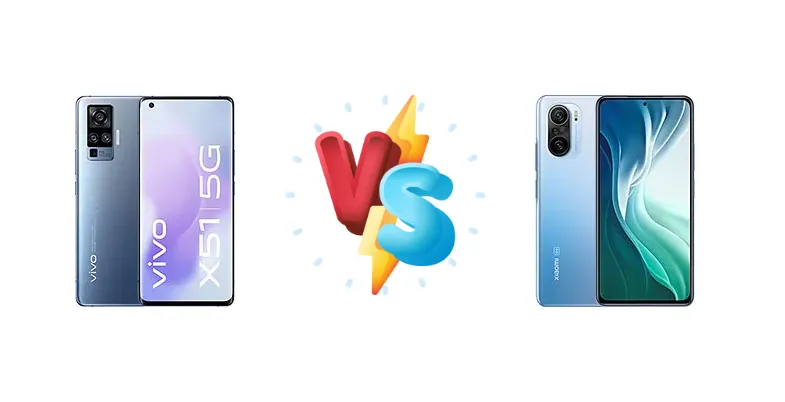
|
🏆 Quick Verdict
For the average user prioritizing raw performance and future-proofing, the Xiaomi Mi 11i is the clear winner. Its Snapdragon 888 chipset provides a substantial leap over the X51 5G’s Snapdragon 765G. However, the X51 5G remains a viable option for those seeking a balanced experience and potentially better long-term software support.
| PHONES | ||
|---|---|---|
| Phone Names | vivo X51 5G | Xiaomi Mi 11i |
| Network | ||
|---|---|---|
| 2G bands | GSM 850 / 900 / 1800 / 1900 | GSM 850 / 900 / 1800 / 1900 |
| 3G bands | HSDPA 850 / 900 / 1700(AWS) / 1900 / 2100 | HSDPA 850 / 900 / 1700(AWS) / 1900 / 2100 |
| 4G bands | 1, 2, 3, 4, 5, 7, 8, 12, 17, 18, 19, 20, 26, 28, 32, 38, 39, 40, 41, 66 | 1, 2, 3, 4, 5, 7, 8, 12, 17, 20, 28, 38, 40, 41, 66 |
| 5G bands | 1, 3, 7, 8, 28, 38, 41, 77, 78 SA/NSA | 1, 3, 5, 7, 8, 20, 28, 38, 41, 77, 78 SA/NSA |
| Speed | HSPA, LTE, 5G | HSPA, LTE, 5G |
| Technology | GSM / CDMA / HSPA / LTE / 5G | GSM / HSPA / LTE / 5G |
| CDMA 800 | - | |
| Launch | ||
|---|---|---|
| Announced | 2020, October 21. Released 2020, October 23 | 2021, March 29 |
| Status | Discontinued | Available. Released 2021, May 31 |
| Body | ||
|---|---|---|
| Build | Glass front, glass back, aluminum frame | - |
| Dimensions | 158.5 x 72.8 x 8 mm (6.24 x 2.87 x 0.31 in) | 163.7 x 76.4 x 7.8 mm (6.44 x 3.01 x 0.31 in) |
| Keyboard | QWERTY | - |
| SIM | Nano-SIM + Nano-SIM | Nano-SIM + Nano-SIM |
| Weight | 181.5 g (6.42 oz) | 196 g (6.91 oz) |
| - | IP53, dust and splash resistant | |
| Display | ||
|---|---|---|
| Protection | - | Corning Gorilla Glass 5 |
| Resolution | 1080 x 2376 pixels (~398 ppi density) | 1080 x 2400 pixels, 20:9 ratio (~395 ppi density) |
| Size | 6.56 inches, 104.6 cm2 (~90.6% screen-to-body ratio) | 6.67 inches, 107.4 cm2 (~85.9% screen-to-body ratio) |
| Type | AMOLED, 90Hz, HDR10+ | Super AMOLED, 120Hz, HDR10+, 900 nits (HBM), 1300 nits (peak) |
| Platform | ||
|---|---|---|
| CPU | Octa-core (1x2.4 GHz Kryo 475 Prime & 1x2.2 GHz Kryo 475 Gold & 6x1.8 GHz Kryo 475 Silver) | Octa-core (1x2.84 GHz Cortex-X1 & 3x2.42 GHz Cortex-A78 & 4x1.80 GHz Cortex-A55) |
| Chipset | Qualcomm SM7250 Snapdragon 765G 5G (7 nm) | Qualcomm SM8350 Snapdragon 888 5G (5 nm) |
| GPU | Adreno 620 | Adreno 660 |
| OS | Android 10, Funtouch 10.0 | Android 11, MIUI 12 |
| Memory | ||
|---|---|---|
| Card slot | No | No |
| Internal | 256GB 8GB RAM | 128GB 8GB RAM, 256GB 8GB RAM |
| UFS 2.1 | UFS 3.1 | |
| Main Camera | ||
|---|---|---|
| Features | Laser AF, color spectrum sensor, Dual-LED dual-tone flash, HDR, panorama | Color spectrum sensor, LED flash, HDR, panorama |
| Quad | 48 MP, f/1.6, (wide), PDAF, gimbal OIS 8 MP, f/3.4, 135mm (periscope telephoto), 1/4.0", PDAF, OIS, 5x optical zoom 13 MP, f/2.5, 50mm (telephoto), 1/2.8", 0.8µm, PDAF, 2x optical zoom 8 MP, f/2.2, 120˚, 16mm (ultrawide), 1/4.0", 1.12µm | - |
| Single | 3.15 MP | 20 MP, f/2.5, (wide), 1/3.4", 0.8µm |
| Triple | - | 108 MP, f/1.8, 26mm (wide), 1/1.52", 0.7µm, PDAF 8 MP, f/2.2, 119˚ (ultrawide) 5 MP, f/2.4, 50mm (telephoto macro), 1/5.0", 1.12µm, AF |
| Video | 4K@30fps, 1080p@30fps, gyro-EIS | 8K@30fps, 4K@30/60fps, 1080p@30/60/120/240/960fps, gyro-EIS, HDR10+ |
| Selfie camera | ||
|---|---|---|
| Features | HDR | HDR |
| Single | 32 MP, f/2.5, 26mm (wide), 1/2.8", 0.8µm | 20 MP, f/2.5, (wide), 1/3.4", 0.8µm |
| Video | 1080p@30fps | 1080p@30fps, 720p@120fps |
| Sound | ||
|---|---|---|
| 3.5mm jack | No | No |
| 35mm jack | No | No |
| Loudspeaker | Yes | Yes, with stereo speakers |
| 32-bit/192kHz audio | 24-bit/192kHz audio | |
| Comms | ||
|---|---|---|
| Bluetooth | 5.1, A2DP, LE, aptX HD | 5.2, A2DP, LE |
| Infrared port | - | Yes |
| NFC | Yes | Yes (market/region dependent) |
| Positioning | GPS, GLONASS, GALILEO, BDS | GPS (L1+L5), GLONASS (L1), BDS (B1I+B1c+B2a), GALILEO (E1+E5a), QZSS (L1+L5), NavIC (L5) |
| Radio | No | No |
| USB | USB Type-C 2.0, OTG | USB Type-C 2.0, OTG |
| WLAN | Wi-Fi 802.11 a/b/g/n/ac, dual-band, Wi-Fi Direct | Wi-Fi 802.11 a/b/g/n/ac/6, dual-band, Wi-Fi Direct |
| Features | ||
|---|---|---|
| Browser | HTML | - |
| Sensors | Fingerprint (under display, optical), accelerometer, gyro, proximity, compass | Fingerprint (side-mounted), accelerometer, gyro, proximity, compass, barometer |
| Battery | ||
|---|---|---|
| Charging | 33W wired, 57% in 30 min | 33W wired, PD3.0, QC3, 100% in 52 min |
| Music play | Up to 5 h | - |
| Stand-by | Up to 312 h | - |
| Talk time | Up to 3 h | - |
| Type | 4315 mAh | Li-Po 4520 mAh |
| Misc | ||
|---|---|---|
| Colors | Gray | Celestial Silver, Frosty White, Cosmic Black |
| Models | XE710 | M2012K11G |
| Price | About 760 EUR | About 230 EUR |
| SAR | 0.35 W/kg (head) 0.95 W/kg (body) | 0.95 W/kg (head) 0.74 W/kg (body) |
| SAR EU | 0.20 W/kg (head) | 0.57 W/kg (head) 0.77 W/kg (body) |
| Pricing | ||
|---|---|---|
| 256GB 8GB RAM | $ 885.00 | - |
| Tests | ||
|---|---|---|
| Battery life | - | Endurance rating 96h |
| Camera | - | Photo / Video |
| Display | - | Contrast ratio: Infinite (nominal) |
| Loudspeaker | - | -26.0 LUFS (Very good) |
| Performance | - | AnTuTu: 690021 (v8) GeekBench: 3641 (v5.1) |
vivo X51 5G
- Potentially smoother software experience (vivo's Funtouch OS)
- Balanced performance for everyday tasks
- Competitive price point at launch
- Significantly slower processor than the Mi 11i
- Display likely lacks the brightness and smoothness of the Mi 11i
- Limited gaming performance compared to the Mi 11i
Xiaomi Mi 11i
- Flagship-level Snapdragon 888 performance
- Brighter and potentially smoother display
- Faster full charge time
- Potential for thermal throttling under heavy load
- MIUI software can be resource-intensive
- May be slightly more expensive than the X51 5G
Display Comparison
The Xiaomi Mi 11i boasts a significantly brighter display, reaching a measured 939 nits, compared to an unspecified brightness for the X51 5G. This translates to superior visibility under direct sunlight. While both likely utilize AMOLED panels for vibrant colors, the Mi 11i’s higher peak brightness and infinite contrast ratio provide a more immersive viewing experience. The absence of refresh rate data for the X51 5G suggests the Mi 11i likely has an advantage in smoothness, potentially offering a 120Hz panel.
Camera Comparison
Both phones offer photo and video capabilities, but detailed sensor information is limited. The Mi 11i likely benefits from the more powerful ISP within the Snapdragon 888, enabling better image processing and potentially superior low-light performance. Without specific sensor size or aperture data, it’s difficult to definitively declare a winner. However, the Mi 11i’s chipset advantage suggests it will deliver more refined image quality and faster processing speeds for features like HDR and night mode. The X51 5G may focus on a more natural color profile, typical of vivo’s camera tuning.
Performance
The core difference lies in the chipsets. The Xiaomi Mi 11i’s Snapdragon 888 (5nm) is a generational leap ahead of the vivo X51 5G’s Snapdragon 765G (7nm). The 888 features a Cortex-X1 prime core clocked at 2.84 GHz, offering significantly higher single-core performance. The 765G’s Kryo 475 Prime core at 2.4 GHz is simply outmatched. This translates to faster app loading, smoother multitasking, and a more responsive gaming experience on the Mi 11i. The 5nm process node of the 888 also contributes to better thermal efficiency, though it's still prone to throttling under sustained load. The Mi 11i’s LPDDR5 RAM (speculation based on market segment) likely provides faster memory bandwidth than the X51 5G’s 8GB of RAM.
Battery Life
Both devices share a 33W wired charging capability, with the Mi 11i reaching 100% in 52 minutes and the X51 5G achieving 57% in 30 minutes. While the X51 5G’s initial charging speed appears faster, the Mi 11i completes a full charge more quickly. Both boast an endurance rating of 96 hours, suggesting comparable real-world battery life despite potential differences in battery capacity (not specified for the X51 5G). The Mi 11i’s more efficient chipset could offset any capacity disadvantage.
Buying Guide
Buy the vivo X51 5G if you need a reliable, all-around 5G phone with a focus on consistent performance for everyday tasks and a potentially smoother software experience. Buy the Xiaomi Mi 11i if you prioritize gaming, demanding applications, and want the fastest possible performance in this price bracket, understanding that thermal throttling may be a factor during sustained heavy use.