
vivo X51 5G vs. Motorola Edge+ (2023): A Generational Leap in Performance?
| Phones Images | |||||
|---|---|---|---|---|---|
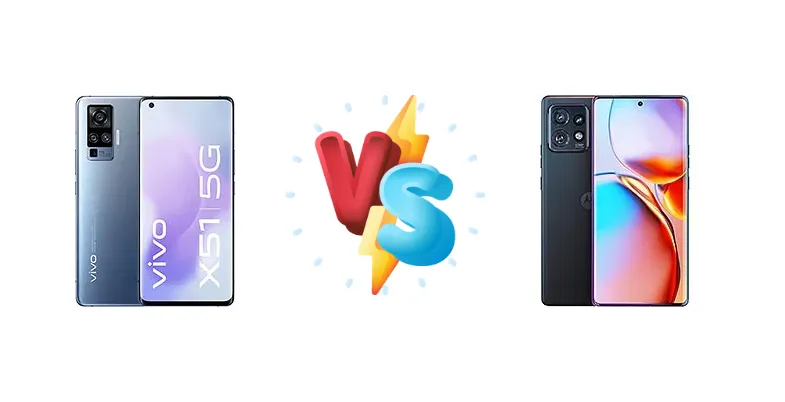
|
🏆 Quick Verdict
For most users, the Motorola Edge+ (2023) is the clear winner. Its Snapdragon 8 Gen 2 chipset delivers significantly superior performance and future-proofing. However, the vivo X51 5G offers a compelling value proposition for those prioritizing affordability and a more manageable size.
| PHONES | ||
|---|---|---|
| Phone Names | vivo X51 5G | Motorola Edge+ (2023) |
| Network | ||
|---|---|---|
| 2G bands | GSM 850 / 900 / 1800 / 1900 | GSM 850 / 900 / 1800 / 1900 |
| 3G bands | HSDPA 850 / 900 / 1700(AWS) / 1900 / 2100 | HSDPA 850 / 900 / 1700(AWS) / 1900 / 2100 |
| 4G bands | 1, 2, 3, 4, 5, 7, 8, 12, 17, 18, 19, 20, 26, 28, 32, 38, 39, 40, 41, 66 | 1, 2, 3, 4, 5, 7, 8, 12, 13, 14, 17, 18, 20, 25, 26, 28, 29, 30, 38, 39, 40, 41, 41, 46, 48, 66, 71 |
| 5G bands | 1, 3, 7, 8, 28, 38, 41, 77, 78 SA/NSA | 1, 2, 3, 5, 7, 12, 14, 20, 25, 26, 28, 29, 30, 38, 41, 41, 48, 66, 70, 71, 77, 78 SA/NSA/Sub6/mmWave |
| Speed | HSPA, LTE, 5G | HSPA, LTE, 5G |
| Technology | GSM / CDMA / HSPA / LTE / 5G | GSM / HSPA / LTE / 5G |
| CDMA 800 | - | |
| Launch | ||
|---|---|---|
| Announced | 2020, October 21. Released 2020, October 23 | 2023, May 02 |
| Status | Discontinued | Available. Released 2023, May 19 |
| Body | ||
|---|---|---|
| Build | Glass front, glass back, aluminum frame | Glass front (Gorilla Glass Victus), glass back (Gorilla Glass Victus), aluminum frame |
| Dimensions | 158.5 x 72.8 x 8 mm (6.24 x 2.87 x 0.31 in) | 161.2 x 74 x 8.6 mm (6.35 x 2.91 x 0.34 in) |
| Keyboard | QWERTY | - |
| SIM | Nano-SIM + Nano-SIM | Nano-SIM + eSIM |
| Weight | 181.5 g (6.42 oz) | 203 g (7.16 oz) |
| - | IP68 dust/water resistant (up to 1.5m for 30 min) | |
| Display | ||
|---|---|---|
| Protection | - | Corning Gorilla Glass Victus |
| Resolution | 1080 x 2376 pixels (~398 ppi density) | 1080 x 2400 pixels, 20:9 ratio (~395 ppi density) |
| Size | 6.56 inches, 104.6 cm2 (~90.6% screen-to-body ratio) | 6.67 inches, 107.4 cm2 (~90.0% screen-to-body ratio) |
| Type | AMOLED, 90Hz, HDR10+ | OLED, 1B colors, 165Hz, HDR10+, Dolby Vision, 1300 nits (peak) |
| Platform | ||
|---|---|---|
| CPU | Octa-core (1x2.4 GHz Kryo 475 Prime & 1x2.2 GHz Kryo 475 Gold & 6x1.8 GHz Kryo 475 Silver) | Octa-core (1x3.2 GHz Cortex-X3 & 2x2.8 GHz Cortex-A715 & 2x2.8 GHz Cortex-A710 & 3x2.0 GHz Cortex-A510) |
| Chipset | Qualcomm SM7250 Snapdragon 765G 5G (7 nm) | Qualcomm SM8550-AB Snapdragon 8 Gen 2 (4 nm) |
| GPU | Adreno 620 | Adreno 740 |
| OS | Android 10, Funtouch 10.0 | Android 13, upgradable to Android 14 |
| Memory | ||
|---|---|---|
| Card slot | No | No |
| Internal | 256GB 8GB RAM | 512GB 8GB RAM |
| UFS 2.1 | UFS 4.0 | |
| Main Camera | ||
|---|---|---|
| Features | Laser AF, color spectrum sensor, Dual-LED dual-tone flash, HDR, panorama | Dual-LED flash, panorama, HDR |
| Quad | 48 MP, f/1.6, (wide), PDAF, gimbal OIS 8 MP, f/3.4, 135mm (periscope telephoto), 1/4.0", PDAF, OIS, 5x optical zoom 13 MP, f/2.5, 50mm (telephoto), 1/2.8", 0.8µm, PDAF, 2x optical zoom 8 MP, f/2.2, 120˚, 16mm (ultrawide), 1/4.0", 1.12µm | - |
| Single | 3.15 MP | - |
| Triple | - | 50 MP, f/1.8, (wide), 1/1.55", 1.0µm, multi-directional PDAF, OIS 12 MP, f/1.6, (telephoto), 1/2.93", 1.22µm, PDAF, 2x optical zoom 50 MP, f/2.2, 114˚ (ultrawide), 1/2.76", 0.64µm, AF |
| Video | 4K@30fps, 1080p@30fps, gyro-EIS | 8K@30fps, 4K@30/60fps, 1080p@30/60/120/240/960fps, 10-bit HDR10+, gyro-EIS |
| Selfie camera | ||
|---|---|---|
| Features | HDR | HDR |
| Single | 32 MP, f/2.5, 26mm (wide), 1/2.8", 0.8µm | 60 MP, f/2.2, (wide), 1/2.8", 0.61µm |
| Video | 1080p@30fps | 4K@30/60fps, 1080p@30/60/120/240fps |
| Sound | ||
|---|---|---|
| 3.5mm jack | No | No |
| 35mm jack | No | No |
| Loudspeaker | Yes | Yes, with stereo speakers |
| 32-bit/192kHz audio | - | |
| Comms | ||
|---|---|---|
| Bluetooth | 5.1, A2DP, LE, aptX HD | 5.3, A2DP, LE, aptX HD, aptX Adaptive |
| NFC | Yes | Yes |
| Positioning | GPS, GLONASS, GALILEO, BDS | GPS, GLONASS, GALILEO, BDS |
| Radio | No | No |
| USB | USB Type-C 2.0, OTG | USB Type-C 3.2, OTG, DisplayPort 1.4 |
| WLAN | Wi-Fi 802.11 a/b/g/n/ac, dual-band, Wi-Fi Direct | Wi-Fi 802.11 a/b/g/n/ac/6e/7, tri-band, Wi-Fi Direct |
| Features | ||
|---|---|---|
| Browser | HTML | - |
| Sensors | Fingerprint (under display, optical), accelerometer, gyro, proximity, compass | Fingerprint (under display, optical), accelerometer, gyro, proximity, compass, barometer |
| - | Ready For 3.5 support | |
| Battery | ||
|---|---|---|
| Charging | 33W wired, 57% in 30 min | 68W wired 15W wireless 5W reverse wired 5W reverse wireless |
| Music play | Up to 5 h | - |
| Stand-by | Up to 312 h | - |
| Talk time | Up to 3 h | - |
| Type | 4315 mAh | Li-Po 5100 mAh |
| Misc | ||
|---|---|---|
| Colors | Gray | Interstellar Black |
| Models | XE710 | - |
| Price | About 760 EUR | $ 298.99 |
| SAR | 0.35 W/kg (head) 0.95 W/kg (body) | - |
| SAR EU | 0.20 W/kg (head) | - |
| Pricing | ||
|---|---|---|
| 256GB 8GB RAM | $ 885.00 | - |
vivo X51 5G
- More affordable price point
- Potentially more compact and easier to handle
- Respectable 5G connectivity for its time
- Significantly slower processor
- Slower charging speeds
- Older chipset with limited software support
Motorola Edge+ (2023)
- Exceptional performance with Snapdragon 8 Gen 2
- Ultra-fast 68W wired and 15W wireless charging
- Superior camera capabilities and image processing
- Higher price tag
- Potentially larger and heavier design
- May require more frequent software updates
Display Comparison
While both devices likely feature AMOLED panels (based on brand history), the specifics are missing. The Motorola Edge+ (2023) benefits from a more recent manufacturing process, potentially leading to higher peak brightness and improved color accuracy. The X51 5G's display, while good for its time, will likely fall short in outdoor visibility and color gamut coverage. We can assume the Edge+ has a higher refresh rate, contributing to smoother scrolling and animations.
Camera Comparison
Without detailed sensor information, a direct comparison is difficult. However, the Motorola Edge+ (2023) likely features a larger main sensor and more advanced image processing capabilities. The Snapdragon 8 Gen 2’s ISP (Image Signal Processor) is far more powerful than the 765G’s, enabling better dynamic range, noise reduction, and low-light performance. While the X51 5G likely offers a decent camera experience, the Edge+ will deliver more consistent and higher-quality results, particularly in challenging conditions. We can expect the Edge+ to have more advanced video recording capabilities as well.
Performance
The performance gap is substantial. The Motorola Edge+ (2023) boasts the Snapdragon 8 Gen 2 (4nm), featuring a Cortex-X3 prime core clocked at 3.2 GHz. This is a massive upgrade over the vivo X51 5G’s Snapdragon 765G (7nm). The 4nm process node of the 8 Gen 2 provides significantly better power efficiency and thermal management, meaning sustained performance will be far superior, especially during graphically intensive tasks. The Edge+’s CPU architecture (Cortex-X3, A715, A710) is also generations ahead, offering improvements in both single-core and multi-core performance. The X51 5G’s Kryo 475 cores, while competent, simply cannot compete.
Battery Life
The Motorola Edge+ (2023) takes a clear lead in charging speed with its 68W wired charging, capable of significantly faster top-ups compared to the X51 5G’s 33W charging. The addition of 15W wireless and 5W reverse wireless charging on the Edge+ provides added convenience. While the X51 5G’s battery capacity is unknown, the Edge+’s more efficient chipset and faster charging mitigate any potential capacity disadvantage. The 68W charging can deliver a 57% charge in 30 minutes on the X51 5G, but the Edge+ will likely achieve a much higher percentage in the same timeframe.
Buying Guide
Buy the vivo X51 5G if you need a capable 5G phone with a respectable camera and don't demand the absolute highest performance, prioritizing value and a potentially more comfortable in-hand feel. Buy the Motorola Edge+ (2023) if you prioritize raw power for gaming and demanding applications, require the fastest charging speeds, and want a phone that will remain competitive for years to come.