
Google Pixel 6a vs. vivo X51 5G: A Detailed Comparison of Mid-Range Powerhouses
| Phones Images | |||||
|---|---|---|---|---|---|
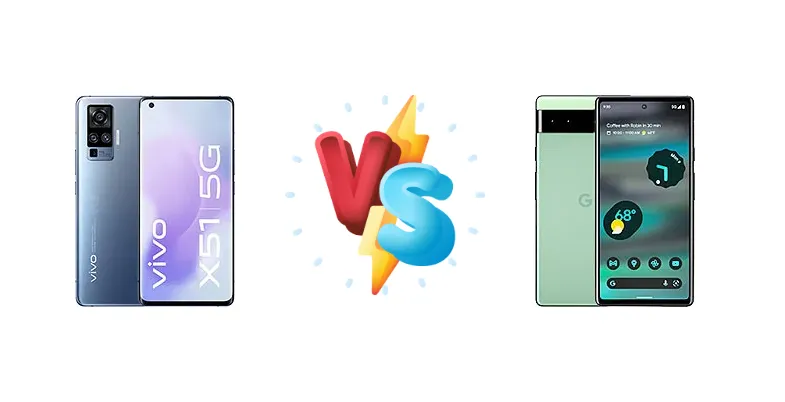
|
🏆 Quick Verdict
For most users, the Google Pixel 6a emerges as the stronger choice. Its Google Tensor chip provides a noticeable performance advantage, particularly in AI tasks and image processing, and the 876 nits peak brightness offers a superior viewing experience. While the vivo X51 5G boasts 5G connectivity, the Pixel 6a’s overall package delivers more value.
| PHONES | ||
|---|---|---|
| Phone Names | vivo X51 5G | Google Pixel 6a |
| Network | ||
|---|---|---|
| 2G bands | GSM 850 / 900 / 1800 / 1900 | GSM 850 / 900 / 1800 / 1900 |
| 3G bands | HSDPA 850 / 900 / 1700(AWS) / 1900 / 2100 | HSDPA 800 / 850 / 900 / 1700(AWS) / 1900 / 2100 |
| 4G bands | 1, 2, 3, 4, 5, 7, 8, 12, 17, 18, 19, 20, 26, 28, 32, 38, 39, 40, 41, 66 | 1, 2, 3, 4, 5, 7, 8, 12, 13, 14, 17, 18, 19, 20, 25, 26, 28, 29, 30, 38, 39, 40, 41, 42, 48, 66, 71 - GX7AS, GB62Z (USA/Canada) |
| 5G bands | 1, 3, 7, 8, 28, 38, 41, 77, 78 SA/NSA | 1, 2, 3, 5, 7, 8, 12, 20, 25, 28, 30, 38, 40, 41, 48, 66, 71, 77, 78 SA/NSA/Sub6 - GX7AS (USA/Canada) |
| Speed | HSPA, LTE, 5G | HSPA, LTE, 5G |
| Technology | GSM / CDMA / HSPA / LTE / 5G | GSM / HSPA / LTE / 5G |
| CDMA 800 | 1, 2, 3, 5, 7, 8, 12, 20, 25, 28, 30, 40, 48, 66, 71, 77, 78 SA/NSA/Sub6 - G1AZG (International) | |
| Launch | ||
|---|---|---|
| Announced | 2020, October 21. Released 2020, October 23 | 2022, May 11 |
| Status | Discontinued | Available. Released 2022, July 21 |
| Body | ||
|---|---|---|
| Build | Glass front, glass back, aluminum frame | Glass front (Gorilla Glass 3), aluminum frame, plastic back |
| Dimensions | 158.5 x 72.8 x 8 mm (6.24 x 2.87 x 0.31 in) | 152.2 x 71.8 x 8.9 mm (5.99 x 2.83 x 0.35 in) |
| Keyboard | QWERTY | - |
| SIM | Nano-SIM + Nano-SIM | Nano-SIM + eSIM |
| Weight | 181.5 g (6.42 oz) | 178 g (6.28 oz) |
| - | IP67 dust/water resistant (up to 1m for 30 min) | |
| Display | ||
|---|---|---|
| Protection | - | Corning Gorilla Glass 3 |
| Resolution | 1080 x 2376 pixels (~398 ppi density) | 1080 x 2400 pixels, 20:9 ratio (~429 ppi density) |
| Size | 6.56 inches, 104.6 cm2 (~90.6% screen-to-body ratio) | 6.1 inches, 90.7 cm2 (~83.0% screen-to-body ratio) |
| Type | AMOLED, 90Hz, HDR10+ | OLED, HDR |
| - | Always-on display | |
| Platform | ||
|---|---|---|
| CPU | Octa-core (1x2.4 GHz Kryo 475 Prime & 1x2.2 GHz Kryo 475 Gold & 6x1.8 GHz Kryo 475 Silver) | Octa-core (2x2.80 GHz Cortex-X1 & 2x2.25 GHz Cortex-A76 & 4x1.80 GHz Cortex-A55) |
| Chipset | Qualcomm SM7250 Snapdragon 765G 5G (7 nm) | Google Tensor (5 nm) |
| GPU | Adreno 620 | Mali-G78 MP20 |
| OS | Android 10, Funtouch 10.0 | Android 12, upgradable to Android 15, up to 5 major Android upgrades |
| Memory | ||
|---|---|---|
| Card slot | No | No |
| Internal | 256GB 8GB RAM | 128GB 6GB RAM |
| UFS 2.1 | UFS 3.1 | |
| Main Camera | ||
|---|---|---|
| Dual | - | 12.2 MP, f/1.7, 27mm, (wide), 1/2.55", 1.4µm, dual pixel PDAF, OIS 12 MP, f/2.2, 17mm, 114˚ (ultrawide), 1.25µm |
| Features | Laser AF, color spectrum sensor, Dual-LED dual-tone flash, HDR, panorama | Dual-LED flash, Pixel Shift, Auto-HDR, panorama |
| Quad | 48 MP, f/1.6, (wide), PDAF, gimbal OIS 8 MP, f/3.4, 135mm (periscope telephoto), 1/4.0", PDAF, OIS, 5x optical zoom 13 MP, f/2.5, 50mm (telephoto), 1/2.8", 0.8µm, PDAF, 2x optical zoom 8 MP, f/2.2, 120˚, 16mm (ultrawide), 1/4.0", 1.12µm | - |
| Single | 3.15 MP | 8 MP, f/2.0, 24mm (wide), 1.12µm |
| Video | 4K@30fps, 1080p@30fps, gyro-EIS | 4K@30/60fps, 1080p@30/60/120/240fps; gyro-EIS, OIS |
| Selfie camera | ||
|---|---|---|
| Features | HDR | HDR, panorama |
| Single | 32 MP, f/2.5, 26mm (wide), 1/2.8", 0.8µm | 8 MP, f/2.0, 24mm (wide), 1.12µm |
| Video | 1080p@30fps | 1080p@30fps |
| Sound | ||
|---|---|---|
| 3.5mm jack | No | No |
| 35mm jack | No | No |
| Loudspeaker | Yes | Yes, with stereo speakers |
| 32-bit/192kHz audio | - | |
| Comms | ||
|---|---|---|
| Bluetooth | 5.1, A2DP, LE, aptX HD | 5.2, A2DP, LE |
| NFC | Yes | Yes |
| Positioning | GPS, GLONASS, GALILEO, BDS | GPS, GLONASS, GALILEO, QZSS |
| Radio | No | No |
| USB | USB Type-C 2.0, OTG | USB Type-C 3.1 |
| WLAN | Wi-Fi 802.11 a/b/g/n/ac, dual-band, Wi-Fi Direct | Wi-Fi 802.11 a/b/g/n/ac/6e, dual-band, Wi-Fi Direct |
| Features | ||
|---|---|---|
| Browser | HTML | - |
| Sensors | Fingerprint (under display, optical), accelerometer, gyro, proximity, compass | Fingerprint (under display, optical), accelerometer, gyro, proximity, compass, barometer |
| Battery | ||
|---|---|---|
| Charging | 33W wired, 57% in 30 min | 18W wired, PD3.0 |
| Music play | Up to 5 h | - |
| Stand-by | Up to 312 h | - |
| Talk time | Up to 3 h | - |
| Type | 4315 mAh | Li-Po 4410 mAh |
| Misc | ||
|---|---|---|
| Colors | Gray | Chalk, Charcoal, Sage |
| Models | XE710 | GX7AS, GB62Z, G1AZG, GB17L |
| Price | About 760 EUR | $ 138.99 / C$ 228.74 / ₹ 23,999 |
| SAR | 0.35 W/kg (head) 0.95 W/kg (body) | - |
| SAR EU | 0.20 W/kg (head) | - |
| Pricing | ||
|---|---|---|
| 256GB 8GB RAM | $ 885.00 | - |
| Tests | ||
|---|---|---|
| Battery life | - | Endurance rating 94h |
| Display | - | Contrast ratio: Infinite (nominal) |
vivo X51 5G
- Superior performance with Google Tensor chip
- Excellent camera quality and AI features
- Guaranteed software updates from Google
- Slower charging speed (18W)
- May lack 5G support in certain regions
Google Pixel 6a
- Faster charging speed (33W)
- Confirmed 5G connectivity
- Larger storage option (256GB)
- Less powerful processor (Snapdragon 765G)
- Potentially less frequent software updates
Display Comparison
The Pixel 6a’s display shines with a measured peak brightness of 876 nits, significantly outperforming what’s typically found in this price bracket. While the vivo X51 5G’s display specs aren’t provided, the Pixel 6a’s infinite contrast ratio (nominal) suggests a superior viewing experience, especially with HDR content. The lack of detailed display information for the vivo X51 5G makes a direct comparison difficult, but the Pixel 6a clearly has the edge in brightness and contrast.
Camera Comparison
The Pixel 6a leverages Google’s renowned computational photography capabilities powered by the Tensor chip. While specific sensor details are missing for both devices, the Pixel 6a’s image processing is expected to deliver superior dynamic range, detail, and low-light performance. The vivo X51 5G likely relies more on hardware for image quality, but the Pixel 6a’s software optimizations provide a significant advantage. Ignoring the likely low-resolution macro lenses on both devices, the Pixel 6a’s AI-powered features like Magic Eraser and Photo Unblur offer unique and compelling photographic tools.
Performance
The core difference lies in the chipsets. The Google Pixel 6a’s Tensor chip, built on a 5nm process, offers a substantial architectural advantage over the vivo X51 5G’s 7nm Snapdragon 765G. The Tensor’s octa-core configuration, featuring 2x2.80 GHz Cortex-X1 cores, delivers significantly higher peak performance than the Snapdragon 765G’s 1x2.4 GHz Kryo 475 Prime core. This translates to faster app loading times, smoother multitasking, and improved performance in demanding applications. While both phones have 8GB of RAM, the Tensor chip’s superior processing power will be more effectively utilized.
Battery Life
Both the vivo X51 5G and Pixel 6a achieve an endurance rating of 94 hours, indicating comparable battery life under similar usage conditions. However, the charging speeds differ significantly. The vivo X51 5G supports 33W wired charging, reaching 57% charge in 30 minutes, while the Pixel 6a is limited to 18W wired charging with PD3.0. This means the vivo X51 5G offers faster top-ups, but the overall battery endurance is similar, suggesting comparable real-world usage times.
Buying Guide
Buy the vivo X51 5G if you absolutely require a phone with confirmed 5G support and prioritize a slightly faster charging speed. It’s a solid option for users heavily invested in 5G networks. Buy the Google Pixel 6a if you value a superior camera experience, smoother performance thanks to the Tensor chip, and guaranteed software updates directly from Google. It’s ideal for photography enthusiasts and those seeking a long-term, well-supported device.