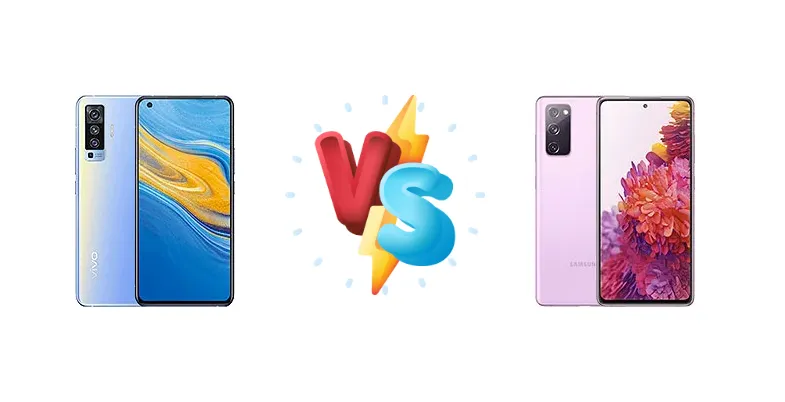
The vivo X50 and the Samsung Galaxy S20 FE 2022 represent compelling options in the mid-range smartphone market. The X50, while older, offers a sleek design and a focus on camera capabilities. The S20 FE 2022, benefiting from a later release, boasts a significantly more powerful processor, but at what cost? This comparison dives deep into the specifications and real-world implications to determine which device delivers the best overall experience.
🏆 Quick Verdict
For most users, the Samsung Galaxy S20 FE 2022 is the superior choice. Its Snapdragon 865 chipset provides a substantial performance advantage over the vivo X50’s Snapdragon 730, translating to smoother multitasking, faster app loading, and a better gaming experience. While the X50 has a respectable camera, the S20 FE’s overall package offers more future-proofing and versatility.
| Network |
|---|
| 2G bands | GSM 850 / 900 / 1800 / 1900 | GSM 850 / 900 / 1800 / 1900 |
| 3G bands | HSDPA 900 / 2100 | HSDPA 850 / 900 / 1700(AWS) / 1900 / 2100 |
| 4G bands | 1, 3, 5, 8, 40 | LTE |
| 5G bands | - | SA/NSA/Sub6 |
| Speed | HSPA, LTE | HSPA 42.2/5.76 Mbps, LTE (5CA) Cat19 1800/200 Mbps, 5G |
| Technology | GSM / HSPA / LTE | GSM / CDMA / HSPA / EVDO / LTE / 5G |
| | - | CDMA2000 1xEV-DO |
| Launch |
|---|
| Announced | 2020, July 07. Released 2020, July 16 | 2022, April 01 |
| Status | Discontinued | Available. Released 2022, April 01 |
| Body |
|---|
| Build | Glass front, glass back, aluminum frame | Glass front (Gorilla Glass 3), plastic back, aluminum frame |
| Dimensions | 159.5 x 75.4 x 7.6 mm (6.28 x 2.97 x 0.30 in) | 159.8 x 74.5 x 8.4 mm (6.29 x 2.93 x 0.33 in) |
| SIM | Nano-SIM + Nano-SIM | Nano-SIM + Nano-SIM |
| Weight | 173 g (6.10 oz) | 190 g (6.70 oz) |
| | - | IP68 dust/water resistant (up to 1.5m for 30 min) |
| Display |
|---|
| Protection | - | Corning Gorilla Glass 3 |
| Resolution | 1080 x 2376 pixels (~398 ppi density) | 1080 x 2400 pixels, 20:9 ratio (~405 ppi density) |
| Size | 6.56 inches, 104.6 cm2 (~87.0% screen-to-body ratio) | 6.5 inches, 102.0 cm2 (~85.7% screen-to-body ratio) |
| Type | AMOLED, 90Hz, HDR10+ | Super AMOLED, 120Hz, HDR10+ |
| | - | Always-on display |
| Platform |
|---|
| CPU | Octa-core (2x2.2 GHz Kryo 470 Gold & 6x1.8 GHz Kryo 470 Silver) | Octa-core (1x2.84 GHz Cortex-A77 & 3x2.42 GHz Cortex-A77 & 4x1.80 GHz Cortex-A55) |
| Chipset | Qualcomm SDM730 Snapdragon 730 (8 nm) | Qualcomm SM8250 Snapdragon 865 5G (7 nm+) |
| GPU | Adreno 618 | Adreno 650 |
| OS | Android 10, Funtouch 10.5 | Android 12, One UI 4.1 |
| Memory |
|---|
| Card slot | No | microSDXC (uses shared SIM slot) |
| Internal | 128GB 8GB RAM, 256GB 8GB RAM | 128GB 6GB RAM |
| | UFS 2.1 | UFS 3.1 |
| Main Camera |
|---|
| Features | Color spectrum sensor, Dual-LED dual-tone flash, HDR, panorama | LED flash, auto-HDR, panorama |
| Quad | 48 MP, f/1.6, (wide), PDAF, OIS
13 MP, f/2.5, 50mm (telephoto), 1/2.8", 0.8µm, PDAF, 2x optical zoom
8 MP, f/2.2, 120˚, 16mm (ultrawide), 1/4.0", 1.12µm
5 MP (macro) | - |
| Single | 5 MP, AF | - |
| Triple | - | 12 MP, f/1.8, 26mm (wide), 1/1.76", 1.8µm, dual pixel PDAF, OIS
8 MP, f/2.4, 76mm (telephoto), 1/4.5", 1.0µm, PDAF, OIS, 3x optical zoom
12 MP, f/2.2, 13mm, 123˚ (ultrawide), 1/3.0", 1.12µm |
| Video | 4K@30fps, 1080p@30fps, gyro-EIS | 4K@30/60fps, 1080p@30/60fps, gyro-EIS |
| Selfie camera |
|---|
| Features | HDR | HDR |
| Single | 32 MP, f/2.5, 26mm (wide), 1/2.8", 0.8µm | 32 MP, f/2.2, 26mm (wide), 1/2.74", 0.8µm |
| Video | 1080p@30fps | 4K@30/60fps, 1080p@30/60fps, gyro-EIS |
| Sound |
|---|
| 3.5mm jack | No | No |
| 35mm jack | No | No |
| Loudspeaker | Yes | Yes, with stereo speakers |
| | 24-bit/192kHz audio | 32-bit/384kHz audio
Tuned by AKG |
| Comms |
|---|
| Bluetooth | 5.1, A2DP, LE, aptX HD | 5.0, A2DP, LE |
| NFC | Yes | Yes |
| Positioning | GPS, GLONASS, GALILEO, BDS | GPS, GLONASS, BDS, GALILEO |
| Radio | No | No |
| USB | USB Type-C, OTG | USB Type-C 3.2, OTG |
| WLAN | Wi-Fi 802.11 a/b/g/n/ac, dual-band, Wi-Fi Direct | Wi-Fi 802.11 a/b/g/n/ac/6, dual-band, Wi-Fi Direct |
| Features |
|---|
| Sensors | Fingerprint (under display, optical), accelerometer, gyro, compass | Fingerprint (under display, optical), accelerometer, gyro, compass |
| | Virtual proximity sensing | Virtual proximity sensing
Bixby natural language commands and dictation
Samsung Pay (Visa, MasterCard certified) |
| Battery |
|---|
| Charging | 33W wired | 25W wired, PD3.0
15W wireless (Qi)
4.5W reverse wireless |
| Stand-by | Up to 570 h (2G) / Up to 420 h (3G) | - |
| Talk time | Up to 17 h 50 min (2G) / Up to 8 h 20 min (3G) | - |
| Type | 4200 mAh | Li-Ion 4500 mAh |
| Misc |
|---|
| Colors | Glaze Black, Frost Blue | Cloud White, Cloud Lavender, Cloud Navy |
| Models | 2004 | SM-G781NK, SM-G781NK22 |
| Price | About 400 EUR | About 520 EUR |
| SAR EU | 0.52 W/kg (head) | - |
| Tests |
|---|
| Audio quality |
Noise -87.8dB / Crosstalk -87.3dB | - |
| Camera |
Photo / Video | - |
| Display |
Contrast ratio: 853:1 (nominal) | - |
| Loudspeaker |
Voice 69dB / Noise 66dB / Ring 67dB | - |
vivo X50
- Sleek and lightweight design
- Capable camera system for everyday use
- Faster 33W wired charging
- Significantly less powerful Snapdragon 730 chipset
- Lacks 5G connectivity
- No wireless charging
Samsung Galaxy S20 FE 2022
- Flagship-level Snapdragon 865 performance
- 5G connectivity for faster data speeds
- Wireless and reverse wireless charging
- Slightly slower 25W wired charging
- Potentially more prone to throttling under sustained load
- Larger and heavier than the vivo X50
Display Comparison
Both phones feature AMOLED displays, but detailed specifications are limited for the X50. The S20 FE 2022 benefits from a 120Hz refresh rate (not specified for the X50), providing a noticeably smoother scrolling experience. The X50’s contrast ratio of 853:1 is respectable, but the S20 FE likely surpasses this, typical of Samsung’s AMOLED panels. While neither phone is explicitly stated to have LTPO technology, the S20 FE’s adaptive refresh rate suggests a more sophisticated display management system, potentially improving battery efficiency. Bezels are comparable, but the S20 FE’s higher resolution display (likely FHD+) offers a sharper image.
Camera Comparison
Both phones offer versatile camera systems, but the S20 FE 2022 likely holds an edge. While detailed sensor information for the X50 is limited, its focus on camera capabilities suggests a well-tuned image processing pipeline. The S20 FE’s main sensor is likely larger, benefiting low-light performance. Optical Image Stabilization (OIS) is present on both, crucial for steady videos and sharp photos. The S20 FE’s image processing benefits from Samsung’s extensive software expertise, offering features like Single Take and enhanced night mode capabilities. We’d advise ignoring the 2MP macro sensors on both phones, as their image quality is typically underwhelming.
Performance
The performance gap is the most significant differentiator. The Samsung Galaxy S20 FE 2022’s Snapdragon 865 5G (7nm+) is a flagship-tier chipset, utilizing a 1x2.84 GHz Cortex-A77 prime core, 3x2.42 GHz Cortex-A77 performance cores, and 4x1.80 GHz Cortex-A55 efficiency cores. This contrasts sharply with the vivo X50’s Snapdragon 730 (8nm), featuring a dual-core 2.2 GHz Kryo 470 Gold and a hexa-core 1.8 GHz Kryo 470 Silver configuration. The 865’s superior architecture and smaller process node translate to significantly faster CPU and GPU performance. While both phones likely utilize LPDDR4X RAM, the 865’s more efficient architecture will minimize bottlenecks. The S20 FE is also 5G capable, while the X50 is not.
Battery Life
The vivo X50 features 33W wired charging, allowing for a relatively quick top-up. The Samsung Galaxy S20 FE 2022 offers 25W wired charging with Power Delivery 3.0 (PD3.0), providing broader compatibility with chargers. The S20 FE also adds 15W wireless charging (Qi) and 4.5W reverse wireless charging, features absent on the X50. While battery capacity isn’t specified for either, the S20 FE’s more efficient chipset and potentially larger battery (based on typical Samsung implementations) likely result in comparable or better real-world battery life, despite the slightly slower wired charging speed.
Buying Guide
Buy the vivo X50 if you prioritize a lighter, more compact phone with a focus on design and a capable camera system for everyday photography. Buy the Samsung Galaxy S20 FE 2022 if you demand flagship-level performance for gaming, demanding applications, and want a phone that will remain responsive for years to come, even with software updates. The S20 FE also offers wireless charging, a feature absent on the X50.
Frequently Asked Questions
❓ Does the Snapdragon 865 in the S20 FE 2022 experience significant throttling during extended gaming sessions?
While the Snapdragon 865 is a powerful chip, it is known to generate heat under sustained load. The S20 FE 2022’s thermal management system is adequate, but some throttling is possible during prolonged gaming. However, the performance even with throttling will still significantly exceed that of the Snapdragon 730 in the vivo X50.
❓ Is the 33W charging on the vivo X50 noticeably faster than the 25W charging on the S20 FE 2022 in real-world use?
The difference in charging speed is not dramatic. While 33W is faster on paper, the S20 FE 2022’s Power Delivery 3.0 (PD3.0) support ensures efficient charging with compatible adapters. Expect both phones to reach a substantial charge level (e.g., 50%) in around 30 minutes.
❓ How does the camera performance of the vivo X50 compare to the S20 FE 2022 in low-light conditions?
The S20 FE 2022 is expected to perform better in low-light scenarios due to its likely larger main sensor and Samsung’s advanced night mode algorithms. While the X50 has a capable camera, it will struggle to capture the same level of detail and clarity in challenging lighting conditions.