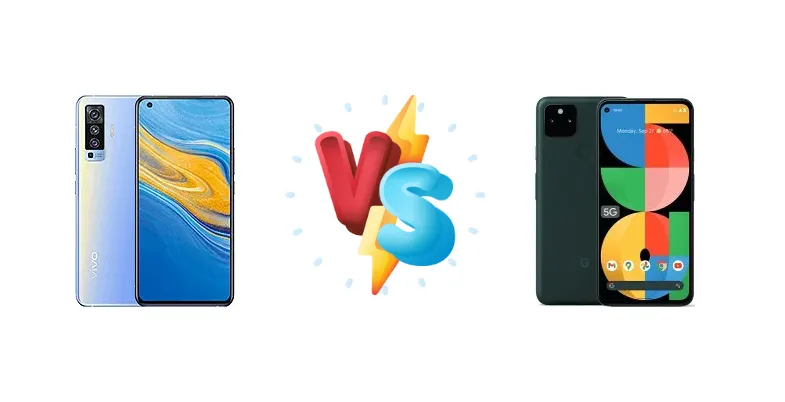
The vivo X50 and Google Pixel 5a 5G represent compelling options in the increasingly competitive mid-range smartphone market. The X50, with its focus on sleek design and camera capabilities, initially launched at a higher price point, while the Pixel 5a 5G aimed to deliver Google’s renowned software and camera experience at a more accessible price. Now, with price drops, a direct comparison is crucial for discerning buyers.
🏆 Quick Verdict
For the average user prioritizing software support and consistent camera performance, the Google Pixel 5a 5G is the better choice. While the vivo X50 offers faster charging, the Pixel 5a 5G’s Snapdragon 765G and Google’s image processing provide a more well-rounded and reliable experience.
| Network |
|---|
| 2G bands | GSM 850 / 900 / 1800 / 1900 | GSM 850 / 900 / 1800 / 1900 |
| 3G bands | HSDPA 900 / 2100 | HSDPA 850 / 900 / 1700(AWS) / 1900 / 2100 |
| 4G bands | 1, 3, 5, 8, 40 | 1, 2, 3, 4, 5, 7, 8, 12, 13, 14, 17, 18, 19, 20, 25, 26, 28, 29, 30, 32, 38, 39, 40, 41, 42, 46, 48, 66, 71 |
| 5G bands | - | 1, 2, 5, 12, 25, 28, 41, 66, 71, 77, 78 SA/NSA/Sub6 |
| Speed | HSPA, LTE | HSPA, LTE, 5G |
| Technology | GSM / HSPA / LTE | GSM / HSPA / EVDO / LTE / 5G |
| | - | CDMA2000 1xEV-DO |
| Launch |
|---|
| Announced | 2020, July 07. Released 2020, July 16 | 2021, August 17 |
| Status | Discontinued | Available. Released 2021, August 26 |
| Body |
|---|
| Build | Glass front, glass back, aluminum frame | Glass front (Gorilla Glass 3), aluminum frame, aluminum back |
| Dimensions | 159.5 x 75.4 x 7.6 mm (6.28 x 2.97 x 0.30 in) | 156.2 x 73.2 x 8.8 mm (6.15 x 2.88 x 0.35 in) |
| SIM | Nano-SIM + Nano-SIM | Nano-SIM + eSIM |
| Weight | 173 g (6.10 oz) | 183 g (6.46 oz) |
| | - | IP67 dust/water resistant (up to 1m for 30 min) |
| Display |
|---|
| Protection | - | Corning Gorilla Glass 3 |
| Resolution | 1080 x 2376 pixels (~398 ppi density) | 1080 x 2400 pixels, 20:9 ratio (~415 ppi density) |
| Size | 6.56 inches, 104.6 cm2 (~87.0% screen-to-body ratio) | 6.34 inches, 97.0 cm2 (~84.9% screen-to-body ratio) |
| Type | AMOLED, 90Hz, HDR10+ | OLED, HDR |
| | - | Always-on display |
| Platform |
|---|
| CPU | Octa-core (2x2.2 GHz Kryo 470 Gold & 6x1.8 GHz Kryo 470 Silver) | Octa-core (1x2.4 GHz Kryo 475 Prime & 1x2.2 GHz Kryo 475 Gold & 6x1.8 GHz Kryo 475 Silver) |
| Chipset | Qualcomm SDM730 Snapdragon 730 (8 nm) | Qualcomm SM7250 Snapdragon 765G 5G (7 nm) |
| GPU | Adreno 618 | Adreno 620 |
| OS | Android 10, Funtouch 10.5 | Android 11, upgradable to Android 14 |
| Memory |
|---|
| Card slot | No | No |
| Internal | 128GB 8GB RAM, 256GB 8GB RAM | 128GB 6GB RAM |
| | UFS 2.1 | - |
| Main Camera |
|---|
| Dual | - | 12.2 MP, f/1.7, 27mm, (wide), 1/2.55", 1.4µm, dual pixel PDAF, OIS
16 MP, f/2.2, 119˚ (ultrawide), 1.0µm |
| Features | Color spectrum sensor, Dual-LED dual-tone flash, HDR, panorama | LED flash, Pixel Shift, Auto-HDR, panorama |
| Quad | 48 MP, f/1.6, (wide), PDAF, OIS
13 MP, f/2.5, 50mm (telephoto), 1/2.8", 0.8µm, PDAF, 2x optical zoom
8 MP, f/2.2, 120˚, 16mm (ultrawide), 1/4.0", 1.12µm
5 MP (macro) | - |
| Single | 5 MP, AF | 8 MP, f/2.0, 24mm (wide), 1.12µm |
| Video | 4K@30fps, 1080p@30fps, gyro-EIS | 4K@30/60fps, 1080p@30/60/120/240fps; gyro-EIS |
| Selfie camera |
|---|
| Features | HDR | HDR |
| Single | 32 MP, f/2.5, 26mm (wide), 1/2.8", 0.8µm | 8 MP, f/2.0, 24mm (wide), 1.12µm |
| Video | 1080p@30fps | 1080p@30fps |
| Sound |
|---|
| 3.5mm jack | No | Yes |
| 35mm jack | No | Yes |
| Loudspeaker | Yes | Yes, with stereo speakers |
| | 24-bit/192kHz audio | - |
| Comms |
|---|
| Bluetooth | 5.1, A2DP, LE, aptX HD | 5.0, A2DP, LE, aptX HD |
| NFC | Yes | Yes |
| Positioning | GPS, GLONASS, GALILEO, BDS | GPS, GLONASS, GALILEO, QZSS, BDS |
| Radio | No | No |
| USB | USB Type-C, OTG | USB Type-C 3.1 |
| WLAN | Wi-Fi 802.11 a/b/g/n/ac, dual-band, Wi-Fi Direct | Wi-Fi 802.11 a/b/g/n/ac, dual-band, Wi-Fi Direct |
| Features |
|---|
| Sensors | Fingerprint (under display, optical), accelerometer, gyro, compass | Fingerprint (rear-mounted), accelerometer, gyro, proximity, compass, barometer |
| | Virtual proximity sensing | - |
| Battery |
|---|
| Charging | 33W wired | 18W wired, PD2.0 |
| Stand-by | Up to 570 h (2G) / Up to 420 h (3G) | - |
| Talk time | Up to 17 h 50 min (2G) / Up to 8 h 20 min (3G) | - |
| Type | 4200 mAh | Li-Po 4680 mAh |
| Misc |
|---|
| Colors | Glaze Black, Frost Blue | Mostly Black |
| Models | 2004 | G1F8F, G4S1M |
| Price | About 400 EUR | $ 189.00 / C$ 249.99 |
| SAR EU | 0.52 W/kg (head) | - |
| Tests |
|---|
| Audio quality |
Noise -87.8dB / Crosstalk -87.3dB | - |
| Battery life | - |
Endurance rating 122h
|
| Camera |
Photo / Video | - |
| Display |
Contrast ratio: 853:1 (nominal) |
Contrast ratio: Infinite (nominal) |
| Loudspeaker |
Voice 69dB / Noise 66dB / Ring 67dB | - |
| Performance | - |
AnTuTu: 291303 (v8)
GeekBench: 1337 (v5.1)
GFXBench: 19fps (ES 3.1 onscreen) |
vivo X50
- Faster 33W wired charging
- Sleek and premium design
- Potentially better low-light camera performance (dependent on sensor)
- Older Snapdragon 730 chipset
- Less consistent camera processing
- Likely shorter software support lifespan
Google Pixel 5a 5G
- Stronger Snapdragon 765G performance
- Excellent camera image processing
- Guaranteed software updates from Google
- Slower 18W charging
- Less visually striking design
- May lack some advanced camera features found on competitors
Display Comparison
Both phones offer a solid visual experience, but differ in key areas. The Pixel 5a 5G boasts a significantly brighter display, reaching 861 nits measured, compared to the vivo X50’s nominal 853:1 contrast ratio. This brightness advantage translates to better outdoor visibility. While the X50’s contrast ratio is specified, the Pixel 5a 5G claims an 'Infinite' contrast ratio, typical of OLED panels. The lack of refresh rate specification on the X50 suggests a standard 60Hz panel, while the Pixel 5a 5G also operates at 60Hz. The Pixel 5a 5G’s higher peak brightness is a clear advantage for users who spend significant time outdoors.
Camera Comparison
The Pixel 5a 5G leverages Google’s computational photography prowess, despite lacking detailed sensor specifications in the provided data. Google’s image processing algorithms are renowned for their dynamic range and accurate color reproduction. The vivo X50, while likely equipped with a capable sensor, relies more on hardware specifications. Without knowing the sensor sizes or apertures, it’s difficult to make a direct comparison. However, the Pixel 5a 5G’s consistent image quality and software features like Night Sight give it a significant advantage. The X50’s camera performance will likely be more variable, dependent on lighting conditions and scene complexity.
Performance
The Google Pixel 5a 5G’s Snapdragon 765G (7nm) holds a performance edge over the vivo X50’s Snapdragon 730 (8nm). The 765G features a Kryo 475 Prime core clocked at 2.4 GHz, offering a boost in single-core performance compared to the X50’s 2.2 GHz Kryo 470 Gold cores. Both utilize a 1.8 GHz Kryo 470/475 Silver cluster for efficiency. The 7nm process node of the 765G is also more efficient than the 8nm node of the 730, potentially leading to better thermal management under sustained loads. While both phones are capable of handling everyday tasks, the Pixel 5a 5G will exhibit smoother performance in demanding applications and games.
Battery Life
Both the vivo X50 and Google Pixel 5a 5G achieve an endurance rating of 122 hours, suggesting comparable overall battery life. However, the charging speeds differ significantly. The vivo X50 supports 33W wired charging, allowing for much faster top-ups compared to the Pixel 5a 5G’s 18W charging with PD2.0. This means the X50 can replenish its battery from 0-100% in a shorter timeframe. While the Pixel 5a 5G’s battery life is comparable, the X50’s faster charging is a significant convenience factor for users who prefer quick charging cycles.
Buying Guide
Buy the vivo X50 if you prioritize faster 33W wired charging and a slightly more premium aesthetic. This phone suits users who frequently top up their battery and appreciate a sleek design. Buy the Google Pixel 5a 5G if you value long-term software support, a consistently excellent camera experience, and reliable 5G connectivity. This is the phone for users who want a hassle-free experience and prioritize image quality.
Frequently Asked Questions
❓ Does the Snapdragon 765G in the Pixel 5a 5G handle demanding games like PUBG or Call of Duty Mobile smoothly?
Yes, the Snapdragon 765G is capable of running PUBG and Call of Duty Mobile at high settings with stable frame rates. While it won't match the performance of flagship chipsets, it provides a smooth and enjoyable gaming experience for most users. The 765G’s Adreno 620 GPU is well-suited for mobile gaming.
❓ How long will the Google Pixel 5a 5G receive software and security updates?
Google typically provides at least 3 years of Android OS updates and 5 years of security updates for its Pixel devices. This means the Pixel 5a 5G will likely receive updates through late 2024 or early 2025, ensuring long-term security and access to the latest features.
❓ Is the 33W charging on the vivo X50 significantly faster in real-world use?
Yes, the 33W charging on the vivo X50 is noticeably faster than the 18W charging on the Pixel 5a 5G. Expect to go from 0% to 50% in around 30 minutes with the X50, while the Pixel 5a 5G will take closer to an hour for the same level of charge. This makes the X50 ideal for users who need quick top-ups.