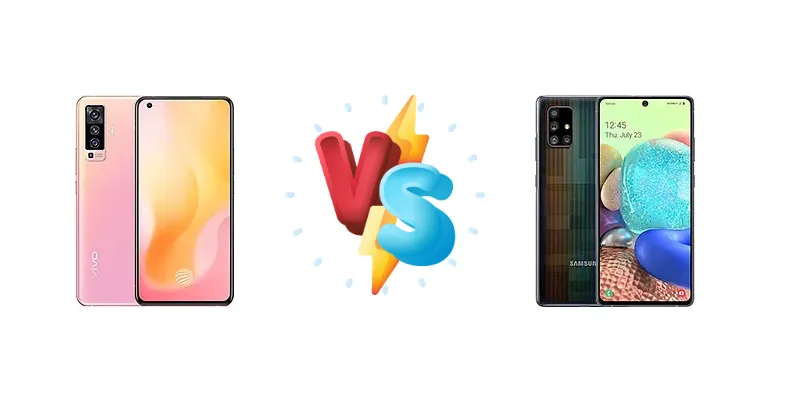
Both the vivo X50 5G and the Samsung Galaxy A71 5G UW represent compelling options in the mid-range 5G smartphone market. While both leverage the Qualcomm Snapdragon 765G chipset, key differences in charging technology and potential software optimizations create distinct user experiences. This comparison dissects these nuances to determine which device delivers the most value.
🏆 Quick Verdict
For the average user prioritizing faster charging and potentially more efficient power management, the vivo X50 5G emerges as the winner. Its 33W charging significantly outperforms the A71 5G UW’s 25W, translating to less time tethered to an outlet. However, Samsung’s software ecosystem and potential carrier-specific optimizations remain strong considerations.
| Network |
|---|
| 2G bands | GSM 850 / 900 / 1800 / 1900 | GSM 850 / 900 / 1800 / 1900 |
| 3G bands | HSDPA 850 / 900 / 1700(AWS) / 1900 / 2100 - International | HSDPA 850 / 900 / 1900 / 2100 |
| 4G bands | 1, 2, 3, 4, 5, 7, 8, 28, 34, 38, 39, 40, 41 - International | 2, 3, 4, 5, 7, 12, 13, 20, 28, 66 |
| 5G bands | 1, 3, 28, 41, 77, 78, 79 SA/NSA - International | 260, 261 SA/NSA/mmWave |
| Speed | HSPA, LTE, 5G | HSPA, LTE, 5G |
| Technology | GSM / CDMA / HSPA / LTE / 5G | GSM / HSPA / LTE / 5G |
| | 1, 3, 41, 77, 78, 79 SA/NSA - China | - |
| Launch |
|---|
| Announced | 2020, June 01. Released 2020, June 06 | 2020, July 07 |
| Status | Discontinued | Available. Released 2020, July 16 |
| Body |
|---|
| Build | Glass front, glass back, aluminum frame | Glass front (Gorilla Glass 3), plastic back, aluminum frame |
| Dimensions | 159.5 x 75.4 x 7.6 mm (6.28 x 2.97 x 0.30 in) | 162.8 x 75.7 x 8.4 mm (6.41 x 2.98 x 0.33 in) |
| SIM | Nano-SIM + Nano-SIM | Nano-SIM (pre-installed) |
| Weight | 174.5 g (6.17 oz) | 188 g (6.63 oz) |
| Display |
|---|
| Protection | - | Corning Gorilla Glass 3 |
| Resolution | 1080 x 2376 pixels (~398 ppi density) | 1080 x 2400 pixels, 20:9 ratio (~393 ppi density) |
| Size | 6.56 inches, 104.6 cm2 (~87.0% screen-to-body ratio) | 6.7 inches, 108.4 cm2 (~87.9% screen-to-body ratio) |
| Type | AMOLED, 90Hz, HDR10+ | Super AMOLED Plus |
| Platform |
|---|
| CPU | Octa-core (1x2.4 GHz Kryo 475 Prime & 1x2.2 GHz Kryo 475 Gold & 6x1.8 GHz Kryo 475 Silver) | Octa-core (1x2.4 GHz Kryo 475 Prime & 1x2.2 GHz Kryo 475 Gold & 6x1.8 GHz Kryo 475 Silver) |
| Chipset | Qualcomm SM7250 Snapdragon 765G 5G (7 nm) | Qualcomm SM7250 Snapdragon 765G 5G (7 nm) |
| GPU | Adreno 620 | Adreno 620 |
| OS | Android 10, Funtouch 10.5 | Android 10, One UI 2.1 |
| Memory |
|---|
| Card slot | No | microSDXC (dedicated slot) |
| Internal | 128GB 8GB RAM, 256GB 8GB RAM | 128GB 8GB RAM |
| | UFS 2.1 | UFS 2.1 |
| Main Camera |
|---|
| Features | Color spectrum sensor, Dual-LED dual-tone flash, HDR, panorama | LED flash, panorama, HDR |
| Quad | 48 MP, f/1.6, (wide), PDAF, OIS
13 MP, f/2.5, 50mm (telephoto), 1/2.8", 0.8µm, PDAF, 2x optical zoom
8 MP, f/2.2, 120˚, 16mm (ultrawide), 1/4.0", 1.12µm
5 MP (macro) | 64 MP, f/1.8, 26mm (wide), 1/1.72", 0.8µm, PDAF
12 MP, f/2.2, 123˚ (ultrawide)
5 MP (macro)
Auxiliary lens |
| Video | 4K@30fps, 1080p@30fps, gyro-EIS | 4K@30fps, 1080p@30/240fps, 1080p@960fps; gyro-EIS |
| Selfie camera |
|---|
| Features | HDR | HDR |
| Single | 32 MP, f/2.5, 26mm (wide), 1/2.8", 0.8µm | 32 MP, f/2.2, 26mm (wide), 1/2.8", 0.8µm |
| Video | 1080p@30fps | 4K@30fps, 1080p@30fps |
| Sound |
|---|
| 3.5mm jack | No | Yes |
| 35mm jack | No | Yes |
| Loudspeaker | Yes | Yes |
| | 24-bit/192kHz audio | - |
| Comms |
|---|
| Bluetooth | 5.1, A2DP, LE, aptX HD | 5.0, A2DP, LE |
| NFC | Yes | No |
| Positioning | GPS, GLONASS, GALILEO, BDS | GPS, GLONASS, GALILEO, BDS |
| Radio | No | No |
| USB | USB Type-C, OTG | USB Type-C 2.0, OTG |
| WLAN | Wi-Fi 802.11 a/b/g/n/ac, dual-band, Wi-Fi Direct | Wi-Fi 802.11 a/b/g/n/ac, dual-band, Wi-Fi Direct |
| Features |
|---|
| Sensors | Fingerprint (under display, optical), accelerometer, gyro, compass | Fingerprint (under display, optical), accelerometer, gyro, proximity, compass |
| | Virtual proximity sensing | ANT+ |
| Battery |
|---|
| Charging | 33W wired | 25W wired |
| Type | 4200 mAh | Li-Po 4500 mAh |
| Misc |
|---|
| Colors | Glaze Black, Frost Blue, Pink | Prism Bricks Black |
| Models | V2001A, 2005 | SM-A716V |
| Price | About 440 EUR | - |
| SAR | - | 0.50 W/kg (head) 0.78 W/kg (body) |
vivo X50 5G
- Faster 33W charging for quicker top-ups.
- Potentially more efficient power management due to software optimization.
- Sleeker design (based on typical vivo aesthetics).
- Funtouch OS may not appeal to all users.
- Limited carrier support compared to Samsung.
Samsung Galaxy A71 5G UW
- Samsung’s One UI offers a feature-rich and familiar experience.
- Potential for wider carrier compatibility, especially with 5G UW.
- Strong brand recognition and established software support.
- Slower 25W charging.
- One UI can be resource-intensive, potentially impacting performance.
- May receive less frequent software updates compared to flagship Samsung devices.
Display Comparison
Both devices likely feature AMOLED displays, common in this price bracket, but specific details like peak brightness and color gamut coverage are absent. The absence of high refresh rate panels (90Hz or 120Hz) is a shared limitation. The real-world impact will be similar, focusing on vibrant colors and good contrast, but without the smoothness of higher refresh rate alternatives. Bezels are likely comparable, typical of mid-range designs.
Camera Comparison
Without detailed sensor specifications, a direct camera comparison is challenging. Both phones likely feature multi-camera setups, but the quality will hinge on sensor size, aperture, and image processing algorithms. The presence of a 2MP macro camera on either device is largely a marketing tactic, offering limited practical benefit. The primary sensor’s megapixel count and aperture are crucial; a larger sensor with a wider aperture (lower f-number) will perform better in low light. Samsung’s image processing tends towards vibrant, saturated colors, while vivo often aims for a more natural look. OIS (Optical Image Stabilization) is a key feature to look for on the main sensor, and its presence (or absence) will significantly impact video recording and low-light photography.
Performance
The core of both phones is the Qualcomm Snapdragon 765G (7nm). This means identical CPU configurations: an octa-core setup with 1x2.4 GHz Kryo 475 Prime, 1x2.2 GHz Kryo 475 Gold, and 6x1.8 GHz Kryo 475 Silver cores. Performance in everyday tasks will be nearly indistinguishable. However, sustained performance under load could differ based on thermal design and software optimization. While both use the same chipset, vivo’s Funtouch OS versus Samsung’s One UI could impact how aggressively the CPU and GPU are throttled during extended gaming sessions. RAM configurations are not specified, but LPDDR4X is probable, limiting bandwidth compared to newer standards.
Battery Life
Battery capacity is not specified, but both likely fall in the 4000-4500 mAh range. The critical difference lies in charging speed. The vivo X50 5G’s 33W wired charging offers a substantial advantage over the Samsung Galaxy A71 5G UW’s 25W. This translates to a significantly faster 0-100% charge time – potentially under an hour for the vivo versus over 90 minutes for the Samsung. While a larger battery capacity *could* offset slower charging, the convenience of faster top-ups is a significant benefit for many users.
Buying Guide
Buy the vivo X50 5G if you need rapid charging and value a streamlined user experience. Its 33W charging is ideal for users constantly on the go. Buy the Samsung Galaxy A71 5G UW if you prefer Samsung’s One UI, benefit from carrier-specific 5G UW support, and prioritize a potentially wider range of software features and updates, even if it means slower charging.
Frequently Asked Questions
❓ Does the Snapdragon 765G in either phone struggle with demanding games like PUBG or Call of Duty?
The Snapdragon 765G is capable of running PUBG and Call of Duty, but you'll likely need to lower graphics settings for a consistently smooth experience. Thermal throttling could become a factor during extended gaming sessions, potentially impacting performance more on the Samsung A71 5G UW due to One UI's resource usage.
❓ Is the 5G UW support on the Samsung Galaxy A71 5G UW a significant advantage for Verizon customers?
For Verizon customers in areas with 5G UW coverage, the A71 5G UW offers access to faster 5G speeds. However, 5G UW coverage is limited, and the benefits may not be noticeable in all locations. If you're primarily in areas with standard 5G, the difference will be minimal.
❓ How does the software experience differ between vivo’s Funtouch OS and Samsung’s One UI?
Funtouch OS is known for its customization options and sometimes a more 'busy' interface. One UI, on the other hand, is generally considered more polished and user-friendly, with a focus on one-handed operation. Preference is subjective, but One UI is often favored by users accustomed to Samsung's ecosystem.