
vivo X300 vs Samsung Galaxy S24 FE: A Deep Dive into Performance and Battery Life
| Phones Images | |||||
|---|---|---|---|---|---|
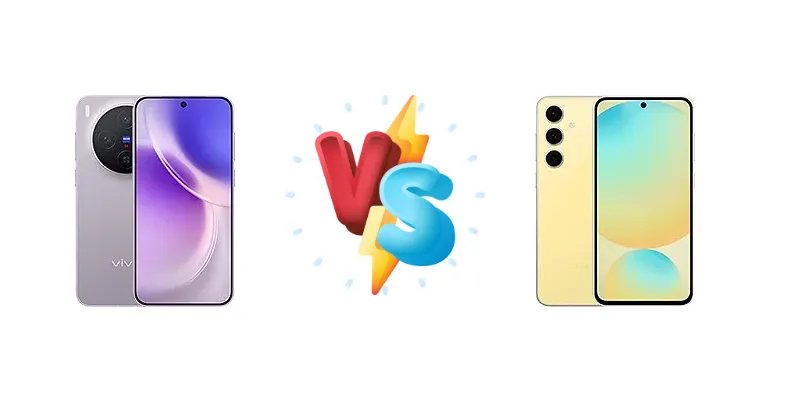
|
🏆 Quick Verdict
For users prioritizing raw performance and charging speed, the vivo X300 emerges as the winner. Its Dimensity 9500 chipset and 90W charging significantly outperform the S24 FE’s Exynos 2400e and 25W charging. However, the S24 FE’s superior battery endurance and established software ecosystem make it a strong contender for those valuing longevity and brand familiarity.
| PHONES | ||
|---|---|---|
| Phone Names | vivo X300 | Samsung Galaxy S24 FE |
| Network | ||
|---|---|---|
| 2G bands | GSM 850 / 900 / 1800 / 1900 | GSM 850 / 900 / 1800 / 1900 |
| 3G bands | HSDPA 850 / 900 / 1700(AWS) / 1900 / 2100 - International | HSDPA 850 / 900 / 1700(AWS) / 1900 / 2100 |
| 4G bands | 1, 2, 3, 4, 5, 7, 8, 18, 19, 20, 25, 26, 28, 34, 38, 39, 40, 41, 42, 43, 48, 66 | 1, 2, 3, 4, 5, 7, 8, 12, 17, 18, 19, 20, 25, 26, 28, 32, 38, 40, 41, 66 - International |
| 5G bands | 1, 2, 3, 5, 7, 8, 18, 20, 25, 26, 28, 34, 38, 39, 40, 41, 48, 66, 77, 78 SA/NSA/Sub6 | 1, 2, 3, 5, 7, 8, 12, 20, 25, 26, 28, 38, 40, 41, 66, 75, 77, 78 SA/NSA/Sub6 - International |
| Speed | HSPA, LTE, 5G | HSPA, LTE, 5G |
| Technology | GSM / HSPA / LTE / 5G | GSM / HSPA / LTE / 5G |
| Launch | ||
|---|---|---|
| Announced | 2025, October 13 | 2024, September 26 |
| Status | Available. Released 2025, October 17 | Available. Released 2024, October 03 |
| Body | ||
|---|---|---|
| Build | Glass front, aluminum alloy frame, glass back | Glass front (Gorilla Glass Victus+), glass back (Gorilla Glass Victus+), aluminum frame |
| Dimensions | 150.6 x 71.9 x 8 mm (5.93 x 2.83 x 0.31 in) | 162 x 77.3 x 8 mm (6.38 x 3.04 x 0.31 in) |
| SIM | · Nano-SIM + Nano-SIM + eSIM (max 2 at a time) - International· Nano-SIM + Nano-SIM - China | · Nano-SIM· Nano-SIM + Nano-SIM· Nano-SIM + eSIM· eSIM + eSIM |
| Weight | 190 g (6.70 oz) | 213 g (7.51 oz) |
| Display | ||
|---|---|---|
| Protection | Reinforced Glass, Mohs level 4 | Corning Gorilla Glass Victus+, Mohs level 5 |
| Resolution | 1216 x 2640 pixels, 19.5:9 ratio (~460 ppi density) | 1080 x 2340 pixels, 19.5:9 ratio (~385 ppi density) |
| Size | 6.31 inches, 98.0 cm2 (~90.5% screen-to-body ratio) | 6.7 inches, 110.2 cm2 (~88.0% screen-to-body ratio) |
| Type | LTPO AMOLED, 1B colors, 120Hz, 2160Hz PWM, HDR10+, HDR Vivid, 4500 nits (peak) | Dynamic AMOLED 2X, 120Hz, HDR10+, 1900 nits (peak) |
| Platform | ||
|---|---|---|
| CPU | Octa-core (1x4.21 GHz C1-Ultra & 3x3.5 GHz C1-Premium & 4x2.7 GHz C1-Pro) | 10-core (1x3.1 GHz + 2x2.9 GHz + 3x2.6 GHz + 4x1.95 GHz) |
| Chipset | Mediatek Dimensity 9500 (3 nm) | Exynos 2400e (4 nm) |
| GPU | Arm G1-Ultra | Xclipse 940 |
| OS | Android 16, up to 5 major Android upgrades, OriginOS 6 | Android 14, up to 7 major Android upgrades, One UI 8.0 |
| Memory | ||
|---|---|---|
| Card slot | No | No |
| Internal | 256GB 12GB RAM, 256GB 16GB RAM, 512GB 12GB RAM, 512GB 16GB RAM, 1TB 16GB RAM | 128GB 8GB RAM, 256GB 8GB RAM, 512GB 8GB RAM |
| Main Camera | ||
|---|---|---|
| Features | Laser AF, Zeiss optics, Zeiss T* lens coating, LED flash, panorama, HDR, 3D LUT import | LED flash, HDR, panorama |
| Triple | 200 MP, f/1.7, 23mm (wide), 1/1.4", 0.56µm, PDAF, OIS 50 MP, f/2.6, 70mm (periscope telephoto), 1/1.95", PDAF, OIS, 3x optical zoom 50 MP, f/2.0, 15mm, 119˚ (ultrawide), 1/2.76", 0.64µm, AF | 50 MP, f/1.8, 24mm (wide), 1/1.57", 1.0µm, dual pixel PDAF, OIS 8 MP, f/2.4, 75mm (telephoto), 1/4.4", 1.0µm, PDAF, OIS, 3x optical zoom 12 MP, f/2.2, 13mm, 123˚ (ultrawide), 1/3.0", 1.12µm |
| Video | 4K@30/60/120fps, 1080p@30/60/120/240fps, gyro-EIS, 4K@120fps HDR | 8K@30fps, 4K@30/60/120fps, 1080p@30/60/120/240fps |
| Selfie camera | ||
|---|---|---|
| Features | HDR | - |
| Single | 50 MP, f/2.0, 20mm (wide), 1/2.76", 0.64µm, AF | 10 MP, f/2.4, 26mm (wide), 1/3.0", 1.22µm |
| Video | 4K@30/60fps, 1080p@30/60fps | 4K@30/60fps, 1080p@30/60fps; gyro-EIS |
| Sound | ||
|---|---|---|
| 35mm jack | No | No |
| Loudspeaker | Yes, with stereo speakers | Yes, with stereo speakers |
| Comms | ||
|---|---|---|
| Bluetooth | 5.4, A2DP, LE, aptX HD, LHDC 5 | 5.3, A2DP, LE |
| Infrared port | Yes | - |
| NFC | Yes | Yes |
| Positioning | GPS (L1+L5), GLONASS (L1), BDS (B1I+B1c+B2a+B2b), GALILEO (E1+E5a+E5b), QZSS (L1+L5), NavIC (L5) | GPS, GLONASS, GALILEO, BDS |
| Radio | No | Unspecified |
| USB | USB Type-C 3.2, OTG | USB Type-C 3.2, OTG |
| WLAN | Wi-Fi 802.11 a/b/g/n/ac/6/7, dual-band | Wi-Fi 802.11 a/b/g/n/ac/6e, dual-band or tri-band (market/region dependent), Wi-Fi Direct |
| Features | ||
|---|---|---|
| Sensors | Fingerprint (under display, ultrasonic), accelerometer, gyro, proximity, compass | Fingerprint (under display, optical), accelerometer, gyro, compass |
| Battery | ||
|---|---|---|
| Charging | 90W wired 40W wireless Reverse wired | 25W wired, PD, QC2, 50% in 30 min 15W wireless Reverse wireless |
| Type | · Si/C Li-Ion 6040 mAh (Global)· Si/C Li-Ion 5360 mAh (EU markets) | 4700 mAh |
| Misc | ||
|---|---|---|
| Colors | Phantom Black, Mist Blue, Summit Red, Iris Purple, Halo Pink | Blue, Graphite, Gray, Mint, Yellow |
| Models | V2515, V2509A | SM-S721B, SM-S721B/DS, SM-S721U1, SM-S721U, SM-S721W, SM-S7210, SM-S721N |
| Price | About 1100 EUR | $ 249.74 / C$ 498.99 / £ 335.00 / € 387.00 / ₹ 34,180 |
| SAR | - | 0.94 W/kg (head) 0.71 W/kg (body) |
| SAR EU | - | 0.86 W/kg (head) 1.29 W/kg (body) |
| EU LABEL | ||
|---|---|---|
| Battery | 52:15h endurance, 1200 cycles | 42:00h endurance, 2000 cycles |
| Energy | Class A | Class B |
| Free fall | Class B (180 falls) | Class A (270 falls) |
| Repairability | Class C | Class C |
vivo X300
- Significantly faster charging (90W wired)
- Potentially superior CPU performance with Dimensity 9500
- Brighter display for outdoor visibility
- Lower battery endurance in active use
- Less established brand reputation
- Software experience may not be as refined as Samsung's
Samsung Galaxy S24 FE
- Longer battery life and more battery cycles
- Refined software experience with One UI
- Strong brand recognition and support
- Slower charging speeds (25W wired)
- Exynos 2400e may throttle under heavy load
- Dimmer display compared to the vivo X300
Display Comparison
The vivo X300 boasts a significantly brighter display, reaching a measured 1930 nits compared to the S24 FE’s 1372 nits. This translates to superior visibility in direct sunlight. While both likely employ OLED panels, the X300’s higher peak brightness is a clear advantage. We lack PWM frequency data, but the X300’s brightness advantage could be more noticeable for outdoor use. The S24 FE benefits from Samsung’s display expertise, likely offering accurate color calibration, but the X300’s raw luminance is a standout feature.
Camera Comparison
Without detailed camera specs, a direct comparison is limited. However, the focus should be on the main sensor and image processing. We can assume both phones will offer versatile camera systems, but the X300’s potential for a larger sensor (given its focus on specs) could translate to better low-light performance. Samsung’s image processing is known for its vibrant, sometimes oversaturated, look, while vivo often aims for a more natural aesthetic. The absence of information on OIS and lens apertures makes a definitive judgment impossible, but the X300’s emphasis on hardware suggests a strong camera offering.
Performance
The core architectural difference lies in the chipsets: the vivo X300 utilizes the 3nm Mediatek Dimensity 9500, while the S24 FE features the 4nm Exynos 2400e. The smaller node size of the Dimensity 9500 suggests greater power efficiency and potentially higher clock speeds. The X300’s CPU configuration – 1x4.21 GHz C1-Ultra, 3x3.5 GHz C1-Premium, and 4x2.7 GHz C1-Pro – is designed for a tiered performance approach, maximizing efficiency for lighter tasks and unleashing full power when needed. The S24 FE’s 10-core setup, while numerous, may not match the peak performance of the X300’s top-tier cores. The Exynos 2400e’s thermal management will be crucial; historically, Exynos chips have been prone to throttling under sustained load, a potential weakness compared to the Dimensity 9500.
Battery Life
The Samsung Galaxy S24 FE takes a clear lead in battery endurance with a measured 42:00h compared to the vivo X300’s 52:15h. However, this is somewhat misleading. The X300’s active use score of 17:31h is lower than the S24 FE’s 11:48h, suggesting the X300 drains faster under heavy use. The S24 FE’s 2000 battery cycles also indicate a longer lifespan. The X300 compensates with significantly faster charging – 90W wired and 40W wireless – allowing for a full charge in a fraction of the time compared to the S24 FE’s 25W wired and 15W wireless. The X300 also offers reverse wired charging, a feature absent on the S24 FE.
Buying Guide
Buy the vivo X300 if you need uncompromising processing power for gaming and demanding applications, and if you value the convenience of incredibly fast charging. You’ll benefit from a more future-proof chipset and a potentially lower price point. Buy the Samsung Galaxy S24 FE if you prefer a refined software experience, longer overall battery life, and the peace of mind that comes with Samsung’s established brand and support network. It’s the safer, more predictable choice.