
vivo X300 Pro vs Samsung Galaxy S23 Ultra: A Deep Dive into Flagship Performance
| Phones Images | |||||
|---|---|---|---|---|---|
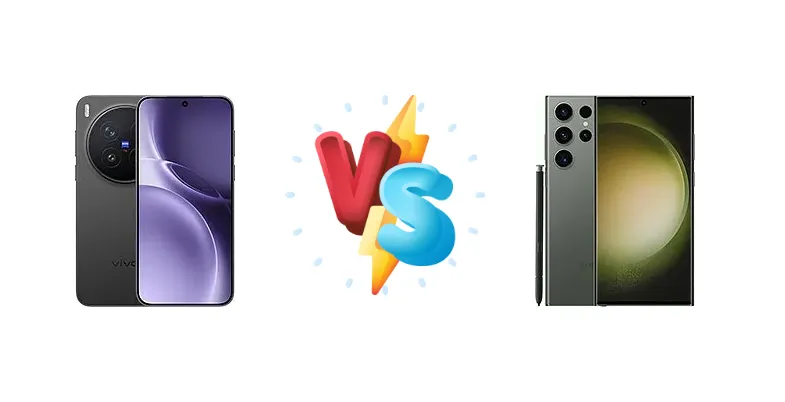
|
🏆 Quick Verdict
For the average user prioritizing all-around excellence, the Samsung Galaxy S23 Ultra remains the safer bet. Its mature software, versatile camera system, and established ecosystem outweigh the X300 Pro’s raw performance potential and faster charging, though the X300 Pro is a strong contender.
| PHONES | ||
|---|---|---|
| Phone Names | vivo X300 Pro | Samsung Galaxy S23 Ultra |
| Network | ||
|---|---|---|
| 2G bands | GSM 850 / 900 / 1800 / 1900 | GSM 850 / 900 / 1800 / 1900 |
| 3G bands | HSDPA 800 / 850 / 900 / 1700(AWS) / 1900 / 2100 - China | HSDPA 850 / 900 / 1700(AWS) / 1900 / 2100 |
| 4G bands | 1, 2, 3, 4, 5, 7, 8, 18, 19, 20, 25, 26, 28, 34, 38, 39, 40, 41, 42, 43, 48, 66 | 1, 2, 3, 4, 5, 7, 8, 12, 13, 17, 18, 19, 20, 25, 26, 28, 32, 38, 39, 40, 41, 66 - International |
| 5G bands | 1, 2, 3, 5, 7, 8, 18, 20, 25, 26, 28, 34, 38, 39, 40, 41, 48, 66, 77, 78, 79 SA/NSA/Sub6 | 1, 2, 3, 5, 7, 8, 12, 20, 25, 28, 38, 40, 41, 66, 75, 77, 78 SA/NSA/Sub6 - International |
| Speed | HSPA, LTE, 5G | HSPA, LTE (up to 7CA), 5G |
| Technology | GSM / HSPA / LTE / 5G | GSM / CDMA / HSPA / EVDO / LTE / 5G |
| - | 1, 7, 28, 41, 66, 71, 78, 258, 260, 261 SA/NSA/Sub6/mmWave - USA | |
| Launch | ||
|---|---|---|
| Announced | 2025, October 13 | 2023, February 01 |
| Status | Available. Released 2025, October 17 | Available. Released 2023, February 17 |
| Body | ||
|---|---|---|
| Build | Glass front (Armor Glass), aluminum alloy frame, glass back | Glass front (Gorilla Glass Victus 2), glass back (Gorilla Glass Victus 2), aluminum frame |
| Dimensions | 161.2 x 75.5 x 8 mm (6.35 x 2.97 x 0.31 in) | 163.4 x 78.1 x 8.9 mm (6.43 x 3.07 x 0.35 in) |
| SIM | · Nano-SIM + Nano-SIM + eSIM (max 2 at a time) - International· Nano-SIM + Nano-SIM - China | · Nano-SIM + eSIM· Nano-SIM + Nano-SIM + eSIM (max 2 at a time) |
| Weight | 226 g (7.97 oz) | 234 g (8.25 oz) |
| - | IP68 dust/water resistant (up to 1.5m for 30 min) Armor aluminum frame with tougher drop and scratch resistance (advertised) Stylus (Bluetooth integration, accelerometer, gyro) | |
| Display | ||
|---|---|---|
| Protection | Armor Glass, Mohs level 4 | Corning Gorilla Glass Victus 2 |
| Resolution | 1260 x 2800 pixels, 20:9 ratio (~452 ppi density) | 1440 x 3088 pixels, 19.3:9 ratio (~500 ppi density) |
| Size | 6.78 inches, 111.5 cm2 (~91.6% screen-to-body ratio) | 6.8 inches, 114.7 cm2 (~89.9% screen-to-body ratio) |
| Type | LTPO AMOLED, 1B colors, 120Hz, 2160Hz PWM, HDR10+, HDR Vivid, Dolby Vision, 4500 nits (peak) | Dynamic AMOLED 2X, 120Hz, HDR10+, 1200 nits (HBM), 1750 nits (peak) |
| - | Always-on display | |
| Platform | ||
|---|---|---|
| CPU | Octa-core (1x4.21 GHz C1-Ultra & 3x3.5 GHz C1-Premium & 4x2.7 GHz C1-Pro) | Octa-core (1x3.36 GHz Cortex-X3 & 2x2.8 GHz Cortex-A715 & 2x2.8 GHz Cortex-A710 & 3x2.0 GHz Cortex-A510) |
| Chipset | Mediatek Dimensity 9500 (3 nm) | Qualcomm SM8550-AC Snapdragon 8 Gen 2 (4 nm) |
| GPU | Arm G1-Ultra | Adreno 740 |
| OS | Android 16, up to 5 major Android upgrades, OriginOS 6 | Android 13, up to 4 major Android upgrades, One UI 8 |
| Memory | ||
|---|---|---|
| Card slot | No | No |
| Internal | 256GB 12GB RAM, 512GB 16GB RAM, 1TB 16GB RAM | 256GB 8GB RAM, 256GB 12GB RAM, 512GB 12GB RAM, 1TB 12GB RAM |
| - | UFS 4.0 | |
| Main Camera | ||
|---|---|---|
| Features | Laser AF, color spectrum sensor, Zeiss optics, Zeiss T* lens coating, LED flash, panorama, HDR, 3D LUT import | Laser AF, LED flash, auto-HDR, panorama |
| Quad | - | 200 MP, f/1.7, 24mm (wide), 1/1.3", 0.6µm, multi-directional PDAF, OIS 10 MP, f/2.4, 70mm (telephoto), 1/3.52", 1.12µm, PDAF, OIS, 3x optical zoom 10 MP, f/4.9, 230mm (periscope telephoto), 1/3.52", 1.12µm, PDAF, OIS, 10x optical zoom 12 MP, f/2.2, 13mm, 120˚ (ultrawide), 1/2.55", 1.4µm, dual pixel PDAF, Super Steady video |
| Single | - | 12 MP, f/2.2, 26mm (wide), Dual Pixel PDAF |
| Triple | 50 MP, f/1.6, 24mm (wide), 1/1.28", 1.22µm, PDAF, OIS 200 MP, f/2.7, 85mm (periscope telephoto), 1/1.4", 0.56µm, multi-directional PDAF, OIS, 3.7x optical zoom, macro 2.7:1 50 MP, f/2.0, 15mm, 119˚ (ultrawide), 1/2.76", 0.64µm, AF | - |
| Video | 8K@30fps, 4K@30/60/120fps, 1080p@30/60/120/240fps, gyro-EIS, 4K@120fps 10-bit Log, Dolby Vision HDR | 8K@24/30fps, 4K@30/60fps, 1080p@30/60/120/240fps, HDR10+, stereo sound rec., gyro-EIS |
| Selfie camera | ||
|---|---|---|
| Features | HDR | HDR, HDR10+ |
| Single | 50 MP, f/2.0, 20mm (wide), 1/2.76", 0.64µm, AF | 12 MP, f/2.2, 26mm (wide), 1/3.2", 1.12µm, dual pixel PDAF |
| Video | 4K@30/60fps, 1080p@30/60fps | 4K@30/60fps, 1080p@30fps |
| Sound | ||
|---|---|---|
| 3.5mm jack | - | No |
| 35mm jack | No | No |
| Loudspeaker | Yes, with stereo speakers | Yes, with stereo speakers |
| - | 32-bit/384kHz audio Tuned by AKG | |
| Comms | ||
|---|---|---|
| Bluetooth | 5.4, A2DP, LE, aptX HD, LHDC 5 | 5.3, A2DP, LE |
| Infrared port | Yes | - |
| NFC | Yes | Yes |
| Positioning | GPS (L1+L5), GLONASS (L1), BDS (B1I+B1c+B2a+B2b), GALILEO (E1+E5a+E5b), QZSS (L1+L5), NavIC (L5) | GPS, GALILEO, GLONASS, BDS, QZSS |
| Radio | No | No |
| USB | USB Type-C 3.2, OTG | USB Type-C 3.2, OTG |
| WLAN | Wi-Fi 802.11 a/b/g/n/ac/6/7, dual-band | Wi-Fi 802.11 a/b/g/n/ac/6e, tri-band, Wi-Fi Direct |
| Features | ||
|---|---|---|
| Sensors | Fingerprint (under display, ultrasonic), accelerometer, gyro, proximity, compass | Fingerprint (under display, ultrasonic), accelerometer, gyro, proximity, compass, barometer |
| - | Samsung DeX, Samsung Wireless DeX (desktop experience support) Bixby natural language commands and dictation Samsung Pay (Visa, MasterCard certified) Ultra Wideband (UWB) support | |
| Battery | ||
|---|---|---|
| Charging | 90W wired 40W wireless Reverse wireless Reverse wired | 45W wired, PD3.0, 65% in 30 min 15W wireless (Qi) 4.5W reverse wireless |
| Type | · Si/C Li-Ion 6510 mAh (Global)· Si/C Li-Ion 5440 mAh (EU markets) | Li-Ion 5000 mAh |
| Misc | ||
|---|---|---|
| Colors | Phantom Black, Mist Blue, Dune Brown, Cloud White | Phantom Black, Green, Cream, Lavender, Graphite, Sky Blue, Lime, Red, BMW M Edition |
| Models | V2514, V2502A | SM-S918B, SM-S918B/DS, SM-S918U, SM-S918U1, SM-S918W, SM-S918N, SM-S9180, SM-S918E, SM-S918E/DS |
| Price | About 1400 EUR | € 549.90 / $ 454.99 / £ 433.00 |
| SAR | - | 1.12 W/kg (head) 0.92 W/kg (body) |
| SAR EU | - | 0.96 W/kg (head) 1.40 W/kg (body) |
| Tests | ||
|---|---|---|
| Battery life | - | Endurance rating 126h |
| Camera | - | Photo / Video |
| Display | - | Contrast ratio: Infinite (nominal) |
| Loudspeaker | - | -25.6 LUFS (Very good) |
| Performance | - | AnTuTu: 1241531 (v9) GeekBench: 4927 (v5.1) GFXBench: 67fps (ES 3.1 onscreen) |
| EU LABEL | ||
|---|---|---|
| Battery | 48:21h endurance, 1200 cycles | - |
| Energy | Class B | - |
| Free fall | Class B (180 falls) | - |
| Repairability | Class C | - |
vivo X300 Pro
- Significantly faster 90W wired charging
- Potentially superior performance with Dimensity 9500 (3nm)
- Higher peak display brightness for outdoor visibility
- Less established software ecosystem
- Limited camera details in provided context
Samsung Galaxy S23 Ultra
- Mature and polished software experience
- Versatile and highly-rated camera system
- Long-term software support from Samsung
- Slower 45W wired charging
- Lower peak display brightness
Display Comparison
The vivo X300 Pro boasts a significantly brighter display, reaching a measured 2113 nits compared to the S23 Ultra’s 1274 nits. This translates to superior visibility in direct sunlight. While both likely utilize LTPO technology for adaptive refresh rates (not explicitly stated for the X300 Pro, but highly probable given its flagship status), the S23 Ultra’s ‘Infinite’ contrast ratio suggests a more refined panel calibration. The practical impact is a more vibrant and punchy image on the Samsung, but the vivo offers a clear advantage in outdoor readability.
Camera Comparison
The context data for both devices is limited to 'Photo / Video', making a detailed comparison difficult. However, Samsung’s history suggests a highly sophisticated camera system with advanced computational photography. The S23 Ultra’s larger sensor (likely 200MP, based on market trends) and extensive OIS system will likely outperform the X300 Pro in low-light conditions and video stabilization. While the X300 Pro may offer competitive image quality, Samsung’s established expertise in image processing gives it a likely advantage. The absence of details on the X300 Pro’s camera specs makes a definitive judgment impossible.
Performance
The core battleground is the chipset. The vivo X300 Pro’s Mediatek Dimensity 9500, fabricated on a 3nm process, promises superior efficiency and performance compared to the Samsung Galaxy S23 Ultra’s 4nm Snapdragon 8 Gen 2. The Dimensity 9500’s octa-core configuration, with its 4.21 GHz C1-Ultra core, suggests a focus on peak performance, while the Snapdragon 8 Gen 2 prioritizes sustained performance. The Snapdragon’s Cortex-X3 core is clocked lower at 3.36 GHz, but benefits from Qualcomm’s optimization. Real-world performance will depend on thermal management, but the 3nm node gives the X300 Pro a theoretical edge. Both devices likely utilize LPDDR5x RAM, minimizing memory bottlenecks.
Battery Life
The Samsung Galaxy S23 Ultra achieves a 13:24h active use score, slightly exceeding the vivo X300 Pro’s 12:45h. However, the X300 Pro’s 90W wired charging is a game-changer, significantly faster than the S23 Ultra’s 45W. The X300 Pro also offers 40W wireless and reverse wireless charging, while the S23 Ultra is limited to 15W wireless and 4.5W reverse wireless. The X300 Pro’s 1200 charge cycles suggest a focus on long-term battery health. While the S23 Ultra’s endurance rating of 126h is respectable, the X300 Pro’s charging speed mitigates any concerns about slightly lower endurance.
Buying Guide
Buy the vivo X300 Pro if you prioritize cutting-edge processor performance, incredibly fast 90W charging, and are comfortable with a potentially less refined software experience. Buy the Samsung Galaxy S23 Ultra if you value a polished, feature-rich experience, a class-leading camera system, and long-term software support, even if it means sacrificing some charging speed.