
vivo X300 Pro vs Honor Magic6 Pro: A Deep Dive into Flagship Performance
| Phones Images | |||||
|---|---|---|---|---|---|
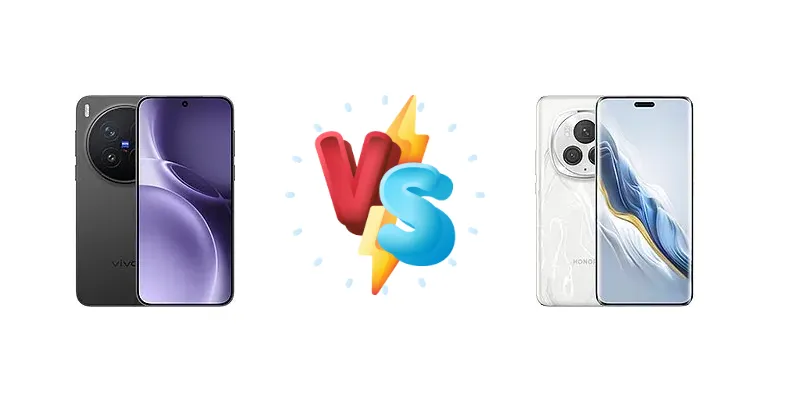
|
🏆 Quick Verdict
For the average user prioritizing sustained performance and longer active use, the Honor Magic6 Pro emerges as the winner. Its Snapdragon 8 Gen 3, coupled with a more efficient battery profile, delivers a superior experience despite the X300 Pro’s impressive charging speeds and peak brightness.
| PHONES | ||
|---|---|---|
| Phone Names | vivo X300 Pro | Honor Magic6 Pro |
| Network | ||
|---|---|---|
| 2G bands | GSM 850 / 900 / 1800 / 1900 | GSM 850 / 900 / 1800 / 1900 |
| 3G bands | HSDPA 800 / 850 / 900 / 1700(AWS) / 1900 / 2100 - China | HSDPA 800 / 850 / 900 / 1700(AWS) / 1900 / 2100 |
| 4G bands | 1, 2, 3, 4, 5, 7, 8, 18, 19, 20, 25, 26, 28, 34, 38, 39, 40, 41, 42, 43, 48, 66 | LTE |
| 5G bands | 1, 2, 3, 5, 7, 8, 18, 20, 25, 26, 28, 34, 38, 39, 40, 41, 48, 66, 77, 78, 79 SA/NSA/Sub6 | SA/NSA |
| Speed | HSPA, LTE, 5G | HSPA, LTE, 5G |
| Technology | GSM / HSPA / LTE / 5G | GSM / CDMA / HSPA / CDMA2000 / LTE / 5G |
| Launch | ||
|---|---|---|
| Announced | 2025, October 13 | 2024, January 11 |
| Status | Available. Released 2025, October 17 | Available. Released 2024, January 18 |
| Body | ||
|---|---|---|
| Build | Glass front (Armor Glass), aluminum alloy frame, glass back | Glass front (NanoCrystal Shield), glass back or silicone polymer back (eco leather) |
| Dimensions | 161.2 x 75.5 x 8 mm (6.35 x 2.97 x 0.31 in) | 162.5 x 75.8 x 8.9 mm (6.40 x 2.98 x 0.35 in) |
| SIM | · Nano-SIM + Nano-SIM + eSIM (max 2 at a time) - International· Nano-SIM + Nano-SIM - China | · Nano-SIM + eSIM· Nano-SIM + Nano-SIM |
| Weight | 226 g (7.97 oz) | 225 g or 229 g (7.94 oz) |
| Display | ||
|---|---|---|
| Protection | Armor Glass, Mohs level 4 | NanoCrystal Shield |
| Resolution | 1260 x 2800 pixels, 20:9 ratio (~452 ppi density) | 1280 x 2800 pixels, 19.5:9 ratio (~453 ppi density) |
| Size | 6.78 inches, 111.5 cm2 (~91.6% screen-to-body ratio) | 6.8 inches, 112.8 cm2 (~91.6% screen-to-body ratio) |
| Type | LTPO AMOLED, 1B colors, 120Hz, 2160Hz PWM, HDR10+, HDR Vivid, Dolby Vision, 4500 nits (peak) | LTPO OLED, 1B colors, 120Hz, Dolby Vision, HDR, 1600 nits (HBM), 5000 nits (peak) |
| Platform | ||
|---|---|---|
| CPU | Octa-core (1x4.21 GHz C1-Ultra & 3x3.5 GHz C1-Premium & 4x2.7 GHz C1-Pro) | Octa-core (1x3.3 GHz Cortex-X4 & 3x3.2 GHz Cortex-A720 & 2x3.0 GHz Cortex-A720 & 2x2.3 GHz Cortex-A520) |
| Chipset | Mediatek Dimensity 9500 (3 nm) | Qualcomm SM8650-AB Snapdragon 8 Gen 3 (4 nm) |
| GPU | Arm G1-Ultra | Adreno 750 |
| OS | Android 16, up to 5 major Android upgrades, OriginOS 6 | Android 14, up to 4 major Android upgrades, MagicOS 8 |
| Memory | ||
|---|---|---|
| Card slot | No | No |
| Internal | 256GB 12GB RAM, 512GB 16GB RAM, 1TB 16GB RAM | 256GB 12GB RAM, 256GB 16GB RAM, 512GB 12GB RAM, 512GB 16GB RAM, 1TB 16GB RAM |
| Main Camera | ||
|---|---|---|
| Features | Laser AF, color spectrum sensor, Zeiss optics, Zeiss T* lens coating, LED flash, panorama, HDR, 3D LUT import | Laser AF, color spectrum sensor, LED flash, HDR, panorama |
| Triple | 50 MP, f/1.6, 24mm (wide), 1/1.28", 1.22µm, PDAF, OIS 200 MP, f/2.7, 85mm (periscope telephoto), 1/1.4", 0.56µm, multi-directional PDAF, OIS, 3.7x optical zoom, macro 2.7:1 50 MP, f/2.0, 15mm, 119˚ (ultrawide), 1/2.76", 0.64µm, AF | 50 MP, f/1.4-2.0, 23mm (wide), 1/1.3", 1.2µm, PDAF, OIS 180 MP, f/2.6, (periscope telephoto), 1/1.49", 0.56µm, PDAF, OIS, 2.5x optical zoom 50 MP, f/2.0, 13mm, 122˚ (ultrawide), 1/2.88", 0.61µm, AF |
| Video | 8K@30fps, 4K@30/60/120fps, 1080p@30/60/120/240fps, gyro-EIS, 4K@120fps 10-bit Log, Dolby Vision HDR | 4K@24/30/60fps, 1080p@30/60/120/240fps, gyro-EIS, OIS, HDR, 10-bit video |
| Selfie camera | ||
|---|---|---|
| Features | HDR | - |
| Single | 50 MP, f/2.0, 20mm (wide), 1/2.76", 0.64µm, AF | 50 MP, f/2.0, 22mm (wide), 1/2.93", 0.6µm, AF TOF 3D, (depth/biometrics sensor) |
| Video | 4K@30/60fps, 1080p@30/60fps | 4K@30fps, 1080p@30/60fps, gyro-EIS |
| Sound | ||
|---|---|---|
| 35mm jack | No | No |
| Loudspeaker | Yes, with stereo speakers | Yes, with stereo speakers |
| Comms | ||
|---|---|---|
| Bluetooth | 5.4, A2DP, LE, aptX HD, LHDC 5 | 5.3, A2DP, LE, aptX HD |
| Infrared port | Yes | Yes |
| NFC | Yes | Yes |
| Positioning | GPS (L1+L5), GLONASS (L1), BDS (B1I+B1c+B2a+B2b), GALILEO (E1+E5a+E5b), QZSS (L1+L5), NavIC (L5) | GPS (L1+L5), GLONASS, BDS (B1I+B1c+B2a), GALILEO (E1+E5a) |
| Radio | No | No |
| USB | USB Type-C 3.2, OTG | USB Type-C 3.2, DisplayPort 1.2, OTG |
| WLAN | Wi-Fi 802.11 a/b/g/n/ac/6/7, dual-band | Wi-Fi 802.11 a/b/g/n/ac/6/7, dual-band, Wi-Fi Direct |
| Features | ||
|---|---|---|
| Sensors | Fingerprint (under display, ultrasonic), accelerometer, gyro, proximity, compass | Fingerprint (under display, optical), Face ID, accelerometer, gyro, proximity, compass |
| Battery | ||
|---|---|---|
| Charging | 90W wired 40W wireless Reverse wireless Reverse wired | 80W wired 66W wireless Reverse wireless 5W reverse wired |
| Type | · Si/C Li-Ion 6510 mAh (Global)· Si/C Li-Ion 5440 mAh (EU markets) | Si/C Li-Ion 5600 mAh |
| Misc | ||
|---|---|---|
| Colors | Phantom Black, Mist Blue, Dune Brown, Cloud White | Black, Green, Blue, Purple, White |
| Models | V2514, V2502A | BVL-AN16, BVL-N49 |
| Price | About 1400 EUR | € 455.54 / $ 899.00 / £ 598.99 |
| EU LABEL | ||
|---|---|---|
| Battery | 48:21h endurance, 1200 cycles | - |
| Energy | Class B | - |
| Free fall | Class B (180 falls) | - |
| Repairability | Class C | - |
vivo X300 Pro
- Incredibly fast 90W wired charging
- Highest peak display brightness for outdoor visibility
- Potentially longer battery lifespan with 1200 cycles
- Shorter active use battery life
- Dimensity 9500 may throttle under sustained load
Honor Magic6 Pro
- Superior sustained performance with Snapdragon 8 Gen 3
- Longer active use battery life
- Excellent image processing capabilities
- Slower charging speeds compared to vivo X300 Pro
- Lower peak display brightness
Display Comparison
The vivo X300 Pro boasts a significantly brighter display, reaching a measured 2113 nits, compared to the Honor Magic6 Pro’s 1578 nits. This translates to superior visibility in direct sunlight. However, brightness isn’t everything. While both likely employ LTPO technology for adaptive refresh rates (based on flagship positioning), the lower peak brightness of the Magic6 Pro may indicate a focus on color accuracy and power efficiency. The X300 Pro’s higher brightness could come at the cost of slightly reduced color gamut coverage or increased power draw. Bezels are assumed to be minimal on both, aligning with current flagship trends.
Camera Comparison
Without detailed camera specs, analysis is limited. However, both phones are expected to feature high-end camera systems. The focus should be on sensor size and image processing. Larger sensors generally capture more light, resulting in better low-light performance. The Snapdragon 8 Gen 3’s ISP (Image Signal Processor) is renowned for its computational photography capabilities, potentially giving the Magic6 Pro an advantage in dynamic range and detail. The X300 Pro’s image processing will likely lean towards vivo’s signature vibrant color profile. We can assume both will feature Optical Image Stabilization (OIS) on the main sensor.
Performance
The core difference lies in the chipsets. The Honor Magic6 Pro’s Snapdragon 8 Gen 3 (4nm) is a proven performer, utilizing a 1x3.3 GHz Cortex-X4 prime core. The vivo X300 Pro’s Dimensity 9500 (3nm) features a more complex core configuration – 1x4.21 GHz C1-Ultra, 3x3.5 GHz C1-Premium, and 4x2.7 GHz C1-Pro. While the Dimensity 9500’s higher clock speeds suggest raw power, the Snapdragon 8 Gen 3’s architectural optimizations and 4nm process generally translate to better sustained performance and thermal management. The Magic6 Pro’s Snapdragon benefits from Qualcomm’s Adreno GPU, known for its gaming prowess, while the Dimensity 9500 relies on an Immortalis-G720 MC12 GPU. Both devices likely feature LPDDR5x RAM, but the Snapdragon’s integrated memory controller may offer a slight edge in latency.
Battery Life
The Honor Magic6 Pro demonstrates a clear advantage in battery endurance, achieving an active use score of 14:06h compared to the vivo X300 Pro’s 12:45h. This suggests more efficient power management despite the X300 Pro’s 1200 charge cycles promising longevity. The X300 Pro compensates with significantly faster charging – 90W wired and 40W wireless – allowing for a full charge in under 40 minutes. The Magic6 Pro’s 80W wired and 66W wireless charging are still fast, but slower. The X300 Pro also offers reverse wired charging, a feature the Magic6 Pro limits to wireless at 5W, making it more versatile for topping up accessories.
Buying Guide
Buy the vivo X300 Pro if you prioritize peak display brightness and incredibly fast charging – 90W wired and 40W wireless are class-leading. It’s ideal for users who frequently consume HDR content and need to top up quickly. Buy the Honor Magic6 Pro if you value sustained performance during demanding tasks like gaming and video editing, and require exceptional battery endurance for all-day use. It’s the better choice for power users and those who dislike frequent charging.