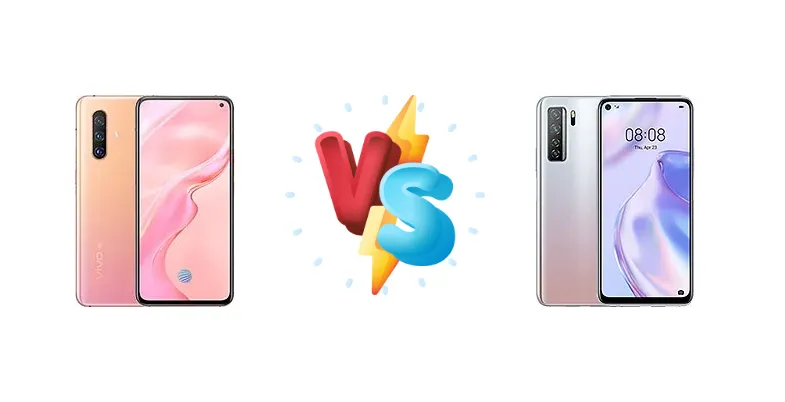
The vivo X30 and Huawei nova 7 SE 5G Youth represent compelling options in the increasingly competitive mid-range 5G smartphone market. While both aim to deliver a premium experience without the flagship price tag, they take different approaches, primarily centered around their respective chipsets and charging capabilities. This comparison dissects those differences to determine which device best suits your needs.
🏆 Quick Verdict
For the average user prioritizing faster charging and potentially better sustained performance, the Huawei nova 7 SE 5G Youth emerges as the stronger choice. Its Mediatek Dimensity 800U and 40W charging offer a tangible advantage over the vivo X30’s Exynos 980 and 33W charging, despite the X30’s slightly more mature software ecosystem.
| Network |
|---|
| 2G bands | GSM 850 / 900 / 1800 / 1900 | GSM 850 / 900 / 1800 / 1900 |
| 3G bands | HSDPA 850 / 900 / 1700(AWS) / 1900 / 2100 | HSDPA 800 / 850 / 900 / 1700(AWS) / 1900 / 2100 |
| 4G bands | 1, 2, 3, 4, 5, 7, 8, 34, 38, 39, 40, 41 | 1, 2, 3, 4, 5, 8, 18, 19, 26, 34, 38, 39, 40, 41 |
| 5G bands | 41, 78 SA/NSA | 1, 41, 77, 78 SA/NSA |
| Speed | HSPA, LTE, 5G (3.6+ Gbps DL) | HSPA, LTE, 5G |
| Technology | GSM / CDMA / HSPA / LTE / 5G | GSM / CDMA / HSPA / LTE / 5G |
| | CDMA 800 & TD-SCDMA | CDMA 800 & TD-SCDMA |
| Launch |
|---|
| Announced | 2019, December. Released 2019, December | 2020, October 16. Released 2020, October 16 |
| Status | Discontinued | Discontinued |
| Body |
|---|
| Build | Glass front, glass back, aluminum frame | - |
| Dimensions | 158.5 x 74.1 x 8.8 mm (6.24 x 2.92 x 0.35 in) | 162.3 x 75 x 8.6 mm (6.39 x 2.95 x 0.34 in) |
| SIM | Nano-SIM + Nano-SIM | Nano-SIM + Nano-SIM |
| Weight | 196.5 g (6.95 oz) | 189 g (6.67 oz) |
| Display |
|---|
| Resolution | 1080 x 2400 pixels, 20:9 ratio (~409 ppi density) | 1080 x 2400 pixels, 20:9 ratio (~405 ppi density) |
| Size | 6.44 inches, 100.1 cm2 (~85.3% screen-to-body ratio) | 6.5 inches, 102.0 cm2 (~83.8% screen-to-body ratio) |
| Type | Super AMOLED, HDR, 800 nits (typ) | IPS LCD, HDR10 |
| Platform |
|---|
| CPU | Octa-core (2x2.2 GHz Cortex-A77 & 6x1.8 GHz Cortex A55) | Octa-core (2x2.4 GHz Cortex-A76 & 6x2.0 GHz Cortex-A55) |
| Chipset | Exynos 980 (8 nm) | Mediatek Dimensity 800U (7 nm) |
| GPU | Mali-G76 MP5 | Mali-G57 MC3 |
| OS | Android 9.0 (Pie), Funtouch 10.0 | Android 10, EMUI 10.1, no Google Play Services |
| Memory |
|---|
| Card slot | No | No |
| Internal | 128GB 8GB RAM, 256GB 8GB RAM | 128GB 8GB RAM |
| | UFS 2.1 | - |
| Main Camera |
|---|
| Features | Laser AF, LED flash, HDR, panorama | LED flash, Panorama, HDR |
| Quad | 64 MP, f/1.8, 26mm (wide), 1/1.72", 0.8µm, PDAF, OIS
32 MP, f/2.0, 50mm (telephoto), 1/2.8", 0.8µm, PDAF, OIS, 2x optical zoom
8 MP, f/2.2, 16mm (ultrawide), 1/4.0", 1.12µm | 64 MP, f/1.8, 26mm (wide), PDAF
8 MP, f/2.4, 17mm (ultrawide)
2 MP (macro)
Auxiliary lens |
| Video | 4K@30fps | 4K@30fps, 1080p@30fps |
| Selfie camera |
|---|
| Features | HDR | HDR |
| Single | 32 MP, f/2.4, 26mm (wide), 1/2.8", 0.8µm | 16 MP, f/2.0, (wide) |
| Video | 1080p@30fps | 1080p@30fps |
| Sound |
|---|
| 3.5mm jack | Yes | Yes |
| 35mm jack | Yes | Yes |
| Loudspeaker | Yes | Yes |
| Comms |
|---|
| Bluetooth | 5.0, A2DP, LE | 5.1, A2DP, LE |
| NFC | Yes | No |
| Positioning | GPS, GLONASS, GALILEO, BDS | GPS, GLONASS, GALILEO, BDS, QZSS |
| Radio | FM radio | No |
| USB | USB Type-C, OTG | USB Type-C 2.0, OTG |
| WLAN | Wi-Fi 802.11 a/b/g/n/ac, dual-band, Wi-Fi Direct | Wi-Fi 802.11 a/b/g/n/ac, dual-band, Wi-Fi Direct |
| Features |
|---|
| Sensors | Fingerprint (under display, optical), accelerometer, gyro, proximity, compass | Fingerprint (side-mounted), accelerometer, proximity, compass |
| Battery |
|---|
| Charging | 33W wired | 40W wired, 70% in 30 min
5W reverse wired |
| Type | 4350 mAh, non-removable | Li-Po 4000 mAh |
| Misc |
|---|
| Colors | Black, Peach, Light Blue, Rainbow Shadow | Crush Green, Space Silver, Midnight Black, Purple |
| Models | V1938CT | CND-AN00 |
| Price | About 420 EUR | About 290 EUR |
vivo X30
- Potentially more refined software experience (depending on user preference)
- Established brand reputation
- Solid all-around performance
- Slower 33W charging
- Less efficient 8nm Exynos 980 chipset
- No reverse wireless charging
Huawei nova 7 SE 5G Youth
- Faster 40W charging with 70% in 30 minutes
- More efficient 7nm Dimensity 800U chipset
- 5W reverse wired charging
- Huawei app ecosystem limitations
- Image processing may not appeal to all users
- Software updates may be less frequent
Display Comparison
Detailed display specifications are unavailable, but both devices likely feature AMOLED panels common in this price bracket. The key difference lies under the hood. The Exynos 980 in the vivo X30, while capable, is built on an 8nm process, while the Dimensity 800U in the nova 7 SE 5G Youth utilizes a more efficient 7nm process. This translates to potentially better thermal management and slightly improved power efficiency for the Huawei device, indirectly impacting display-on battery life. Bezels and color accuracy are assumed to be comparable given the market segment.
Camera Comparison
Without detailed camera specs, a direct comparison is difficult. However, both phones likely feature multi-camera setups geared towards social media sharing. The focus should be on image processing. Huawei’s image processing is known for its vibrant, sometimes oversaturated, look, while vivo typically aims for a more natural color profile. Sensor size and aperture are critical, but unavailable. The presence of OIS (Optical Image Stabilization) would be a significant advantage for either device, but is unconfirmed.
Performance
The chipset battle is central here. The Huawei nova 7 SE 5G Youth’s Mediatek Dimensity 800U, with its 2x2.4 GHz Cortex-A76 cores, boasts a higher clock speed than the vivo X30’s Exynos 980 (2x2.2 GHz Cortex-A77). While core architecture isn’t a direct 1:1 comparison, the Dimensity 800U’s newer 7nm process gives it an edge in efficiency. The Exynos 980, while still a capable performer, may exhibit more thermal throttling under sustained load. Both phones utilize a 6x Cortex-A55 cluster for efficiency tasks. The Dimensity 800U’s integrated 5G modem is also a benefit, potentially offering more stable 5G connectivity.
Battery Life
The Huawei nova 7 SE 5G Youth’s 40W wired charging is a clear advantage, promising a 70% charge in just 30 minutes. The vivo X30’s 33W charging is respectable, but noticeably slower. While battery capacity isn’t specified, the Dimensity 800U’s 7nm efficiency could offset a potentially smaller battery in the nova 7 SE 5G Youth, resulting in comparable real-world battery life. The nova 7 SE 5G Youth also offers 5W reverse wired charging, a feature absent on the vivo X30.
Buying Guide
Buy the vivo X30 if you prioritize a potentially more refined software experience and are comfortable with slightly slower charging speeds. Buy the Huawei nova 7 SE 5G Youth if you value faster charging, potentially better sustained gaming performance, and a more modern chipset fabrication process, even if it means navigating Huawei’s app ecosystem.
Frequently Asked Questions
❓ Does the Exynos 980 in the vivo X30 overheat during prolonged gaming sessions?
The Exynos 980, being built on an 8nm process, is more prone to thermal throttling than the Dimensity 800U’s 7nm process. While it won’t necessarily overheat to the point of being unusable, expect some performance degradation after extended gaming sessions. The Huawei nova 7 SE 5G Youth is likely to maintain higher sustained performance.
❓ How significant is the difference between 33W and 40W charging in real-world use?
The 40W charging on the Huawei nova 7 SE 5G Youth is noticeably faster. Huawei claims 70% charge in 30 minutes, while the vivo X30 will take considerably longer. This difference is particularly beneficial for users who frequently need to top up their battery quickly.
❓ What are the implications of Huawei’s app ecosystem on the nova 7 SE 5G Youth?
Due to ongoing restrictions, the Huawei nova 7 SE 5G Youth does not have full access to the Google Play Store. Users rely on Huawei’s AppGallery and sideloading apps, which can be less convenient and may not offer the same level of app availability.
❓ Is the Dimensity 800U capable of running demanding games like PUBG Mobile at high frame rates?
Yes, the Dimensity 800U is well-equipped to handle PUBG Mobile at high frame rates (60fps). Its Mali-G57 MC4 GPU provides sufficient graphical power, and the 7nm process helps maintain stable performance during extended gaming sessions.