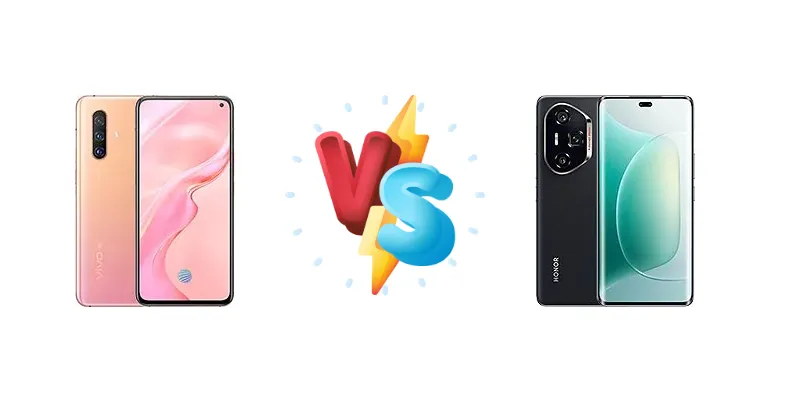
The vivo X30, released in late 2019, represented a solid mid-range offering. Now, the Honor 300 Ultra arrives as a modern flagship, boasting a significantly more powerful chipset and dramatically faster charging. This comparison dissects the core differences between these two devices, helping you determine if the newer model justifies its higher price point.
🏆 Quick Verdict
For the average user prioritizing performance and future-proofing, the Honor 300 Ultra is the clear winner. Its Snapdragon 8 Gen 3 chipset delivers a substantial performance uplift and superior efficiency compared to the vivo X30’s Exynos 980. However, the X30 remains a viable option for budget-conscious users with less demanding needs.
| Network |
|---|
| 2G bands | GSM 850 / 900 / 1800 / 1900 | GSM 850 / 900 / 1800 / 1900 |
| 3G bands | HSDPA 850 / 900 / 1700(AWS) / 1900 / 2100 | HSDPA 800 / 850 / 900 / 1700(AWS) / 1900 / 2100 |
| 4G bands | 1, 2, 3, 4, 5, 7, 8, 34, 38, 39, 40, 41 | LTE |
| 5G bands | 41, 78 SA/NSA | SA/NSA |
| Speed | HSPA, LTE, 5G (3.6+ Gbps DL) | HSPA, LTE, 5G |
| Technology | GSM / CDMA / HSPA / LTE / 5G | GSM / HSPA / LTE / 5G |
| | CDMA 800 & TD-SCDMA | - |
| Launch |
|---|
| Announced | 2019, December. Released 2019, December | 2024, December 02 |
| Status | Discontinued | Available. Released 2024, December 07 |
| Body |
|---|
| Build | Glass front, glass back, aluminum frame | Glass front, glass back or silicone polymer back (eco leather) |
| Dimensions | 158.5 x 74.1 x 8.8 mm (6.24 x 2.92 x 0.35 in) | 163.8 x 75.3 x 8.2 mm (6.45 x 2.96 x 0.32 in) |
| SIM | Nano-SIM + Nano-SIM | Nano-SIM + Nano-SIM |
| Weight | 196.5 g (6.95 oz) | 198 g (6.98 oz) |
| Display |
|---|
| Protection | - | Giant rhino glass |
| Resolution | 1080 x 2400 pixels, 20:9 ratio (~409 ppi density) | 1224 x 2700 pixels (~437 ppi density) |
| Size | 6.44 inches, 100.1 cm2 (~85.3% screen-to-body ratio) | 6.78 inches, 111.5 cm2 (~90.4% screen-to-body ratio) |
| Type | Super AMOLED, HDR, 800 nits (typ) | AMOLED, 1B colors, 120Hz, HDR, 1200 nits (HBM), 4000 nits (peak) |
| Platform |
|---|
| CPU | Octa-core (2x2.2 GHz Cortex-A77 & 6x1.8 GHz Cortex A55) | Octa-core (1x3.0 GHz Cortex-X4 & 5x2.95 GHz Cortex-A720 & 2x2.0 GHz Cortex-A520) |
| Chipset | Exynos 980 (8 nm) | Qualcomm SM8650-AB Snapdragon 8 Gen 3 (4 nm) |
| GPU | Mali-G76 MP5 | Adreno 750 |
| OS | Android 9.0 (Pie), Funtouch 10.0 | Android 15, MagicOS 9 |
| Memory |
|---|
| Card slot | No | No |
| Internal | 128GB 8GB RAM, 256GB 8GB RAM | 512GB 12GB RAM, 1TB 16GB RAM |
| | UFS 2.1 | - |
| Main Camera |
|---|
| Features | Laser AF, LED flash, HDR, panorama | LED flash, HDR, panorama |
| Quad | 64 MP, f/1.8, 26mm (wide), 1/1.72", 0.8µm, PDAF, OIS
32 MP, f/2.0, 50mm (telephoto), 1/2.8", 0.8µm, PDAF, OIS, 2x optical zoom
8 MP, f/2.2, 16mm (ultrawide), 1/4.0", 1.12µm | - |
| Triple | - | 50 MP, f/2.0, (wide), 1/1.56", 1.0µm, PDAF, OIS
50 MP, f/3.0, (periscope telephoto), 1/2.51", 0.7µm, PDAF, OIS, 3.8x optical zoom
12 MP, f/2.2, 112˚ (ultrawide), AF |
| Video | 4K@30fps | 4K, 1080p, gyro-EIS, OIS |
| Selfie camera |
|---|
| Dual | - | 50 MP, f/2.1, (wide)
2 MP, f/2.4, (depth) |
| Features | HDR | HDR |
| Single | 32 MP, f/2.4, 26mm (wide), 1/2.8", 0.8µm | - |
| Video | 1080p@30fps | 4K, 1080p, gyro-EIS |
| Sound |
|---|
| 3.5mm jack | Yes | - |
| 35mm jack | Yes | No |
| Loudspeaker | Yes | Yes, with stereo speakers |
| Comms |
|---|
| Bluetooth | 5.0, A2DP, LE | 5.3, A2DP, LE, aptX HD |
| Infrared port | - | Yes |
| NFC | Yes | Yes |
| Positioning | GPS, GLONASS, GALILEO, BDS | GPS, GALILEO, GLONASS, QZSS, BDS (B1I+B1c) |
| Radio | FM radio | No |
| USB | USB Type-C, OTG | USB Type-C 2.0, OTG |
| WLAN | Wi-Fi 802.11 a/b/g/n/ac, dual-band, Wi-Fi Direct | Wi-Fi 802.11 a/b/g/n/ac/6/7, dual-band, Wi-Fi Direct |
| Features |
|---|
| Sensors | Fingerprint (under display, optical), accelerometer, gyro, proximity, compass | Fingerprint (under display, ultrasonic), accelerometer, gyro, compass, ultrasound proximity |
| Battery |
|---|
| Charging | 33W wired | 100W wired, 59% in 15 min
80W wireless, 39% in 15 min
5W reverse wired
Reverse wireless |
| Type | 4350 mAh, non-removable | Si/C Li-Ion 5300 mAh |
| Misc |
|---|
| Colors | Black, Peach, Light Blue, Rainbow Shadow | Black, White |
| Models | V1938CT | - |
| Price | About 420 EUR | About 550 EUR |
vivo X30
- More affordable price point
- Compact and lightweight design (likely)
- Functional for basic smartphone tasks
- Outdated chipset with limited performance
- Slower charging speed
- Inferior camera capabilities
Honor 300 Ultra
- Exceptional performance with Snapdragon 8 Gen 3
- Ultra-fast 100W wired and 80W wireless charging
- Advanced camera system for high-quality photos and videos
- Higher price tag
- Potentially larger and heavier design
- May have features not needed by all users
Display Comparison
While specific display details for the vivo X30 (resolution, panel type) are not provided, it likely features a standard AMOLED panel. The Honor 300 Ultra, being a flagship, is expected to have a higher resolution display with potentially LTPO technology for adaptive refresh rates, improving battery life. The difference in display quality will be noticeable in brightness, color accuracy, and smoothness, benefiting content consumers on the Honor 300 Ultra.
Camera Comparison
Without detailed camera specs for the vivo X30, a direct comparison is limited. However, the Honor 300 Ultra, as a flagship, is expected to feature a more advanced camera system with a larger sensor, improved image stabilization (OIS), and more sophisticated image processing algorithms. The Snapdragon 8 Gen 3’s ISP (Image Signal Processor) also contributes to superior image quality, particularly in low-light conditions. While the X30 may suffice for casual photography, the Honor 300 Ultra will deliver significantly better results for enthusiasts.
Performance
The core difference lies in the chipsets. The vivo X30’s Exynos 980 (8nm) utilizes older Cortex-A77 and A55 cores. In contrast, the Honor 300 Ultra’s Snapdragon 8 Gen 3 (4nm) features the latest Cortex-X4 prime core and A720/A520 performance cores. This translates to a massive performance advantage for the Honor 300 Ultra in CPU-intensive tasks and gaming. The 4nm process node of the Snapdragon 8 Gen 3 also provides significantly better thermal efficiency, reducing throttling during sustained workloads. The Honor 300 Ultra will handle demanding games and applications with ease, while the X30 may struggle with newer titles at higher settings.
Battery Life
The vivo X30 offers 33W wired charging, a respectable speed for its time. The Honor 300 Ultra, however, leaps ahead with 100W wired charging, capable of adding 59% charge in just 15 minutes. It also includes 80W wireless charging and reverse wireless charging, features absent on the X30. While battery capacity isn’t specified for either device, the Honor 300 Ultra’s charging speed dramatically reduces downtime, making it ideal for users who need to quickly top up their battery. The efficiency gains from the 4nm Snapdragon 8 Gen 3 will also contribute to better overall battery life.
Buying Guide
Buy the vivo X30 if you need a functional, affordable smartphone for everyday tasks like browsing, social media, and light photography. It’s ideal for users who prioritize value and aren’t concerned with the latest gaming or demanding applications. Buy the Honor 300 Ultra if you prioritize top-tier performance, fast charging, and a smoother user experience, especially if you’re a mobile gamer or frequently use resource-intensive apps.
Frequently Asked Questions
❓ Does the Exynos 980 in the vivo X30 overheat during prolonged gaming sessions?
The Exynos 980, being an older 8nm chip, is more prone to thermal throttling than the Snapdragon 8 Gen 3. While it can handle casual gaming, extended sessions with demanding titles may lead to noticeable performance drops as the chip heats up. The Honor 300 Ultra's 4nm Snapdragon 8 Gen 3 will maintain higher sustained performance.
❓ How much faster is the 100W charging on the Honor 300 Ultra compared to the 33W charging on the vivo X30 in real-world use?
The Honor 300 Ultra's 100W charging is dramatically faster. It can add approximately 59% charge in 15 minutes, while the vivo X30's 33W charging will take considerably longer to achieve a similar charge level – likely over 45 minutes. This makes a significant difference for users who need a quick power boost.
❓ Will the Honor 300 Ultra run graphically intensive games like Genshin Impact at maximum settings?
Yes, the Snapdragon 8 Gen 3 in the Honor 300 Ultra is more than capable of running Genshin Impact and other demanding games at maximum settings with high frame rates. The X30's Exynos 980 would likely require significant graphical compromises to achieve playable frame rates.
❓ Is the difference in performance between these two phones noticeable for everyday tasks like browsing and social media?
While both phones can handle everyday tasks, the Honor 300 Ultra will provide a noticeably smoother and more responsive experience. App loading times will be faster, multitasking will be more fluid, and animations will be more seamless due to the superior processing power of the Snapdragon 8 Gen 3.