
vivo X200s vs Xiaomi 14T Pro: A Flagship Face-Off
| Phones Images | |||||
|---|---|---|---|---|---|
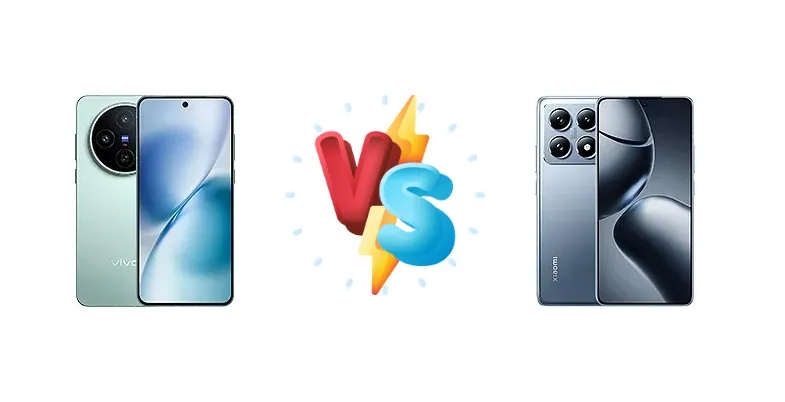
|
🏆 Quick Verdict
For users prioritizing raw processing power and future-proofing, the vivo X200s, with its Dimensity 9400+ chipset, emerges as the winner. However, the Xiaomi 14T Pro’s significantly faster 120W charging and proven battery life make it a strong contender for those valuing convenience and all-day usability.
| PHONES | ||
|---|---|---|
| Phone Names | vivo X200s | Xiaomi 14T Pro |
| Network | ||
|---|---|---|
| 2G bands | GSM 850 / 900 / 1800 / 1900 | GSM 850 / 900 / 1800 / 1900 |
| 3G bands | HSDPA 850 / 900 / 1700(AWS) / 1900 / 2100 | HSDPA 800 / 850 / 900 / 1700(AWS) / 1900 / 2100 |
| 4G bands | 1, 2, 3, 4, 5, 7, 8, 18, 19, 25, 26, 28, 34, 38, 39, 40, 41, 42, 43, 48, 66 | 1, 2, 3, 4, 5, 7, 8, 12, 13, 17, 18, 19, 20, 25, 26, 28, 32, 38, 39, 40, 41, 42, 48, 66 |
| 5G bands | 1, 2, 3, 5, 7, 8, 18, 25, 26, 28A, 34, 38, 39, 40, 41, 48, 66, 77, 78 SA/NSA/Sub6 | 1, 2, 3, 5, 7, 8, 12, 20, 25, 26, 28, 38, 40, 41, 48, 66, 75, 77, 78 SA/NSA |
| Speed | HSPA, LTE, 5G | HSPA, LTE, 5G |
| Technology | GSM / HSPA / LTE / 5G | GSM / HSPA / LTE / 5G |
| Launch | ||
|---|---|---|
| Announced | 2025, April 21 | 2024, September 26 |
| Status | Available. Released 2025, April 25 | Available. Released 2024, September 26 |
| Body | ||
|---|---|---|
| Build | - | Glass front (Gorilla Glass 5), aluminum frame, glass back (Panda X) |
| Dimensions | 160 x 74.3 x 8 mm (6.30 x 2.93 x 0.31 in) | 160.4 x 75.1 x 8.4 mm (6.31 x 2.96 x 0.33 in) |
| SIM | · Nano-SIM + Nano-SIM + eSIM (max 2 at a time)· Nano-SIM + Nano-SIM | · Nano-SIM + eSIM· eSIM + eSIM· Nano-SIM + Nano-SIM |
| Weight | 203 g (7.16 oz) | 209 g (7.37 oz) |
| Display | ||
|---|---|---|
| Protection | - | Corning Gorilla Glass 5 |
| Resolution | 1260 x 2800 pixels, 20:9 ratio (~460 ppi density) | 1220 x 2712 pixels, 20:9 ratio (~446 ppi density) |
| Size | 6.67 inches, 107.4 cm2 (~90.4% screen-to-body ratio) | 6.67 inches, 107.4 cm2 (~89.1% screen-to-body ratio) |
| Type | AMOLED, 1B colors, 120Hz, 2160Hz PWM, HDR10+, HDR Vivid, 5000 nits (peak) | AMOLED, 68B colors, 144Hz, 3840Hz PWM, Dolby Vision, HDR10+, 1600 nits (HBM), 4000 nits (peak) |
| Platform | ||
|---|---|---|
| CPU | Octa-core (1x3.73 GHz Cortex-X925 & 3x3.3 GHz Cortex-X4 & 4x2.4 GHz Cortex-A720) | Octa-core (1x3.4 GHz Cortex-X4 & 3x2.85 GHz Cortex-X4 & 4x2.0 GHz Cortex-A720) |
| Chipset | Mediatek Dimensity 9400+ (3 nm) | Mediatek Dimensity 9300+ (4 nm) |
| GPU | Immortalis-G925 | Immortalis-G720 MC12 |
| OS | Android 15, up to 4 major Android upgrades, Funtouch 15 (International), OriginOS 5 (China) | Android 14, HyperOS |
| Memory | ||
|---|---|---|
| Card slot | No | No |
| Internal | 256GB 12GB RAM, 256GB 16GB RAM, 512GB 12GB RAM, 512GB 16GB RAM, 1TB 16GB RAM | 256GB 12GB RAM, 512GB 12GB RAM, 512GB 16GB RAM, 1TB 12GB RAM |
| Main Camera | ||
|---|---|---|
| Features | Laser AF, Zeiss optics, Zeiss T* lens coating, LED flash, panorama, HDR, 3D LUT import | Leica lens, Ultra HDR, LED flash, HDR, panorama |
| Triple | 50 MP, f/1.6, 23mm (wide), 1/1.56", PDAF, OIS 50 MP, f/2.6, 70mm (periscope telephoto), 1/1.95", PDAF, OIS, 3x optical zoom 50 MP, f/2.0, 15mm, 119˚ (ultrawide), 1/2.76", 0.64µm, AF | 50 MP, f/1.6, 23mm (wide), 1/1.31", 1.2µm, PDAF, OIS 50 MP, f/2.0, 60mm (telephoto), 1/2.88", 0.61µm, PDAF, 2.6x optical zoom 12 MP, f/2.2, 15mm (ultrawide), 1/3.06", 1.12µm |
| Video | 4K@30/60fps, 1080p@30/60/120/240fps, gyro-EIS | 8K@24/30fps, 4K@24/30/60fps, 1080p@30/60/120/240/960fps, gyro-EIS, 10-bit Rec. 2020, HDR10+ |
| Selfie camera | ||
|---|---|---|
| Features | HDR | HDR |
| Single | 32 MP, f/2.0, 20mm (ultrawide) | 32 MP, f/2.0, 25mm (wide), 1/3.44", 0.64µm |
| Video | 4K@30/60fps, 1080p@30/60fps | 4K@30fps, 1080p@30/60fps, HDR10+ |
| Sound | ||
|---|---|---|
| 35mm jack | No | No |
| Loudspeaker | Yes, with stereo speakers | Yes, with stereo speakers |
| Comms | ||
|---|---|---|
| Bluetooth | 5.4, A2DP, LE, aptX HD, LHDC 5 | 5.4, A2DP, LE, LHDC |
| Infrared port | Yes | Yes |
| NFC | Yes | Yes (market/region dependent) |
| Positioning | GPS (L1+L5), GLONASS (L1), BDS (B1I+B1c+B2a+B2b), GALILEO (E1+E5a+E5b), QZSS (L1+L5), NavIC (L1+L5) | GPS (L1+L5), BDS (B1I+B1C+B2a+B2b), GALILEO (E1+E5a+E5b), QZSS (L1+L5), NavIC (L5), GLONASS |
| Radio | No | No |
| USB | USB Type-C 2.0, OTG | USB Type-C 2.0, OTG |
| WLAN | Wi-Fi 802.11 a/b/g/n/ac/6/7, dual-band | Wi-Fi 802.11 a/b/g/n/ac/6e/7, dual-band, Wi-Fi Direct |
| Features | ||
|---|---|---|
| Sensors | Fingerprint (under display, ultrasonic), accelerometer, gyro, proximity, compass | Fingerprint (under display, optical), accelerometer, gyro, proximity, compass |
| Battery | ||
|---|---|---|
| Charging | 90W wired 40W wireless Reverse wired | 120W wired, PD3.0, QC4, 100% in 19 min 50W wireless, 100% in 45 min |
| Type | Si/C Li-Ion 6200 mAh | Li-Po 5000 mAh |
| Misc | ||
|---|---|---|
| Colors | Gray, Silver, Mint, Purple | Titan Gray, Titan Blue, Titan Black |
| Models | V2458A | 2407FPN8EG |
| Price | About 510 EUR | $ 550.00 / £ 498.00 / € 539.99 |
| SAR EU | - | 0.99 W/kg (head) 1.00 W/kg (body) |
vivo X200s
- Potentially superior CPU performance with Dimensity 9400+
- More advanced CPU core configuration
- 3nm process for improved efficiency
- Slower wired charging (90W vs 120W)
- Battery capacity currently unknown
- Display specifications not yet available
Xiaomi 14T Pro
- Ultra-fast 120W wired charging
- Bright 1228 nit display
- Proven 12:32h battery life
- Older Dimensity 9300+ chipset
- Less advanced CPU core configuration
- 4nm process less efficient than 3nm
Display Comparison
The Xiaomi 14T Pro boasts a measured peak brightness of 1228 nits, ensuring excellent visibility even in direct sunlight. While the X200s’ display specifications are currently unavailable, vivo typically employs high-quality AMOLED panels. The 14T Pro’s brightness advantage is a tangible benefit for outdoor use. The absence of LTPO information for the X200s suggests the 14T Pro may offer more adaptive refresh rate control, potentially improving battery life. Color accuracy and delta-E values remain unknown for both, requiring further testing.
Camera Comparison
Without detailed camera specifications for the X200s, a direct comparison is limited. However, both phones are expected to feature multi-camera systems. The Xiaomi 14T Pro’s image processing is known for its vibrant, often saturated, color profiles. The X200s, leveraging the newer chipset’s ISP, may offer improved computational photography capabilities and potentially better low-light performance. Sensor size and OIS implementation will be crucial differentiating factors, but remain unknown for the X200s at this time. We can assume both will offer capable main sensors, but the X200s’ ISP could provide an edge in dynamic range and detail.
Performance
The core difference lies in the chipsets: the vivo X200s utilizes the Mediatek Dimensity 9400+ (3nm) while the Xiaomi 14T Pro features the Dimensity 9300+ (4nm). The 9400+’s Cortex-X925 core, clocked at 3.73 GHz, represents a significant architectural leap over the 9300+'s 3.4 GHz Cortex-X4. This, combined with the 3nm process, should translate to superior single-core performance and improved power efficiency. The X200s also benefits from a more diverse core configuration (1xX925, 3xX4, 4xA720) compared to the 14T Pro’s (1xX4, 3xX4, 4xA720). While both utilize LPDDR5x RAM, the X200s’ chipset advantage will likely result in smoother multitasking and faster app loading times.
Battery Life
The Xiaomi 14T Pro’s 120W wired charging is a standout feature, achieving a full charge in just 19 minutes. This is significantly faster than the vivo X200s’ 90W charging. While the X200s offers 40W wireless charging, the 14T Pro’s 50W wireless charging is also competitive, reaching 100% in 45 minutes. The 14T Pro’s active use battery score of 12:32h demonstrates solid endurance. The X200s’ battery capacity is currently unknown, but the more efficient Dimensity 9400+ could potentially offset a smaller battery size. However, the 14T Pro’s charging speed provides a significant convenience advantage.
Buying Guide
Buy the vivo X200s if you demand the absolute best CPU performance for demanding tasks like video editing, high-end gaming, or running complex applications. Its newer chipset architecture offers a performance edge. Buy the Xiaomi 14T Pro if you prioritize rapid charging, a consistently bright display, and a well-rounded experience without sacrificing performance – it’s the pragmatic choice for power users who don’t want to be tethered to a charger.