
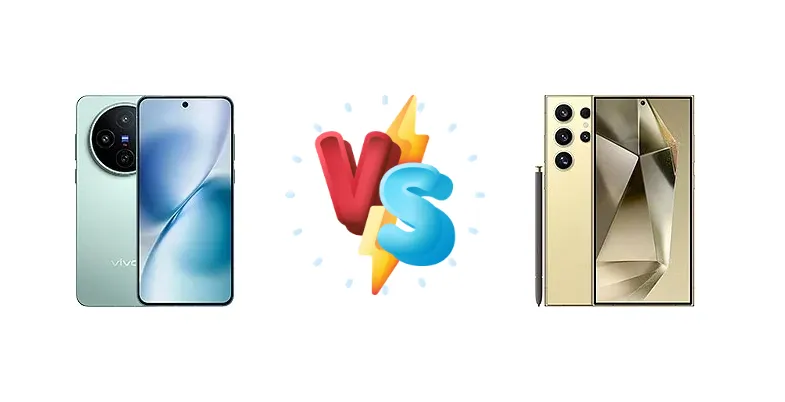
vivo X200s vs Samsung Galaxy S24 Ultra: A Flagship Face-Off
| Phones Images | |||||
|---|---|---|---|---|---|
|
🏆 Quick Verdict
For the average user prioritizing a well-rounded experience with exceptional battery life and a mature software ecosystem, the Samsung Galaxy S24 Ultra remains the safer bet. However, the vivo X200s’ Dimensity 9400+ offers a compelling performance advantage for demanding users, especially gamers, and its faster charging is a significant benefit.
| PHONES | ||
|---|---|---|
| Phone Names | vivo X200s | Samsung Galaxy S24 Ultra |
| Network | ||
|---|---|---|
| 2G bands | GSM 850 / 900 / 1800 / 1900 | GSM 850 / 900 / 1800 / 1900 |
| 3G bands | HSDPA 850 / 900 / 1700(AWS) / 1900 / 2100 | HSDPA 850 / 900 / 1700(AWS) / 1900 / 2100 |
| 4G bands | 1, 2, 3, 4, 5, 7, 8, 18, 19, 25, 26, 28, 34, 38, 39, 40, 41, 42, 43, 48, 66 | 1, 2, 3, 4, 5, 7, 8, 12, 13, 17, 18, 19, 20, 25, 26, 28, 32, 38, 39, 40, 41, 66 - International |
| 5G bands | 1, 2, 3, 5, 7, 8, 18, 25, 26, 28A, 34, 38, 39, 40, 41, 48, 66, 77, 78 SA/NSA/Sub6 | 1, 2, 3, 5, 7, 8, 12, 20, 25, 26, 28, 38, 40, 41, 66, 75, 77, 78 SA/NSA/Sub6 - International |
| Speed | HSPA, LTE, 5G | HSPA, LTE (up to 7CA), 5G |
| Technology | GSM / HSPA / LTE / 5G | GSM / CDMA / HSPA / EVDO / LTE / 5G |
| Launch | ||
|---|---|---|
| Announced | 2025, April 21 | 2024, January 17 |
| Status | Available. Released 2025, April 25 | Available. Released 2024, January 24 |
| Body | ||
|---|---|---|
| Build | - | Glass front (Corning Gorilla Armor), glass back (Corning Gorilla Armor), titanium frame (grade 2) |
| Dimensions | 160 x 74.3 x 8 mm (6.30 x 2.93 x 0.31 in) | 162.3 x 79 x 8.6 mm (6.39 x 3.11 x 0.34 in) |
| SIM | · Nano-SIM + Nano-SIM + eSIM (max 2 at a time)· Nano-SIM + Nano-SIM | · Nano-SIM + Nano-SIM + eSIM + eSIM (max 2 at a time) - INT· Nano-SIM + eSIM + eSIM (max 2 at a time) - USA· Nano-SIM + Nano-SIM - CN |
| Weight | 203 g (7.16 oz) | 232 g or 233 g (8.18 oz) |
| Display | ||
|---|---|---|
| Protection | - | Corning Gorilla Armor |
| Resolution | 1260 x 2800 pixels, 20:9 ratio (~460 ppi density) | 1440 x 3120 pixels, 19.5:9 ratio (~505 ppi density) |
| Size | 6.67 inches, 107.4 cm2 (~90.4% screen-to-body ratio) | 6.8 inches, 113.5 cm2 (~88.5% screen-to-body ratio) |
| Type | AMOLED, 1B colors, 120Hz, 2160Hz PWM, HDR10+, HDR Vivid, 5000 nits (peak) | Dynamic LTPO AMOLED 2X, 120Hz, HDR10+, 2600 nits (peak) |
| Platform | ||
|---|---|---|
| CPU | Octa-core (1x3.73 GHz Cortex-X925 & 3x3.3 GHz Cortex-X4 & 4x2.4 GHz Cortex-A720) | 8-core (1x3.39GHz Cortex-X4 & 3x3.1GHz Cortex-A720 & 2x2.9GHz Cortex-A720 & 2x2.2GHz Cortex-A520) |
| Chipset | Mediatek Dimensity 9400+ (3 nm) | Qualcomm SM8650-AC Snapdragon 8 Gen 3 (4 nm) |
| GPU | Immortalis-G925 | Adreno 750 (1 GHz) |
| OS | Android 15, up to 4 major Android upgrades, Funtouch 15 (International), OriginOS 5 (China) | Android 14, up to 7 major Android upgrades, One UI 8.0 |
| Memory | ||
|---|---|---|
| Card slot | No | No |
| Internal | 256GB 12GB RAM, 256GB 16GB RAM, 512GB 12GB RAM, 512GB 16GB RAM, 1TB 16GB RAM | 256GB 12GB RAM, 512GB 12GB RAM, 1TB 12GB RAM |
| Main Camera | ||
|---|---|---|
| Features | Laser AF, Zeiss optics, Zeiss T* lens coating, LED flash, panorama, HDR, 3D LUT import | Laser AF, LED flash, auto-HDR, panorama |
| Quad | - | 200 MP, f/1.7, 24mm (wide), 1/1.3", 0.6µm, multi-directional PDAF, OIS 10 MP, f/2.4, 67mm (telephoto), 1/3.52", 1.12µm, PDAF, OIS, 3x optical zoom 50 MP, f/3.4, 111mm (periscope telephoto), 1/2.52", 0.7µm, PDAF, OIS, 5x optical zoom 12 MP, f/2.2, 13mm, 120˚ (ultrawide), 1/2.55", 1.4µm, dual pixel PDAF, Super Steady video |
| Triple | 50 MP, f/1.6, 23mm (wide), 1/1.56", PDAF, OIS 50 MP, f/2.6, 70mm (periscope telephoto), 1/1.95", PDAF, OIS, 3x optical zoom 50 MP, f/2.0, 15mm, 119˚ (ultrawide), 1/2.76", 0.64µm, AF | - |
| Video | 4K@30/60fps, 1080p@30/60/120/240fps, gyro-EIS | 8K@24/30fps, 4K@30/60/120fps, 1080p@30/60/120/240fps, HDR10+, stereo sound rec., gyro-EIS |
| Selfie camera | ||
|---|---|---|
| Features | HDR | HDR, HDR10+ |
| Single | 32 MP, f/2.0, 20mm (ultrawide) | 12 MP, f/2.2, 26mm (wide), 1/3.2", 1.12µm, dual pixel PDAF |
| Video | 4K@30/60fps, 1080p@30/60fps | 4K@30/60fps, 1080p@30fps |
| Sound | ||
|---|---|---|
| 35mm jack | No | No |
| Loudspeaker | Yes, with stereo speakers | Yes, with stereo speakers |
| Comms | ||
|---|---|---|
| Bluetooth | 5.4, A2DP, LE, aptX HD, LHDC 5 | 5.3, A2DP, LE |
| Infrared port | Yes | - |
| NFC | Yes | Yes |
| Positioning | GPS (L1+L5), GLONASS (L1), BDS (B1I+B1c+B2a+B2b), GALILEO (E1+E5a+E5b), QZSS (L1+L5), NavIC (L1+L5) | GPS, GLONASS, BDS, GALILEO, QZSS |
| Radio | No | No |
| USB | USB Type-C 2.0, OTG | USB Type-C 3.2, DisplayPort 1.2, OTG |
| WLAN | Wi-Fi 802.11 a/b/g/n/ac/6/7, dual-band | Wi-Fi 802.11 a/b/g/n/ac/6e/7, tri-band, Wi-Fi Direct |
| Features | ||
|---|---|---|
| Sensors | Fingerprint (under display, ultrasonic), accelerometer, gyro, proximity, compass | Fingerprint (under display, ultrasonic), accelerometer, gyro, proximity, compass, barometer |
| Battery | ||
|---|---|---|
| Charging | 90W wired 40W wireless Reverse wired | 45W wired, PD3.0, 65% in 30 min 15W wireless (Qi) 4.5W reverse wireless |
| Type | Si/C Li-Ion 6200 mAh | Li-Ion 5000 mAh |
| Misc | ||
|---|---|---|
| Colors | Gray, Silver, Mint, Purple | Titanium Black, Titanium Gray, Titanium Violet, Titanium Yellow, Titanium Blue, Titanium Green, Titanium Orange |
| Models | V2458A | SM-S928B, SM-S928B/DS, SM-S928U, SM-S928U1, SM-S928W, SM-S928N, SM-S9280, SM-S928E, SM-S928E/DS |
| Price | About 510 EUR | $ 514.94 / C$ 929.99 / £ 630.00 / € 658.53 / ₹ 84,999 |
| SAR | - | 1.26 W/kg (head) 0.62 W/kg (body) |
| SAR EU | - | 1.06 W/kg (head) 1.30 W/kg (body) |
vivo X200s
- Potentially superior CPU performance with Dimensity 9400+
- Significantly faster 90W wired charging
- 40W wireless charging and reverse wired charging capabilities
- Software experience may be less refined than Samsung’s One UI
- Camera performance is currently unknown and unproven
Samsung Galaxy S24 Ultra
- Exceptional battery life (13:49h active use)
- Industry-leading camera system and image processing
- Polished and feature-rich One UI software experience
- Slower 45W wired charging
- Snapdragon 8 Gen 3 may throttle under sustained load
Display Comparison
The Samsung Galaxy S24 Ultra boasts a peak brightness of 1447 nits, ensuring excellent visibility even in direct sunlight. While the X200s’ display specs are currently unavailable, Samsung’s display technology is known for its color accuracy and LTPO capabilities, allowing for dynamic refresh rate scaling to conserve battery. The S24 Ultra’s higher peak brightness is a clear advantage for outdoor use, and its established display calibration provides a more consistent viewing experience. We anticipate the X200s will need to match or exceed these specs to compete effectively.
Camera Comparison
The Samsung Galaxy S24 Ultra is renowned for its versatile camera system, though specific details require a full review. It’s expected to excel in both photo and video capture, leveraging advanced image processing algorithms. The vivo X200s’ camera specifications are currently unknown, but a flagship device at this price point is expected to feature a high-resolution main sensor and robust image stabilization. The S24 Ultra’s established reputation for consistent image quality and video recording capabilities gives it a significant advantage, particularly in challenging lighting conditions. We'll need to see the X200s' sensor size and processing pipeline to assess its true capabilities.
Performance
The core difference lies in the chipsets: the vivo X200s utilizes the 3nm MediaTek Dimensity 9400+ with a Cortex-X925 prime core clocked at 3.73 GHz, while the S24 Ultra features the 4nm Qualcomm Snapdragon 8 Gen 3 with a Cortex-X4 prime core at 3.39 GHz. The Dimensity 9400+'s higher clock speed and newer architecture suggest a potential edge in CPU-intensive tasks. However, the Snapdragon 8 Gen 3 benefits from Qualcomm’s optimized software and thermal management. The S24 Ultra’s 8-core configuration, while slightly slower on the prime core, features more efficient A720 cores, potentially leading to sustained performance. The X200s’ advantage will be most noticeable in benchmarks and tasks that heavily utilize the CPU.
Battery Life
The Samsung Galaxy S24 Ultra delivers an impressive 13:49 hours of active use, demonstrating excellent battery endurance. The vivo X200s compensates with significantly faster charging: 90W wired, 40W wireless, and reverse wired charging. The S24 Ultra offers 45W wired, 15W wireless, and 4.5W reverse wireless. While the X200s’ battery capacity is unknown, its 90W charging allows for a much quicker top-up, potentially mitigating any capacity disadvantage. The S24 Ultra prioritizes longevity, while the X200s prioritizes convenience.
Buying Guide
Buy the vivo X200s if you prioritize peak CPU performance for demanding tasks like video editing or gaming, and value incredibly fast 90W charging. You’re willing to accept a potentially less refined software experience for cutting-edge hardware. Buy the Samsung Galaxy S24 Ultra if you prefer a polished, feature-rich experience with industry-leading camera capabilities, exceptional battery endurance, and a guaranteed long-term software support commitment.