
vivo X200 vs iQOO 12 Pro: A Deep Dive into Flagship Performance and Charging
| Phones Images | |||||
|---|---|---|---|---|---|
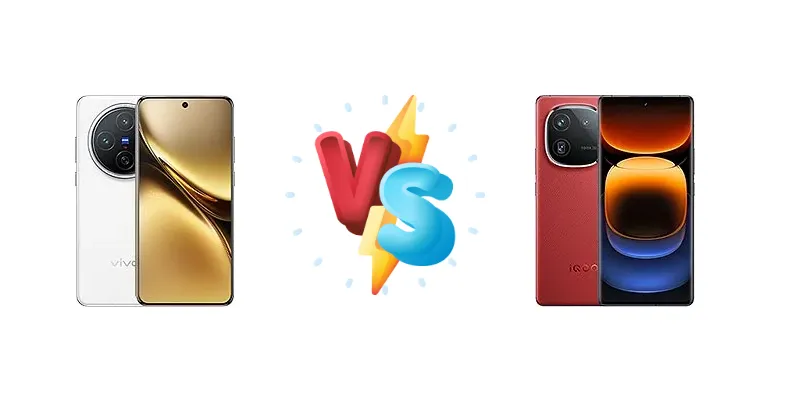
|
🏆 Quick Verdict
For the average user prioritizing sustained performance and a balanced experience, the vivo X200 edges out the iQOO 12 Pro. The Dimensity 9400’s 3nm process and active use battery life of 14:51h suggest better thermal management and longevity, despite the iQOO 12 Pro’s faster charging.
| PHONES | ||
|---|---|---|
| Phone Names | vivo X200 | vivo iQOO 12 Pro |
| Network | ||
|---|---|---|
| 2G bands | GSM 850 / 900 / 1800 / 1900 | GSM 850 / 900 / 1800 / 1900 |
| 3G bands | HSDPA 850 / 900 / 1700(AWS) / 1900 / 2100 - International | HSDPA 800 / 850 / 900 / 1700(AWS) / 1900 / 2100 |
| 4G bands | 1, 2, 3, 4, 5, 7, 8, 12, 17, 18, 19, 20, 26, 28, 32, 38, 39, 40, 41, 42 - International | 1, 2, 3, 4, 5, 7, 8, 12, 17, 18, 19, 20, 25, 26, 28, 34, 38, 39, 40, 41, 42, 66 |
| 5G bands | 1, 3, 5, 7, 8, 20, 26, 28, 38, 40, 41, 75, 77, 78 SA/NSA/Sub6 - International | 1, 2, 3, 5, 7, 8, 12, 20, 25, 26, 28, 66, 38, 40, 41, 77, 78 SA/NSA |
| Speed | HSPA, LTE, 5G | HSPA, LTE, 5G |
| Technology | GSM / HSPA / LTE / 5G | GSM / CDMA / HSPA / CDMA2000 / LTE / 5G |
| Launch | ||
|---|---|---|
| Announced | 2024, October 14 | 2023, November 07 |
| Status | Available. Released 2024, October 19 | Available. Released 2023, November 14 |
| Body | ||
|---|---|---|
| Build | Glass front, aluminum alloy frame, glass back or fiber-reinforced plastic back | - |
| Dimensions | 160.3 x 74.8 x 8 mm (6.31 x 2.94 x 0.31 in) | 164.6 x 75.4 x 8.6 mm or 8.8 mm |
| SIM | · Nano-SIM + Nano-SIM + eSIM (max 2 at a time)· Nano-SIM + Nano-SIM | Nano-SIM + Nano-SIM |
| Weight | 197 g or 202 g (6.95 oz) | 205 g or 210 g (7.23 oz) |
| Display | ||
|---|---|---|
| Protection | Schott Xensation Alpha | - |
| Resolution | 1260 x 2800 pixels, 20:9 ratio (~460 ppi density) | 1440 x 3200 pixels, 20:9 ratio (~518 ppi density) |
| Size | 6.67 inches, 107.4 cm2 (~89.6% screen-to-body ratio) | 6.78 inches, 111.0 cm2 (~89.4% screen-to-body ratio) |
| Type | AMOLED, 1B colors, 120Hz, 2160Hz PWM, HDR10+, 4500 nits (peak) | LTPO AMOLED, 1B colors, 144Hz, HDR10+, 1600 nits (HBM), 3000 nits (peak) |
| Platform | ||
|---|---|---|
| CPU | Octa-core (1x3.63 GHz Cortex-X925 & 3x3.3 GHz Cortex-X4 & 4x2.4 GHz Cortex-A720) | Octa-core (1x3.3 GHz Cortex-X4 & 3x3.2 GHz Cortex-A720 & 2x3.0 GHz Cortex-A720 & 2x2.3 GHz Cortex-A520) |
| Chipset | Mediatek Dimensity 9400 (3 nm) | Qualcomm SM8650-AB Snapdragon 8 Gen 3 (4 nm) |
| GPU | Immortalis-G925 | Adreno 750 |
| OS | Android 15, up to 4 major Android upgrades, Funtouch 15 (International), OriginOS 5 (China) | Android 14, up to 2 major Android upgrades, Funtouch 14 (International), OriginOS 4 (China) |
| Memory | ||
|---|---|---|
| Card slot | No | No |
| Internal | 256GB 12GB RAM, 512GB 12GB RAM, 512GB 16GB RAM, 1TB 16GB RAM | 256GB 16GB RAM, 512GB 16GB RAM, 1TB 16GB RAM |
| Main Camera | ||
|---|---|---|
| Features | Laser AF, Zeiss optics, Zeiss T* lens coating, LED flash, panorama, HDR, 3D LUT import | Color spectrum sensor, Dual-LED flash, HDR, panorama |
| Triple | 50 MP, f/1.6, 23mm (wide), 1/1.56", PDAF, OIS 50 MP, f/2.6, 70mm (periscope telephoto), 1/1.95", PDAF, OIS, 3x optical zoom 50 MP, f/2.0, 15mm, 119˚ (ultrawide), 1/2.76", 0.64µm, AF | 50 MP, f/1.7, 23mm (wide), 1/1.3", 1.2µm, ulti-directional PDAF, OIS 64 MP, f/2.6, 70mm (periscope telephoto), 1/2.0", PDAF, OIS, 3x optical zoom 50 MP, f/2.0, 15mm, 119˚ (ultrawide), AF |
| Video | 4K@30/60fps, 1080p@30/60/120/240fps, gyro-EIS | 8K@30fps, 4K@24/30/60fps, 1080p@30/60/120/240fps, gyro-EIS |
| Selfie camera | ||
|---|---|---|
| Features | HDR | HDR |
| Single | 32 MP, f/2.0, 20mm (ultrawide) | 16 MP, f/2.5, (wide) |
| Video | 4K@30/60fps, 1080p@30/60fps | 1080p@30fps, gyro-EIS |
| Sound | ||
|---|---|---|
| 35mm jack | No | No |
| Loudspeaker | Yes, with stereo speakers | Yes, with stereo speakers |
| Comms | ||
|---|---|---|
| Bluetooth | 5.4, A2DP, LE, aptX HD, LHDC 5 | 5.4, A2DP, LE, aptX HD, aptX Adaptive, aptX Lossless |
| Infrared port | Yes | Yes |
| NFC | Yes | Yes |
| Positioning | GPS (L1+L5), GLONASS (L1), BDS (B1I+B1c+B2a+B2b), GALILEO (E1+E5a+E5b), QZSS (L1+L5), NavIC (L5) | GPS (L1+L5), GLONASS (G1), BDS (B1I+B1c+B2a), GALILEO (E1+E5a), QZSS (L1+L5) |
| Radio | No | No |
| USB | USB Type-C 2.0, OTG | USB Type-C 2.0, OTG |
| WLAN | Wi-Fi 802.11 a/b/g/n/ac/6/7, dual-band | Wi-Fi 802.11 a/b/g/n/ac/6/7, tri-band, Wi-Fi Direct |
| Features | ||
|---|---|---|
| Sensors | Fingerprint (under display, optical), accelerometer, gyro, proximity, compass | Fingerprint (under display, ultrasonic), accelerometer, gyro, proximity, compass |
| Battery | ||
|---|---|---|
| Charging | 90W wired Reverse wired | 120W wired 50W wireless 10W reverse wireless |
| Type | Market-dependent versions:· Si/C Li-Ion 5800 mAh (Global)· Li-Ion 5220 mAh (Austria) | 5100 mAh |
| Misc | ||
|---|---|---|
| Colors | Natural Green (Aurora Green), Cosmos Black, Blue, White, Titanium | Black, Red, White (BMW M branding) |
| Models | V2415A, V2405A, V2415 | V2329A |
| Price | About 1030 EUR | About 650 EUR |
| SAR | 1.00 W/kg (head) 0.78 W/kg (body) | - |
vivo X200
- Superior battery life (14:51h active use)
- More efficient 3nm Dimensity 9400 chipset
- Brighter display (1563 nits)
- Slower charging speeds (90W wired)
- Potentially less powerful GPU compared to Snapdragon
vivo iQOO 12 Pro
- Blazing-fast 120W wired charging
- 50W wireless charging
- Powerful Snapdragon 8 Gen 3 chipset
- Potentially more thermal throttling under sustained load
- Likely shorter battery life compared to X200
Display Comparison
The vivo X200 boasts a display capable of reaching 1563 nits of peak brightness, ensuring excellent visibility even in direct sunlight. While the iQOO 12 Pro’s display specs aren’t provided, iQOO typically focuses on high refresh rates and color accuracy. The X200’s brightness advantage is significant, and the absence of LTPO information for the iQOO 12 Pro suggests it may not be as dynamically power-efficient in varying content. This impacts battery life, especially for users who consume a lot of video.
Camera Comparison
Without detailed camera specifications, a direct comparison is difficult. However, both phones likely feature high-resolution main sensors and optical image stabilization (OIS). The iQOO series often emphasizes computational photography, while vivo’s X series leans towards natural color reproduction. The absence of information regarding sensor sizes makes it impossible to determine which phone has a clear advantage in low-light performance. We can assume both will offer excellent image quality, but the processing style will likely differ.
Performance
The core difference lies in the chipsets: the vivo X200 utilizes the Mediatek Dimensity 9400 (3nm) with a unique CPU configuration (1x3.63 GHz Cortex-X925, 3x3.3 GHz Cortex-X4, 4x2.4 GHz Cortex-A720), while the iQOO 12 Pro features the Qualcomm Snapdragon 8 Gen 3 (4nm) (1x3.3 GHz Cortex-X4, 3x3.2 GHz Cortex-A720, 2x3.0 GHz Cortex-A720, 2x2.3 GHz Cortex-A520). The Dimensity 9400’s 3nm process gives it a theoretical efficiency advantage over the Snapdragon 8 Gen 3’s 4nm node, potentially leading to less heat generation under sustained load. The X200’s Cortex-X925 core is also newer and potentially more performant than the X4 in the Snapdragon. However, Qualcomm’s optimizations and Adreno GPU typically deliver superior graphics performance.
Battery Life
The vivo X200 achieves an impressive 14:51h of active use, indicating excellent battery life. The iQOO 12 Pro compensates with significantly faster charging: 120W wired, 50W wireless, and 10W reverse wireless, compared to the X200’s 90W wired and reverse wired. While the iQOO 12 Pro’s battery capacity isn’t specified, the faster charging speeds are a major draw for users who frequently need to top up their phones. The X200’s longer runtime, however, reduces the need for frequent charging.
Buying Guide
Buy the vivo X200 if you need a phone that prioritizes long-term sustained performance during demanding tasks like video editing or extended gaming sessions, and value efficient power consumption. Buy the vivo iQOO 12 Pro if you prefer the absolute fastest charging speeds available (120W wired, 50W wireless) and need peak performance for short bursts, even if it means potentially more aggressive thermal throttling.