
vivo X200 vs Samsung Galaxy S24 FE: A Deep Dive into Performance and Value
| Phones Images | |||||
|---|---|---|---|---|---|
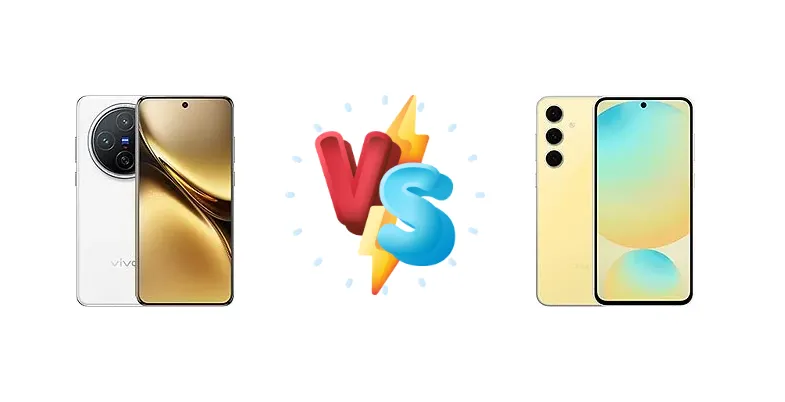
|
🏆 Quick Verdict
For users prioritizing raw performance and incredibly fast charging, the vivo X200 takes the lead. Its Dimensity 9400 chipset and 90W charging are significant advantages. However, the Samsung Galaxy S24 FE offers a more balanced package with exceptional battery endurance and a proven track record, making it the better choice for most users.
| PHONES | ||
|---|---|---|
| Phone Names | vivo X200 | Samsung Galaxy S24 FE |
| Network | ||
|---|---|---|
| 2G bands | GSM 850 / 900 / 1800 / 1900 | GSM 850 / 900 / 1800 / 1900 |
| 3G bands | HSDPA 850 / 900 / 1700(AWS) / 1900 / 2100 - International | HSDPA 850 / 900 / 1700(AWS) / 1900 / 2100 |
| 4G bands | 1, 2, 3, 4, 5, 7, 8, 12, 17, 18, 19, 20, 26, 28, 32, 38, 39, 40, 41, 42 - International | 1, 2, 3, 4, 5, 7, 8, 12, 17, 18, 19, 20, 25, 26, 28, 32, 38, 40, 41, 66 - International |
| 5G bands | 1, 3, 5, 7, 8, 20, 26, 28, 38, 40, 41, 75, 77, 78 SA/NSA/Sub6 - International | 1, 2, 3, 5, 7, 8, 12, 20, 25, 26, 28, 38, 40, 41, 66, 75, 77, 78 SA/NSA/Sub6 - International |
| Speed | HSPA, LTE, 5G | HSPA, LTE, 5G |
| Technology | GSM / HSPA / LTE / 5G | GSM / HSPA / LTE / 5G |
| Launch | ||
|---|---|---|
| Announced | 2024, October 14 | 2024, September 26 |
| Status | Available. Released 2024, October 19 | Available. Released 2024, October 03 |
| Body | ||
|---|---|---|
| Build | Glass front, aluminum alloy frame, glass back or fiber-reinforced plastic back | Glass front (Gorilla Glass Victus+), glass back (Gorilla Glass Victus+), aluminum frame |
| Dimensions | 160.3 x 74.8 x 8 mm (6.31 x 2.94 x 0.31 in) | 162 x 77.3 x 8 mm (6.38 x 3.04 x 0.31 in) |
| SIM | · Nano-SIM + Nano-SIM + eSIM (max 2 at a time)· Nano-SIM + Nano-SIM | · Nano-SIM· Nano-SIM + Nano-SIM· Nano-SIM + eSIM· eSIM + eSIM |
| Weight | 197 g or 202 g (6.95 oz) | 213 g (7.51 oz) |
| Display | ||
|---|---|---|
| Protection | Schott Xensation Alpha | Corning Gorilla Glass Victus+, Mohs level 5 |
| Resolution | 1260 x 2800 pixels, 20:9 ratio (~460 ppi density) | 1080 x 2340 pixels, 19.5:9 ratio (~385 ppi density) |
| Size | 6.67 inches, 107.4 cm2 (~89.6% screen-to-body ratio) | 6.7 inches, 110.2 cm2 (~88.0% screen-to-body ratio) |
| Type | AMOLED, 1B colors, 120Hz, 2160Hz PWM, HDR10+, 4500 nits (peak) | Dynamic AMOLED 2X, 120Hz, HDR10+, 1900 nits (peak) |
| Platform | ||
|---|---|---|
| CPU | Octa-core (1x3.63 GHz Cortex-X925 & 3x3.3 GHz Cortex-X4 & 4x2.4 GHz Cortex-A720) | 10-core (1x3.1 GHz + 2x2.9 GHz + 3x2.6 GHz + 4x1.95 GHz) |
| Chipset | Mediatek Dimensity 9400 (3 nm) | Exynos 2400e (4 nm) |
| GPU | Immortalis-G925 | Xclipse 940 |
| OS | Android 15, up to 4 major Android upgrades, Funtouch 15 (International), OriginOS 5 (China) | Android 14, up to 7 major Android upgrades, One UI 8.0 |
| Memory | ||
|---|---|---|
| Card slot | No | No |
| Internal | 256GB 12GB RAM, 512GB 12GB RAM, 512GB 16GB RAM, 1TB 16GB RAM | 128GB 8GB RAM, 256GB 8GB RAM, 512GB 8GB RAM |
| Main Camera | ||
|---|---|---|
| Features | Laser AF, Zeiss optics, Zeiss T* lens coating, LED flash, panorama, HDR, 3D LUT import | LED flash, HDR, panorama |
| Triple | 50 MP, f/1.6, 23mm (wide), 1/1.56", PDAF, OIS 50 MP, f/2.6, 70mm (periscope telephoto), 1/1.95", PDAF, OIS, 3x optical zoom 50 MP, f/2.0, 15mm, 119˚ (ultrawide), 1/2.76", 0.64µm, AF | 50 MP, f/1.8, 24mm (wide), 1/1.57", 1.0µm, dual pixel PDAF, OIS 8 MP, f/2.4, 75mm (telephoto), 1/4.4", 1.0µm, PDAF, OIS, 3x optical zoom 12 MP, f/2.2, 13mm, 123˚ (ultrawide), 1/3.0", 1.12µm |
| Video | 4K@30/60fps, 1080p@30/60/120/240fps, gyro-EIS | 8K@30fps, 4K@30/60/120fps, 1080p@30/60/120/240fps |
| Selfie camera | ||
|---|---|---|
| Features | HDR | - |
| Single | 32 MP, f/2.0, 20mm (ultrawide) | 10 MP, f/2.4, 26mm (wide), 1/3.0", 1.22µm |
| Video | 4K@30/60fps, 1080p@30/60fps | 4K@30/60fps, 1080p@30/60fps; gyro-EIS |
| Sound | ||
|---|---|---|
| 35mm jack | No | No |
| Loudspeaker | Yes, with stereo speakers | Yes, with stereo speakers |
| Comms | ||
|---|---|---|
| Bluetooth | 5.4, A2DP, LE, aptX HD, LHDC 5 | 5.3, A2DP, LE |
| Infrared port | Yes | - |
| NFC | Yes | Yes |
| Positioning | GPS (L1+L5), GLONASS (L1), BDS (B1I+B1c+B2a+B2b), GALILEO (E1+E5a+E5b), QZSS (L1+L5), NavIC (L5) | GPS, GLONASS, GALILEO, BDS |
| Radio | No | Unspecified |
| USB | USB Type-C 2.0, OTG | USB Type-C 3.2, OTG |
| WLAN | Wi-Fi 802.11 a/b/g/n/ac/6/7, dual-band | Wi-Fi 802.11 a/b/g/n/ac/6e, dual-band or tri-band (market/region dependent), Wi-Fi Direct |
| Features | ||
|---|---|---|
| Sensors | Fingerprint (under display, optical), accelerometer, gyro, proximity, compass | Fingerprint (under display, optical), accelerometer, gyro, compass |
| Battery | ||
|---|---|---|
| Charging | 90W wired Reverse wired | 25W wired, PD, QC2, 50% in 30 min 15W wireless Reverse wireless |
| Type | Market-dependent versions:· Si/C Li-Ion 5800 mAh (Global)· Li-Ion 5220 mAh (Austria) | 4700 mAh |
| Misc | ||
|---|---|---|
| Colors | Natural Green (Aurora Green), Cosmos Black, Blue, White, Titanium | Blue, Graphite, Gray, Mint, Yellow |
| Models | V2415A, V2405A, V2415 | SM-S721B, SM-S721B/DS, SM-S721U1, SM-S721U, SM-S721W, SM-S7210, SM-S721N |
| Price | About 1030 EUR | $ 249.74 / C$ 498.99 / £ 335.00 / € 387.00 / ₹ 34,180 |
| SAR | 1.00 W/kg (head) 0.78 W/kg (body) | 0.94 W/kg (head) 0.71 W/kg (body) |
| SAR EU | - | 0.86 W/kg (head) 1.29 W/kg (body) |
| EU LABEL | ||
|---|---|---|
| Battery | - | 42:00h endurance, 2000 cycles |
| Energy | - | Class B |
| Free fall | - | Class A (270 falls) |
| Repairability | - | Class C |
vivo X200
- Significantly faster charging (90W)
- Potentially superior CPU performance with Dimensity 9400
- Brighter display for outdoor visibility
- Shorter battery endurance compared to S24 FE
- Brand recognition is lower than Samsung
Samsung Galaxy S24 FE
- Exceptional battery life and longevity (42:00h endurance, 2000 cycles)
- Well-established Samsung ecosystem and software support
- Proven camera performance with Samsung’s image processing
- Slower charging speed (25W)
- Less powerful chipset compared to Dimensity 9400
Display Comparison
The vivo X200 boasts a brighter display, reaching a measured 1563 nits compared to the Galaxy S24 FE’s 1372 nits. This translates to better visibility under direct sunlight. While both likely utilize OLED panels, the X200’s higher peak brightness is a clear advantage. We lack PWM frequency data, but the X200’s focus on display tech suggests a potentially more advanced panel. The S24 FE benefits from Samsung’s established display calibration expertise, likely offering accurate colors out of the box, but the X200’s raw brightness gives it an edge for outdoor use.
Camera Comparison
Without detailed camera specs, it’s difficult to make a definitive judgment. However, the focus should be on the main sensor and image processing. We assume both phones will feature multi-camera systems, but the quality of the primary sensor is paramount. The X200’s positioning suggests a focus on image quality, potentially utilizing a larger sensor. Samsung’s image processing is generally well-regarded, producing vibrant and shareable photos. The S24 FE likely benefits from Samsung’s computational photography expertise, but the X200’s potential for a superior sensor could give it an edge in low-light performance. We’ll disregard the likely inclusion of low-resolution macro lenses on both devices.
Performance
The core difference lies in the chipsets. The vivo X200’s Mediatek Dimensity 9400, built on a 3nm process, features a unique CPU configuration with a Cortex-X925 prime core, suggesting a focus on peak performance. The Samsung Galaxy S24 FE’s Exynos 2400e, on a 4nm node, employs a 10-core setup. While core count isn’t everything, the Dimensity 9400’s newer architecture and smaller process node should deliver superior performance and efficiency. The X200’s CPU configuration (1x3.63 GHz Cortex-X925, 3x3.3 GHz Cortex-X4, 4x2.4 GHz Cortex-A720) is geared towards handling demanding tasks, while the Exynos 2400e (1x3.1 GHz + 2x2.9 GHz + 3x2.6 GHz + 4x1.95 GHz) appears more balanced. Thermal management will be crucial for the Exynos 2400e, as previous Exynos chips have been prone to throttling under sustained load.
Battery Life
The Samsung Galaxy S24 FE boasts an impressive 42:00h endurance and 2000 charge cycles, indicating exceptional longevity and battery health retention. While the vivo X200 offers a respectable active use score of 14:51h, it falls short of the S24 FE. However, the X200 compensates with blazing-fast 90W wired charging, significantly reducing downtime. The S24 FE’s 25W charging, while supporting PD and QC2, is considerably slower. The X200 can likely achieve a full charge in under 40 minutes, while the S24 FE takes closer to 90 minutes. The S24 FE’s reverse wireless charging is a convenience feature, but the X200 also offers reverse wired charging, potentially providing faster power delivery to accessories.
Buying Guide
Buy the vivo X200 if you need uncompromising processing power for demanding games and applications, and value the fastest possible charging speeds. You’re a power user who prioritizes benchmarks and future-proofing. Buy the Samsung Galaxy S24 FE if you prefer a phone with exceptional all-day battery life, a well-rounded camera system, and the established ecosystem of Samsung’s One UI. You value reliability and longevity over bleeding-edge specs.