
vivo X200 vs Honor Magic6 Pro: A Deep Dive into Flagship Performance
| Phones Images | |||||
|---|---|---|---|---|---|
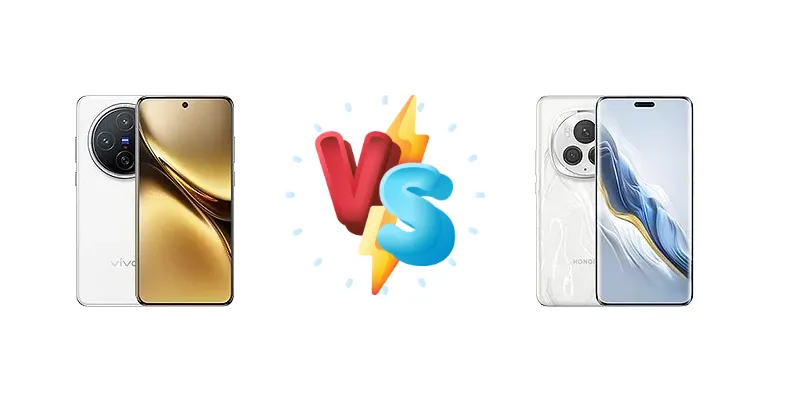
|
🏆 Quick Verdict
For the average user prioritizing raw performance and slightly longer battery life, the vivo X200 emerges as the winner. Its Dimensity 9400 chipset delivers a measurable performance edge, and the 14:51 active use score provides a bit more endurance. However, the Honor Magic6 Pro’s wireless charging and slightly brighter display are compelling alternatives.
| PHONES | ||
|---|---|---|
| Phone Names | vivo X200 | Honor Magic6 Pro |
| Network | ||
|---|---|---|
| 2G bands | GSM 850 / 900 / 1800 / 1900 | GSM 850 / 900 / 1800 / 1900 |
| 3G bands | HSDPA 850 / 900 / 1700(AWS) / 1900 / 2100 - International | HSDPA 800 / 850 / 900 / 1700(AWS) / 1900 / 2100 |
| 4G bands | 1, 2, 3, 4, 5, 7, 8, 12, 17, 18, 19, 20, 26, 28, 32, 38, 39, 40, 41, 42 - International | LTE |
| 5G bands | 1, 3, 5, 7, 8, 20, 26, 28, 38, 40, 41, 75, 77, 78 SA/NSA/Sub6 - International | SA/NSA |
| Speed | HSPA, LTE, 5G | HSPA, LTE, 5G |
| Technology | GSM / HSPA / LTE / 5G | GSM / CDMA / HSPA / CDMA2000 / LTE / 5G |
| Launch | ||
|---|---|---|
| Announced | 2024, October 14 | 2024, January 11 |
| Status | Available. Released 2024, October 19 | Available. Released 2024, January 18 |
| Body | ||
|---|---|---|
| Build | Glass front, aluminum alloy frame, glass back or fiber-reinforced plastic back | Glass front (NanoCrystal Shield), glass back or silicone polymer back (eco leather) |
| Dimensions | 160.3 x 74.8 x 8 mm (6.31 x 2.94 x 0.31 in) | 162.5 x 75.8 x 8.9 mm (6.40 x 2.98 x 0.35 in) |
| SIM | · Nano-SIM + Nano-SIM + eSIM (max 2 at a time)· Nano-SIM + Nano-SIM | · Nano-SIM + eSIM· Nano-SIM + Nano-SIM |
| Weight | 197 g or 202 g (6.95 oz) | 225 g or 229 g (7.94 oz) |
| Display | ||
|---|---|---|
| Protection | Schott Xensation Alpha | NanoCrystal Shield |
| Resolution | 1260 x 2800 pixels, 20:9 ratio (~460 ppi density) | 1280 x 2800 pixels, 19.5:9 ratio (~453 ppi density) |
| Size | 6.67 inches, 107.4 cm2 (~89.6% screen-to-body ratio) | 6.8 inches, 112.8 cm2 (~91.6% screen-to-body ratio) |
| Type | AMOLED, 1B colors, 120Hz, 2160Hz PWM, HDR10+, 4500 nits (peak) | LTPO OLED, 1B colors, 120Hz, Dolby Vision, HDR, 1600 nits (HBM), 5000 nits (peak) |
| Platform | ||
|---|---|---|
| CPU | Octa-core (1x3.63 GHz Cortex-X925 & 3x3.3 GHz Cortex-X4 & 4x2.4 GHz Cortex-A720) | Octa-core (1x3.3 GHz Cortex-X4 & 3x3.2 GHz Cortex-A720 & 2x3.0 GHz Cortex-A720 & 2x2.3 GHz Cortex-A520) |
| Chipset | Mediatek Dimensity 9400 (3 nm) | Qualcomm SM8650-AB Snapdragon 8 Gen 3 (4 nm) |
| GPU | Immortalis-G925 | Adreno 750 |
| OS | Android 15, up to 4 major Android upgrades, Funtouch 15 (International), OriginOS 5 (China) | Android 14, up to 4 major Android upgrades, MagicOS 8 |
| Memory | ||
|---|---|---|
| Card slot | No | No |
| Internal | 256GB 12GB RAM, 512GB 12GB RAM, 512GB 16GB RAM, 1TB 16GB RAM | 256GB 12GB RAM, 256GB 16GB RAM, 512GB 12GB RAM, 512GB 16GB RAM, 1TB 16GB RAM |
| Main Camera | ||
|---|---|---|
| Features | Laser AF, Zeiss optics, Zeiss T* lens coating, LED flash, panorama, HDR, 3D LUT import | Laser AF, color spectrum sensor, LED flash, HDR, panorama |
| Triple | 50 MP, f/1.6, 23mm (wide), 1/1.56", PDAF, OIS 50 MP, f/2.6, 70mm (periscope telephoto), 1/1.95", PDAF, OIS, 3x optical zoom 50 MP, f/2.0, 15mm, 119˚ (ultrawide), 1/2.76", 0.64µm, AF | 50 MP, f/1.4-2.0, 23mm (wide), 1/1.3", 1.2µm, PDAF, OIS 180 MP, f/2.6, (periscope telephoto), 1/1.49", 0.56µm, PDAF, OIS, 2.5x optical zoom 50 MP, f/2.0, 13mm, 122˚ (ultrawide), 1/2.88", 0.61µm, AF |
| Video | 4K@30/60fps, 1080p@30/60/120/240fps, gyro-EIS | 4K@24/30/60fps, 1080p@30/60/120/240fps, gyro-EIS, OIS, HDR, 10-bit video |
| Selfie camera | ||
|---|---|---|
| Features | HDR | - |
| Single | 32 MP, f/2.0, 20mm (ultrawide) | 50 MP, f/2.0, 22mm (wide), 1/2.93", 0.6µm, AF TOF 3D, (depth/biometrics sensor) |
| Video | 4K@30/60fps, 1080p@30/60fps | 4K@30fps, 1080p@30/60fps, gyro-EIS |
| Sound | ||
|---|---|---|
| 35mm jack | No | No |
| Loudspeaker | Yes, with stereo speakers | Yes, with stereo speakers |
| Comms | ||
|---|---|---|
| Bluetooth | 5.4, A2DP, LE, aptX HD, LHDC 5 | 5.3, A2DP, LE, aptX HD |
| Infrared port | Yes | Yes |
| NFC | Yes | Yes |
| Positioning | GPS (L1+L5), GLONASS (L1), BDS (B1I+B1c+B2a+B2b), GALILEO (E1+E5a+E5b), QZSS (L1+L5), NavIC (L5) | GPS (L1+L5), GLONASS, BDS (B1I+B1c+B2a), GALILEO (E1+E5a) |
| Radio | No | No |
| USB | USB Type-C 2.0, OTG | USB Type-C 3.2, DisplayPort 1.2, OTG |
| WLAN | Wi-Fi 802.11 a/b/g/n/ac/6/7, dual-band | Wi-Fi 802.11 a/b/g/n/ac/6/7, dual-band, Wi-Fi Direct |
| Features | ||
|---|---|---|
| Sensors | Fingerprint (under display, optical), accelerometer, gyro, proximity, compass | Fingerprint (under display, optical), Face ID, accelerometer, gyro, proximity, compass |
| Battery | ||
|---|---|---|
| Charging | 90W wired Reverse wired | 80W wired 66W wireless Reverse wireless 5W reverse wired |
| Type | Market-dependent versions:· Si/C Li-Ion 5800 mAh (Global)· Li-Ion 5220 mAh (Austria) | Si/C Li-Ion 5600 mAh |
| Misc | ||
|---|---|---|
| Colors | Natural Green (Aurora Green), Cosmos Black, Blue, White, Titanium | Black, Green, Blue, Purple, White |
| Models | V2415A, V2405A, V2415 | BVL-AN16, BVL-N49 |
| Price | About 1030 EUR | € 455.54 / $ 899.00 / £ 598.99 |
| SAR | 1.00 W/kg (head) 0.78 W/kg (body) | - |
vivo X200
- Superior CPU performance with Dimensity 9400
- Slightly longer battery life in active use
- Faster 90W wired charging
- Lacks wireless charging
- Lower peak display brightness compared to Magic6 Pro
Honor Magic6 Pro
- Brighter display for outdoor visibility
- Convenient 66W wireless charging
- Established brand reputation
- Slightly lower CPU performance
- Shorter battery life in active use
Display Comparison
Both the vivo X200 and Honor Magic6 Pro boast exceptional displays, with measured peak brightness reaching 1563 nits and 1578 nits respectively. While the Magic6 Pro edges out the X200 in peak brightness, the difference is likely imperceptible in most real-world scenarios. Both are expected to utilize LTPO technology for adaptive refresh rates, conserving battery life. The absence of detailed panel specifications (like PWM frequency) prevents a full assessment of eye comfort, but both manufacturers typically employ high-quality panels in their flagship devices.
Camera Comparison
Without detailed camera specifications, a direct comparison is limited. However, both brands are known for their imaging prowess. The focus should be on sensor size and image processing algorithms. The absence of information regarding sensor sizes makes it difficult to determine a clear winner. Both phones likely employ advanced computational photography techniques to enhance image quality, but their approaches may differ, resulting in distinct aesthetic styles. The inclusion of OIS (Optical Image Stabilization) is expected on the main sensors of both devices, minimizing blur in low-light conditions.
Performance
The core difference lies in the chipsets. The vivo X200’s MediaTek Dimensity 9400, built on a 3nm process, features a unique CPU configuration with 1x3.63 GHz Cortex-X925, 3x3.3 GHz Cortex-X4, and 4x2.4 GHz Cortex-A720 cores. This contrasts with the Honor Magic6 Pro’s Qualcomm Snapdragon 8 Gen 3 (4nm) with 1x3.3 GHz Cortex-X4, 3x3.2 GHz Cortex-A720, 2x3.0 GHz Cortex-A720, and 2x2.3 GHz Cortex-A520 cores. The Dimensity 9400’s higher clock speeds on its prime cores suggest a potential advantage in single-core performance, crucial for responsive UI and app loading. The 4nm process of the Snapdragon 8 Gen 3 offers excellent efficiency, but the 3nm Dimensity 9400 should theoretically provide even better thermal management under sustained load. Both devices are expected to feature ample LPDDR5x RAM, ensuring smooth multitasking.
Battery Life
The vivo X200 achieves an active use battery score of 14:51h, slightly surpassing the Honor Magic6 Pro’s 14:06h. This suggests the Dimensity 9400’s efficiency, despite its higher performance, contributes to better endurance. The X200 supports 90W wired charging, enabling rapid replenishment, while the Magic6 Pro offers 80W wired charging. The Honor Magic6 Pro distinguishes itself with 66W wireless charging and 5W reverse wired charging, providing greater versatility. While the X200 offers reverse wired charging, the wattage is unspecified. The combination of faster wired charging and slightly longer battery life gives the X200 a slight edge in this category.
Buying Guide
Buy the vivo X200 if you need uncompromising CPU performance for demanding tasks like video editing or gaming, and value the fastest possible wired charging. Buy the Honor Magic6 Pro if you prioritize wireless charging convenience, a marginally brighter display for outdoor visibility, and a more established brand reputation in certain markets.