
vivo X200 vs Google Pixel 8a: A Deep Dive into Performance, Battery, and Value
| Phones Images | |||||
|---|---|---|---|---|---|
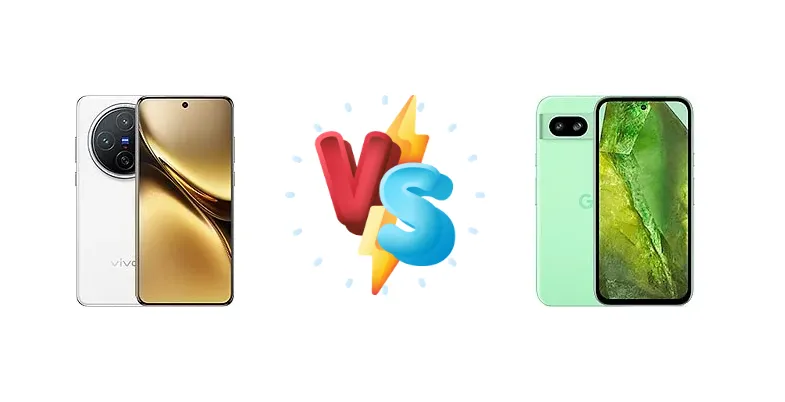
|
🏆 Quick Verdict
For users prioritizing raw performance and rapid charging, the vivo X200 is the clear winner. However, the Google Pixel 8a excels in battery life, offering over double the endurance, and provides a more refined software experience with Google's AI features, making it the better all-rounder for most.
| PHONES | ||
|---|---|---|
| Phone Names | vivo X200 | Google Pixel 8a |
| Network | ||
|---|---|---|
| 2G bands | GSM 850 / 900 / 1800 / 1900 | GSM 850 / 900 / 1800 / 1900 |
| 3G bands | HSDPA 850 / 900 / 1700(AWS) / 1900 / 2100 - International | HSDPA 800 / 850 / 900 / 1700(AWS) / 1900 / 2100 |
| 4G bands | 1, 2, 3, 4, 5, 7, 8, 12, 17, 18, 19, 20, 26, 28, 32, 38, 39, 40, 41, 42 - International | 1, 2, 3, 4, 5, 7, 8, 12, 17, 18, 19, 20, 26, 28, 32, 38, 40, 41, 42, 66 - G6GPR (International) |
| 5G bands | 1, 3, 5, 7, 8, 20, 26, 28, 38, 40, 41, 75, 77, 78 SA/NSA/Sub6 - International | 1, 2, 3, 5, 7, 8, 12, 20, 26, 28, 38, 40, 41, 66, 75, 76, 77, 78 SA/NSA/Sub6 - G6GPR (International) |
| Speed | HSPA, LTE, 5G | HSPA, LTE, 5G |
| Technology | GSM / HSPA / LTE / 5G | GSM / HSPA / LTE / 5G |
| Launch | ||
|---|---|---|
| Announced | 2024, October 14 | 2024, May 07 |
| Status | Available. Released 2024, October 19 | Available. Released 2024, May 14 |
| Body | ||
|---|---|---|
| Build | Glass front, aluminum alloy frame, glass back or fiber-reinforced plastic back | Glass front (Gorilla Glass 3), aluminum frame, plastic back |
| Dimensions | 160.3 x 74.8 x 8 mm (6.31 x 2.94 x 0.31 in) | 152.1 x 72.7 x 8.9 mm (5.99 x 2.86 x 0.35 in) |
| SIM | · Nano-SIM + Nano-SIM + eSIM (max 2 at a time)· Nano-SIM + Nano-SIM | Nano-SIM + eSIM |
| Weight | 197 g or 202 g (6.95 oz) | 188 g (6.63 oz) |
| Display | ||
|---|---|---|
| Protection | Schott Xensation Alpha | Corning Gorilla Glass 3, Mohs level 5 |
| Resolution | 1260 x 2800 pixels, 20:9 ratio (~460 ppi density) | 1080 x 2400 pixels, 20:9 ratio (~430 ppi density) |
| Size | 6.67 inches, 107.4 cm2 (~89.6% screen-to-body ratio) | 6.1 inches, 90.3 cm2 (~81.6% screen-to-body ratio) |
| Type | AMOLED, 1B colors, 120Hz, 2160Hz PWM, HDR10+, 4500 nits (peak) | OLED, HDR, 120Hz, 2000 nits (peak) |
| Platform | ||
|---|---|---|
| CPU | Octa-core (1x3.63 GHz Cortex-X925 & 3x3.3 GHz Cortex-X4 & 4x2.4 GHz Cortex-A720) | Nona-core (1x3.0 GHz Cortex-X3 & 4x2.45 GHz Cortex-A715 & 4x2.15 GHz Cortex-A510) |
| Chipset | Mediatek Dimensity 9400 (3 nm) | Google Tensor G3 (4 nm) |
| GPU | Immortalis-G925 | Immortalis-G715s MC10 |
| OS | Android 15, up to 4 major Android upgrades, Funtouch 15 (International), OriginOS 5 (China) | Android 14, upgradable to Android 16, up to 7 major Android upgrades |
| Memory | ||
|---|---|---|
| Card slot | No | No |
| Internal | 256GB 12GB RAM, 512GB 12GB RAM, 512GB 16GB RAM, 1TB 16GB RAM | 128GB 8GB RAM, 256GB 8GB RAM |
| Main Camera | ||
|---|---|---|
| Dual | - | 64 MP (16 MP eff.), f/1.9, 26mm (wide), 1/1.73", 0.8µm, dual pixel PDAF, OIS 13 MP, f/2.2, 120˚ (ultrawide), 1.12µm |
| Features | Laser AF, Zeiss optics, Zeiss T* lens coating, LED flash, panorama, HDR, 3D LUT import | Dual-LED flash, Pixel Shift, Ultra HDR, panorama, Best Take |
| Triple | 50 MP, f/1.6, 23mm (wide), 1/1.56", PDAF, OIS 50 MP, f/2.6, 70mm (periscope telephoto), 1/1.95", PDAF, OIS, 3x optical zoom 50 MP, f/2.0, 15mm, 119˚ (ultrawide), 1/2.76", 0.64µm, AF | - |
| Video | 4K@30/60fps, 1080p@30/60/120/240fps, gyro-EIS | 4K@30/60fps, 1080p@30/60/120/240fps, OIS |
| Selfie camera | ||
|---|---|---|
| Features | HDR | HDR, panorama |
| Single | 32 MP, f/2.0, 20mm (ultrawide) | 13 MP, f/2.2, 20mm (ultrawide), 1.12µm |
| Video | 4K@30/60fps, 1080p@30/60fps | 4K@30fps, 1080p@30/60fps |
| Sound | ||
|---|---|---|
| 35mm jack | No | No |
| Loudspeaker | Yes, with stereo speakers | Yes, with stereo speakers |
| Comms | ||
|---|---|---|
| Bluetooth | 5.4, A2DP, LE, aptX HD, LHDC 5 | 5.3, A2DP, LE |
| Infrared port | Yes | - |
| NFC | Yes | Yes |
| Positioning | GPS (L1+L5), GLONASS (L1), BDS (B1I+B1c+B2a+B2b), GALILEO (E1+E5a+E5b), QZSS (L1+L5), NavIC (L5) | GPS, GLONASS, GALILEO, BDS, QZSS, NavIC |
| Radio | No | No |
| USB | USB Type-C 2.0, OTG | USB Type-C 3.2 |
| WLAN | Wi-Fi 802.11 a/b/g/n/ac/6/7, dual-band | Wi-Fi 802.11 a/b/g/n/ac/6e, dual/tri-band (market/region dependent) |
| Features | ||
|---|---|---|
| Sensors | Fingerprint (under display, optical), accelerometer, gyro, proximity, compass | Fingerprint (under display, optical), accelerometer, gyro, proximity, compass, barometer |
| Battery | ||
|---|---|---|
| Charging | 90W wired Reverse wired | 18W wired, PD3.0 7.5W wireless Bypass charging |
| Type | Market-dependent versions:· Si/C Li-Ion 5800 mAh (Global)· Li-Ion 5220 mAh (Austria) | Li-Po 4492 mAh |
| Misc | ||
|---|---|---|
| Colors | Natural Green (Aurora Green), Cosmos Black, Blue, White, Titanium | Obsidian, Porcelain, Bay, Aloe |
| Models | V2415A, V2405A, V2415 | GKV4X, G6GPR, G8HHN, G576D |
| Price | About 1030 EUR | $ 229.98 / C$ 417.99 / £ 279.00 / € 299.99 / ₹ 33,300 |
| SAR | 1.00 W/kg (head) 0.78 W/kg (body) | - |
| EU LABEL | ||
|---|---|---|
| Battery | - | 40:06h endurance, 1000 cycles |
| Energy | - | Class B |
| Free fall | - | Class A (270 falls) |
| Repairability | - | Class B |
vivo X200
- Blazing-fast performance with Dimensity 9400
- Ultra-fast 90W wired charging
- High peak display brightness
- Significantly shorter battery life
- Software experience may not match Pixel's refinement
Google Pixel 8a
- Exceptional battery life (40+ hours endurance)
- Google's AI-powered software features
- Excellent camera image processing
- Slower charging speed (18W)
- Less powerful chipset compared to Dimensity 9400
Display Comparison
Both the vivo X200 and Google Pixel 8a feature excellent displays, achieving comparable peak brightness levels at 1563 nits and 1508 nits respectively. This ensures excellent visibility even in direct sunlight. While neither specification details refresh rate, the X200’s focus on performance suggests a higher refresh rate is likely, potentially offering smoother scrolling and animations. The Pixel 8a’s display is known for its color accuracy, a hallmark of Google’s displays, while the X200 may prioritize vibrancy.
Camera Comparison
While detailed camera specs are absent, the Pixel 8a is renowned for its computational photography prowess, leveraging Google’s image processing algorithms to deliver consistently excellent results. The X200, while potentially featuring a higher resolution sensor, will rely more on hardware capabilities. The Pixel 8a’s strength lies in dynamic range and low-light performance, while the X200 may offer more flexibility with manual controls. Without sensor size data, it’s difficult to definitively declare a winner, but the Pixel’s software advantage is substantial.
Performance
The core difference lies in the chipsets. The vivo X200’s Mediatek Dimensity 9400, built on a 3nm process, boasts an octa-core configuration with a high-clocked Cortex-X925 prime core at 3.63 GHz. This contrasts with the Google Pixel 8a’s Google Tensor G3 (4nm) nona-core setup, topped by a Cortex-X3 at 3.0 GHz. The Dimensity 9400’s newer architecture and smaller process node suggest a significant performance advantage, particularly in CPU-intensive tasks. However, the Tensor G3 benefits from Google’s software optimization and dedicated AI processing capabilities, potentially excelling in machine learning tasks. The X200’s likely LPDDR5x RAM pairing will further enhance its performance.
Battery Life
Battery life is where the Pixel 8a truly shines. Its endurance rating of 40:06h significantly surpasses the vivo X200’s 14:51h active use score. This difference is likely due to the more efficient Tensor G3 chipset and Google’s software optimizations. While the X200 compensates with incredibly fast 90W wired charging, allowing for rapid top-ups, the Pixel 8a’s longevity reduces the need for frequent charging. The Pixel 8a also offers 7.5W wireless charging and 'bypass charging' which minimizes battery degradation during charging, features absent in the X200’s specifications.
Buying Guide
Buy the vivo X200 if you demand the fastest possible Android performance for demanding tasks like gaming and video editing, and value the convenience of 90W wired charging. Buy the Google Pixel 8a if you prioritize long-lasting battery life, a clean and intuitive software experience, and Google’s industry-leading camera processing, all at a competitive price point.