
vivo X200 Pro vs Xiaomi 14 Pro: A Battle of Android Flagship Titans
| Phones Images | |||||
|---|---|---|---|---|---|
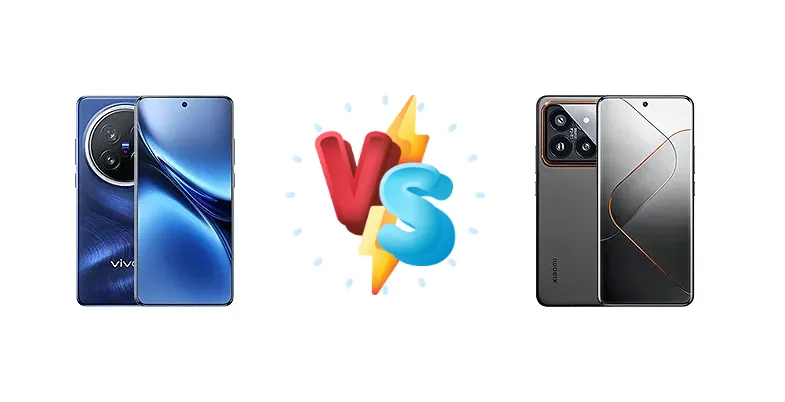
|
🏆 Quick Verdict
For the average user prioritizing raw speed and charging convenience, the Xiaomi 14 Pro emerges as the winner. Its Snapdragon 8 Gen 3 chipset and 120W charging offer a noticeable edge. However, the vivo X200 Pro’s impressive 15:09 active use battery life makes it a strong contender for power users.
| PHONES | ||
|---|---|---|
| Phone Names | vivo X200 Pro | Xiaomi 14 Pro |
| Network | ||
|---|---|---|
| 2G bands | GSM 850 / 900 / 1800 / 1900 | GSM 850 / 900 / 1800 / 1900 |
| 3G bands | HSDPA 800 / 850 / 900 / 1700(AWS) / 1900 / 2100 - China | HSDPA 800 / 850 / 900 / 1700(AWS) / 1900 / 2100 |
| 4G bands | 1, 2, 3, 4, 5, 7, 8, 12, 17, 18, 19, 20, 26, 28, 32, 34, 38, 39, 40, 41, 42, 66 - International | 1, 3, 4, 5, 7, 8, 18, 19, 26, 28, 34, 38, 39, 40, 41, 42, 48, 66 |
| 5G bands | 1, 2, 3, 5, 7, 8, 12, 20, 25, 26, 28, 38, 40, 41, 66, 77, 78 SA/NSA/Sub6 - India | 1, 3, 5, 7, 8, 28, 38, 40, 41, 48, 66, 77, 78, 79 SA/NSA |
| Speed | HSPA, LTE, 5G | HSPA, LTE, 5G |
| Technology | GSM / HSPA / LTE / 5G | GSM / CDMA / HSPA / CDMA2000 / LTE / 5G |
| Launch | ||
|---|---|---|
| Announced | 2024, October 14 | 2023, October 26 |
| Status | Available. Released 2024, October 19 | Available. Released 2023, November 01 |
| Body | ||
|---|---|---|
| Build | Glass front, aluminum alloy frame, glass back or fiber-reinforced plastic back | Glass front, aluminum frame or titanium frame, glass back |
| Dimensions | 162.4 x 76 x 8.2 mm or 8.5 mm | 161.4 x 75.3 x 8.5 mm |
| SIM | · Nano-SIM + Nano-SIM + eSIM (max 2 at a time)· Nano-SIM + Nano-SIM | Nano-SIM + Nano-SIM |
| Weight | 223 g or 228 g (7.87 oz) | 223 g or 230 g (7.87 oz) |
| Display | ||
|---|---|---|
| Protection | Scratch/drop-resistant glass (Armor Glass) | Shatterproof glass |
| Resolution | 1260 x 2800 pixels, 20:9 ratio (~452 ppi density) | 1440 x 3200 pixels, 20:9 ratio (~522 ppi density) |
| Size | 6.78 inches, 111.5 cm2 (~90.3% screen-to-body ratio) | 6.73 inches, 108.9 cm2 (~89.6% screen-to-body ratio) |
| Type | LTPO AMOLED, 1B colors, 120Hz, 2160Hz PWM, HDR10+, Dolby Vision, 4500 nits (peak) | LTPO AMOLED, 68B colors, 120Hz, Dolby Vision, HDR10+, 3000 nits (peak) |
| Platform | ||
|---|---|---|
| CPU | Octa-core (1x3.63 GHz Cortex-X925 & 3x3.3 GHz Cortex-X4 & 4x2.4 GHz Cortex-A720) | Octa-core (1x3.3 GHz Cortex-X4 & 3x3.2 GHz Cortex-A720 & 2x3.0 GHz Cortex-A720 & 2x2.3 GHz Cortex-A520) |
| Chipset | Mediatek Dimensity 9400 (3 nm) | Qualcomm SM8650-AB Snapdragon 8 Gen 3 (4 nm) |
| GPU | Immortalis-G925 | Adreno 750 |
| OS | Android 15, up to 4 major Android upgrades, Funtouch 15 (International), OriginOS 5 (China) | Android 14, HyperOS |
| Memory | ||
|---|---|---|
| Card slot | No | No |
| Internal | 256GB 12GB RAM, 512GB 16GB RAM, 1TB 16GB RAM | 256GB 12GB RAM, 512GB 16GB RAM, 1TB 16GB RAM |
| Main Camera | ||
|---|---|---|
| Features | Laser AF, color spectrum sensor, Zeiss optics, Zeiss T* lens coating, LED flash, panorama, HDR, 3D LUT import | Laser AF, color spectrum sensor, Leica lens, Dual-LED dual-tone flash, HDR, panorama |
| Triple | 50 MP, f/1.6, 23mm (wide), 1/1.28", 1.22µm, PDAF, OIS 200 MP, f/2.7, 85mm (periscope telephoto), 1/1.4", 0.56µm, multi-directional PDAF, OIS, 3.7x optical zoom, macro 2.7:1 50 MP, f/2.0, 15mm, 119˚ (ultrawide), 1/2.76", 0.64µm, AF | 50 MP, f/1.4-f/4.0, 23mm (wide), 1/1.31", 1.2µm, dual pixel PDAF, OIS 50 MP, f/2.0, 75mm (telephoto), PDAF (10cm - ∞), OIS, 3.2x optical zoom 50 MP, f/2.2, 14mm, 115˚ (ultrawide), AF |
| Video | 8K@30fps, 4K@30/60/120fps, 1080p@30/60/120/240fps, gyro-EIS, 10-bit Log, Dolby Vision HDR | 8K@24fps (HDR), 4K@24/30/60fps (HDR10+, 10-bit Dolby Vision HDR, 10-bit LOG), 1080p@30/60/120/240/960fps, 720p@1920fps, gyro-EIS |
| Selfie camera | ||
|---|---|---|
| Features | HDR | HDR, panorama |
| Single | 32 MP, f/2.0, 20mm (ultrawide) | 32 MP, f/2.0, 22mm (wide), 0.7µm |
| Video | 4K@30/60fps, 1080p@30/60fps | 4K@30/60fps, 1080p@30/60fps, gyro-EIS |
| Sound | ||
|---|---|---|
| 35mm jack | No | No |
| Loudspeaker | Yes, with stereo speakers | Yes, with stereo speakers |
| Comms | ||
|---|---|---|
| Bluetooth | 5.4, A2DP, LE, aptX HD, LHDC 5 | 5.4, A2DP, LE, aptX HD, aptX Adaptive |
| Infrared port | Yes | Yes |
| NFC | Yes | Yes |
| Positioning | GPS (L1+L5), GLONASS (L1), BDS (B1I+B1c+B2a+B2b), GALILEO (E1+E5a+E5b), QZSS (L1+L5), NavIC (L5) | GPS (L1+L5), GLONASS (G1), BDS (B1I+B1c+B2a), GALILEO (E1+E5a), QZSS (L1+L5), NavIC (L5) |
| Radio | No | No |
| USB | USB Type-C 3.2, OTG | USB Type-C 3.2 Gen 2, OTG |
| WLAN | Wi-Fi 802.11 a/b/g/n/ac/6/7, dual-band | Wi-Fi 802.11 a/b/g/n/ac/6e/7, dual-band, Wi-Fi Direct |
| Features | ||
|---|---|---|
| Sensors | Fingerprint (under display, ultrasonic), accelerometer, gyro, proximity, compass | Fingerprint (under display, optical), accelerometer, proximity, gyro, compass, barometer |
| Battery | ||
|---|---|---|
| Charging | 90W wired 30W wireless Reverse wireless Reverse wired | 120W wired, PD3.0, QC4, 100% in 18 min 50W wireless, 100% in 40 min 10W reverse wireless |
| Type | · Si/C Li-Ion 6000 mAh (Global)· Li-Ion 5200 mAh (Austria, Hungary, Germany) | Li-Po 4880 mAh |
| Misc | ||
|---|---|---|
| Colors | Cosmos Black, Titanium Grey, Blue, White | Black, Silver, Titanium, Green |
| Models | V2413, V2405A, V2405DA | 23116PN5BC |
| Price | £ 969.00 / ₹ 94,999 | About 650 EUR |
| SAR | 0.99 W/kg (head) 0.90 W/kg (body) | - |
vivo X200 Pro
- Exceptional battery life (15:09h active use)
- High peak display brightness (1881 nits)
- Reverse wired charging for added versatility
- Slower charging speed (90W) compared to Xiaomi
- Chipset performance may trail Snapdragon 8 Gen 3
Xiaomi 14 Pro
- Blazing-fast 120W wired charging (18 minutes to 100%)
- Potentially superior gaming performance with Snapdragon 8 Gen 3
- Qualcomm Snapdragon ISP for advanced image processing
- Battery life likely shorter than vivo X200 Pro
- Wireless charging slower than vivo (50W vs 30W)
Display Comparison
While both devices are expected to feature high-quality displays, the vivo X200 Pro boasts a measured peak brightness of 1881 nits, suggesting superior visibility in direct sunlight. The Xiaomi 14 Pro’s display specifications are currently unavailable, but Xiaomi typically employs LTPO panels for adaptive refresh rates, potentially offering power savings. The difference in brightness will be most noticeable outdoors, giving the X200 Pro an advantage for users who spend significant time outside.
Camera Comparison
Detailed camera specs are currently unavailable for both devices. However, given both brands’ history, we can expect both phones to feature advanced camera systems. The Xiaomi 14 Pro is likely to leverage Qualcomm’s Snapdragon ISP for enhanced image processing. The vivo X200 Pro will likely focus on computational photography and color science, a hallmark of the brand. Without sensor size and aperture details, it’s difficult to definitively declare a winner, but the Xiaomi’s ISP integration gives it a slight edge in potential image quality.
Performance
The core of this comparison lies in the chipsets. The vivo X200 Pro’s Mediatek Dimensity 9400, built on a 3nm process, features a unique CPU configuration with a Cortex-X925 prime core, alongside X4 and A720 cores. This contrasts with the Xiaomi 14 Pro’s Snapdragon 8 Gen 3 (4nm), utilizing a Cortex-X4 prime core and a different mix of A720 and A520 cores. The 3nm node of the Dimensity 9400 *should* translate to better power efficiency, but the Snapdragon 8 Gen 3’s architectural optimizations and potentially higher clock speeds could deliver superior sustained performance. The Xiaomi 14 Pro’s GPU is also likely to outperform the X200 Pro’s, offering a better gaming experience.
Battery Life
The vivo X200 Pro shines in battery life, achieving an impressive 15:09 hours of active use. The Xiaomi 14 Pro’s battery capacity is unknown, but its 120W wired charging (100% in 18 minutes) significantly surpasses the X200 Pro’s 90W charging. The Xiaomi also offers 50W wireless charging, compared to the vivo’s 30W. While the X200 Pro offers longer runtimes, the Xiaomi 14 Pro’s charging speed is a game-changer for users who need to quickly top up their battery. The inclusion of reverse wired charging on the vivo is a niche feature that may appeal to users with multiple devices.
Buying Guide
Buy the vivo X200 Pro if you prioritize exceptional battery endurance and are comfortable with a slightly less aggressive charging speed. This phone is ideal for users who frequently travel or heavily rely on their smartphone throughout the day. Buy the Xiaomi 14 Pro if you demand the fastest possible performance, lightning-fast 120W charging, and a streamlined user experience. It’s the perfect choice for gamers and power users who want the best of everything.