
vivo X200 Pro vs Oppo Find X7 Ultra: A Deep Dive into Flagship Performance
| Phones Images | |||||
|---|---|---|---|---|---|
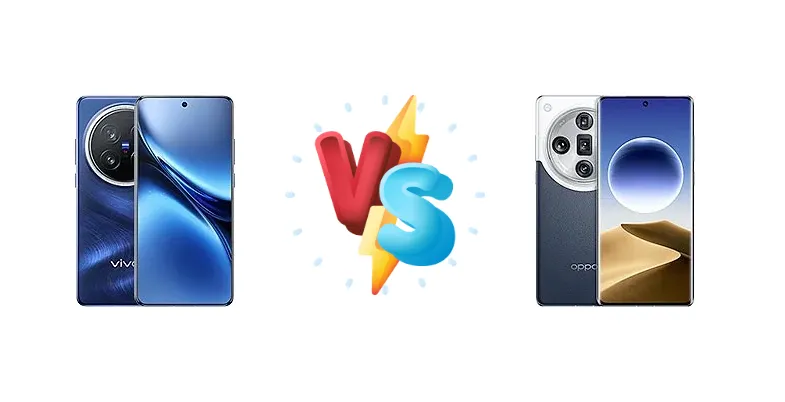
|
🏆 Quick Verdict
For the average user prioritizing sustained performance and battery life, the vivo X200 Pro emerges as the winner. Its Dimensity 9400 chipset and superior battery endurance provide a smoother, longer-lasting experience, despite the Oppo Find X7 Ultra’s faster charging capabilities.
| PHONES | ||
|---|---|---|
| Phone Names | vivo X200 Pro | Oppo Find X7 Ultra |
| Network | ||
|---|---|---|
| 2G bands | GSM 850 / 900 / 1800 / 1900 | GSM 850 / 900 / 1800 / 1900 |
| 3G bands | HSDPA 800 / 850 / 900 / 1700(AWS) / 1900 / 2100 - China | HSDPA 800 / 850 / 900 / 1700(AWS) / 1900 / 2100 |
| 4G bands | 1, 2, 3, 4, 5, 7, 8, 12, 17, 18, 19, 20, 26, 28, 32, 34, 38, 39, 40, 41, 42, 66 - International | 1, 2, 3, 4, 5, 7, 8, 12, 17, 18, 19, 20, 26, 28, 34, 38, 39, 40, 41, 66 |
| 5G bands | 1, 2, 3, 5, 7, 8, 12, 20, 25, 26, 28, 38, 40, 41, 66, 77, 78 SA/NSA/Sub6 - India | 1, 2, 3, 5, 7, 8, 20, 28, 38, 40, 41, 66, 77, 78, 79 SA/NSA |
| Speed | HSPA, LTE, 5G | HSPA, LTE, 5G |
| Technology | GSM / HSPA / LTE / 5G | GSM / CDMA / HSPA / CDMA2000 / LTE / 5G |
| Launch | ||
|---|---|---|
| Announced | 2024, October 14 | 2024, January 08 |
| Status | Available. Released 2024, October 19 | Available. Released 2024, January 12 |
| Body | ||
|---|---|---|
| Build | Glass front, aluminum alloy frame, glass back or fiber-reinforced plastic back | Glass front (Gorilla Glass Victus 2), glass back (Gorilla Glass) or eco leather back, aluminum frame |
| Dimensions | 162.4 x 76 x 8.2 mm or 8.5 mm | 164.3 x 76.2 x 9.5 mm (6.47 x 3.00 x 0.37 in) |
| SIM | · Nano-SIM + Nano-SIM + eSIM (max 2 at a time)· Nano-SIM + Nano-SIM | Nano-SIM + Nano-SIM |
| Weight | 223 g or 228 g (7.87 oz) | 221 g (7.80 oz) |
| Display | ||
|---|---|---|
| Protection | Scratch/drop-resistant glass (Armor Glass) | Corning Gorilla Glass Victus 2 |
| Resolution | 1260 x 2800 pixels, 20:9 ratio (~452 ppi density) | 1440 x 3168 pixels (~510 ppi density) |
| Size | 6.78 inches, 111.5 cm2 (~90.3% screen-to-body ratio) | 6.82 inches, 113.0 cm2 (~90.3% screen-to-body ratio) |
| Type | LTPO AMOLED, 1B colors, 120Hz, 2160Hz PWM, HDR10+, Dolby Vision, 4500 nits (peak) | LTPO AMOLED, 1B colors, 120Hz, Dolby Vision, HDR10+, 1600 nits (typ), 2600 nits (HBM), 4500 nits (peak) |
| Platform | ||
|---|---|---|
| CPU | Octa-core (1x3.63 GHz Cortex-X925 & 3x3.3 GHz Cortex-X4 & 4x2.4 GHz Cortex-A720) | Octa-core (1x3.3 GHz Cortex-X4 & 3x3.2 GHz Cortex-A720 & 2x3.0 GHz Cortex-A720 & 2x2.3 GHz Cortex-A520) |
| Chipset | Mediatek Dimensity 9400 (3 nm) | Qualcomm SM8650-AB Snapdragon 8 Gen 3 (4 nm) |
| GPU | Immortalis-G925 | Adreno 750 |
| OS | Android 15, up to 4 major Android upgrades, Funtouch 15 (International), OriginOS 5 (China) | Android 14, up to 4 major Android upgrades, ColorOS 14 |
| Memory | ||
|---|---|---|
| Card slot | No | No |
| Internal | 256GB 12GB RAM, 512GB 16GB RAM, 1TB 16GB RAM | 256GB 12GB RAM, 256GB 16GB RAM, 512GB 16GB RAM |
| Main Camera | ||
|---|---|---|
| Features | Laser AF, color spectrum sensor, Zeiss optics, Zeiss T* lens coating, LED flash, panorama, HDR, 3D LUT import | Laser AF, color spectrum sensor, Hasselblad Color Calibration, LED flash, HDR, panorama |
| Quad | - | 50 MP, f/1.8, 23mm (wide), 1.0"-type, 1.6µm, dual pixel PDAF, OIS 50 MP, f/2.6, 65mm (periscope telephoto), 1/1.56", 1.0µm, 2.8x optical zoom, multi-directional PDAF (25cm - ∞), OIS 50 MP, f/4.3, 135mm (periscope telephoto), 1/2.51", 0.7µm, 6x optical zoom, dual pixel PDAF (35cm - ∞), OIS 50 MP, f/2.0, 14mm, 123˚ (ultrawide), 1/1.95", 1.0µm, PDAF |
| Triple | 50 MP, f/1.6, 23mm (wide), 1/1.28", 1.22µm, PDAF, OIS 200 MP, f/2.7, 85mm (periscope telephoto), 1/1.4", 0.56µm, multi-directional PDAF, OIS, 3.7x optical zoom, macro 2.7:1 50 MP, f/2.0, 15mm, 119˚ (ultrawide), 1/2.76", 0.64µm, AF | - |
| Video | 8K@30fps, 4K@30/60/120fps, 1080p@30/60/120/240fps, gyro-EIS, 10-bit Log, Dolby Vision HDR | 4K@30/60fps, 1080p@30/60/240fps; gyro-EIS; HDR, 10‑bit video, Dolby Vision |
| Selfie camera | ||
|---|---|---|
| Features | HDR | Panorama |
| Single | 32 MP, f/2.0, 20mm (ultrawide) | 32 MP, f/2.4, 21mm (wide), 1/2.74", 0.8µm, PDAF |
| Video | 4K@30/60fps, 1080p@30/60fps | 4K@30/60fps, 1080p@30fps, gyro-EIS |
| Sound | ||
|---|---|---|
| 35mm jack | No | No |
| Loudspeaker | Yes, with stereo speakers | Yes, with stereo speakers |
| Comms | ||
|---|---|---|
| Bluetooth | 5.4, A2DP, LE, aptX HD, LHDC 5 | 5.4, A2DP, LE, aptX HD, LHDC |
| Infrared port | Yes | Yes |
| NFC | Yes | Yes |
| Positioning | GPS (L1+L5), GLONASS (L1), BDS (B1I+B1c+B2a+B2b), GALILEO (E1+E5a+E5b), QZSS (L1+L5), NavIC (L5) | GPS (L1+L5), BDS (B1I+B1c+B2a), GALILEO (E1+E5a), QZSS (L1+L5), GLONASS |
| Radio | No | No |
| USB | USB Type-C 3.2, OTG | USB Type-C 3.2, OTG |
| WLAN | Wi-Fi 802.11 a/b/g/n/ac/6/7, dual-band | Wi-Fi 802.11 a/b/g/n/ac/6e/7, dual-band, Wi-Fi Direct |
| Features | ||
|---|---|---|
| Sensors | Fingerprint (under display, ultrasonic), accelerometer, gyro, proximity, compass | Fingerprint (under display, optical), accelerometer, gyro, proximity, compass |
| Battery | ||
|---|---|---|
| Charging | 90W wired 30W wireless Reverse wireless Reverse wired | 100W wired, PD, 50% in 10 min, 100% in 26 min 50W wireless 10W reverse wireless |
| Type | · Si/C Li-Ion 6000 mAh (Global)· Li-Ion 5200 mAh (Austria, Hungary, Germany) | 5000 mAh |
| Misc | ||
|---|---|---|
| Colors | Cosmos Black, Titanium Grey, Blue, White | Black, Dark Blue, Light Brown |
| Models | V2413, V2405A, V2405DA | PHY110, PHY120 |
| Price | £ 969.00 / ₹ 94,999 | $ 546.64 |
| SAR | 0.99 W/kg (head) 0.90 W/kg (body) | - |
vivo X200 Pro
- Superior battery life (15:09h active use)
- Brighter display (1881 nits)
- Potentially better thermal management with Dimensity 9400
- Slower wired charging (90W vs 100W)
- Reverse wired charging may not be universally useful
Oppo Find X7 Ultra
- Faster wired charging (100W, 0-100% in 26 minutes)
- Strong brand reputation for camera technology
- Potentially better software optimization within the Oppo ecosystem
- Shorter battery life (12:47h active use)
- Dimmer display (1165 nits)
- Snapdragon 8 Gen 3 may be more prone to thermal throttling
Display Comparison
The vivo X200 Pro boasts a significantly brighter display, reaching a measured 1881 nits compared to the Oppo Find X7 Ultra’s 1165 nits. This translates to superior visibility in direct sunlight. While both likely employ LTPO technology for adaptive refresh rates, the X200 Pro’s higher peak brightness is a clear advantage for outdoor users. The impact of panel technology (OLED vs AMOLED) isn't specified, but both are expected to deliver excellent color accuracy and contrast.
Camera Comparison
Without detailed camera specs, a direct comparison is limited. However, the focus should be on sensor size and image processing. Both brands are known for excellent camera performance, but the larger the main sensor, the better the low-light performance. The absence of information on sensor sizes necessitates relying on brand reputation; Oppo has historically focused on camera innovation. The 2MP macro cameras on both devices are likely to be of limited utility for most users.
Performance
The core difference lies in the chipsets: the vivo X200 Pro utilizes the Mediatek Dimensity 9400 (3nm) while the Oppo Find X7 Ultra features the Qualcomm Snapdragon 8 Gen 3 (4nm). The Dimensity 9400’s newer 3nm process should offer improved power efficiency and thermal management compared to the Snapdragon 8 Gen 3’s 4nm node. The X200 Pro’s CPU configuration (1x3.63 GHz Cortex-X925, 3x3.3 GHz Cortex-X4, 4x2.4 GHz Cortex-A720) appears to prioritize peak performance with the X925 core, while the Find X7 Ultra (1x3.3 GHz Cortex-X4, 3x3.2 GHz Cortex-A720, 2x3.0 GHz Cortex-A720, 2x2.3 GHz Cortex-A520) has a more balanced core distribution. The impact of LPDDR5x RAM speed isn't specified, but is expected to be similar on both devices.
Battery Life
The vivo X200 Pro demonstrates a clear advantage in battery life, achieving 15:09 hours of active use compared to the Oppo Find X7 Ultra’s 12:47 hours. While the Find X7 Ultra compensates with faster charging – 100W wired (0-100% in 26 minutes) versus the X200 Pro’s 90W – the longer runtime of the X200 Pro is more valuable for users who frequently use their phones throughout the day. The X200 Pro also offers reverse wired charging, a feature not explicitly mentioned for the Find X7 Ultra.
Buying Guide
Buy the vivo X200 Pro if you need exceptional battery life for all-day use, prioritize sustained gaming performance without thermal throttling, and value the latest in processor technology. Buy the Oppo Find X7 Ultra if you prefer the fastest possible wired charging speeds, are heavily invested in the Oppo ecosystem, and prioritize a slightly brighter display for outdoor visibility.