
vivo X200 FE vs Xiaomi 14T Pro: A Deep Dive into Performance and Endurance
| Phones Images | |||||
|---|---|---|---|---|---|
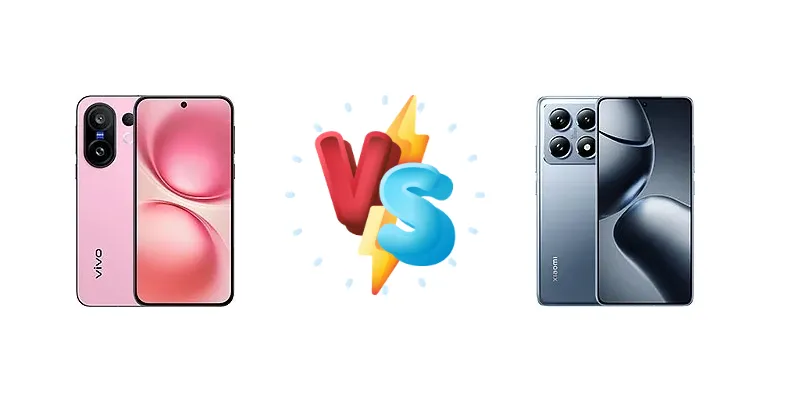
|
🏆 Quick Verdict
For the average user prioritizing long-term battery health and overall endurance, the vivo X200 FE emerges as the winner. Its impressive 58:09h battery endurance, coupled with 800 charge cycles, offers peace of mind. However, the Xiaomi 14T Pro’s blistering 120W charging is a game-changer for those who need to top up quickly.
| PHONES | ||
|---|---|---|
| Phone Names | vivo X200 FE | Xiaomi 14T Pro |
| Network | ||
|---|---|---|
| 2G bands | GSM 850 / 900 / 1800 / 1900 | GSM 850 / 900 / 1800 / 1900 |
| 3G bands | HSDPA 800 / 850 / 900 / 1700(AWS) / 1900 / 2100 | HSDPA 800 / 850 / 900 / 1700(AWS) / 1900 / 2100 |
| 4G bands | 1, 2, 3, 4, 5, 7, 8, 12, 17, 18, 19, 20, 25, 26, 28, 32, 34, 38, 39, 40, 41, 42, 43, 48, 66, 71 | 1, 2, 3, 4, 5, 7, 8, 12, 13, 17, 18, 19, 20, 25, 26, 28, 32, 38, 39, 40, 41, 42, 48, 66 |
| 5G bands | 1, 3, 5, 7, 8, 20, 26, 28, 38, 40, 41, 71, 77, 78 SA/NSA | 1, 2, 3, 5, 7, 8, 12, 20, 25, 26, 28, 38, 40, 41, 48, 66, 75, 77, 78 SA/NSA |
| Speed | HSPA, LTE, 5G | HSPA, LTE, 5G |
| Technology | GSM / HSPA / LTE / 5G | GSM / HSPA / LTE / 5G |
| Launch | ||
|---|---|---|
| Announced | 2025, June 23 | 2024, September 26 |
| Status | Available. Released 2025, July 05 | Available. Released 2024, September 26 |
| Body | ||
|---|---|---|
| Build | Glass front, aluminum frame, glass back | Glass front (Gorilla Glass 5), aluminum frame, glass back (Panda X) |
| Dimensions | 150.8 x 71.8 x 8 mm (5.94 x 2.83 x 0.31 in) | 160.4 x 75.1 x 8.4 mm (6.31 x 2.96 x 0.33 in) |
| SIM | · Nano-SIM + Nano-SIM + eSIM (max 2 at a time)· Nano-SIM + Nano-SIM | · Nano-SIM + eSIM· eSIM + eSIM· Nano-SIM + Nano-SIM |
| Weight | 186 g (6.56 oz) | 209 g (7.37 oz) |
| Display | ||
|---|---|---|
| Protection | Schott Xensation Core or Shield Glass, Mohs level 5 | Corning Gorilla Glass 5 |
| Resolution | 1216 x 2640 pixels, 19.5:9 ratio (~461 ppi density) | 1220 x 2712 pixels, 20:9 ratio (~446 ppi density) |
| Size | 6.31 inches, 97.6 cm2 (~90.2% screen-to-body ratio) | 6.67 inches, 107.4 cm2 (~89.1% screen-to-body ratio) |
| Type | LTPO AMOLED, 1B colors, 120Hz, 2160Hz PWM, HDR10+, 4500 / 5000 nits (peak) | AMOLED, 68B colors, 144Hz, 3840Hz PWM, Dolby Vision, HDR10+, 1600 nits (HBM), 4000 nits (peak) |
| Platform | ||
|---|---|---|
| CPU | Octa-core (1x3.4 GHz Cortex-X4 & 3x2.85 GHz Cortex-X4 & 4x2.0 GHz Cortex-A720) | Octa-core (1x3.4 GHz Cortex-X4 & 3x2.85 GHz Cortex-X4 & 4x2.0 GHz Cortex-A720) |
| Chipset | Mediatek Dimensity 9300+ (4 nm) | Mediatek Dimensity 9300+ (4 nm) |
| GPU | Immortalis-G720 MC12 | Immortalis-G720 MC12 |
| OS | Android 15, up to 4 major Android upgrades, Funtouch 15 | Android 14, HyperOS |
| Memory | ||
|---|---|---|
| Card slot | No | No |
| Internal | 256GB 12GB RAM, 512GB 12GB RAM, 512GB 16GB RAM | 256GB 12GB RAM, 512GB 12GB RAM, 512GB 16GB RAM, 1TB 12GB RAM |
| Main Camera | ||
|---|---|---|
| Features | Laser AF, Zeiss optics, Zeiss T* lens coating, LED flash, panorama, HDR | Leica lens, Ultra HDR, LED flash, HDR, panorama |
| Triple | 50 MP, f/1.9, 23mm (wide), 1/1.56", 1.0µm, PDAF 50 MP, f/2.7, 70mm (periscope telephoto), 1/1.95", 0.8µm, multi-directional PDAF (55cm - ∞), OIS, 3x optical zoom 8 MP, f/2.0, 15mm (ultrawide), 1/4.0", 1.12µm | 50 MP, f/1.6, 23mm (wide), 1/1.31", 1.2µm, PDAF, OIS 50 MP, f/2.0, 60mm (telephoto), 1/2.88", 0.61µm, PDAF, 2.6x optical zoom 12 MP, f/2.2, 15mm (ultrawide), 1/3.06", 1.12µm |
| Video | 4K@30/60fps, 1080p@30/60/120fps, gyro-EIS, HDR | 8K@24/30fps, 4K@24/30/60fps, 1080p@30/60/120/240/960fps, gyro-EIS, 10-bit Rec. 2020, HDR10+ |
| Selfie camera | ||
|---|---|---|
| Features | HDR | HDR |
| Single | 50 MP, f/2.0, 20mm (wide), 1/2.76", 0.64µm, PDAF | 32 MP, f/2.0, 25mm (wide), 1/3.44", 0.64µm |
| Video | 4K@30/60fps, 1080p | 4K@30fps, 1080p@30/60fps, HDR10+ |
| Sound | ||
|---|---|---|
| 35mm jack | No | No |
| Loudspeaker | Yes, with stereo speakers | Yes, with stereo speakers |
| Comms | ||
|---|---|---|
| Bluetooth | 5.4, A2DP, LE, aptX HD | 5.4, A2DP, LE, LHDC |
| Infrared port | Yes | Yes |
| NFC | Yes | Yes (market/region dependent) |
| Positioning | GPS, GALILEO, GLONASS, QZSS, BDS | GPS (L1+L5), BDS (B1I+B1C+B2a+B2b), GALILEO (E1+E5a+E5b), QZSS (L1+L5), NavIC (L5), GLONASS |
| Radio | No | No |
| USB | USB Type-C 2.0, OTG | USB Type-C 2.0, OTG |
| WLAN | Wi-Fi 802.11 a/b/g/n/ac/6 or 7 (market specific), dual-band | Wi-Fi 802.11 a/b/g/n/ac/6e/7, dual-band, Wi-Fi Direct |
| Features | ||
|---|---|---|
| Sensors | Fingerprint (under display, optical), accelerometer, gyro, proximity, compass | Fingerprint (under display, optical), accelerometer, gyro, proximity, compass |
| Battery | ||
|---|---|---|
| Charging | 90W wired, 100% in 57 min Reverse wired | 120W wired, PD3.0, QC4, 100% in 19 min 50W wireless, 100% in 45 min |
| Type | Market-dependent versions:· Si/C Li-Ion 6500 mAh (Global)· Si/C Li-Ion 5300 mAh (Austria only) | Li-Po 5000 mAh |
| Misc | ||
|---|---|---|
| Colors | Luxe Grey (Black Luxe), Frost Blue (Blue Breeze), Amber Yellow (Yellow Glow), Pink Vibe | Titan Gray, Titan Blue, Titan Black |
| Models | V2503 | 2407FPN8EG |
| Price | € 799.00 / $ 721.58 / ₹ 59,998 | $ 550.00 / £ 498.00 / € 539.99 |
| SAR | 0.99 W/kg (head) 0.99 W/kg (body) | - |
| SAR EU | - | 0.99 W/kg (head) 1.00 W/kg (body) |
| EU LABEL | ||
|---|---|---|
| Battery | 58:09h endurance, 800 cycles | - |
| Energy | Class B | - |
| Free fall | Class C (100 falls) | - |
| Repairability | Class C | - |
vivo X200 FE
- Exceptional battery endurance (58:09h)
- Superior long-term battery health (800 charge cycles)
- Brighter display (1758 nits)
- Slower charging speed (90W)
- No wireless charging
Xiaomi 14T Pro
- Blazing-fast 120W wired charging (19 minutes)
- Convenient 50W wireless charging
- Potentially more aggressive pricing
- Shorter battery endurance (12:32h active use)
- Lower peak display brightness
Display Comparison
The Xiaomi 14T Pro and vivo X200 FE both offer vibrant displays, but the X200 FE pulls ahead with a measured peak brightness of 1758 nits compared to the 14T Pro’s 1228 nits. This translates to significantly better visibility under direct sunlight. While both likely utilize AMOLED panels, the higher brightness of the X200 FE suggests a more advanced panel capable of delivering a more impactful HDR experience. Details regarding PWM dimming rates are absent, but the brightness difference is a clear advantage for the vivo.
Camera Comparison
Context data lacks specific camera details, making a direct comparison challenging. However, given the market positioning, we can infer that both phones will feature multi-camera systems. The Xiaomi 14T Pro, historically, leans towards higher megapixel counts, while vivo often prioritizes image processing and color science. Without sensor size or aperture information, it’s difficult to assess low-light performance. The absence of details suggests neither phone is likely to be a standout in the camera department, focusing instead on overall system balance.
Performance
Both devices are equipped with the Mediatek Dimensity 9300+ (4 nm) chipset, featuring the same CPU configuration: 1x3.4 GHz Cortex-X4, 3x2.85 GHz Cortex-X4, and 4x2.0 GHz Cortex-A720. This means raw processing power will be nearly identical. The performance will be limited by thermal management and RAM speed, which are not specified. However, the similar chipset and core configuration suggest comparable gaming and multitasking capabilities. The 4nm process node ensures efficient power consumption, minimizing throttling during sustained workloads.
Battery Life
The battery performance is where these phones truly diverge. The vivo X200 FE boasts an impressive 58:09h endurance score and a remarkable 800 charge cycles, indicating superior long-term battery health. In active use, it lasts 15:16h. The Xiaomi 14T Pro, while still respectable, offers 12:32h of active use. The 14T Pro compensates with its significantly faster charging: 120W wired (0-100% in 19 minutes) and 50W wireless (0-100% in 45 minutes), compared to the X200 FE’s 90W wired (57 minutes) and lack of wireless charging. This difference caters to vastly different user needs – endurance versus convenience.
Buying Guide
Buy the vivo X200 FE if you need exceptional battery life, prioritize long-term battery health with its 800 charge cycles, and value a brighter display for outdoor visibility. Buy the Xiaomi 14T Pro if you absolutely require the fastest possible charging speeds – getting from 0 to 100% in just 19 minutes – and also appreciate the convenience of 50W wireless charging.