
vivo X200 FE vs iQOO 12 Pro: A Deep Dive into Flagship Performance and Value
| Phones Images | |||||
|---|---|---|---|---|---|
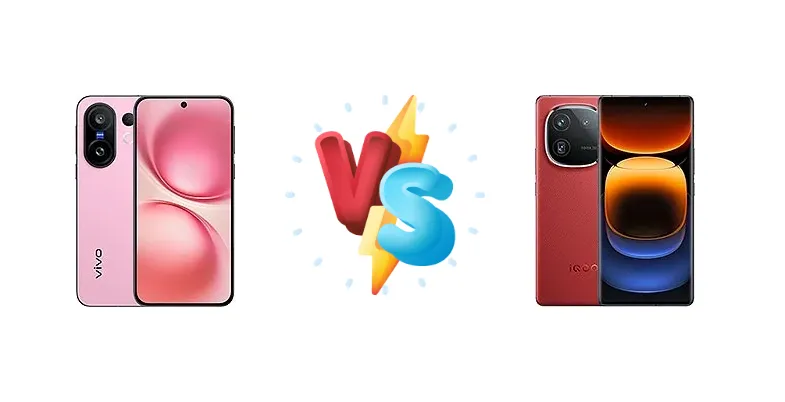
|
🏆 Quick Verdict
For the average user prioritizing raw performance and the fastest charging speeds, the iQOO 12 Pro is the clear winner. However, the vivo X200 FE offers a strong alternative with excellent processing power and impressive battery endurance, making it a compelling choice for those seeking a more balanced experience.
| PHONES | ||
|---|---|---|
| Phone Names | vivo X200 FE | vivo iQOO 12 Pro |
| Network | ||
|---|---|---|
| 2G bands | GSM 850 / 900 / 1800 / 1900 | GSM 850 / 900 / 1800 / 1900 |
| 3G bands | HSDPA 800 / 850 / 900 / 1700(AWS) / 1900 / 2100 | HSDPA 800 / 850 / 900 / 1700(AWS) / 1900 / 2100 |
| 4G bands | 1, 2, 3, 4, 5, 7, 8, 12, 17, 18, 19, 20, 25, 26, 28, 32, 34, 38, 39, 40, 41, 42, 43, 48, 66, 71 | 1, 2, 3, 4, 5, 7, 8, 12, 17, 18, 19, 20, 25, 26, 28, 34, 38, 39, 40, 41, 42, 66 |
| 5G bands | 1, 3, 5, 7, 8, 20, 26, 28, 38, 40, 41, 71, 77, 78 SA/NSA | 1, 2, 3, 5, 7, 8, 12, 20, 25, 26, 28, 66, 38, 40, 41, 77, 78 SA/NSA |
| Speed | HSPA, LTE, 5G | HSPA, LTE, 5G |
| Technology | GSM / HSPA / LTE / 5G | GSM / CDMA / HSPA / CDMA2000 / LTE / 5G |
| Launch | ||
|---|---|---|
| Announced | 2025, June 23 | 2023, November 07 |
| Status | Available. Released 2025, July 05 | Available. Released 2023, November 14 |
| Body | ||
|---|---|---|
| Build | Glass front, aluminum frame, glass back | - |
| Dimensions | 150.8 x 71.8 x 8 mm (5.94 x 2.83 x 0.31 in) | 164.6 x 75.4 x 8.6 mm or 8.8 mm |
| SIM | · Nano-SIM + Nano-SIM + eSIM (max 2 at a time)· Nano-SIM + Nano-SIM | Nano-SIM + Nano-SIM |
| Weight | 186 g (6.56 oz) | 205 g or 210 g (7.23 oz) |
| Display | ||
|---|---|---|
| Protection | Schott Xensation Core or Shield Glass, Mohs level 5 | - |
| Resolution | 1216 x 2640 pixels, 19.5:9 ratio (~461 ppi density) | 1440 x 3200 pixels, 20:9 ratio (~518 ppi density) |
| Size | 6.31 inches, 97.6 cm2 (~90.2% screen-to-body ratio) | 6.78 inches, 111.0 cm2 (~89.4% screen-to-body ratio) |
| Type | LTPO AMOLED, 1B colors, 120Hz, 2160Hz PWM, HDR10+, 4500 / 5000 nits (peak) | LTPO AMOLED, 1B colors, 144Hz, HDR10+, 1600 nits (HBM), 3000 nits (peak) |
| Platform | ||
|---|---|---|
| CPU | Octa-core (1x3.4 GHz Cortex-X4 & 3x2.85 GHz Cortex-X4 & 4x2.0 GHz Cortex-A720) | Octa-core (1x3.3 GHz Cortex-X4 & 3x3.2 GHz Cortex-A720 & 2x3.0 GHz Cortex-A720 & 2x2.3 GHz Cortex-A520) |
| Chipset | Mediatek Dimensity 9300+ (4 nm) | Qualcomm SM8650-AB Snapdragon 8 Gen 3 (4 nm) |
| GPU | Immortalis-G720 MC12 | Adreno 750 |
| OS | Android 15, up to 4 major Android upgrades, Funtouch 15 | Android 14, up to 2 major Android upgrades, Funtouch 14 (International), OriginOS 4 (China) |
| Memory | ||
|---|---|---|
| Card slot | No | No |
| Internal | 256GB 12GB RAM, 512GB 12GB RAM, 512GB 16GB RAM | 256GB 16GB RAM, 512GB 16GB RAM, 1TB 16GB RAM |
| Main Camera | ||
|---|---|---|
| Features | Laser AF, Zeiss optics, Zeiss T* lens coating, LED flash, panorama, HDR | Color spectrum sensor, Dual-LED flash, HDR, panorama |
| Triple | 50 MP, f/1.9, 23mm (wide), 1/1.56", 1.0µm, PDAF 50 MP, f/2.7, 70mm (periscope telephoto), 1/1.95", 0.8µm, multi-directional PDAF (55cm - ∞), OIS, 3x optical zoom 8 MP, f/2.0, 15mm (ultrawide), 1/4.0", 1.12µm | 50 MP, f/1.7, 23mm (wide), 1/1.3", 1.2µm, ulti-directional PDAF, OIS 64 MP, f/2.6, 70mm (periscope telephoto), 1/2.0", PDAF, OIS, 3x optical zoom 50 MP, f/2.0, 15mm, 119˚ (ultrawide), AF |
| Video | 4K@30/60fps, 1080p@30/60/120fps, gyro-EIS, HDR | 8K@30fps, 4K@24/30/60fps, 1080p@30/60/120/240fps, gyro-EIS |
| Selfie camera | ||
|---|---|---|
| Features | HDR | HDR |
| Single | 50 MP, f/2.0, 20mm (wide), 1/2.76", 0.64µm, PDAF | 16 MP, f/2.5, (wide) |
| Video | 4K@30/60fps, 1080p | 1080p@30fps, gyro-EIS |
| Sound | ||
|---|---|---|
| 35mm jack | No | No |
| Loudspeaker | Yes, with stereo speakers | Yes, with stereo speakers |
| Comms | ||
|---|---|---|
| Bluetooth | 5.4, A2DP, LE, aptX HD | 5.4, A2DP, LE, aptX HD, aptX Adaptive, aptX Lossless |
| Infrared port | Yes | Yes |
| NFC | Yes | Yes |
| Positioning | GPS, GALILEO, GLONASS, QZSS, BDS | GPS (L1+L5), GLONASS (G1), BDS (B1I+B1c+B2a), GALILEO (E1+E5a), QZSS (L1+L5) |
| Radio | No | No |
| USB | USB Type-C 2.0, OTG | USB Type-C 2.0, OTG |
| WLAN | Wi-Fi 802.11 a/b/g/n/ac/6 or 7 (market specific), dual-band | Wi-Fi 802.11 a/b/g/n/ac/6/7, tri-band, Wi-Fi Direct |
| Features | ||
|---|---|---|
| Sensors | Fingerprint (under display, optical), accelerometer, gyro, proximity, compass | Fingerprint (under display, ultrasonic), accelerometer, gyro, proximity, compass |
| Battery | ||
|---|---|---|
| Charging | 90W wired, 100% in 57 min Reverse wired | 120W wired 50W wireless 10W reverse wireless |
| Type | Market-dependent versions:· Si/C Li-Ion 6500 mAh (Global)· Si/C Li-Ion 5300 mAh (Austria only) | 5100 mAh |
| Misc | ||
|---|---|---|
| Colors | Luxe Grey (Black Luxe), Frost Blue (Blue Breeze), Amber Yellow (Yellow Glow), Pink Vibe | Black, Red, White (BMW M branding) |
| Models | V2503 | V2329A |
| Price | € 799.00 / $ 721.58 / ₹ 59,998 | About 650 EUR |
| SAR | 0.99 W/kg (head) 0.99 W/kg (body) | - |
| EU LABEL | ||
|---|---|---|
| Battery | 58:09h endurance, 800 cycles | - |
| Energy | Class B | - |
| Free fall | Class C (100 falls) | - |
| Repairability | Class C | - |
vivo X200 FE
- Excellent battery endurance (58:09h)
- Powerful Dimensity 9300+ processor
- High peak display brightness (1758 nits)
- Slower charging speed (90W wired)
- No wireless charging
vivo iQOO 12 Pro
- Blazing-fast 120W wired charging
- 50W wireless charging
- Snapdragon 8 Gen 3 for peak performance
- Potentially lower battery endurance compared to X200 FE
- May run hotter under sustained load
Display Comparison
Both phones feature 4nm chipsets, but the display differences are notable. The vivo X200 FE boasts a peak brightness of 1758 nits, ensuring excellent visibility even in direct sunlight. While panel technology details are missing, the X200 FE’s brightness suggests a high-quality AMOLED. The iQOO 12 Pro, lacking specific brightness data, likely offers a comparable experience, but the X200 FE has a measurable advantage in peak luminance. Bezels are expected to be minimal on both, aligning with current flagship trends.
Camera Comparison
Without detailed camera specs, a direct comparison is difficult. However, both phones are expected to feature capable camera systems. The iQOO 12 Pro, given its positioning, may prioritize video recording capabilities and advanced computational photography features. The X200 FE, traditionally, focuses on color science and natural image processing. The absence of information regarding sensor sizes and OIS makes a definitive judgment impossible, but both are likely to offer competitive image quality in their respective price brackets.
Performance
The core battleground is the chipset. The iQOO 12 Pro’s Snapdragon 8 Gen 3 (3.3 GHz Cortex-X4) is a powerhouse, but the vivo X200 FE’s Dimensity 9300+ (3.4 GHz Cortex-X4) isn’t far behind. The Dimensity’s unique CPU core configuration – one X4 at 3.4GHz and *three* additional X4 cores at 2.85GHz – suggests strong multi-core performance. The Snapdragon 8 Gen 3 utilizes a more traditional 1+3+2+2 configuration. Both utilize 4nm fabrication, but Qualcomm’s architecture is generally considered more efficient for sustained loads. The iQOO 12 Pro’s LPDDR5x RAM and optimized cooling system will likely provide a slight edge in prolonged gaming sessions.
Battery Life
The iQOO 12 Pro dominates in charging speed with 120W wired charging, achieving a full charge in a significantly shorter time than the X200 FE’s 90W charging (57 minutes to 100%). The addition of 50W wireless charging on the iQOO 12 Pro is a substantial advantage. While the X200 FE boasts impressive battery endurance with 58:09h, the iQOO 12 Pro’s faster charging mitigates any potential concerns about battery life. The X200 FE’s 800 cycle battery health suggests long-term reliability.
Buying Guide
Buy the vivo X200 FE if you need a flagship-level processor for demanding tasks, value long battery life with 58:09h endurance, and appreciate a slightly more refined software experience. Buy the vivo iQOO 12 Pro if you prioritize ultimate gaming performance, require the fastest possible charging (120W wired and 50W wireless), and want a device specifically tuned for competitive mobile gaming.