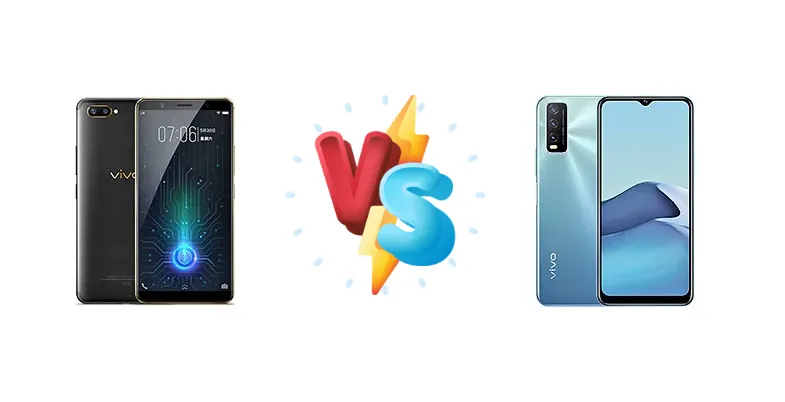
Choosing a new smartphone can be overwhelming. The vivo X20 Plus UD and vivo Y20t offer distinct features and price points. This comprehensive comparison will help you understand their strengths and weaknesses, guiding you to the perfect device for your needs.
🏆 Quick Verdict
The vivo X20 Plus UD generally wins due to its superior chipset and faster charging, offering a smoother experience. However, the Y20t presents a compelling value proposition with a more modern Snapdragon 662 and a lower price tag, making it a strong contender for budget-conscious buyers.
| Network |
|---|
| 2G bands | GSM 900 / 1800 | GSM 850 / 900 / 1800 / 1900 |
| 3G bands | HSDPA 850 / 900 / 1900 / 2100 | HSDPA 850 / 900 / 2100 |
| 4G bands | 1, 2, 3, 4, 5, 8, 38, 39, 40, 41 | 1, 3, 5, 8, 38, 40, 41 |
| Speed | HSPA 42.2/5.76 Mbps, LTE (2CA) Cat6 300/50 Mbps | HSPA, LTE |
| Technology | GSM / CDMA / HSPA / LTE | GSM / HSPA / LTE |
| | CDMA 800 & TD-SCDMA | - |
| Launch |
|---|
| Announced | 2018, January. Released 2018, January | 2021, October 11 |
| Status | Discontinued | Available. Released 2021, October 11 |
| Body |
|---|
| Build | Glass front, aluminum back, aluminum frame | Glass front, plastic back, plastic frame |
| Dimensions | 155.3 x 80.1 x 7.5 mm (6.11 x 3.15 x 0.30 in) | 164.4 x 76.3 x 8.4 mm (6.47 x 3.00 x 0.33 in) |
| SIM | Nano-SIM + Nano-SIM | Nano-SIM + Nano-SIM |
| Weight | 181.5 g (6.42 oz) | 192 g (6.77 oz) |
| Display |
|---|
| Resolution | 1080 x 2160 pixels, 18:9 ratio (~376 ppi density) | 720 x 1600 pixels, 20:9 ratio (~270 ppi density) |
| Size | 6.43 inches, 106.7 cm2 (~85.8% screen-to-body ratio) | 6.51 inches, 102.3 cm2 (~81.6% screen-to-body ratio) |
| Type | Super AMOLED | IPS LCD |
| Platform |
|---|
| CPU | Octa-core (4x2.2 GHz Kryo 260 Gold & 4x1.8 GHz Kryo 260 Silver) | Octa-core (4x2.0 GHz Kryo 260 Gold & 4x1.8 GHz Kryo 260 Silver) |
| Chipset | Qualcomm SDM660 Snapdragon 660 (14 nm) | Qualcomm SM6115 Snapdragon 662 (11 nm) |
| GPU | Adreno 512 | Adreno 610 |
| OS | Android 7.1.1 (Nougat), Funtouch 3.2 | Android 11, Funtouch 11.1 |
| Memory |
|---|
| Card slot | microSDXC (uses shared SIM slot) | microSDXC (dedicated slot) |
| Internal | 128GB 4GB RAM | 64GB 6GB RAM |
| | eMMC 5.1 | eMMC 5.1 |
| Main Camera |
|---|
| Dual | 12 MP, f/1.8, AF
Auxiliary lens | - |
| Features | LED flash, HDR, panorama | LED flash, HDR |
| Single | - | 8 MP, f/1.8, (wide) |
| Triple | - | 13 MP, f/2.2, (wide), PDAF
2 MP (macro)
Auxiliary lens |
| Video | 1080p@30fps | 1080p@30fps |
| Selfie camera |
|---|
| Single | 12 MP, f/2.0, (wide), 1/2.8", 1.28µm | 8 MP, f/1.8, (wide) |
| Video | - | 1080p@30fps |
| Sound |
|---|
| 3.5mm jack | Yes | Yes |
| 35mm jack | Yes | Yes |
| Loudspeaker | Yes | Yes |
| | 32-bit/192kHz audio
| - |
| Comms |
|---|
| Bluetooth | 5.0, A2DP, LE | 5.0, A2DP, LE |
| NFC | No | No |
| Positioning | GPS | GPS, GLONASS, BDS, GALILEO |
| Radio | No | FM radio |
| USB | microUSB 2.0, OTG | microUSB 2.0, OTG |
| WLAN | Wi-Fi 802.11 a/b/g/n/ac, dual-band, Wi-Fi Direct | Wi-Fi 802.11 a/b/g/n/ac, dual-band, Wi-Fi Direct |
| Features |
|---|
| Sensors | Fingerprint (under display, optical), accelerometer, proximity, compass | Fingerprint (side-mounted), accelerometer, proximity, compass |
| Battery |
|---|
| Charging | 22.5W wired | 18W wired |
| Type | Li-Ion 3900 mAh, non-removable | 5000 mAh |
| Misc |
|---|
| Colors | Matte Black, Gold, Rose gold | Obsidian Black, Purist Blue |
| Models | - | V2129 |
| Price | About 550 EUR | About 180 EUR |
vivo X20 Plus UD
- Faster Charging (22.5W)
- Potentially Better Camera
- Likely Larger Display
- Premium Build Quality (assumed)
- Older Chipset (SDM660)
- Potentially Higher Price
- Under-Display Fingerprint Sensor Reliability (potential issue)
vivo Y20t
- More Modern Chipset (SDM662)
- Better Performance Efficiency
- Lower Price
- Reliable Fingerprint Sensor (side-mounted)
- Slower Charging (18W)
- Potentially Less Advanced Camera
- Standard Display
- Less Premium Build Quality (assumed)
Display Comparison
While specific display details are limited, the X20 Plus UD likely features a larger display and potentially a higher resolution, given its positioning as a premium device. The Y20t likely has a standard HD+ display. Expect the X20 Plus UD to offer a more immersive viewing experience.
Camera Comparison
The X20 Plus UD likely boasts a more advanced camera system, potentially with a higher megapixel count and additional features like OIS. The Y20t's camera is likely adequate for everyday photography, but may lack the advanced features of the X20 Plus UD. Specific camera specs are needed for a more accurate comparison.
Performance
The X20 Plus UD's Snapdragon 660 is a capable chipset, but the Y20t's Snapdragon 662, built on a more efficient 11nm process, generally provides better performance and efficiency. Expect smoother multitasking and slightly faster app loading times on the Y20t.
Battery Life
Both phones offer decent battery life. The X20 Plus UD's 22.5W charging provides faster replenishment compared to the Y20t's 18W charging. Battery capacity is likely similar, around 4000-5000 mAh for both.
Buying Guide
The vivo X20 Plus UD is ideal for users prioritizing performance and faster charging, willing to invest a bit more. The vivo Y20t is a great choice for those seeking a reliable, budget-friendly smartphone with decent features and a modern chipset.
Frequently Asked Questions
❓ Is the under-display fingerprint sensor on the X20 Plus UD reliable?
Under-display fingerprint sensors can sometimes be less reliable than traditional sensors. Reviews of the X20 Plus UD suggest varying experiences with its sensor.
❓ Which phone is better for gaming?
The vivo Y20t's Snapdragon 662 generally offers better gaming performance and efficiency compared to the X20 Plus UD's Snapdragon 660.