
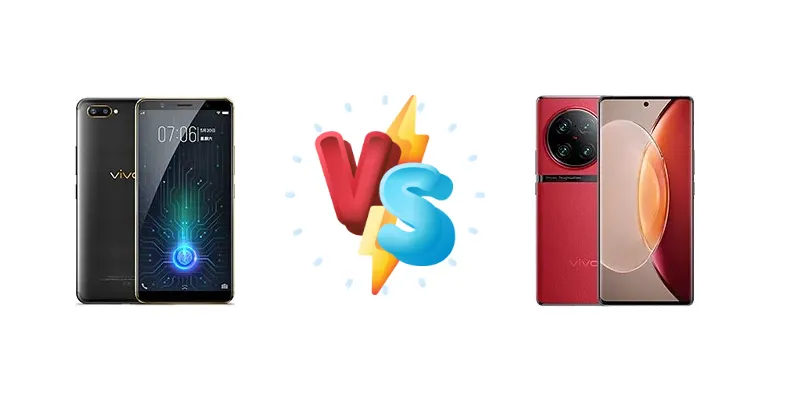
vivo X20 Plus UD vs vivo X90 Pro+: A Detailed Comparison
| Phones Images | |||||
|---|---|---|---|---|---|
|
🏆 Quick Verdict
The vivo X90 Pro+ is the clear winner. Its Snapdragon 8 Gen 2 chipset, vastly superior camera system, faster charging, and modern features like reverse wireless charging make it a significant upgrade over the X20 Plus UD, despite the older phone's larger display.
| PHONES | ||
|---|---|---|
| Phone Names | vivo X20 Plus UD | vivo X90 Pro+ |
| Network | ||
|---|---|---|
| 2G bands | GSM 900 / 1800 | GSM 850 / 900 / 1800 / 1900 - SIM 1 & SIM 2 |
| 3G bands | HSDPA 850 / 900 / 1900 / 2100 | HSDPA 800 / 850 / 900 / 1700(AWS) / 1900 / 2100 |
| 4G bands | 1, 2, 3, 4, 5, 8, 38, 39, 40, 41 | 1, 2, 3, 4, 5, 7, 8, 12, 17, 18, 19, 20, 25, 26, 28, 34, 38, 39, 40, 41, 42, 66 |
| 5G bands | - | 1, 2, 3, 5, 7, 8, 12, 20, 28, 38, 40, 41, 66, 77, 78, 79 SA/NSA |
| Speed | HSPA 42.2/5.76 Mbps, LTE (2CA) Cat6 300/50 Mbps | HSPA, LTE-A, 5G |
| Technology | GSM / CDMA / HSPA / LTE | GSM / CDMA / HSPA / EVDO / LTE / 5G |
| CDMA 800 & TD-SCDMA | CDMA2000 1xEV-DO | |
| Launch | ||
|---|---|---|
| Announced | 2018, January. Released 2018, January | 2022, November 22 |
| Status | Discontinued | Available. Released 2022, December 06 |
| Body | ||
|---|---|---|
| Build | Glass front, aluminum back, aluminum frame | Glass front, aluminum frame, eco leather back |
| Dimensions | 155.3 x 80.1 x 7.5 mm (6.11 x 3.15 x 0.30 in) | 164.4 x 75.3 x 9.7 mm (6.47 x 2.96 x 0.38 in) |
| SIM | Nano-SIM + Nano-SIM | Dual SIM (Nano-SIM, dual stand-by) |
| Weight | 181.5 g (6.42 oz) | 221 g (7.80 oz) |
| - | IP68 dust/water resistant (up to 1.5m for 30 min) | |
| Display | ||
|---|---|---|
| Resolution | 1080 x 2160 pixels, 18:9 ratio (~376 ppi density) | 1440 x 3200 pixels, 20:9 ratio (~517 ppi density) |
| Size | 6.43 inches, 106.7 cm2 (~85.8% screen-to-body ratio) | 6.78 inches, 111.4 cm2 (~90.0% screen-to-body ratio) |
| Type | Super AMOLED | LTPO4 AMOLED, 1B colors, 120Hz, Dolby Vision, HDR10+, 1800 nits (peak) |
| Platform | ||
|---|---|---|
| CPU | Octa-core (4x2.2 GHz Kryo 260 Gold & 4x1.8 GHz Kryo 260 Silver) | Octa-core (1x3.2 GHz Cortex-X3 & 2x2.8 GHz Cortex-A715 & 2x2.8 GHz Cortex-A710 & 3x2.0 GHz Cortex-A510) |
| Chipset | Qualcomm SDM660 Snapdragon 660 (14 nm) | Qualcomm SM8550-AB Snapdragon 8 Gen 2 (4 nm) |
| GPU | Adreno 512 | Adreno 740 |
| OS | Android 7.1.1 (Nougat), Funtouch 3.2 | Android 13, Funtouch (Global), Origin OS 3 (China) |
| Memory | ||
|---|---|---|
| Card slot | microSDXC (uses shared SIM slot) | No |
| Internal | 128GB 4GB RAM | 256GB 12GB RAM, 512GB 12GB RAM |
| eMMC 5.1 | UFS 4.0 | |
| Main Camera | ||
|---|---|---|
| Dual | 12 MP, f/1.8, AF Auxiliary lens | - |
| Features | LED flash, HDR, panorama | Zeiss optics, Zeiss T* lens coating, Pixel Shift, dual-LED dual-tone flash, HDR, panorama |
| Quad | - | 50.3 MP, f/1.8, 23mm (wide), 1.0"-type, 1.6µm, Dual Pixel PDAF, Laser AF, OIS 64 MP, f/3.5, 90mm (periscope telephoto), 1/2.0", 0.7µm, PDAF, OIS, 3.5x optical zoom 50 MP, f/1.6, 50mm (telephoto), 1/2.4", 0.7µm, AF, 2x optical zoom, OIS 48 MP, f/2.2, 14mm, 114˚ (ultrawide), 1/2.0", 0.8µm, AF |
| Single | - | 32 MP, f/2.5, 24mm (wide), 1/2.8", 0.8µm |
| Video | 1080p@30fps | 8K@30fps, 4K@30/60fps, 1080p@30/60fps, gyro-EIS, 14-bit RAW video |
| Selfie camera | ||
|---|---|---|
| Features | - | HDR |
| Single | 12 MP, f/2.0, (wide), 1/2.8", 1.28µm | 32 MP, f/2.5, 24mm (wide), 1/2.8", 0.8µm |
| Video | - | 1080p@30/60fps |
| Sound | ||
|---|---|---|
| 3.5mm jack | Yes | No |
| 35mm jack | Yes | - |
| Loudspeaker | Yes | Yes, with stereo speakers |
| 32-bit/192kHz audio | 32-bit/192kHz audio | |
| Comms | ||
|---|---|---|
| Bluetooth | 5.0, A2DP, LE | 5.3, A2DP, LE, aptX HD |
| Infrared port | - | Yes |
| NFC | No | Yes |
| Positioning | GPS | GPS (L1+L5), GLONASS, BDS, GALILEO, QZSS |
| Radio | No | No |
| USB | microUSB 2.0, OTG | USB Type-C 3.2, OTG |
| WLAN | Wi-Fi 802.11 a/b/g/n/ac, dual-band, Wi-Fi Direct | Wi-Fi 802.11 a/b/g/n/ac/6, dual-band, Wi-Fi Direct |
| Features | ||
|---|---|---|
| Sensors | Fingerprint (under display, optical), accelerometer, proximity, compass | Fingerprint (under display, ultrasonic), accelerometer, gyro, proximity, compass, color spectrum |
| Battery | ||
|---|---|---|
| Charging | 22.5W wired | 80W wired, 100% in 33 min (advertised) 50W wireless Reverse wired |
| Type | Li-Ion 3900 mAh, non-removable | Li-Po 4700 mAh, non-removable |
| Misc | ||
|---|---|---|
| Colors | Matte Black, Gold, Rose gold | Black, Red |
| Models | - | V2227A |
| Price | About 550 EUR | About 1030 EUR |
vivo X20 Plus UD
- Large Display
- In-Display Fingerprint Sensor
- More Affordable (Historically)
- Outdated Chipset
- Slower Charging
- Less Powerful Camera
- Older Software
vivo X90 Pro+
- Flagship Performance (Snapdragon 8 Gen 2)
- Exceptional Camera System
- Fast Charging (80W Wired, 50W Wireless)
- Modern Features (Reverse Wireless Charging)
- High Refresh Rate Display
- Higher Price
- Potentially Larger Size/Weight
Display Comparison
The X20 Plus UD features a large 6.41-inch AMOLED display, likely with a Full HD+ resolution. While offering a spacious viewing experience, it lacks the advanced display technology found in the X90 Pro+. The X90 Pro+ boasts a 6.78-inch LTPO AMOLED display with a 120Hz refresh rate and likely a higher resolution (QHD+), resulting in smoother visuals and sharper details. The X90 Pro+'s LTPO technology also contributes to better power efficiency.
Camera Comparison
The X90 Pro+ features a groundbreaking camera system, likely including a large 1-inch sensor primary camera, a periscope telephoto lens, and an ultrawide lens. Expect exceptional image quality, impressive zoom capabilities, and advanced features like improved low-light performance and computational photography. The X20 Plus UD's camera is adequate for basic photography but falls far short of the X90 Pro+'s capabilities.
Performance
This is where the X90 Pro+ truly shines. The Snapdragon 8 Gen 2 is a powerhouse, offering significantly faster processing speeds and improved graphics performance compared to the X20 Plus UD's Snapdragon 660. Everyday tasks, gaming, and demanding applications will run flawlessly on the X90 Pro+, while the X20 Plus UD may show signs of lag or struggle with more intensive workloads.
Battery Life
The X90 Pro+ has a larger battery capacity and significantly faster charging speeds (80W wired, 50W wireless). The 33-minute advertised charging time is a major advantage. The X20 Plus UD's 22.5W wired charging is considerably slower, and its battery capacity is likely smaller, resulting in shorter battery life overall.
Buying Guide
The vivo X20 Plus UD is a viable option for budget-conscious users who prioritize a large screen and in-display fingerprint sensor, and don't need the latest performance. The vivo X90 Pro+ is for photography enthusiasts and power users who demand top-tier performance, a premium camera experience, and the latest features, and are willing to pay a premium.