
vivo X100s vs Samsung Galaxy S24 Ultra: A Head-to-Head Flagship Battle
| Phones Images | |||||
|---|---|---|---|---|---|
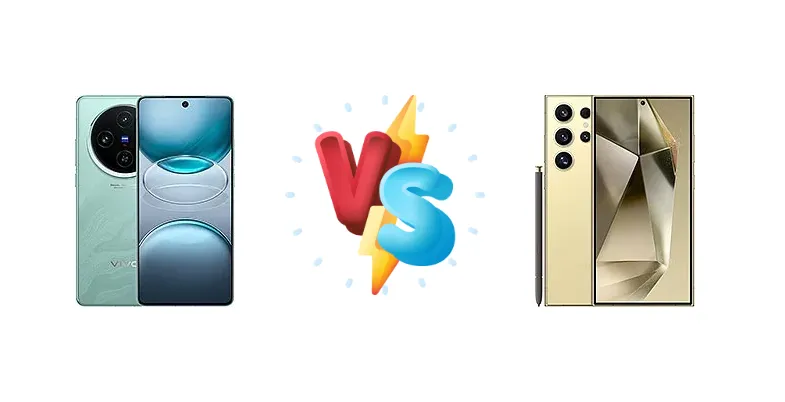
|
🏆 Quick Verdict
For users prioritizing peak performance and incredibly fast charging, the vivo X100s is the clear winner. However, the Samsung Galaxy S24 Ultra offers a more polished, feature-rich experience with superior battery life and a more versatile camera system, making it the better choice for the average user.
| PHONES | ||
|---|---|---|
| Phone Names | vivo X100s | Samsung Galaxy S24 Ultra |
| Network | ||
|---|---|---|
| 2G bands | GSM 850 / 900 / 1800 / 1900 | GSM 850 / 900 / 1800 / 1900 |
| 3G bands | HSDPA 800 / 850 / 900 / 1700(AWS) / 1900 / 2100 | HSDPA 850 / 900 / 1700(AWS) / 1900 / 2100 |
| 4G bands | 1, 2, 3, 4, 5, 7, 8, 18, 19, 26, 28, 34, 38, 39, 40, 41 | 1, 2, 3, 4, 5, 7, 8, 12, 13, 17, 18, 19, 20, 25, 26, 28, 32, 38, 39, 40, 41, 66 - International |
| 5G bands | 1, 3, 5, 8, 28, 38, 40, 41, 77, 78 SA/NSA | 1, 2, 3, 5, 7, 8, 12, 20, 25, 26, 28, 38, 40, 41, 66, 75, 77, 78 SA/NSA/Sub6 - International |
| Speed | HSPA, LTE, 5G | HSPA, LTE (up to 7CA), 5G |
| Technology | GSM / CDMA / HSPA / LTE / 5G | GSM / CDMA / HSPA / EVDO / LTE / 5G |
| Launch | ||
|---|---|---|
| Announced | 2024, May 13 | 2024, January 17 |
| Status | Available. Released 2024, May 17 | Available. Released 2024, January 24 |
| Body | ||
|---|---|---|
| Build | Glass front, aluminum frame, glass back | Glass front (Corning Gorilla Armor), glass back (Corning Gorilla Armor), titanium frame (grade 2) |
| Dimensions | 163.1 x 75.8 x 7.8 mm (6.42 x 2.98 x 0.31 in) | 162.3 x 79 x 8.6 mm (6.39 x 3.11 x 0.34 in) |
| SIM | Nano-SIM + Nano-SIM | · Nano-SIM + Nano-SIM + eSIM + eSIM (max 2 at a time) - INT· Nano-SIM + eSIM + eSIM (max 2 at a time) - USA· Nano-SIM + Nano-SIM - CN |
| Weight | 203 g (7.16 oz) | 232 g or 233 g (8.18 oz) |
| Display | ||
|---|---|---|
| Protection | - | Corning Gorilla Armor |
| Resolution | 1260 x 2800 pixels, 20:9 ratio (~453 ppi density) | 1440 x 3120 pixels, 19.5:9 ratio (~505 ppi density) |
| Size | 6.78 inches, 111.0 cm2 (~89.8% screen-to-body ratio) | 6.8 inches, 113.5 cm2 (~88.5% screen-to-body ratio) |
| Type | LTPO AMOLED, 1B colors, 120Hz, 3000 nits (peak) | Dynamic LTPO AMOLED 2X, 120Hz, HDR10+, 2600 nits (peak) |
| Platform | ||
|---|---|---|
| CPU | Octa-core (1x3.4 GHz Cortex-X4 & 3x2.85 GHz Cortex-X4 & 4x2.0 GHz Cortex-A720) | 8-core (1x3.39GHz Cortex-X4 & 3x3.1GHz Cortex-A720 & 2x2.9GHz Cortex-A720 & 2x2.2GHz Cortex-A520) |
| Chipset | Mediatek Dimensity 9300+ (4 nm) | Qualcomm SM8650-AC Snapdragon 8 Gen 3 (4 nm) |
| GPU | Immortalis-G720 MC12 | Adreno 750 (1 GHz) |
| OS | Android 14, OriginOS 4 | Android 14, up to 7 major Android upgrades, One UI 8.0 |
| Memory | ||
|---|---|---|
| Card slot | No | No |
| Internal | 256GB 12GB RAM, 256GB 16GB RAM, 512GB 12GB RAM, 512GB 16GB RAM, 1TB 16GB RAM | 256GB 12GB RAM, 512GB 12GB RAM, 1TB 12GB RAM |
| Main Camera | ||
|---|---|---|
| Features | Laser AF, color spectrum sensor, Zeiss optics, Zeiss T* lens coating, LED flash, panorama, HDR, 3D LUT import | Laser AF, LED flash, auto-HDR, panorama |
| Quad | - | 200 MP, f/1.7, 24mm (wide), 1/1.3", 0.6µm, multi-directional PDAF, OIS 10 MP, f/2.4, 67mm (telephoto), 1/3.52", 1.12µm, PDAF, OIS, 3x optical zoom 50 MP, f/3.4, 111mm (periscope telephoto), 1/2.52", 0.7µm, PDAF, OIS, 5x optical zoom 12 MP, f/2.2, 13mm, 120˚ (ultrawide), 1/2.55", 1.4µm, dual pixel PDAF, Super Steady video |
| Triple | 50 MP, f/1.6, (wide), 1/1.49", PDAF, OIS 64 MP, f/2.6, 70mm (periscope telephoto), 1/2.0", PDAF, OIS, 3x optical zoom 50 MP, f/2.0, 15mm, 119˚ (ultrawide), 1/2.76", 0.64µm, AF | - |
| Video | 4K@30/60fps, 1080p, gyro-EIS | 8K@24/30fps, 4K@30/60/120fps, 1080p@30/60/120/240fps, HDR10+, stereo sound rec., gyro-EIS |
| Selfie camera | ||
|---|---|---|
| Features | HDR | HDR, HDR10+ |
| Single | 32 MP, f/2.0, 20mm (ultrawide) | 12 MP, f/2.2, 26mm (wide), 1/3.2", 1.12µm, dual pixel PDAF |
| Video | 1080p@30/60fps | 4K@30/60fps, 1080p@30fps |
| Sound | ||
|---|---|---|
| 35mm jack | No | No |
| Loudspeaker | Yes, with stereo speakers | Yes, with stereo speakers |
| Comms | ||
|---|---|---|
| Bluetooth | 5.4, A2DP, LE, aptX HD, LHDC | 5.3, A2DP, LE |
| Infrared port | Yes | - |
| NFC | Yes | Yes |
| Positioning | GPS (L1+L5), BDS (B1I+B1c+B2a), GALILEO (E1+E5a), QZSS (L1+L5), NavIC (L5), GLONASS | GPS, GLONASS, BDS, GALILEO, QZSS |
| Radio | No | No |
| USB | USB Type-C 2.0, OTG | USB Type-C 3.2, DisplayPort 1.2, OTG |
| WLAN | Wi-Fi 802.11 a/b/g/n/ac/6/7, dual-band | Wi-Fi 802.11 a/b/g/n/ac/6e/7, tri-band, Wi-Fi Direct |
| Features | ||
|---|---|---|
| Sensors | Fingerprint (under display, optical), accelerometer, gyro, proximity, compass | Fingerprint (under display, ultrasonic), accelerometer, gyro, proximity, compass, barometer |
| Battery | ||
|---|---|---|
| Charging | 100W wired, 50% in 11 min Reverse wired | 45W wired, PD3.0, 65% in 30 min 15W wireless (Qi) 4.5W reverse wireless |
| Type | Li-Ion 5100 mAh | Li-Ion 5000 mAh |
| Misc | ||
|---|---|---|
| Colors | Titanium, White, Grey, Green | Titanium Black, Titanium Gray, Titanium Violet, Titanium Yellow, Titanium Blue, Titanium Green, Titanium Orange |
| Models | V2359A | SM-S928B, SM-S928B/DS, SM-S928U, SM-S928U1, SM-S928W, SM-S928N, SM-S9280, SM-S928E, SM-S928E/DS |
| Price | About 520 EUR | $ 514.94 / C$ 929.99 / £ 630.00 / € 658.53 / ₹ 84,999 |
| SAR | - | 1.26 W/kg (head) 0.62 W/kg (body) |
| SAR EU | - | 1.06 W/kg (head) 1.30 W/kg (body) |
vivo X100s
- Blazing-fast Dimensity 9300+ processor
- Incredibly fast 100W wired charging
- Potentially superior sustained CPU performance
- Battery life data currently unavailable
- Camera system details are limited
Samsung Galaxy S24 Ultra
- Excellent all-day battery life (13:49h active use)
- Versatile camera system with advanced zoom
- Bright and vibrant display (1447 nits)
- Slower 45W wired charging
- Snapdragon 8 Gen 3 may throttle under sustained load
Display Comparison
The Samsung Galaxy S24 Ultra boasts a peak brightness of 1447 nits, ensuring excellent visibility even in direct sunlight. While the X100s’ display specs are not provided, Samsung’s panel technology is known for its color accuracy and vibrancy. The S24 Ultra’s adaptive refresh rate (LTPO) likely contributes to better power efficiency. The S24 Ultra’s larger screen size and potentially higher resolution will provide a more immersive viewing experience, while the X100s may focus on a more compact form factor.
Camera Comparison
The Samsung Galaxy S24 Ultra is expected to feature a multi-camera system with a focus on versatility, including wide, ultrawide, and telephoto lenses with significant optical zoom capabilities. While specific sensor details are not provided, Samsung’s image processing algorithms are renowned for their vibrant colors and detail. The vivo X100s’ camera specifications are not detailed, but it is likely to emphasize computational photography and image stabilization. The S24 Ultra’s superior zoom capabilities and established camera reputation give it an edge in overall camera performance.
Performance
The vivo X100s is powered by the Mediatek Dimensity 9300+, built on a 4nm process, featuring a unique CPU configuration with a 3.4 GHz Cortex-X4 prime core and three additional Cortex-X4 cores. This contrasts with the Samsung Galaxy S24 Ultra’s Qualcomm Snapdragon 8 Gen 3 (also 4nm) which utilizes a more traditional 1x large core, 3x medium, 2x medium, and 2x small core setup. The X100s’ aggressive core configuration suggests a focus on sustained peak performance, potentially exceeding the S24 Ultra in raw CPU benchmarks. However, the Snapdragon 8 Gen 3’s optimized architecture and thermal design may provide more consistent performance under prolonged load. Both devices utilize LPDDR5x RAM, but the X100s’ chipset may benefit from Mediatek’s HyperEngine technology for enhanced gaming performance.
Battery Life
The Samsung Galaxy S24 Ultra achieves an impressive 13:49 hours of active use, demonstrating excellent battery life. The vivo X100s, while lacking specific battery life data, compensates with its 100W wired charging, capable of reaching 50% charge in just 11 minutes. The S24 Ultra’s 45W charging (65% in 30 minutes) is significantly slower. This difference in charging speed is a major advantage for the X100s, offering quick top-ups throughout the day. The S24 Ultra’s larger battery capacity provides longer overall runtime, but the X100s’ faster charging mitigates range anxiety.
Buying Guide
Buy the vivo X100s if you demand the absolute fastest Android performance for demanding tasks like gaming and video editing, and value the convenience of 100W wired charging. Buy the Samsung Galaxy S24 Ultra if you prioritize all-day battery life, a comprehensive camera system with excellent zoom capabilities, and a more refined software experience with longer software support.