
vivo X100s vs Honor Magic6 Pro: A Deep Dive into Android Flagship Performance
| Phones Images | |||||
|---|---|---|---|---|---|
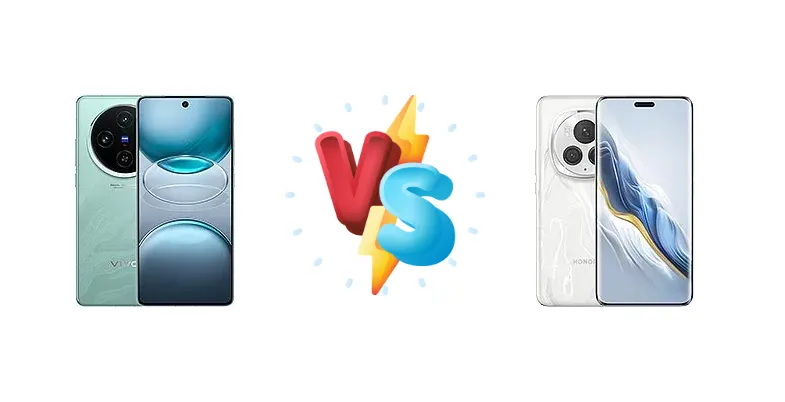
|
🏆 Quick Verdict
For the average user prioritizing raw performance and sustained gaming, the Honor Magic6 Pro edges out the vivo X100s. The Snapdragon 8 Gen 3, coupled with its superior battery life (14:06h active use), provides a more consistently powerful experience. However, the X100s offers a compelling alternative for those seeking a potentially more efficient chipset.
| PHONES | ||
|---|---|---|
| Phone Names | vivo X100s | Honor Magic6 Pro |
| Network | ||
|---|---|---|
| 2G bands | GSM 850 / 900 / 1800 / 1900 | GSM 850 / 900 / 1800 / 1900 |
| 3G bands | HSDPA 800 / 850 / 900 / 1700(AWS) / 1900 / 2100 | HSDPA 800 / 850 / 900 / 1700(AWS) / 1900 / 2100 |
| 4G bands | 1, 2, 3, 4, 5, 7, 8, 18, 19, 26, 28, 34, 38, 39, 40, 41 | LTE |
| 5G bands | 1, 3, 5, 8, 28, 38, 40, 41, 77, 78 SA/NSA | SA/NSA |
| Speed | HSPA, LTE, 5G | HSPA, LTE, 5G |
| Technology | GSM / CDMA / HSPA / LTE / 5G | GSM / CDMA / HSPA / CDMA2000 / LTE / 5G |
| Launch | ||
|---|---|---|
| Announced | 2024, May 13 | 2024, January 11 |
| Status | Available. Released 2024, May 17 | Available. Released 2024, January 18 |
| Body | ||
|---|---|---|
| Build | Glass front, aluminum frame, glass back | Glass front (NanoCrystal Shield), glass back or silicone polymer back (eco leather) |
| Dimensions | 163.1 x 75.8 x 7.8 mm (6.42 x 2.98 x 0.31 in) | 162.5 x 75.8 x 8.9 mm (6.40 x 2.98 x 0.35 in) |
| SIM | Nano-SIM + Nano-SIM | · Nano-SIM + eSIM· Nano-SIM + Nano-SIM |
| Weight | 203 g (7.16 oz) | 225 g or 229 g (7.94 oz) |
| Display | ||
|---|---|---|
| Protection | - | NanoCrystal Shield |
| Resolution | 1260 x 2800 pixels, 20:9 ratio (~453 ppi density) | 1280 x 2800 pixels, 19.5:9 ratio (~453 ppi density) |
| Size | 6.78 inches, 111.0 cm2 (~89.8% screen-to-body ratio) | 6.8 inches, 112.8 cm2 (~91.6% screen-to-body ratio) |
| Type | LTPO AMOLED, 1B colors, 120Hz, 3000 nits (peak) | LTPO OLED, 1B colors, 120Hz, Dolby Vision, HDR, 1600 nits (HBM), 5000 nits (peak) |
| Platform | ||
|---|---|---|
| CPU | Octa-core (1x3.4 GHz Cortex-X4 & 3x2.85 GHz Cortex-X4 & 4x2.0 GHz Cortex-A720) | Octa-core (1x3.3 GHz Cortex-X4 & 3x3.2 GHz Cortex-A720 & 2x3.0 GHz Cortex-A720 & 2x2.3 GHz Cortex-A520) |
| Chipset | Mediatek Dimensity 9300+ (4 nm) | Qualcomm SM8650-AB Snapdragon 8 Gen 3 (4 nm) |
| GPU | Immortalis-G720 MC12 | Adreno 750 |
| OS | Android 14, OriginOS 4 | Android 14, up to 4 major Android upgrades, MagicOS 8 |
| Memory | ||
|---|---|---|
| Card slot | No | No |
| Internal | 256GB 12GB RAM, 256GB 16GB RAM, 512GB 12GB RAM, 512GB 16GB RAM, 1TB 16GB RAM | 256GB 12GB RAM, 256GB 16GB RAM, 512GB 12GB RAM, 512GB 16GB RAM, 1TB 16GB RAM |
| Main Camera | ||
|---|---|---|
| Features | Laser AF, color spectrum sensor, Zeiss optics, Zeiss T* lens coating, LED flash, panorama, HDR, 3D LUT import | Laser AF, color spectrum sensor, LED flash, HDR, panorama |
| Triple | 50 MP, f/1.6, (wide), 1/1.49", PDAF, OIS 64 MP, f/2.6, 70mm (periscope telephoto), 1/2.0", PDAF, OIS, 3x optical zoom 50 MP, f/2.0, 15mm, 119˚ (ultrawide), 1/2.76", 0.64µm, AF | 50 MP, f/1.4-2.0, 23mm (wide), 1/1.3", 1.2µm, PDAF, OIS 180 MP, f/2.6, (periscope telephoto), 1/1.49", 0.56µm, PDAF, OIS, 2.5x optical zoom 50 MP, f/2.0, 13mm, 122˚ (ultrawide), 1/2.88", 0.61µm, AF |
| Video | 4K@30/60fps, 1080p, gyro-EIS | 4K@24/30/60fps, 1080p@30/60/120/240fps, gyro-EIS, OIS, HDR, 10-bit video |
| Selfie camera | ||
|---|---|---|
| Features | HDR | - |
| Single | 32 MP, f/2.0, 20mm (ultrawide) | 50 MP, f/2.0, 22mm (wide), 1/2.93", 0.6µm, AF TOF 3D, (depth/biometrics sensor) |
| Video | 1080p@30/60fps | 4K@30fps, 1080p@30/60fps, gyro-EIS |
| Sound | ||
|---|---|---|
| 35mm jack | No | No |
| Loudspeaker | Yes, with stereo speakers | Yes, with stereo speakers |
| Comms | ||
|---|---|---|
| Bluetooth | 5.4, A2DP, LE, aptX HD, LHDC | 5.3, A2DP, LE, aptX HD |
| Infrared port | Yes | Yes |
| NFC | Yes | Yes |
| Positioning | GPS (L1+L5), BDS (B1I+B1c+B2a), GALILEO (E1+E5a), QZSS (L1+L5), NavIC (L5), GLONASS | GPS (L1+L5), GLONASS, BDS (B1I+B1c+B2a), GALILEO (E1+E5a) |
| Radio | No | No |
| USB | USB Type-C 2.0, OTG | USB Type-C 3.2, DisplayPort 1.2, OTG |
| WLAN | Wi-Fi 802.11 a/b/g/n/ac/6/7, dual-band | Wi-Fi 802.11 a/b/g/n/ac/6/7, dual-band, Wi-Fi Direct |
| Features | ||
|---|---|---|
| Sensors | Fingerprint (under display, optical), accelerometer, gyro, proximity, compass | Fingerprint (under display, optical), Face ID, accelerometer, gyro, proximity, compass |
| Battery | ||
|---|---|---|
| Charging | 100W wired, 50% in 11 min Reverse wired | 80W wired 66W wireless Reverse wireless 5W reverse wired |
| Type | Li-Ion 5100 mAh | Si/C Li-Ion 5600 mAh |
| Misc | ||
|---|---|---|
| Colors | Titanium, White, Grey, Green | Black, Green, Blue, Purple, White |
| Models | V2359A | BVL-AN16, BVL-N49 |
| Price | About 520 EUR | € 455.54 / $ 899.00 / £ 598.99 |
vivo X100s
- Potentially more efficient Dimensity 9300+ chipset
- Faster 100W wired charging
- Likely competitive camera system (details pending)
- Limited information on display quality
- Battery life likely inferior to Magic6 Pro
Honor Magic6 Pro
- Exceptional battery life (14:06h active use)
- Brighter display (1578 nits)
- Powerful Snapdragon 8 Gen 3 chipset
- Slower 80W wired charging
- Potentially less efficient chipset compared to Dimensity 9300+
Display Comparison
The Honor Magic6 Pro boasts a significantly brighter display, reaching a measured peak of 1578 nits, making it far more usable in direct sunlight compared to the X100s (brightness data unavailable). While both likely utilize LTPO technology for adaptive refresh rates, the Magic6 Pro’s higher peak brightness is a clear advantage. The X100s’ display specs are currently limited, making a detailed comparison of color accuracy and panel quality difficult, but the Magic6 Pro sets a high bar.
Camera Comparison
Without detailed camera specs for the X100s, a direct comparison is challenging. However, both phones are expected to feature high-end camera systems. The Magic6 Pro’s image processing is likely tuned for vibrant, social media-ready photos, while vivo typically aims for a more natural look. The presence of OIS on both devices is expected, but sensor sizes and lens apertures will be key differentiators. Ignoring the typical 2MP macro lens found on many phones, the main sensor and ultrawide performance will be the deciding factors for photography enthusiasts.
Performance
The core of the difference lies in the chipsets. The Honor Magic6 Pro’s Snapdragon 8 Gen 3 (4nm) features a 1x3.3 GHz Cortex-X4 prime core, while the vivo X100s utilizes the Dimensity 9300+ (4nm) with a faster 1x3.4 GHz Cortex-X4. However, the Dimensity 9300+ also includes *three* Cortex-X4 cores versus the Snapdragon’s single core, potentially offering benefits in multi-threaded workloads. The Snapdragon 8 Gen 3’s architecture, with its 3x3.2 GHz Cortex-A720 cores and 2x3.0 GHz Cortex-A720 cores, is more balanced than the X100s’ 4x2.0 GHz Cortex-A720 configuration. This suggests the Snapdragon may offer more consistent performance across a wider range of applications. Both utilize LPDDR5x RAM, but thermal management will be crucial in determining real-world sustained performance.
Battery Life
The Honor Magic6 Pro clearly wins in battery endurance with a reported 14:06 hours of active use. While the X100s’ battery capacity is unknown, the Magic6 Pro’s larger battery combined with the Snapdragon 8 Gen 3’s efficiency provides a significant advantage. The X100s offers faster wired charging at 100W (50% in 11 minutes) compared to the Magic6 Pro’s 80W, but the Magic6 Pro compensates with 66W wireless charging and 5W reverse wired charging. The faster wired charging of the X100s is useful for quick top-ups, but the Magic6 Pro’s overall battery life and wireless charging capabilities offer greater convenience.
Buying Guide
Buy the vivo X100s if you prioritize a potentially more power-efficient chipset and are comfortable with a slightly less refined software experience. It’s ideal for users who frequently switch between tasks and value quick app launches. Buy the Honor Magic6 Pro if you demand the absolute best sustained performance for demanding tasks like gaming and video editing, and if long battery life is a critical requirement. It’s the choice for power users and content creators.