
vivo X100s Pro vs Honor Magic6 Pro: A Deep Dive into Android Flagship Performance
| Phones Images | |||||
|---|---|---|---|---|---|
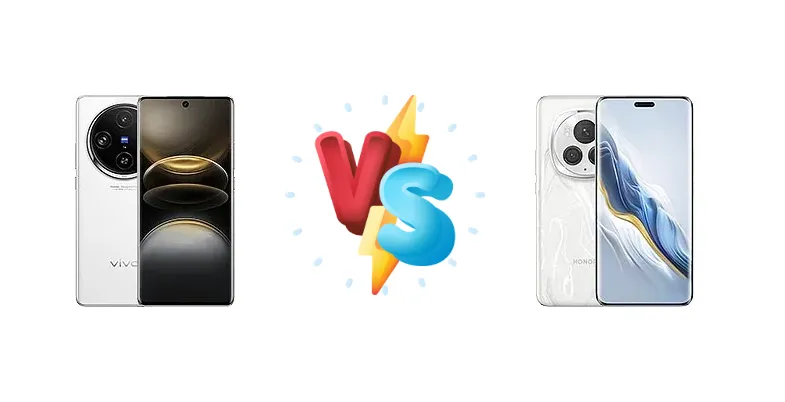
|
🏆 Quick Verdict
For the average user prioritizing sustained performance and battery longevity, the Honor Magic6 Pro emerges as the winner. Its Snapdragon 8 Gen 3, coupled with a larger battery and efficient charging, provides a more consistently smooth experience. However, the vivo X100s Pro offers a compelling alternative for those seeking the absolute latest in MediaTek silicon.
| PHONES | ||
|---|---|---|
| Phone Names | vivo X100s Pro | Honor Magic6 Pro |
| Network | ||
|---|---|---|
| 2G bands | GSM 850 / 900 / 1800 / 1900 | GSM 850 / 900 / 1800 / 1900 |
| 3G bands | HSDPA 800 / 850 / 900 / 1700(AWS) / 1900 / 2100 | HSDPA 800 / 850 / 900 / 1700(AWS) / 1900 / 2100 |
| 4G bands | 1, 2, 3, 4, 5, 7, 8, 12, 17, 18, 19, 26, 28, 34, 38, 39, 40, 41 | LTE |
| 5G bands | 1, 3, 5, 8, 28, 38, 40, 41, 77, 78, 79 SA/NSA | SA/NSA |
| Speed | HSPA, LTE, 5G | HSPA, LTE, 5G |
| Technology | GSM / CDMA / HSPA / LTE / 5G | GSM / CDMA / HSPA / CDMA2000 / LTE / 5G |
| Launch | ||
|---|---|---|
| Announced | 2024, May 13 | 2024, January 11 |
| Status | Available. Released 2024, May 17 | Available. Released 2024, January 18 |
| Body | ||
|---|---|---|
| Build | Glass front, aluminum frame, glass back | Glass front (NanoCrystal Shield), glass back or silicone polymer back (eco leather) |
| Dimensions | 164.1 x 75.3 x 8.9 mm (6.46 x 2.96 x 0.35 in) | 162.5 x 75.8 x 8.9 mm (6.40 x 2.98 x 0.35 in) |
| SIM | Nano-SIM + Nano-SIM | · Nano-SIM + eSIM· Nano-SIM + Nano-SIM |
| Weight | 224 g (7.90 oz) | 225 g or 229 g (7.94 oz) |
| Display | ||
|---|---|---|
| Protection | - | NanoCrystal Shield |
| Resolution | 1260 x 2800 pixels, 20:9 ratio (~453 ppi density) | 1280 x 2800 pixels, 19.5:9 ratio (~453 ppi density) |
| Size | 6.78 inches, 111.0 cm2 (~89.8% screen-to-body ratio) | 6.8 inches, 112.8 cm2 (~91.6% screen-to-body ratio) |
| Type | LTPO AMOLED, 1B colors, 120Hz, 3000 nits (peak) | LTPO OLED, 1B colors, 120Hz, Dolby Vision, HDR, 1600 nits (HBM), 5000 nits (peak) |
| Platform | ||
|---|---|---|
| CPU | Octa-core (1x3.4 GHz Cortex-X4 & 3x2.85 GHz Cortex-X4 & 4x2.0 GHz Cortex-A720) | Octa-core (1x3.3 GHz Cortex-X4 & 3x3.2 GHz Cortex-A720 & 2x3.0 GHz Cortex-A720 & 2x2.3 GHz Cortex-A520) |
| Chipset | Mediatek Dimensity 9300+ (4 nm) | Qualcomm SM8650-AB Snapdragon 8 Gen 3 (4 nm) |
| GPU | Immortalis-G720 MC12 | Adreno 750 |
| OS | Android 14, OriginOS 4 | Android 14, up to 4 major Android upgrades, MagicOS 8 |
| Memory | ||
|---|---|---|
| Card slot | No | No |
| Internal | 256GB 12GB RAM, 512GB 16GB RAM, 1TB 16GB RAM | 256GB 12GB RAM, 256GB 16GB RAM, 512GB 12GB RAM, 512GB 16GB RAM, 1TB 16GB RAM |
| Main Camera | ||
|---|---|---|
| Features | Laser AF, color spectrum sensor, Zeiss optics, Zeiss T* lens coating, LED flash, panorama, HDR, 3D LUT import | Laser AF, color spectrum sensor, LED flash, HDR, panorama |
| Triple | 50 MP, f/1.8, 23mm (wide), 1/0.98", 1.6µm, dual pixel PDAF, OIS 50 MP, f/2.5, 100mm (periscope telephoto), 1/2", 0.7µm, PDAF (18cm - ∞), OIS, 4.3x optical zoom 50 MP, f/2.0, 15mm, 119˚ (ultrawide), 1/2.76", 0.64µm, AF | 50 MP, f/1.4-2.0, 23mm (wide), 1/1.3", 1.2µm, PDAF, OIS 180 MP, f/2.6, (periscope telephoto), 1/1.49", 0.56µm, PDAF, OIS, 2.5x optical zoom 50 MP, f/2.0, 13mm, 122˚ (ultrawide), 1/2.88", 0.61µm, AF |
| Video | 8K@30fps (China model only), 4K@30/60fps, 1080p, gyro-EIS | 4K@24/30/60fps, 1080p@30/60/120/240fps, gyro-EIS, OIS, HDR, 10-bit video |
| Selfie camera | ||
|---|---|---|
| Features | HDR | - |
| Single | 32 MP, f/2.0, 20mm (ultrawide) | 50 MP, f/2.0, 22mm (wide), 1/2.93", 0.6µm, AF TOF 3D, (depth/biometrics sensor) |
| Video | 4K@30/60fps, 1080p@30/60fps | 4K@30fps, 1080p@30/60fps, gyro-EIS |
| Sound | ||
|---|---|---|
| 35mm jack | No | No |
| Loudspeaker | Yes, with stereo speakers | Yes, with stereo speakers |
| Comms | ||
|---|---|---|
| Bluetooth | 5.4, A2DP, LE, aptX HD, LHDC | 5.3, A2DP, LE, aptX HD |
| Infrared port | Yes | Yes |
| NFC | Yes | Yes |
| Positioning | GPS (L1+L5), BDS (B1I+B1c+B2a+B2b), GALILEO (E1+E5a+E5b), QZSS (L1+L5), NavIC (L5), GLONASS | GPS (L1+L5), GLONASS, BDS (B1I+B1c+B2a), GALILEO (E1+E5a) |
| Radio | No | No |
| USB | USB Type-C 3.2, OTG, DisplayPort | USB Type-C 3.2, DisplayPort 1.2, OTG |
| WLAN | Wi-Fi 802.11 a/b/g/n/ac/6/7, dual-band | Wi-Fi 802.11 a/b/g/n/ac/6/7, dual-band, Wi-Fi Direct |
| Features | ||
|---|---|---|
| Sensors | Fingerprint (under display, optical), accelerometer, gyro, proximity, compass | Fingerprint (under display, optical), Face ID, accelerometer, gyro, proximity, compass |
| Battery | ||
|---|---|---|
| Charging | 100W wired, 50% in 12 min 50W wireless Reverse wired | 80W wired 66W wireless Reverse wireless 5W reverse wired |
| Type | Li-Ion 5400 mAh | Si/C Li-Ion 5600 mAh |
| Misc | ||
|---|---|---|
| Colors | Titanium, White, Grey | Black, Green, Blue, Purple, White |
| Models | V2324HA | BVL-AN16, BVL-N49 |
| Price | About 640 EUR | € 455.54 / $ 899.00 / £ 598.99 |
vivo X100s Pro
- Potentially higher multi-core CPU performance due to the Dimensity 9300+'s core configuration.
- Faster 100W wired charging for quicker top-ups.
- Latest MediaTek flagship chipset for early adopters.
- Potential for thermal throttling under sustained load.
- Battery life likely inferior to the Honor Magic6 Pro.
- Display brightness data currently unavailable.
Honor Magic6 Pro
- Exceptional battery life with 14:06h of active use.
- Significantly brighter display (1578 nits) for outdoor visibility.
- Snapdragon 8 Gen 3 offers excellent performance and thermal management.
- Slower 80W wired charging compared to the X100s Pro.
- Potentially less aggressive CPU core configuration.
- Reverse wired charging is limited to 5W.
Display Comparison
The Honor Magic6 Pro boasts a significantly brighter display, reaching a measured 1578 nits, making it substantially more readable outdoors compared to the X100s Pro (brightness data unavailable). While both likely utilize LTPO technology for adaptive refresh rates, the Magic6 Pro’s peak brightness is a clear advantage. The X100s Pro’s display specs are currently unknown, but the Magic6 Pro’s panel is a standout feature for outdoor visibility and HDR content consumption. Bezels are expected to be minimal on both devices, reflecting current flagship trends.
Camera Comparison
Detailed camera specs are missing for both devices, but the market positioning suggests both will feature high-resolution main sensors. The focus should be on sensor size and optical image stabilization (OIS). Without specific aperture data, it’s difficult to assess low-light performance. Image processing philosophies will also be key; vivo typically favors vibrant, saturated colors, while Honor often aims for a more natural look. The absence of details on telephoto lenses and ultrawide cameras prevents a comprehensive comparison.
Performance
The core of the performance difference lies in the chipsets. The Honor Magic6 Pro’s Snapdragon 8 Gen 3 (4nm) features a 1x3.3 GHz Cortex-X4 prime core, while the vivo X100s Pro’s Dimensity 9300+ (4nm) utilizes a 1x3.4 GHz Cortex-X4, alongside *three* additional Cortex-X4 cores. This suggests a potential advantage in multi-core workloads for the X100s Pro. However, the Snapdragon 8 Gen 3’s architecture is known for its efficiency and thermal management. The Dimensity 9300+’s aggressive core configuration may lead to more pronounced throttling under sustained load. Both devices utilize LPDDR5x RAM, but the Snapdragon’s integrated NPU likely provides a more refined AI experience.
Battery Life
The Honor Magic6 Pro clearly wins in battery endurance with an active use score of 14:06h. While the X100s Pro’s battery capacity is unknown, the Magic6 Pro’s longevity is a significant advantage. Charging speeds are competitive, with the X100s Pro offering 100W wired and 50W wireless, while the Magic6 Pro provides 80W wired and 66W wireless. The X100s Pro’s faster wired charging (100W vs 80W) allows for a 50% charge in 12 minutes, potentially offsetting the Magic6 Pro’s larger battery capacity for quick top-ups. Both support reverse wireless charging, but the Magic6 Pro offers a more substantial 5W reverse wired charging capability.
Buying Guide
Buy the vivo X100s Pro if you need the absolute latest processor technology and are comfortable potentially managing thermal throttling during extended, demanding tasks. Buy the Honor Magic6 Pro if you prefer a more balanced experience with exceptional battery life, consistently high performance, and a brighter, more visible display in direct sunlight. The Magic6 Pro is ideal for power users who prioritize reliability and longevity.