
vivo X100 vs OnePlus 12R: A Deep Dive into Performance and Value
| Phones Images | |||||
|---|---|---|---|---|---|
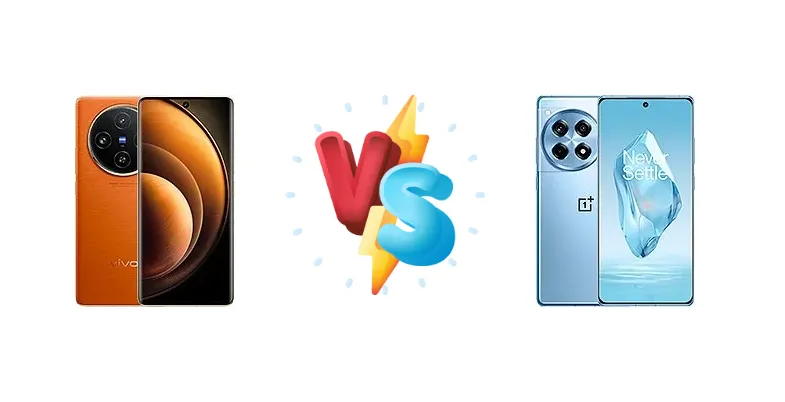
|
🏆 Quick Verdict
For the average user prioritizing sustained performance and a proven track record, the OnePlus 12R emerges as the stronger choice. Its Snapdragon 8 Gen 2 offers excellent efficiency and gaming capabilities, coupled with impressive 14:32 hour active use battery life. While the X100’s Dimensity 9300 is potent, its real-world benefits aren’t substantial enough to offset the 12R’s overall package.
| PHONES | ||
|---|---|---|
| Phone Names | vivo X100 | OnePlus 12R |
| Network | ||
|---|---|---|
| 2G bands | GSM 850 / 900 / 1800 / 1900 | GSM 850 / 900 / 1800 / 1900 |
| 3G bands | HSDPA 800 / 850 / 900 / 1700(AWS) / 1900 / 2100 | HSDPA 850 / 900 / 1700(AWS) / 1900 / 2100 |
| 4G bands | 1, 2, 3, 4, 5, 7, 8, 12, 17, 18, 19, 20, 26, 28, 34, 38, 39, 40, 41, 42 - International | 1, 2, 3, 4, 5, 7, 8, 12, 17, 18, 19, 20, 26, 28, 32, 38, 39, 40, 41, 66 |
| 5G bands | 1, 3, 5, 7, 8, 28, 38, 40, 41, 77, 78 SA/NSA - International | 1, 2, 3, 5, 7, 8, 12, 20, 28, 38, 40, 41, 66, 77, 78 SA/NSA |
| Speed | HSPA, LTE, 5G | HSPA, LTE, 5G |
| Technology | GSM / CDMA / HSPA / LTE / 5G | GSM / CDMA / HSPA / LTE / 5G |
| Launch | ||
|---|---|---|
| Announced | 2023, November 13 | 2024, January 23 |
| Status | Available. Released 2023, November 21 | Available. Released 2024, February 06 |
| Body | ||
|---|---|---|
| Build | Glass front, glass back | Glass front (Gorilla Glass Victus 2), aluminum frame, glass back |
| Dimensions | 164.1 x 75.2 x 8.5 mm or 8.8 mm | 163.3 x 75.3 x 8.8 mm (6.43 x 2.96 x 0.35 in) |
| SIM | Nano-SIM + Nano-SIM | · Nano-SIM + Nano-SIM + eSIM (max 2 at a time)· Nano-SIM + Nano-SIM |
| Weight | 202 g or 206 g (7.13 oz) | 207 g (7.30 oz) |
| Display | ||
|---|---|---|
| Protection | - | Corning Gorilla Glass Victus 2 |
| Resolution | 1260 x 2800 pixels, 20:9 ratio (~452 ppi density) | 1264 x 2780 pixels (~450 ppi density) |
| Size | 6.78 inches, 111.5 cm2 (~90.3% screen-to-body ratio) | 6.78 inches, 111.7 cm2 (~90.9% screen-to-body ratio) |
| Type | LTPO AMOLED, 1B colors, 120Hz, 3000 nits (peak) | LTPO4 AMOLED, 1B colors, 120Hz, HDR10+, Dolby Vision, 1600 nits (HBM), 4500 nits (peak) |
| Platform | ||
|---|---|---|
| CPU | Octa-core (1x3.25 GHz Cortex-X4 & 3x2.85 GHz Cortex-X4 & 4x2.0 GHz Cortex-A720) | Octa-core (1x3.2 GHz Cortex-X3 & 2x2.8 GHz Cortex-A715 & 2x2.8 GHz Cortex-A710 & 3x2.0 GHz Cortex-A510) |
| Chipset | Mediatek Dimensity 9300 (4 nm) | Qualcomm SM8550-AB Snapdragon 8 Gen 2 (4 nm) |
| GPU | Immortalis-G720 MC12 | Adreno 740 |
| OS | Android 14, Funtouch 14 (International), OriginOS 4 (China) | Android 14, up to 3 major Android upgrades, OxygenOS 15 |
| Memory | ||
|---|---|---|
| Card slot | No | No |
| Internal | 256GB 12GB RAM, 256GB 16GB RAM, 512GB 16GB RAM, 1TB 16GB RAM | 128GB 8GB RAM, 256GB 8GB RAM, 256GB 12GB RAM, 256GB 16GB RAM |
| Main Camera | ||
|---|---|---|
| Features | Laser AF, color spectrum sensor, Zeiss optics, Zeiss T* lens coating, LED flash, panorama, HDR, 3D LUT import | Laser AF, color spectrum sensor, LED flash, HDR, panorama |
| Triple | 50 MP, f/1.6, (wide), 1/1.49", PDAF, OIS 64 MP, f/2.6, 70mm (periscope telephoto), 1/2.0", PDAF, OIS, 3x optical zoom 50 MP, f/2.0, 15mm, 119˚ (ultrawide), 1/2.76", 0.64µm, AF | 50 MP, f/1.8, 24mm (wide), 1/1.56", 1.0µm, multi-directional PDAF, OIS 8 MP, f/2.2, 16mm, 112˚ (ultrawide), 1/4.0", 1.12µm 2 MP (macro) |
| Video | 4K, 1080p, gyro-EIS | 4K@30/60fps, 1080p@30/60/120/240fps, gyro-EIS, OIS |
| Selfie camera | ||
|---|---|---|
| Features | HDR | HDR, panorama |
| Single | 32 MP, f/2.0, 20mm (ultrawide) | 16 MP, f/2.4, 26mm (wide), 1/3", 1.0µm |
| Video | 4K@30fps, 1080p@30/60fps | 1080p@30fps, gyro-EIS |
| Sound | ||
|---|---|---|
| 35mm jack | No | No |
| Loudspeaker | Yes, with stereo speakers | Yes, with stereo speakers |
| Comms | ||
|---|---|---|
| Bluetooth | 5.4, A2DP, LE, aptX HD | 5.3, A2DP, LE, aptX HD |
| Infrared port | Yes | Yes |
| NFC | Yes | Yes |
| Positioning | GPS (L1+L5), GLONASS (G1), BDS (B1I+B1c+B2a), GALILEO (E1+E5a), QZSS (L1+L5), NavIC (L5) | GPS, GALILEO, GLONASS, BDS, QZSS |
| Radio | No | No |
| USB | USB Type-C 2.0, OTG | USB Type-C 2.0 |
| WLAN | Wi-Fi 802.11 a/b/g/n/ac/6/7, tri-band, Wi-Fi Direct | Wi-Fi 802.11 a/b/g/n/ac/6/7, dual-band |
| Features | ||
|---|---|---|
| Sensors | Fingerprint (under display, optical), accelerometer, gyro, proximity, compass | Fingerprint (under display, optical), accelerometer, gyro, proximity, compass |
| Battery | ||
|---|---|---|
| Charging | 120W wired, 50% in 11 min Reverse wired | 100W wired, 100% in 26 min |
| Type | Li-Ion 5000 mAh | Li-Ion 5500 mAh |
| Misc | ||
|---|---|---|
| Colors | Startrail Blue, Asteroid Black, White, Orange | Iron Gray, Cool Blue, Electric Violet, Sunset Dune |
| Models | V2309A, V2308 | CPH2609, CPH2585, CPH2611 |
| Price | ₹ 51,999 | € 410.84 / $ 399.95 / £ 649.00 |
| SAR | - | 1.19 W/kg (head) 0.82 W/kg (body) |
vivo X100
- Ultra-fast 120W charging
- Latest Mediatek Dimensity 9300 chipset
- Potentially superior camera system (based on brand reputation)
- Potential for early adopter software issues
- Uncertain thermal performance under sustained load
OnePlus 12R
- Excellent 14:32 hour active use battery life
- Proven Snapdragon 8 Gen 2 performance
- Mature and stable software experience
- Slower charging speed compared to vivo X100
- Less cutting-edge chipset
Display Comparison
The OnePlus 12R boasts a display capable of reaching 1181 nits of peak brightness, ensuring excellent visibility even in direct sunlight. While the vivo X100’s display specs are not provided, it’s likely to be competitive, but the 12R’s measured brightness provides a concrete advantage. Both devices utilize 4nm chipsets, which contribute to efficient power consumption for the displays. The absence of LTPO information for the X100 means we can’t assess its adaptive refresh rate capabilities, a feature likely present on the 12R to further optimize battery life.
Camera Comparison
Without detailed camera specifications for the vivo X100, a direct comparison is limited. However, the X100’s brand positioning suggests a strong emphasis on camera capabilities. The OnePlus 12R, while capable, is likely to prioritize overall value over cutting-edge camera technology. The Snapdragon 8 Gen 2’s ISP (Image Signal Processor) is highly capable, but the X100’s Dimensity 9300 also features a powerful ISP. The absence of information regarding sensor sizes and OIS on the X100 makes it difficult to assess its low-light performance relative to the 12R.
Performance
The core difference lies in the chipsets: the vivo X100 features the Mediatek Dimensity 9300, utilizing a unique core configuration with Cortex-X4 cores, while the OnePlus 12R employs the Qualcomm Snapdragon 8 Gen 2. The Dimensity 9300’s 3x Cortex-X4 setup suggests a focus on peak performance, but the Snapdragon 8 Gen 2’s more balanced architecture (1x Cortex-X3, 2x A715, 2x A710, 3x A510) often translates to more consistent performance under sustained loads. The 4nm fabrication process is shared, but Qualcomm’s optimization of the 8 Gen 2 is renowned for its thermal efficiency, potentially leading to less throttling during extended gaming sessions. The 12R’s LPDDR5x RAM complements the Snapdragon, ensuring swift data access.
Battery Life
The OnePlus 12R shines with a reported 14:32 hours of active use, demonstrating excellent battery endurance. The vivo X100 counters with 120W wired charging, achieving 50% charge in just 11 minutes – a significant advantage for users who prioritize rapid top-ups. The 12R’s 100W charging, reaching 100% in 26 minutes, is still very fast, but noticeably slower. This trade-off highlights a key decision point: prioritizing all-day battery life (12R) versus ultra-fast charging (X100).
Buying Guide
Buy the vivo X100 if you absolutely need the latest silicon and are willing to potentially troubleshoot early adopter issues for a marginal performance gain. Its 120W charging is also a significant draw. Buy the OnePlus 12R if you prioritize a refined, reliable experience with exceptional battery life, proven gaming performance, and a more mature software ecosystem. It’s the smarter choice for most users.