
vivo X100 vs Asus ROG Phone 8 Pro: Which Flagship Reigns Supreme?
| Phones Images | |||||
|---|---|---|---|---|---|
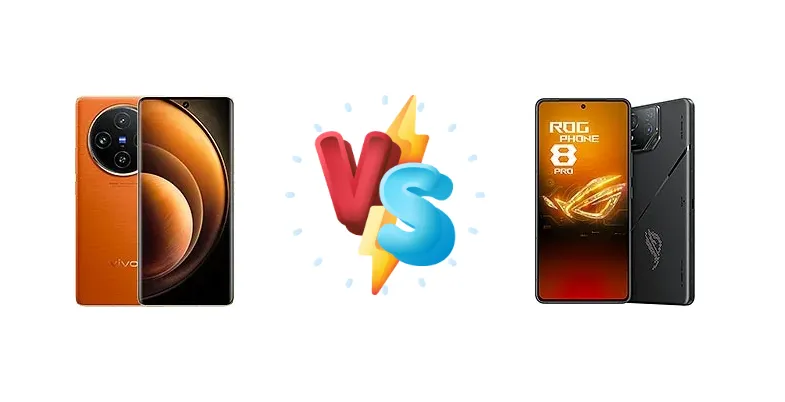
|
🏆 Quick Verdict
For the average user prioritizing a well-rounded experience with exceptional camera capabilities, the vivo X100 emerges as the winner. Its Dimensity 9300 delivers impressive performance, and its 120W charging significantly outperforms the ROG Phone 8 Pro’s variable charging speeds. However, gamers will find the ROG Phone 8 Pro’s dedicated features and sustained performance under load more compelling.
| PHONES | ||
|---|---|---|
| Phone Names | vivo X100 | Asus ROG Phone 8 Pro |
| Network | ||
|---|---|---|
| 2G bands | GSM 850 / 900 / 1800 / 1900 | GSM 850 / 900 / 1800 / 1900 |
| 3G bands | HSDPA 800 / 850 / 900 / 1700(AWS) / 1900 / 2100 | HSDPA 850 / 900 / 1700(AWS) / 1800 / 1900 / 2100 - International |
| 4G bands | 1, 2, 3, 4, 5, 7, 8, 12, 17, 18, 19, 20, 26, 28, 34, 38, 39, 40, 41, 42 - International | 1, 2, 3, 4, 5, 7, 8, 12, 17, 18, 19, 20, 25, 26, 28, 32, 34, 38, 39, 40, 41, 42, 43, 48, 66 - International |
| 5G bands | 1, 3, 5, 7, 8, 28, 38, 40, 41, 77, 78 SA/NSA - International | 1, 2, 3, 5, 7, 8, 12, 18, 20, 25, 26, 28, 38, 40, 41, 48, 66, 77, 78, 79 SA/NSA/Sub6 - International |
| Speed | HSPA, LTE, 5G | HSPA, LTE (Up to 7CA), 5G |
| Technology | GSM / CDMA / HSPA / LTE / 5G | GSM / CDMA / HSPA / LTE / 5G |
| Launch | ||
|---|---|---|
| Announced | 2023, November 13 | 2024, January 08 |
| Status | Available. Released 2023, November 21 | Available. Released 2024, January 18 |
| Body | ||
|---|---|---|
| Build | Glass front, glass back | Glass front (Gorilla Glass Victus 2), glass back (Gorilla Glass), aluminum frame |
| Dimensions | 164.1 x 75.2 x 8.5 mm or 8.8 mm | 163.8 x 76.8 x 8.9 mm (6.45 x 3.02 x 0.35 in) |
| SIM | Nano-SIM + Nano-SIM | Nano-SIM + Nano-SIM |
| Weight | 202 g or 206 g (7.13 oz) | 225 g (7.94 oz) |
| Display | ||
|---|---|---|
| Protection | - | Corning Gorilla Glass Victus 2 |
| Resolution | 1260 x 2800 pixels, 20:9 ratio (~452 ppi density) | 1080 x 2400 pixels, 20:9 ratio (~388 ppi density) |
| Size | 6.78 inches, 111.5 cm2 (~90.3% screen-to-body ratio) | 6.78 inches, 111.0 cm2 (~88.2% screen-to-body ratio) |
| Type | LTPO AMOLED, 1B colors, 120Hz, 3000 nits (peak) | LTPO AMOLED, 1B colors, 165Hz, HDR10, 1600 nits (HBM), 2500 nits (peak) |
| Platform | ||
|---|---|---|
| CPU | Octa-core (1x3.25 GHz Cortex-X4 & 3x2.85 GHz Cortex-X4 & 4x2.0 GHz Cortex-A720) | Octa-core (1x3.3 GHz Cortex-X4 & 3x3.2 GHz Cortex-A720 & 2x3.0 GHz Cortex-A720 & 2x2.3 GHz Cortex-A520) |
| Chipset | Mediatek Dimensity 9300 (4 nm) | Qualcomm SM8650-AB Snapdragon 8 Gen 3 (4 nm) |
| GPU | Immortalis-G720 MC12 | Adreno 750 |
| OS | Android 14, Funtouch 14 (International), OriginOS 4 (China) | Android 14, up to 2 major Android upgrades |
| Memory | ||
|---|---|---|
| Card slot | No | No |
| Internal | 256GB 12GB RAM, 256GB 16GB RAM, 512GB 16GB RAM, 1TB 16GB RAM | 512GB 16GB RAM, 1TB 24GB RAM |
| Main Camera | ||
|---|---|---|
| Features | Laser AF, color spectrum sensor, Zeiss optics, Zeiss T* lens coating, LED flash, panorama, HDR, 3D LUT import | LED flash, HDR, panorama |
| Triple | 50 MP, f/1.6, (wide), 1/1.49", PDAF, OIS 64 MP, f/2.6, 70mm (periscope telephoto), 1/2.0", PDAF, OIS, 3x optical zoom 50 MP, f/2.0, 15mm, 119˚ (ultrawide), 1/2.76", 0.64µm, AF | 50 MP, f/1.9, 24mm (wide), 1/1.56", 1.0µm, PDAF, gimbal OIS 32 MP, f/2.4, (telephoto), 1/3.2", 0.7µm, PDAF, OIS, 3x optical zoom 13 MP, f/2.2, 13mm, 120˚ (ultrawide) |
| Video | 4K, 1080p, gyro-EIS | 8K@24fps, 4K@30/60fps, 1080p@30/60/120/240fps, 720p@480fps; gyro-EIS, HDR10+ |
| Selfie camera | ||
|---|---|---|
| Features | HDR | Panorama, HDR |
| Single | 32 MP, f/2.0, 20mm (ultrawide) | 32 MP, f/2.5, 22mm (wide), 1/3.2", 0.7µm |
| Video | 4K@30fps, 1080p@30/60fps | 1080p@30fps |
| Sound | ||
|---|---|---|
| 35mm jack | No | Yes |
| Loudspeaker | Yes, with stereo speakers | Yes, with stereo speakers |
| Comms | ||
|---|---|---|
| Bluetooth | 5.4, A2DP, LE, aptX HD | 5.4, A2DP, LE, aptX HD, aptX Adaptive, aptX Lossless |
| Infrared port | Yes | - |
| NFC | Yes | Yes |
| Positioning | GPS (L1+L5), GLONASS (G1), BDS (B1I+B1c+B2a), GALILEO (E1+E5a), QZSS (L1+L5), NavIC (L5) | GPS (L1+L5), BDS (B1I+B1c+B2a), GALILEO (E1+E5a), QZSS (L1+L5), NavIC (L5), GLONASS |
| Radio | No | No |
| USB | USB Type-C 2.0, OTG | USB Type-C (side), DisplayPort 1.4; USB Type-C (bottom), OTG |
| WLAN | Wi-Fi 802.11 a/b/g/n/ac/6/7, tri-band, Wi-Fi Direct | Wi-Fi 802.11 a/b/g/n/ac/6e/7, tri-band, Wi-Fi Direct |
| Features | ||
|---|---|---|
| Sensors | Fingerprint (under display, optical), accelerometer, gyro, proximity, compass | Fingerprint (under display, optical), accelerometer, gyro, proximity, compass |
| Battery | ||
|---|---|---|
| Charging | 120W wired, 50% in 11 min Reverse wired | 65W wired, PD3.0, PPS, QC5, 100% in 39 min - International 30W wired, PD3.0, PPS - India 15W wireless (Qi) 10W reverse wired |
| Type | Li-Ion 5000 mAh | 5500 mAh |
| Misc | ||
|---|---|---|
| Colors | Startrail Blue, Asteroid Black, White, Orange | Phantom Black |
| Models | V2309A, V2308 | AI2401, AI2401_A, AI2401_D |
| Price | ₹ 51,999 | $ 1,157.98 / £ 1,693.75 / € 632.66 |
vivo X100
- Ultra-fast 120W charging
- Potentially superior camera system
- Unique Dimensity 9300 CPU architecture
- Battery life likely shorter than ROG Phone 8 Pro
- Gaming features less prominent
Asus ROG Phone 8 Pro
- Exceptional battery life (14:43h active use)
- Dedicated gaming features (AirTriggers, high refresh rate)
- Brighter display for outdoor visibility
- Slower charging speeds (variable by region)
- Camera performance likely less refined than vivo X100
Display Comparison
The Asus ROG Phone 8 Pro boasts a significantly brighter display, reaching a measured 1765 nits, making it more visible outdoors under direct sunlight. While the vivo X100’s display specifications aren’t provided, the ROG Phone’s brightness advantage is substantial. Both likely utilize AMOLED technology, but the ROG Phone’s higher peak brightness and likely higher refresh rate (based on ROG branding) cater to the fast-paced visuals of gaming. The ROG Phone 8 Pro’s display is also likely optimized for color accuracy and low blue light emission, crucial for extended gaming sessions.
Camera Comparison
The context data lacks detailed camera specifications for both devices, but the vivo X100, historically, prioritizes camera performance. We can expect a sophisticated image processing pipeline and potentially larger sensor sizes. The ROG Phone 8 Pro, while capable, typically focuses less on camera prowess and more on gaming features. The presence of OIS (Optical Image Stabilization) is likely on both, but the X100 is expected to deliver superior image quality, particularly in low-light conditions, and more versatile shooting modes. Ignoring the likely inclusion of low-resolution macro lenses on both, the main sensor and image processing will be the key differentiators.
Performance
Both phones are powered by 4nm chipsets, but the Snapdragon 8 Gen 3 in the ROG Phone 8 Pro (3.3 GHz peak clock speed) has a slight edge in raw CPU performance over the vivo X100’s Dimensity 9300 (3.25 GHz). However, the Dimensity 9300’s unique CPU core configuration – featuring four Cortex-X4 cores – suggests strong multi-core performance. The ROG Phone 8 Pro benefits from Qualcomm’s Snapdragon Elite Gaming features, optimized for gaming performance and efficiency. Thermal management will be critical; the ROG Phone 8 Pro’s larger chassis and advanced cooling system likely provide better sustained performance under heavy load, mitigating potential throttling compared to the more compact X100.
Battery Life
The Asus ROG Phone 8 Pro demonstrates a clear advantage in battery endurance, achieving 14 hours and 43 minutes of active use. The vivo X100’s battery capacity is unknown, but its 120W wired charging (50% in 11 minutes) is significantly faster than the ROG Phone 8 Pro’s 65W (International) or 30W (India) charging. While the ROG Phone 8 Pro offers wireless charging (15W Qi) and reverse wired charging (10W), the X100’s faster wired charging is more practical for quickly topping up the battery. The ROG Phone 8 Pro’s larger battery capacity, combined with the Snapdragon 8 Gen 3’s efficiency, translates to longer overall usage.
Buying Guide
Buy the vivo X100 if you need a versatile flagship with a top-tier camera system, incredibly fast charging, and a more refined everyday experience. Buy the Asus ROG Phone 8 Pro if you prioritize uncompromising gaming performance, extended battery life during intense gaming sessions, and specialized gaming features like AirTriggers and a high refresh rate display.