
vivo X Fold+ vs Xiaomi Mix Fold 3: A Deep Dive into Foldable Flagships
| Phones Images | |||||
|---|---|---|---|---|---|
|
🏆 Quick Verdict
For most users, the Xiaomi Mix Fold 3 emerges as the superior choice. The Snapdragon 8 Gen 2 provides a noticeable performance uplift, and its brighter display enhances outdoor visibility. While the X Fold+ offers faster 80W charging, the Mix Fold 3’s overall package is more compelling.
| PHONES | ||
|---|---|---|
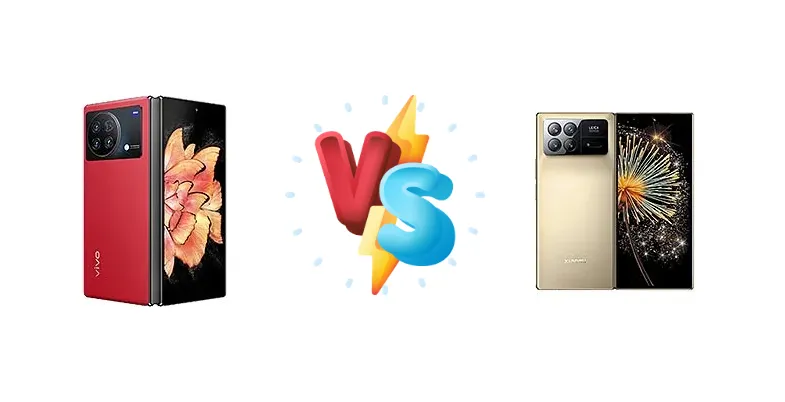
| Phone Names | vivo X Fold+ | Xiaomi Mix Fold 3 |
| Network | ||
|---|---|---|
| 2G bands | GSM 850 / 900 / 1800 / 1900 | GSM 850 / 900 / 1800 / 1900 |
| 3G bands | HSDPA 800 / 850 / 900 / 1700(AWS) / 1900 / 2100 | HSDPA 800 / 850 / 900 / 1700(AWS) / 1900 / 2100 |
| 4G bands | 1, 2, 3, 4, 5, 7, 8, 12, 17, 18, 19, 20, 25, 26, 28, 32, 66 | 1, 2, 3, 4, 5, 7, 8, 12, 17, 18, 19, 26, 34, 38, 39, 40, 41, 42 |
| 5G bands | 1, 2, 3, 5, 7, 8, 12, 20, 28, 66, 38, 40, 41, 77, 78, 79 SA/NSA | 1, 3, 5, 8, 28, 38, 40, 41, 77, 78, 79 SA/NSA |
| Speed | HSPA, LTE, 5G | HSPA, LTE, 5G |
| Technology | GSM / CDMA / HSPA / CDMA2000 / LTE / 5G | GSM / CDMA / HSPA / EVDO / LTE / 5G |
| Launch | ||
|---|---|---|
| Announced | 2022, September 26 | 2023, August 14 |
| Status | Available. Released 2022, September 29 | Available. Released 2023, August 14 |
| Body | ||
|---|---|---|
| Build | - | Glass front (folded), plastic front (unfolded), glass back or aramid fiber back, aluminum frame |
| Dimensions | Unfolded: 162 x 144.9 x 6.3 mm Folded: 162 x 74.5 x 14.6 mm | Unfolded: 161.2 x 143.3 x 5.3 mm Folded: 161.2 x 73.5 x 10.9 mm |
| SIM | Nano-SIM | Nano-SIM + Nano-SIM |
| Weight | 311 g (10.97 oz) | 255 g or 259 g (8.99 oz) |
| Display | ||
|---|---|---|
| Resolution | 1916 x 2160 pixels (~360 ppi density) | 1916 x 2160 pixels (~360 ppi density) |
| Size | 8.03 inches, 206.5 cm2 (~88.0% screen-to-body ratio) | 8.03 inches, 206.5 cm2 (~89.4% screen-to-body ratio) |
| Type | Foldable LTPO AMOLED, 120Hz, HDR10+ | Foldable LTPO OLED+, 1B colors, 120Hz, HDR10+, Dolby Vision, 1300 nits (peak) |
| Platform | ||
|---|---|---|
| CPU | Octa-core (1x3.19 GHz Cortex-X2 & 3x2.75 GHz Cortex-A710 & 4x2.0 GHz Cortex-A510) | Octa-core (1x3.36 GHz Cortex-X3 & 2x2.8 GHz Cortex-A715 & 2x2.8 GHz Cortex-A710 & 3x2.0 GHz Cortex-A510) |
| Chipset | Qualcomm SM8475 Snapdragon 8+ Gen 1 (4 nm) | Qualcomm SM8550-AC Snapdragon 8 Gen 2 (4 nm) |
| GPU | Adreno 730 | Adreno 740 |
| OS | Android 12, OriginOS Ocean | Android 13, upgradable to Android 14, HyperOS |
| Memory | ||
|---|---|---|
| Card slot | No | No |
| Internal | 256GB 12GB RAM, 512GB 12GB RAM | 256GB 12GB RAM, 512GB 16GB RAM, 1TB 16GB RAM |
| Main Camera | ||
|---|---|---|
| Features | Laser AF, Zeiss optics, Zeiss T* lens coating, Dual-LED flash, panorama | Color spectrum sensor, LED flash, HDR, panorama, Leica lenses |
| Quad | 50 MP, f/1.8, (wide), 1/1.57", 1.0µm, dual pixel PDAF, OIS 8 MP, f/3.4, 125mm (periscope telephoto), PDAF, OIS, 5x optical zoom 12 MP, f/2.0, 47mm (telephoto), PDAF, 2x optical zoom 48 MP, f/2.2, 14mm, 114˚ (ultrawide) | 50 MP, f/1.8, 23mm (wide), 1/1.49", 1.0µm, PDAF, OIS 10 MP, f/2.0, 75mm (telephoto), 1/3.94", 1.0µm, PDAF, OIS, 3.2x optical zoom 10 MP, f/2.9, 115mm (telephoto), 1/3.94", 1.0µm, PDAF, OIS, 5x optical zoom 12 MP, f/2.2, 15mm, 120˚ (ultrawide), 1/3.1", 1.12µm |
| Video | 8K@30fps, 4K@30/60fps, 1080p@30/60fps, gyro-EIS | 8K@24fps, 4K@24/30/60fps, 1080p@30/60/120/240/960/1920fps, Dolby Vision HDR |
| Selfie camera | ||
|---|---|---|
| Features | HDR | HDR, panorama |
| Single | 16 MP, f/2.5, (wide) Cover camera: 16 MP, f/2.5, (wide) | 20 MP, f/2.3, 23mm (wide), 1/4.0", 0.8µm Cover camera: 20 MP, f/2.3, 23mm (wide), 1/4.0", 0.8µm |
| Video | 1080p@30fps | 1080p@30/60fps |
| Sound | ||
|---|---|---|
| 35mm jack | No | No |
| Loudspeaker | Yes, with stereo speakers | Yes, with stereo speakers |
| Comms | ||
|---|---|---|
| Bluetooth | 5.2, A2DP, LE, aptX HD, aptX Adaptive, aptX Lossless | 5.3, A2DP, LE |
| Infrared port | - | Yes |
| NFC | Yes | Yes |
| Positioning | GPS, GLONASS, BDS, GALILEO, QZSS, NavIC | GPS (L1+L5), GLONASS (G1), BDS (B1I+B1c+B2a), GALILEO (E1+E5a), QZSS (L1+L5), NavIC (L5) |
| Radio | No | No |
| USB | USB Type-C 3.2, OTG | USB Type-C 3.2, OTG |
| WLAN | Wi-Fi 802.11 a/b/g/n/ac/6, dual-band, Wi-Fi Direct | Wi-Fi 802.11 a/b/g/n/ac/6e/7, dual-band (tri-band after future SW update) |
| Features | ||
|---|---|---|
| Sensors | Fingerprint (under display, optical), accelerometer, gyro, proximity, compass, barometer | Fingerprint (side-mounted), accelerometer, gyro, proximity, compass, barometer |
| Battery | ||
|---|---|---|
| Charging | 80W wired, 100% in 35 min 50W wireless 10W reverse wireless | 67W wired, PD3.0, QC4, 100% in 40 min 50W wireless, 100% in 55 min |
| Type | 4730 mAh | Li-Po 4800 mAh |
| Misc | ||
|---|---|---|
| Colors | Black, Blue, Red | Black, Gold |
| Models | V2229A | 2308CPXD0C |
| Price | About 1450 EUR | About 1150 EUR |
vivo X Fold+
- Extremely fast 80W wired charging
- Proven Snapdragon 8+ Gen 1 performance
- Potentially more affordable price point
- Older chipset compared to the Mix Fold 3
- Missing display brightness specifications
Xiaomi Mix Fold 3
- Latest Snapdragon 8 Gen 2 chipset for superior performance
- Significantly brighter 1277 nit display
- Longer battery endurance (117h rating)
- Slower 67W wired charging
- Higher price likely
Display Comparison
The Xiaomi Mix Fold 3 boasts a significantly brighter display, reaching a measured 1277 nits peak brightness, crucial for usability in direct sunlight. While the X Fold+’s display specs aren’t provided, the Mix Fold 3’s brightness advantage is substantial. Both likely utilize LTPO technology for adaptive refresh rates, conserving battery life, but the Mix Fold 3’s panel is demonstrably superior in outdoor conditions. Bezels are a critical factor in foldable design, and a detailed visual comparison would be needed to determine which device minimizes them more effectively.
Camera Comparison
Detailed camera specs beyond 'Photo/Video' are missing for the Mix Fold 3, making a direct comparison challenging. However, the foldable form factor often prioritizes versatility over absolute image quality. The X Fold+’s camera system, while not detailed here, likely focuses on a balanced approach. The Mix Fold 3’s camera system will need independent review to assess its strengths and weaknesses. It's important to note that the inclusion of a 2MP macro camera on either device is largely a marketing tactic and offers limited real-world benefit.
Performance
The core difference lies in the chipsets. The Xiaomi Mix Fold 3’s Snapdragon 8 Gen 2 (4nm) represents a significant leap over the vivo X Fold+’s Snapdragon 8+ Gen 1 (4nm). The Gen 2 features a newer Cortex-X3 prime core clocked at 3.36 GHz versus the X2 in the 8+ Gen 1 at 3.19 GHz, alongside improved Cortex-A715 and A710 cores. This translates to faster application loading, smoother multitasking, and improved gaming performance. The Mix Fold 3’s architecture also benefits from enhanced thermal efficiency, potentially leading to less throttling during sustained workloads. Both devices likely utilize LPDDR5x RAM, but the chipset difference is the dominant factor.
Battery Life
The Xiaomi Mix Fold 3 has an endurance rating of 117 hours, suggesting respectable battery life. The vivo X Fold+’s battery capacity is not specified, but its 80W wired charging is a key advantage, achieving a 100% charge in just 35 minutes. The Mix Fold 3’s 67W wired charging (40 minutes to 100%) and 50W wireless charging (55 minutes to 100%) are slower, but the Mix Fold 3’s more efficient chipset may offset this difference in real-world usage. Both devices offer 50W wireless charging and 10W reverse wireless charging.
Buying Guide
Buy the vivo X Fold+ if you prioritize extremely fast charging speeds and are comfortable with a slightly older chipset. Its 80W wired charging is a significant advantage for those who frequently need to top up their battery. Buy the Xiaomi Mix Fold 3 if you demand the latest performance, a brighter and more vibrant display, and are willing to accept slightly slower charging in exchange for a more future-proof device.