
vivo X Fold+ vs Samsung Galaxy Z Fold5: A Deep Dive into Foldable Supremacy
| Phones Images | |||||
|---|---|---|---|---|---|
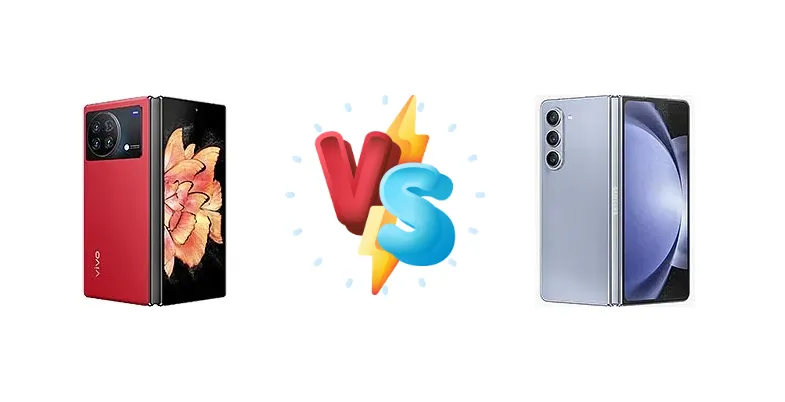
|
🏆 Quick Verdict
For the average user prioritizing longevity and a polished software experience, the Samsung Galaxy Z Fold5 is the safer bet. However, the vivo X Fold+ delivers significantly faster 80W charging and a comparable processor, making it a compelling option for power users who value speed and don't mind a potentially less refined software experience.
| PHONES | ||
|---|---|---|
| Phone Names | vivo X Fold+ | Samsung Galaxy Z Fold5 |
| Network | ||
|---|---|---|
| 2G bands | GSM 850 / 900 / 1800 / 1900 | GSM 850 / 900 / 1800 / 1900 |
| 3G bands | HSDPA 800 / 850 / 900 / 1700(AWS) / 1900 / 2100 | HSDPA 850 / 900 / 1700(AWS) / 1900 / 2100 |
| 4G bands | 1, 2, 3, 4, 5, 7, 8, 12, 17, 18, 19, 20, 25, 26, 28, 32, 66 | 1, 2, 3, 4, 5, 7, 8, 12, 13, 17, 18, 19, 20, 25, 26, 28, 38, 39, 40, 41, 66 - International |
| 5G bands | 1, 2, 3, 5, 7, 8, 12, 20, 28, 66, 38, 40, 41, 77, 78, 79 SA/NSA | 1, 2, 3, 5, 7, 8, 12, 20, 25, 28, 38, 40, 41, 66, 77, 78 SA/NSA/Sub6 - International |
| Speed | HSPA, LTE, 5G | HSPA, LTE, 5G |
| Technology | GSM / CDMA / HSPA / CDMA2000 / LTE / 5G | GSM / CDMA / HSPA / EVDO / LTE / 5G |
| Launch | ||
|---|---|---|
| Announced | 2022, September 26 | 2023, July 26 |
| Status | Available. Released 2022, September 29 | Available. Released 2023, August 11 |
| Body | ||
|---|---|---|
| Build | - | Glass front (Gorilla Glass Victus 2) (folded), plastic front (unfolded), glass back (Gorilla Glass Victus 2), aluminum frame |
| Dimensions | Unfolded: 162 x 144.9 x 6.3 mm Folded: 162 x 74.5 x 14.6 mm | Unfolded: 154.9 x 129.9 x 6.1 mmFolded: 154.9 x 67.1 x 13.4 mm |
| SIM | Nano-SIM | · Nano-SIM + eSIM· Nano-SIM + Nano-SIM + eSIM (max 2 at a time) |
| Weight | 311 g (10.97 oz) | 253 g (8.92 oz) |
| Display | ||
|---|---|---|
| Resolution | 1916 x 2160 pixels (~360 ppi density) | 1812 x 2176 pixels (~373 ppi density) |
| Size | 8.03 inches, 206.5 cm2 (~88.0% screen-to-body ratio) | 7.6 inches, 183.2 cm2 (~91.1% screen-to-body ratio) |
| Type | Foldable LTPO AMOLED, 120Hz, HDR10+ | Foldable Dynamic AMOLED 2X, 120Hz, HDR10+ |
| Platform | ||
|---|---|---|
| CPU | Octa-core (1x3.19 GHz Cortex-X2 & 3x2.75 GHz Cortex-A710 & 4x2.0 GHz Cortex-A510) | Octa-core (1x3.36 GHz Cortex-X3 & 2x2.8 GHz Cortex-A715 & 2x2.8 GHz Cortex-A710 & 3x2.0 GHz Cortex-A510) |
| Chipset | Qualcomm SM8475 Snapdragon 8+ Gen 1 (4 nm) | Qualcomm SM8550-AC Snapdragon 8 Gen 2 (4 nm) |
| GPU | Adreno 730 | Adreno 740 |
| OS | Android 12, OriginOS Ocean | Android 13, up to 4 major Android upgrades, One UI 6.1.1 |
| Memory | ||
|---|---|---|
| Card slot | No | No |
| Internal | 256GB 12GB RAM, 512GB 12GB RAM | 256GB 12GB RAM, 512GB 12GB RAM, 1TB 12GB RAM |
| Main Camera | ||
|---|---|---|
| Features | Laser AF, Zeiss optics, Zeiss T* lens coating, Dual-LED flash, panorama | LED flash, HDR, panorama |
| Quad | 50 MP, f/1.8, (wide), 1/1.57", 1.0µm, dual pixel PDAF, OIS 8 MP, f/3.4, 125mm (periscope telephoto), PDAF, OIS, 5x optical zoom 12 MP, f/2.0, 47mm (telephoto), PDAF, 2x optical zoom 48 MP, f/2.2, 14mm, 114˚ (ultrawide) | - |
| Triple | - | 50 MP, f/1.8, 23mm (wide), 1/1.56", 1.0µm, dual pixel PDAF, OIS 10 MP, f/2.4, 66mm (telephoto), 1/3.94", 1.0µm, PDAF, OIS, 3x optical zoom 12 MP, f/2.2, 12mm, 123˚ (ultrawide), 1/3.06", 1.12µm |
| Video | 8K@30fps, 4K@30/60fps, 1080p@30/60fps, gyro-EIS | 8K@30fps, 4K@60fps, 1080p@60/240fps (gyro-EIS), HDR10+ |
| Selfie camera | ||
|---|---|---|
| Features | HDR | HDR |
| Single | 16 MP, f/2.5, (wide) Cover camera: 16 MP, f/2.5, (wide) | 4 MP, f/1.8, 26mm (wide), 1/3.0", 2.0µm, under display Cover camera: 10 MP, f/2.2, 24mm (wide), 1/3.0", 1.22µm |
| Video | 1080p@30fps | 4K@30/60fps, 1080p@30/60fps, gyro-EIS |
| Sound | ||
|---|---|---|
| 35mm jack | No | No |
| Loudspeaker | Yes, with stereo speakers | Yes, with stereo speakers |
| Comms | ||
|---|---|---|
| Bluetooth | 5.2, A2DP, LE, aptX HD, aptX Adaptive, aptX Lossless | 5.3, A2DP, LE, aptX HD |
| NFC | Yes | Yes |
| Positioning | GPS, GLONASS, BDS, GALILEO, QZSS, NavIC | GPS, GLONASS, GALILEO, BDS |
| Radio | No | No |
| USB | USB Type-C 3.2, OTG | USB Type-C 3.2, OTG |
| WLAN | Wi-Fi 802.11 a/b/g/n/ac/6, dual-band, Wi-Fi Direct | Wi-Fi 802.11 a/b/g/n/ac/6e, tri-band, Wi-Fi Direct |
| Features | ||
|---|---|---|
| Sensors | Fingerprint (under display, optical), accelerometer, gyro, proximity, compass, barometer | Fingerprint (side-mounted), accelerometer, gyro, proximity, compass, barometer |
| Battery | ||
|---|---|---|
| Charging | 80W wired, 100% in 35 min 50W wireless 10W reverse wireless | 25W wired, 50% in 30 min 15W wireless 4.5W reverse wireless |
| Type | 4730 mAh | Li-Po 4400 mAh |
| Misc | ||
|---|---|---|
| Colors | Black, Blue, Red | Icy Blue, Phantom Black, Cream, Gray, Blue |
| Models | V2229A | SM-F946B, SM-F946B/DS, SM-F946U, SM-F946U1, SM-F946N, SM-F946W, SM-F9460 |
| Price | About 1450 EUR | € 660.00 / $ 607.00 / £ 520.69 / ₹ 86,000 |
| SAR | - | 1.16 W/kg (head) |
| SAR EU | - | 1.24 W/kg (head) 1.19 W/kg (body) |
vivo X Fold+
- Significantly faster 80W wired charging
- Powerful Snapdragon 8+ Gen 1 processor
- Potentially more aggressive pricing (depending on region)
- Software experience may be less refined than Samsung’s One UI
- Camera system details are currently limited
Samsung Galaxy Z Fold5
- Brighter and more refined display
- More powerful Snapdragon 8 Gen 2 processor
- Mature software ecosystem with long-term support
- Slower 25W wired charging
- Higher price point
Display Comparison
The Samsung Galaxy Z Fold5 boasts a peak brightness of 1257 nits, offering superior visibility in direct sunlight compared to the X Fold+, whose brightness is not specified but is likely lower given the focus on other features. Both utilize foldable LTPO displays, enabling adaptive refresh rates for power efficiency. However, Samsung’s display benefits from years of refinement in hinge technology and crease reduction, potentially offering a more seamless viewing experience. The Z Fold5’s cover display also benefits from a narrower bezel, maximizing screen real estate.
Camera Comparison
Detailed camera specs for the vivo X Fold+ are unavailable, making a direct comparison challenging. However, Samsung typically prioritizes image processing and versatility in its flagship devices. The Z Fold5 likely features a more sophisticated camera system with advanced computational photography features. While the X Fold+ may offer competitive hardware, Samsung’s software optimization and multi-camera setup (including telephoto lenses) likely provide a wider range of shooting options and superior image quality in various conditions. We can assume the X Fold+ will have a capable camera, but the Z Fold5 likely has the edge.
Performance
The Galaxy Z Fold5’s Snapdragon 8 Gen 2 (4nm) represents a significant leap in performance and efficiency over the X Fold+'s Snapdragon 8+ Gen 1 (4nm). The Gen 2 features a newer Cortex-X3 prime core clocked at 3.36 GHz versus the X Fold+'s 3.19 GHz Cortex-X2, alongside improved Cortex-A715 and A710 cores. This translates to faster app loading, smoother multitasking, and better sustained performance during demanding tasks like gaming. While both utilize a 4nm process, the architectural improvements in the Gen 2 provide a clear advantage. The Z Fold5’s LPDDR5x RAM further enhances memory bandwidth, contributing to overall system responsiveness.
Battery Life
The Samsung Galaxy Z Fold5 demonstrates impressive battery endurance, achieving an active use score of 12:01h and an endurance rating of 95h. While the X Fold+'s battery capacity is unknown, its 80W wired charging is a standout feature, achieving a 100% charge in just 35 minutes. In contrast, the Z Fold5’s 25W charging takes 30 minutes to reach 50%. This difference is substantial for users who prioritize quick top-ups. The Z Fold5’s longer endurance rating suggests better overall efficiency, but the X Fold+'s charging speed mitigates range anxiety.
Buying Guide
Buy the vivo X Fold+ if you need blazing-fast charging – its 80W wired charging is a game-changer compared to the Z Fold5’s 25W. It’s ideal for users who frequently top up their phones and dislike waiting. Buy the Samsung Galaxy Z Fold5 if you prefer a more mature software ecosystem, a brighter display, and a proven track record of durability and long-term software support. It’s the better choice for those seeking a premium, refined foldable experience.