
vivo X Fold+ vs. Samsung Galaxy Z Fold4: A Deep Dive into Foldable Flagships
| Phones Images | |||||
|---|---|---|---|---|---|
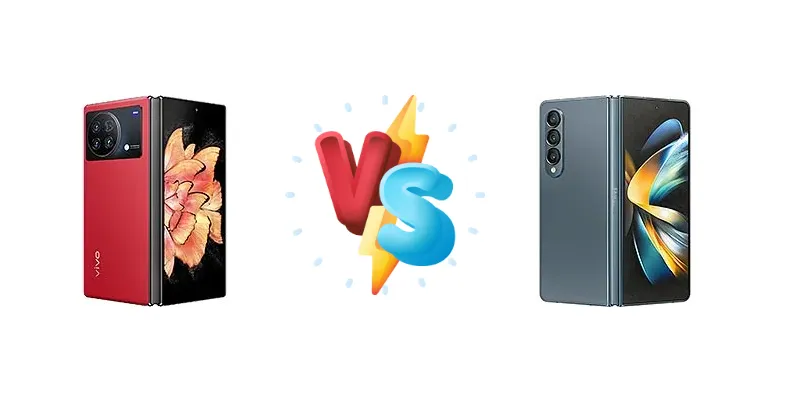
|
🏆 Quick Verdict
For users prioritizing rapid charging and potentially longer sustained performance, the vivo X Fold+ emerges as the winner. Its 80W charging significantly outperforms the Z Fold4’s 25W, and while both share the same chipset, subtle CPU clock differences *could* translate to a slight edge in demanding tasks. However, Samsung’s software ecosystem and established foldable design remain compelling.
| PHONES | ||
|---|---|---|
| Phone Names | vivo X Fold+ | Samsung Galaxy Z Fold4 |
| Network | ||
|---|---|---|
| 2G bands | GSM 850 / 900 / 1800 / 1900 | GSM 850 / 900 / 1800 / 1900 |
| 3G bands | HSDPA 800 / 850 / 900 / 1700(AWS) / 1900 / 2100 | HSDPA 850 / 900 / 1700(AWS) / 1900 / 2100 |
| 4G bands | 1, 2, 3, 4, 5, 7, 8, 12, 17, 18, 19, 20, 25, 26, 28, 32, 66 | 1, 2, 3, 4, 5, 7, 8, 12, 13, 17, 18, 19, 20, 25, 26, 28, 32, 38, 39, 40, 41, 66 - International |
| 5G bands | 1, 2, 3, 5, 7, 8, 12, 20, 28, 66, 38, 40, 41, 77, 78, 79 SA/NSA | 1, 2, 3, 5, 7, 8, 12, 20, 25, 28, 38, 40, 41, 66, 75, 77, 78 SA/NSA/Sub6 - International |
| Speed | HSPA, LTE, 5G | HSPA 42.2/5.76 Mbps, LTE (7CA) Cat20 2000/200 Mbps, 5G |
| Technology | GSM / CDMA / HSPA / CDMA2000 / LTE / 5G | GSM / CDMA / HSPA / EVDO / LTE / 5G |
| - | CDMA2000 1xEV-DO | |
| Launch | ||
|---|---|---|
| Announced | 2022, September 26 | 2022, August 10 |
| Status | Available. Released 2022, September 29 | Available. Released 2022, August 25 |
| Body | ||
|---|---|---|
| Build | - | Glass front (Gorilla Glass Victus+) (folded), plastic front (unfolded), glass back (Gorilla Glass Victus+), aluminum frame |
| Dimensions | Unfolded: 162 x 144.9 x 6.3 mm Folded: 162 x 74.5 x 14.6 mm | Unfolded: 155.1 x 130.1 x 6.3 mmFolded: 155.1 x 67.1 x 14.2-15.8 mm |
| SIM | Nano-SIM | · Nano-SIM + eSIM· Nano-SIM + Nano-SIM + eSIM (max 2 at a time) |
| Weight | 311 g (10.97 oz) | 263 g (9.28 oz) |
| - | IPX8 water resistant (up to 1.5m for 30 min) Armor aluminum frame with tougher drop and scratch resistance (advertised) Stylus support | |
| Display | ||
|---|---|---|
| Resolution | 1916 x 2160 pixels (~360 ppi density) | 1812 x 2176 pixels (~373 ppi density) |
| Size | 8.03 inches, 206.5 cm2 (~88.0% screen-to-body ratio) | 7.6 inches, 183.2 cm2 (~90.9% screen-to-body ratio) |
| Type | Foldable LTPO AMOLED, 120Hz, HDR10+ | Foldable Dynamic AMOLED 2X, 120Hz, HDR10+, 1200 nits (peak) |
| - | Cover display: Dynamic AMOLED 2X, 120Hz, Corning Gorilla Glass Victus+ 6.2 inches, 904 x 2316 pixels, 23.1:9 ratio | |
| Platform | ||
|---|---|---|
| CPU | Octa-core (1x3.19 GHz Cortex-X2 & 3x2.75 GHz Cortex-A710 & 4x2.0 GHz Cortex-A510) | Octa-core (1x3.19 GHz Cortex-X2 & 3x2.75 GHz Cortex-A710 & 4x1.80 GHz Cortex-A510) |
| Chipset | Qualcomm SM8475 Snapdragon 8+ Gen 1 (4 nm) | Qualcomm SM8475 Snapdragon 8+ Gen 1 (4 nm) |
| GPU | Adreno 730 | Adreno 730 |
| OS | Android 12, OriginOS Ocean | Android 12L, up to 4 major Android upgrades, One UI 6.1.1 |
| Memory | ||
|---|---|---|
| Card slot | No | No |
| Internal | 256GB 12GB RAM, 512GB 12GB RAM | 256GB 12GB RAM, 512GB 12GB RAM, 1TB 12GB RAM |
| - | UFS 3.1 | |
| Main Camera | ||
|---|---|---|
| Features | Laser AF, Zeiss optics, Zeiss T* lens coating, Dual-LED flash, panorama | LED flash, HDR, panorama |
| Quad | 50 MP, f/1.8, (wide), 1/1.57", 1.0µm, dual pixel PDAF, OIS 8 MP, f/3.4, 125mm (periscope telephoto), PDAF, OIS, 5x optical zoom 12 MP, f/2.0, 47mm (telephoto), PDAF, 2x optical zoom 48 MP, f/2.2, 14mm, 114˚ (ultrawide) | - |
| Triple | - | 50 MP, f/1.8, 23mm (wide), 1/1.56", 1.0µm, dual pixel PDAF, OIS 10 MP, f/2.4, 66mm (telephoto), 1/3.94", 1.0µm, PDAF, OIS, 3x optical zoom 12 MP, f/2.2, 12mm, 123˚ (ultrawide), 1/3.06", 1.12µm |
| Video | 8K@30fps, 4K@30/60fps, 1080p@30/60fps, gyro-EIS | 8K@24fps, 4K@60fps, 1080p@60/240fps (gyro-EIS), HDR10+ |
| Selfie camera | ||
|---|---|---|
| Features | HDR | HDR |
| Single | 16 MP, f/2.5, (wide) Cover camera: 16 MP, f/2.5, (wide) | 4 MP, f/1.8, 26mm (wide), 1/3.0", 2.0µm, under display Cover camera: 10 MP, f/2.2, 24mm (wide), 1/3.0", 1.22µm |
| Video | 1080p@30fps | 4K@30/60fps, 1080p@30/60fps, gyro-EIS |
| Sound | ||
|---|---|---|
| 3.5mm jack | - | No |
| 35mm jack | No | No |
| Loudspeaker | Yes, with stereo speakers | Yes, with stereo speakers |
| - | 32-bit/384kHz audio Tuned by AKG | |
| Comms | ||
|---|---|---|
| Bluetooth | 5.2, A2DP, LE, aptX HD, aptX Adaptive, aptX Lossless | 5.2, A2DP, LE, aptX HD |
| NFC | Yes | Yes |
| Positioning | GPS, GLONASS, BDS, GALILEO, QZSS, NavIC | GPS, GLONASS, GALILEO, BDS |
| Radio | No | No |
| USB | USB Type-C 3.2, OTG | USB Type-C 3.2, OTG |
| WLAN | Wi-Fi 802.11 a/b/g/n/ac/6, dual-band, Wi-Fi Direct | Wi-Fi 802.11 a/b/g/n/ac/6e, dual-band, Wi-Fi Direct |
| Features | ||
|---|---|---|
| Sensors | Fingerprint (under display, optical), accelerometer, gyro, proximity, compass, barometer | Fingerprint (side-mounted), accelerometer, gyro, proximity, compass, barometer |
| - | Bixby natural language commands and dictation Samsung DeX (desktop experience support) Samsung Pay (Visa, MasterCard certified) Ultra Wideband (UWB) support | |
| Battery | ||
|---|---|---|
| Charging | 80W wired, 100% in 35 min 50W wireless 10W reverse wireless | 25W wired, 50% in 30 min 15W wireless 4.5W reverse wireless |
| Type | 4730 mAh | Li-Po 4400 mAh |
| Misc | ||
|---|---|---|
| Colors | Black, Blue, Red | Graygreen, Phantom Black, Beige, Burgundy |
| Models | V2229A | SM-F936B, SM-F936B/DS, SM-F936U, SM-F936U1, SM-F936N, SM-F936W, SM-F9360 |
| Price | About 1450 EUR | $ 457.00 / € 511.80 / £ 485.00 / ₹ 73,899 |
| SAR | - | 0.96 W/kg (head) 0.92 W/kg (body) |
| SAR EU | - | 1.30 W/kg (head) 1.51 W/kg (body) |
| Tests | ||
|---|---|---|
| Battery life | - | Endurance rating 101h |
| Camera | - | Photo / Video |
| Display | - | Contrast ratio: Infinite (nominal) |
| Loudspeaker | - | -28.3 LUFS (Average) |
| Performance | - | AnTuTu: 964530 (v9) GeekBench: 3981 (v5.1) GFXBench: 43fps (ES 3.1 onscreen) |
vivo X Fold+
- Significantly faster 80W wired charging
- Potentially better sustained performance due to higher clocked CPU cores
- 50W wireless charging and 10W reverse wireless charging
- Competitive hinge design reported
- Less established software ecosystem for foldable devices
- Limited camera specification details available
Samsung Galaxy Z Fold4
- Refined foldable design and hinge mechanism
- Proven durability and reliability
- Mature software experience optimized for foldable use
- Strong integration with the Samsung ecosystem
- Slow 25W wired charging
- Lower clocked CPU cores compared to X Fold+
- Slower wireless and reverse wireless charging speeds
Display Comparison
Both the vivo X Fold+ and Galaxy Z Fold4 feature large, foldable displays powered by the Snapdragon 8+ Gen 1. The Z Fold4 is measured at 1000 nits peak brightness, suggesting a vibrant outdoor viewing experience. While the X Fold+’s brightness isn’t specified, it’s reasonable to expect similar performance given its flagship status. Both utilize LTPO technology for adaptive refresh rates, conserving battery life. The key difference lies in the hinge and crease management, where Samsung has a significant head start in refinement, though the X Fold+ is reported to have a very competitive hinge design. Contrast ratios are infinite (nominal) on the Z Fold4, typical of OLED panels.
Camera Comparison
Both phones feature capable camera systems, but detailed sensor information for the X Fold+ is currently limited. The Z Fold4’s camera is described as 'Photo / Video' without specifics, indicating a versatile setup. The focus should be on image processing algorithms and low-light performance. Given vivo’s strong camera reputation, the X Fold+ is likely to deliver competitive image quality, potentially with a different color science preference. The absence of detailed camera specs for the X Fold+ makes a direct comparison challenging, but it’s safe to assume both phones will excel in most common photography scenarios.
Performance
Both devices are equipped with the Qualcomm SM8475 Snapdragon 8+ Gen 1 (4 nm) chipset, but a crucial difference lies in the CPU configuration. The Z Fold4’s Cortex-A510 cores are clocked at 1.80 GHz, while the X Fold+ boasts a higher 2.0 GHz clock speed. This seemingly minor difference, combined with potentially more aggressive thermal design in the X Fold+, *could* lead to sustained performance gains during extended gaming or video editing sessions. Both utilize LPDDR5X RAM, ensuring fast memory access. However, without detailed thermal testing, it’s difficult to definitively declare a performance winner.
Battery Life
The Galaxy Z Fold4 has an endurance rating of 101 hours, indicating solid battery life. However, the X Fold+’s 80W wired charging is a game-changer, achieving a full charge in just 35 minutes. This is significantly faster than the Z Fold4’s 25W charging, which takes 30 minutes to reach 50%. The X Fold+ also offers 50W wireless charging and 10W reverse wireless charging, while the Z Fold4 provides 15W wireless and 4.5W reverse wireless. While the Z Fold4’s endurance rating suggests comparable overall battery life, the X Fold+'s charging speed offers a substantial convenience advantage.
Buying Guide
Buy the vivo X Fold+ if you need blazing-fast charging, value potential thermal advantages from a slightly different CPU configuration, and are comfortable exploring a less-established foldable software experience. Buy the Samsung Galaxy Z Fold4 if you prioritize a refined software experience, a proven track record of durability in foldable designs, and integration with the broader Samsung ecosystem. The Z Fold4 is the safer, more polished choice, while the X Fold+ is the riskier, potentially more rewarding one.