
vivo X Fold+ vs Honor Magic Vs3: A Deep Dive into Foldable Flagship Performance
| Phones Images | |||||
|---|---|---|---|---|---|
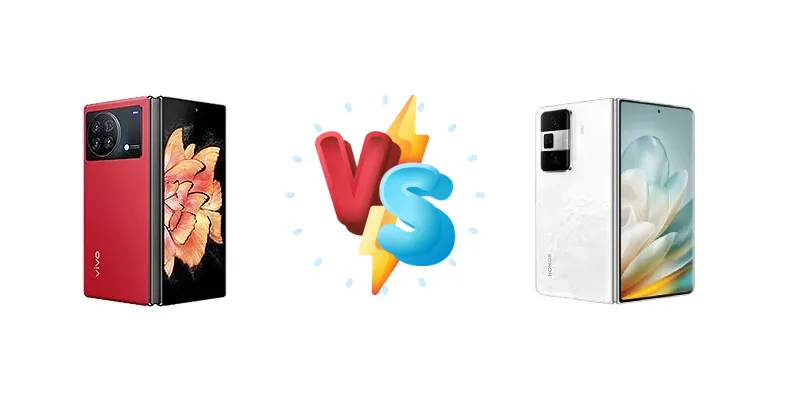
|
🏆 Quick Verdict
For users prioritizing raw performance and future-proofing, the Honor Magic Vs3 is the clear winner. Its Snapdragon 8 Gen 2 chipset provides a noticeable performance uplift and improved efficiency. However, the vivo X Fold+ offers competitive charging speeds and a potentially more refined software experience, making it a viable option for those less concerned with absolute power.
| PHONES | ||
|---|---|---|
| Phone Names | vivo X Fold+ | Honor Magic Vs3 |
| Network | ||
|---|---|---|
| 2G bands | GSM 850 / 900 / 1800 / 1900 | GSM 850 / 900 / 1800 / 1900 |
| 3G bands | HSDPA 800 / 850 / 900 / 1700(AWS) / 1900 / 2100 | HSDPA 800 / 850 / 900 / 1700(AWS) / 1900 / 2100 |
| 4G bands | 1, 2, 3, 4, 5, 7, 8, 12, 17, 18, 19, 20, 25, 26, 28, 32, 66 | 1, 2, 3, 4, 5, 7, 8, 12, 17, 18, 19, 20, 26, 28, 34, 38, 39, 40, 41, 66 |
| 5G bands | 1, 2, 3, 5, 7, 8, 12, 20, 28, 66, 38, 40, 41, 77, 78, 79 SA/NSA | 1, 3, 5, 8, 28, 38, 41, 77, 78 SA/NSA |
| Speed | HSPA, LTE, 5G | HSPA, LTE, 5G |
| Technology | GSM / CDMA / HSPA / CDMA2000 / LTE / 5G | GSM / CDMA / HSPA / CDMA2000 / LTE / 5G |
| Launch | ||
|---|---|---|
| Announced | 2022, September 26 | 2024, July 12 |
| Status | Available. Released 2022, September 29 | Available. Released 2024, July 19 |
| Body | ||
|---|---|---|
| Dimensions | Unfolded: 162 x 144.9 x 6.3 mm Folded: 162 x 74.5 x 14.6 mm | Unfolded: 156.8 x 145.2 x 4.65 mm or 4.8 mmFolded: 156.8 x 74.0 x 9.8 mm or 10.1 mm |
| SIM | Nano-SIM | · Nano-SIM + eSIM· Nano-SIM + Nano-SIM |
| Weight | 311 g (10.97 oz) | 229 g or 231 g (8.08 oz) |
| Display | ||
|---|---|---|
| Protection | - | King Kong Rhinoceros |
| Resolution | 1916 x 2160 pixels (~360 ppi density) | 2156 x 2344 pixels (~402 ppi density) |
| Size | 8.03 inches, 206.5 cm2 (~88.0% screen-to-body ratio) | 7.92 inches, 201.6 cm2 (~88.6% screen-to-body ratio) |
| Type | Foldable LTPO AMOLED, 120Hz, HDR10+ | Foldable LTPO AMOLED, 1B colors, Dolby Vision, 120Hz |
| Platform | ||
|---|---|---|
| CPU | Octa-core (1x3.19 GHz Cortex-X2 & 3x2.75 GHz Cortex-A710 & 4x2.0 GHz Cortex-A510) | Octa-core (1x3.2 GHz Cortex-X3 & 2x2.8 GHz Cortex-A715 & 2x2.8 GHz Cortex-A710 & 3x2.0 GHz Cortex-A510) |
| Chipset | Qualcomm SM8475 Snapdragon 8+ Gen 1 (4 nm) | Qualcomm SM8550-AB Snapdragon 8 Gen 2 (4 nm) |
| GPU | Adreno 730 | Adreno 740 |
| OS | Android 12, OriginOS Ocean | Android 14, MagicOS 8.0.1 |
| Memory | ||
|---|---|---|
| Card slot | No | No |
| Internal | 256GB 12GB RAM, 512GB 12GB RAM | 256GB 12GB RAM, 512GB 12GB RAM, 1TB 16GB RAM |
| Main Camera | ||
|---|---|---|
| Features | Laser AF, Zeiss optics, Zeiss T* lens coating, Dual-LED flash, panorama | Laser AF, LED flash, HDR, panorama |
| Quad | 50 MP, f/1.8, (wide), 1/1.57", 1.0µm, dual pixel PDAF, OIS 8 MP, f/3.4, 125mm (periscope telephoto), PDAF, OIS, 5x optical zoom 12 MP, f/2.0, 47mm (telephoto), PDAF, 2x optical zoom 48 MP, f/2.2, 14mm, 114˚ (ultrawide) | - |
| Triple | - | 50 MP, f/1.9, (wide), 1/1.56", PDAF, OIS 8 MP, f/3.4, (periscope telephoto), PDAF, OIS, 5x optical zoom 40 MP, f/2.2, 112˚, (ultrawide), AF |
| Video | 8K@30fps, 4K@30/60fps, 1080p@30/60fps, gyro-EIS | 4K@30/60fps (10-bit), 1080p@30/60fps, gyro-EIS, OIS |
| Selfie camera | ||
|---|---|---|
| Features | HDR | HDR |
| Single | 16 MP, f/2.5, (wide) Cover camera: 16 MP, f/2.5, (wide) | 16 MP, f/2.2, 90˚, (wide) Cover camera: 16 MP, f/2.2, 90˚, (wide) |
| Video | 1080p@30fps | 4K@30fps, 1080p@30fps, gyro-EIS |
| Sound | ||
|---|---|---|
| 35mm jack | No | No |
| Loudspeaker | Yes, with stereo speakers | Yes, with stereo speakers |
| Comms | ||
|---|---|---|
| Bluetooth | 5.2, A2DP, LE, aptX HD, aptX Adaptive, aptX Lossless | 5.3, A2DP, LE, aptX HD, LDAC |
| Infrared port | - | Yes |
| NFC | Yes | Yes |
| Positioning | GPS, GLONASS, BDS, GALILEO, QZSS, NavIC | GPS (L1+L5), GLONASS (L1), BDS (B1I+B1c+B2a), GALILEO (E1+E5a) |
| Radio | No | No |
| USB | USB Type-C 3.2, OTG | USB Type-C 3.1, OTG, Display Port 1.2 |
| WLAN | Wi-Fi 802.11 a/b/g/n/ac/6, dual-band, Wi-Fi Direct | Wi-Fi 802.11 a/b/g/n/ac/6e/7, dual-band, Wi-Fi Direct |
| Features | ||
|---|---|---|
| Sensors | Fingerprint (under display, optical), accelerometer, gyro, proximity, compass, barometer | Fingerprint (side-mounted), accelerometer, gyro, proximity, compass, barometer |
| Battery | ||
|---|---|---|
| Charging | 80W wired, 100% in 35 min 50W wireless 10W reverse wireless | 66W wired 50W wireless 5W reverse wired |
| Type | 4730 mAh | Li-Po 5000 mAh |
| Misc | ||
|---|---|---|
| Colors | Black, Blue, Red | Velvet Black, Snow, Tundra Green |
| Models | V2229A | FLC-AN00 |
| Price | About 1450 EUR | About 980 EUR |
vivo X Fold+
- Faster 80W wired charging
- Potentially refined software experience (vivo's Funtouch OS)
- Competitive performance with Snapdragon 8+ Gen 1
- Older Snapdragon 8+ Gen 1 chipset
- Less efficient processor compared to Snapdragon 8 Gen 2
- Potentially lower peak performance in demanding tasks
Honor Magic Vs3
- Latest Snapdragon 8 Gen 2 chipset for superior performance
- Improved power efficiency for longer battery life
- More advanced ISP for potentially better image processing
- Slower 66W wired charging
- Potentially less refined software experience (Honor's MagicOS)
- May run slightly warmer under sustained load
Display Comparison
Both devices feature foldable displays, but specifics beyond resolution are missing. However, the foldable form factor inherently presents challenges with crease visibility and durability. The quality of the hinge mechanism will be a key differentiator, though not specified in the provided data. The external displays are also crucial for everyday use, and their size and aspect ratio would impact usability. Without further data, it's difficult to definitively declare a winner, but the panel technology (LTPO) and peak brightness will be critical factors.
Camera Comparison
Without detailed camera specifications, a direct comparison is limited. However, the chipset plays a role in image signal processing (ISP) capabilities. The Snapdragon 8 Gen 2 in the Magic Vs3 boasts a more advanced ISP, potentially leading to better image quality, especially in low-light conditions. The X Fold+’s ISP is still capable, but the newer technology in the Magic Vs3 offers an edge. The absence of sensor size or aperture information makes a definitive judgment impossible, but the Magic Vs3’s processor advantage suggests superior image processing.
Performance
The Honor Magic Vs3’s Snapdragon 8 Gen 2 (4nm) represents a significant leap over the vivo X Fold+'s Snapdragon 8+ Gen 1 (4nm). The Gen 2 features a newer Cortex-X3 prime core clocked at 3.2 GHz versus the X Fold+'s 3.19 GHz Cortex-X2. More importantly, the Gen 2 utilizes improved Cortex-A715 and A710 cores, offering better performance and efficiency. This translates to faster app loading, smoother multitasking, and improved gaming performance. The Magic Vs3 will also exhibit better thermal management, reducing throttling during sustained workloads. The X Fold+ remains a capable performer, but the Gen 2 in the Magic Vs3 provides a tangible advantage.
Battery Life
The vivo X Fold+ boasts an 80W wired charging capability, achieving a 100% charge in just 35 minutes, alongside 50W wireless and 10W reverse wireless. The Honor Magic Vs3 offers 66W wired charging, 50W wireless, and 5W reverse wired. While the X Fold+ charges faster, the Snapdragon 8 Gen 2 in the Magic Vs3 is more power-efficient. This means the Magic Vs3 may offset its slower charging with longer battery life. The actual battery capacity (mAh) is unknown for both devices, making a precise battery life prediction difficult, but the efficiency of the Gen 2 chipset is a significant advantage for the Magic Vs3.
Buying Guide
Buy the vivo X Fold+ if you value extremely fast charging (80W wired) and a potentially more polished software experience, and are comfortable with a slightly older chipset. Buy the Honor Magic Vs3 if you prioritize top-tier performance, the latest Snapdragon 8 Gen 2, and are willing to trade a bit of charging speed for a more powerful processor and potentially longer software support.