
vivo X Fold+ vs. Google Pixel Fold: A Deep Dive into Foldable Performance and Features
| Phones Images | |||||
|---|---|---|---|---|---|
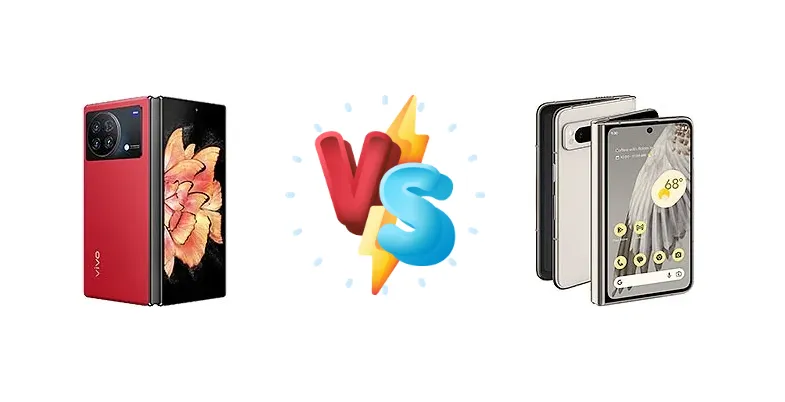
|
🏆 Quick Verdict
For users prioritizing sustained performance and faster charging, the vivo X Fold+ emerges as the winner. Its Snapdragon 8+ Gen 1 offers a clear advantage in demanding tasks. However, the Pixel Fold’s software experience and integration with Google’s ecosystem are compelling for those invested in the Google ecosystem.
| PHONES | ||
|---|---|---|
| Phone Names | vivo X Fold+ | Google Pixel Fold |
| Network | ||
|---|---|---|
| 2G bands | GSM 850 / 900 / 1800 / 1900 | GSM 850 / 900 / 1800 / 1900 |
| 3G bands | HSDPA 800 / 850 / 900 / 1700(AWS) / 1900 / 2100 | HSDPA 800 / 850 / 900 / 1700(AWS) / 1900 / 2100 |
| 4G bands | 1, 2, 3, 4, 5, 7, 8, 12, 17, 18, 19, 20, 25, 26, 28, 32, 66 | 1, 2, 3, 4, 5, 7, 8, 12, 13, 14, 17, 18, 19, 20, 21, 25, 26, 28, 29, 30, 32, 38, 39, 40, 41, 42, 46, 48, 66, 71 |
| 5G bands | 1, 2, 3, 5, 7, 8, 12, 20, 28, 66, 38, 40, 41, 77, 78, 79 SA/NSA | 1, 2, 3, 5, 7, 8, 12, 14, 20, 25, 28, 30, 38, 40, 41, 48, 66, 71, 75, 76, 77, 78, 79, 257, 258, 260, 261 SA/NSA/Sub6/mmWave |
| Speed | HSPA, LTE, 5G | HSPA, LTE, 5G |
| Technology | GSM / CDMA / HSPA / CDMA2000 / LTE / 5G | GSM / CDMA / HSPA / EVDO / LTE / 5G |
| - | CDMA2000 1xEV-DO | |
| Launch | ||
|---|---|---|
| Announced | 2022, September 26 | 2023, May 10 |
| Status | Available. Released 2022, September 29 | Available. Released 2023, June 27 |
| Body | ||
|---|---|---|
| Build | - | Glass front (Gorilla Glass Victus) (folded), plastic front (unfolded), glass back (Gorilla Glass Victus), aluminum frame |
| Dimensions | Unfolded: 162 x 144.9 x 6.3 mm Folded: 162 x 74.5 x 14.6 mm | Unfolded: 139.7 x 158.7 x 5.8 mmFolded: 139.7 x 79.5 x 12.1 mm |
| SIM | Nano-SIM | Nano-SIM + eSIM |
| Weight | 311 g (10.97 oz) | 283 g (9.98 oz) |
| - | IPX8 water resistant | |
| Display | ||
|---|---|---|
| Resolution | 1916 x 2160 pixels (~360 ppi density) | 1840 x 2208 pixels (~378 ppi density) |
| Size | 8.03 inches, 206.5 cm2 (~88.0% screen-to-body ratio) | 7.6 inches, 183.3 cm2 (~82.7% screen-to-body ratio) |
| Type | Foldable LTPO AMOLED, 120Hz, HDR10+ | Foldable OLED, 120Hz, HDR10+, 1000 nits (HBM), 1450 nits (peak) |
| - | Cover display: OLED, 120Hz, HDR, Corning Gorilla Glass Victus 5.8 inches, 1080 x 2092 pixels, 17.4:9 ratio, 408 ppi 1200 nits (HBM), 1550 nits (peak) | |
| Platform | ||
|---|---|---|
| CPU | Octa-core (1x3.19 GHz Cortex-X2 & 3x2.75 GHz Cortex-A710 & 4x2.0 GHz Cortex-A510) | Octa-core (2x2.85 GHz Cortex-X1 & 2x2.35 GHz Cortex-A78 & 4x1.80 GHz Cortex-A55) |
| Chipset | Qualcomm SM8475 Snapdragon 8+ Gen 1 (4 nm) | Google Tensor G2 (5 nm) |
| GPU | Adreno 730 | Mali-G710 MP7 |
| OS | Android 12, OriginOS Ocean | Android 13, upgradable to Android 15, up to 5 major Android upgrades |
| Memory | ||
|---|---|---|
| Card slot | No | No |
| Internal | 256GB 12GB RAM, 512GB 12GB RAM | 256GB 12GB RAM, 512GB 12GB RAM |
| - | UFS 3.1 | |
| Main Camera | ||
|---|---|---|
| Features | Laser AF, Zeiss optics, Zeiss T* lens coating, Dual-LED flash, panorama | Laser AF, Dual-LED flash, HDR, panorama |
| Quad | 50 MP, f/1.8, (wide), 1/1.57", 1.0µm, dual pixel PDAF, OIS 8 MP, f/3.4, 125mm (periscope telephoto), PDAF, OIS, 5x optical zoom 12 MP, f/2.0, 47mm (telephoto), PDAF, 2x optical zoom 48 MP, f/2.2, 14mm, 114˚ (ultrawide) | - |
| Triple | - | 48 MP, f/1.7, 25mm (wide), 1/2.0", 0.8µm, dual pixel PDAF, OIS 10.8 MP, f/3.1, 112mm (telephoto), 1/3.1", 1.22µm, dual pixel PDAF, OIS, 5x optical zoom 10.8 MP, f/2.2, 121˚, (ultrawide), 1/3.0", 1.25µm |
| Video | 8K@30fps, 4K@30/60fps, 1080p@30/60fps, gyro-EIS | 4K@30/60fps, 1080p@30/60/120/240fps, 10-bit HDR |
| Selfie camera | ||
|---|---|---|
| Features | HDR | HDR, panorama |
| Single | 16 MP, f/2.5, (wide) Cover camera: 16 MP, f/2.5, (wide) | 8 MP, f/2.0, 24mm (wide), 1/4.0", 1.12µm Cover camera: 9.5 MP, f/2.2, 24mm (wide), 1.22µm, dual pixel PDAF |
| Video | 1080p@30fps | 4K@30/60fps, 1080p@30/60fps |
| Sound | ||
|---|---|---|
| 3.5mm jack | - | No |
| 35mm jack | No | No |
| Loudspeaker | Yes, with stereo speakers | Yes, with stereo speakers |
| Comms | ||
|---|---|---|
| Bluetooth | 5.2, A2DP, LE, aptX HD, aptX Adaptive, aptX Lossless | 5.2, A2DP, LE, aptX HD |
| NFC | Yes | Yes |
| Positioning | GPS, GLONASS, BDS, GALILEO, QZSS, NavIC | GPS, GLONASS, GALILEO, BDS |
| Radio | No | No |
| USB | USB Type-C 3.2, OTG | USB Type-C 3.2, OTG |
| WLAN | Wi-Fi 802.11 a/b/g/n/ac/6, dual-band, Wi-Fi Direct | Wi-Fi 802.11 a/b/g/n/ac/6e, tri-band, Wi-Fi Direct |
| Features | ||
|---|---|---|
| Sensors | Fingerprint (under display, optical), accelerometer, gyro, proximity, compass, barometer | Fingerprint (side-mounted), accelerometer, gyro, proximity, compass, barometer |
| - | Ultra Wideband (UWB) support | |
| Battery | ||
|---|---|---|
| Charging | 80W wired, 100% in 35 min 50W wireless 10W reverse wireless | Wired, PD3.0 Wireless |
| Type | 4730 mAh | Li-Po 4821 mAh |
| Misc | ||
|---|---|---|
| Colors | Black, Blue, Red | Porcelain, Obsidian |
| Models | V2229A | G9FPL |
| Price | About 1450 EUR | € 670.87 / $ 389.26 / £ 899.99 |
vivo X Fold+
- Faster 80W wired charging
- More powerful Snapdragon 8+ Gen 1 processor
- Potentially better thermal management
- Software experience may not be as refined as Pixel
- Brand recognition lower than Google
Google Pixel Fold
- Seamless Google ecosystem integration
- AI-powered camera features
- Clean Android software experience
- Slower charging speeds
- Tensor G2 may throttle under sustained load
- Potentially less powerful GPU
Display Comparison
While both devices feature foldable displays, specifics are missing. However, given vivo’s history, the X Fold+ likely employs an LTPO panel for variable refresh rates, maximizing battery efficiency. The Pixel Fold’s display, while likely excellent, may not achieve the same peak brightness as some competing foldables. Bezels are a critical factor in the foldable experience; a closer examination of real-world usage would reveal which device minimizes distractions more effectively. Color accuracy is expected to be high on both, but the X Fold+'s panel may offer a wider color gamut.
Camera Comparison
Details on camera sensors are absent, but both phones are expected to deliver flagship-level image quality. The Pixel Fold will heavily rely on Google’s computational photography prowess, leveraging the Tensor G2’s AI capabilities for features like Super Res Zoom and Magic Eraser. The X Fold+ likely focuses on hardware capabilities, potentially featuring larger sensors and more advanced optical image stabilization (OIS). The absence of a dedicated telephoto lens on the Pixel Fold is a potential drawback compared to what vivo might offer. Image processing styles will differ significantly – Pixel favoring a more natural look, while vivo often boosts saturation and contrast.
Performance
The core difference lies in the chipsets. The vivo X Fold+’s Snapdragon 8+ Gen 1 (4nm) boasts a Cortex-X2 prime core clocked at 3.19 GHz, offering strong single-core performance. The Google Pixel Fold’s Tensor G2 (5nm) prioritizes AI and machine learning tasks with its Cortex-X1 cores at 2.85 GHz. While the Tensor G2 excels in on-device AI processing, the Snapdragon 8+ Gen 1 generally delivers superior GPU performance and sustained CPU loads due to its more mature architecture and thermal design. The 4nm process of the Snapdragon also contributes to better thermal efficiency, potentially reducing throttling during extended gaming sessions. The Pixel Fold's A55 cores are less efficient than the X Fold+'s A510 cores, impacting sustained performance.
Battery Life
The vivo X Fold+’s 80W wired charging is a significant advantage, promising a full charge in just 35 minutes. The Pixel Fold’s charging speed is unspecified but likely slower, relying on PD3.0. The X Fold+ also offers 50W wireless and 10W reverse wireless charging, features not explicitly mentioned for the Pixel Fold. While battery capacity is unknown for both, the faster charging of the X Fold+ mitigates the impact of a potentially smaller battery, providing more convenient top-ups throughout the day.
Buying Guide
Buy the vivo X Fold+ if you need a foldable that can handle intensive gaming, video editing, or multitasking without significant throttling, and if fast charging is a priority. Buy the Google Pixel Fold if you value a clean Android experience, seamless Google integration, and a camera focused on computational photography, even if it means sacrificing some raw processing power.