
vivo X Fold5 vs Samsung Galaxy Z Fold5: A Deep Dive into Foldable Flagships
| Phones Images | |||||
|---|---|---|---|---|---|
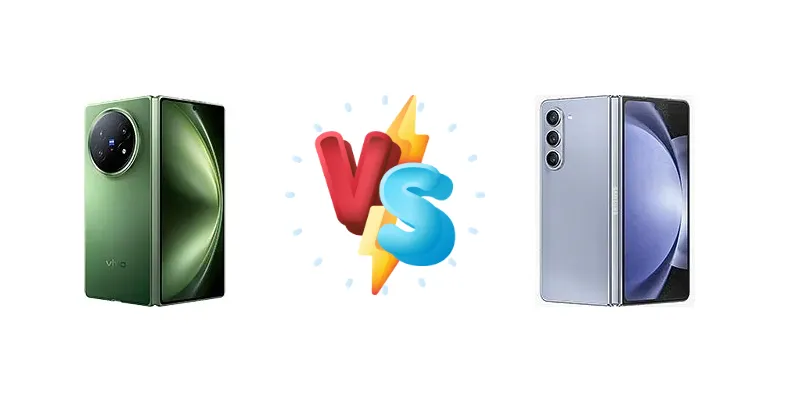
|
🏆 Quick Verdict
For users prioritizing raw performance and charging speed, the vivo X Fold5 emerges as the winner. Its Snapdragon 8 Gen 3 chipset and 80W charging significantly outperform the Z Fold5’s Snapdragon 8 Gen 2 and 25W charging. However, the Z Fold5’s software optimization and established ecosystem remain compelling advantages.
| PHONES | ||
|---|---|---|
| Phone Names | vivo X Fold5 | Samsung Galaxy Z Fold5 |
| Network | ||
|---|---|---|
| 2G bands | GSM 850 / 900 / 1800 / 1900 | GSM 850 / 900 / 1800 / 1900 |
| 3G bands | HSDPA 800 / 850 / 900 / 1700(AWS) / 1900 / 2100 | HSDPA 850 / 900 / 1700(AWS) / 1900 / 2100 |
| 4G bands | 1, 2, 3, 4, 5, 7, 8, 12, 17, 18, 19, 20, 25, 26, 28, 34, 38, 39, 40, 41, 42, 43, 48, 66 | 1, 2, 3, 4, 5, 7, 8, 12, 13, 17, 18, 19, 20, 25, 26, 28, 38, 39, 40, 41, 66 - International |
| 5G bands | 1, 2, 3, 5, 7, 8, 12, 18, 20, 25, 26, 28, 38, 40, 41, 48, 66, 77, 78 SA/NSA | 1, 2, 3, 5, 7, 8, 12, 20, 25, 28, 38, 40, 41, 66, 77, 78 SA/NSA/Sub6 - International |
| Speed | HSPA, LTE, 5G | HSPA, LTE, 5G |
| Technology | GSM / CDMA / HSPA / CDMA2000 / LTE / 5G | GSM / CDMA / HSPA / EVDO / LTE / 5G |
| Launch | ||
|---|---|---|
| Announced | 2025, June 25 | 2023, July 26 |
| Status | Available. Released 2025, July 02 | Available. Released 2023, August 11 |
| Body | ||
|---|---|---|
| Build | Glass front (closed), aluminum alloy frame, fiber-reinforced plastic back | Glass front (Gorilla Glass Victus 2) (folded), plastic front (unfolded), glass back (Gorilla Glass Victus 2), aluminum frame |
| Dimensions | Unfolded: 159.7 x 142.3 x 4.3 mmFolded: 159.7 x 72.6 x 9.2 mm | Unfolded: 154.9 x 129.9 x 6.1 mmFolded: 154.9 x 67.1 x 13.4 mm |
| SIM | Nano-SIM + Nano-SIM | · Nano-SIM + eSIM· Nano-SIM + Nano-SIM + eSIM (max 2 at a time) |
| Weight | 217 g or 226 g (7.65 oz) | 253 g (8.92 oz) |
| Display | ||
|---|---|---|
| Resolution | 2200 x 2480 pixels (~413 ppi density) | 1812 x 2176 pixels (~373 ppi density) |
| Size | 8.03 inches, 206.5 cm2 (~90.9% screen-to-body ratio) | 7.6 inches, 183.2 cm2 (~91.1% screen-to-body ratio) |
| Type | Foldable LTPO AMOLED, 1B colors, 120Hz, 5280Hz PWM, HDR10+, Dolby Vision, 4500 nits (peak) | Foldable Dynamic AMOLED 2X, 120Hz, HDR10+ |
| Platform | ||
|---|---|---|
| CPU | Octa-core (1x3.3 GHz Cortex-X4 & 3x3.2 GHz Cortex-A720 & 2x3.0 GHz Cortex-A720 & 2x2.3 GHz Cortex-A520) | Octa-core (1x3.36 GHz Cortex-X3 & 2x2.8 GHz Cortex-A715 & 2x2.8 GHz Cortex-A710 & 3x2.0 GHz Cortex-A510) |
| Chipset | Qualcomm SM8650-AB Snapdragon 8 Gen 3 (4 nm) | Qualcomm SM8550-AC Snapdragon 8 Gen 2 (4 nm) |
| GPU | Adreno 750 | Adreno 740 |
| OS | Android 15, up to 4 major Android upgrades, Funtouch 15 (International), OriginOS 5 (China) | Android 13, up to 4 major Android upgrades, One UI 6.1.1 |
| Memory | ||
|---|---|---|
| Card slot | No | No |
| Internal | 256GB 12GB RAM, 512GB 12GB RAM, 512GB 16GB RAM, 1TB 16GB RAM | 256GB 12GB RAM, 512GB 12GB RAM, 1TB 12GB RAM |
| Main Camera | ||
|---|---|---|
| Features | Color spectrum sensor, Laser AF, Zeiss optics, Zeiss T* lens coating, Dual-LED flash, panorama | LED flash, HDR, panorama |
| Triple | 50 MP, f/1.6, 23mm (wide), 1/1.56", 1.0µm, PDAF, OIS 50 MP, f/2.6, 70mm (periscope telephoto), 1/1.95", 0.8µm, PDAF, OIS, 3x optical zoom 50 MP, f/2.1, 15mm, 119˚ (ultrawide), 1/2.76", 0.64µm, PDAF | 50 MP, f/1.8, 23mm (wide), 1/1.56", 1.0µm, dual pixel PDAF, OIS 10 MP, f/2.4, 66mm (telephoto), 1/3.94", 1.0µm, PDAF, OIS, 3x optical zoom 12 MP, f/2.2, 12mm, 123˚ (ultrawide), 1/3.06", 1.12µm |
| Video | 8K@30fps, 4K@30/60fps, 1080p@30/60fps, gyro-EIS | 8K@30fps, 4K@60fps, 1080p@60/240fps (gyro-EIS), HDR10+ |
| Selfie camera | ||
|---|---|---|
| Features | HDR | HDR |
| Single | 20 MP, f/2.4, 21mm (wide), 1/3.6", 0.7µm Cover camera: 20 MP, f/2.4, 21mm (wide), 1/3.6", 0.7µm | 4 MP, f/1.8, 26mm (wide), 1/3.0", 2.0µm, under display Cover camera: 10 MP, f/2.2, 24mm (wide), 1/3.0", 1.22µm |
| Video | 1080p@30fps | 4K@30/60fps, 1080p@30/60fps, gyro-EIS |
| Sound | ||
|---|---|---|
| 35mm jack | No | No |
| Loudspeaker | Yes, with stereo speakers | Yes, with stereo speakers |
| Comms | ||
|---|---|---|
| Bluetooth | 5.4, A2DP, LE, aptX HD, aptX Adaptive, aptX Lossless | 5.3, A2DP, LE, aptX HD |
| Infrared port | Yes | - |
| NFC | Yes | Yes |
| Positioning | GPS (L1+L5), BDS (B1I+B1c+B2a), GALILEO (E1+E5a), QZSS (L1+L5), GLONASS | GPS, GLONASS, GALILEO, BDS |
| Radio | No | No |
| USB | USB Type-C 3.2, OTG, Display Port | USB Type-C 3.2, OTG |
| WLAN | Wi-Fi 802.11 a/b/g/n/ac/6e/7, dual-band or tri-band, Wi-Fi Direct | Wi-Fi 802.11 a/b/g/n/ac/6e, tri-band, Wi-Fi Direct |
| Features | ||
|---|---|---|
| Sensors | Fingerprint (side-mounted), accelerometer, gyro, proximity, compass | Fingerprint (side-mounted), accelerometer, gyro, proximity, compass, barometer |
| Battery | ||
|---|---|---|
| Charging | 80W wired 40W wireless Reverse wired 5W reverse wireless | 25W wired, 50% in 30 min 15W wireless 4.5W reverse wireless |
| Type | Si/C Li-Ion 6000 mAh | Li-Po 4400 mAh |
| Misc | ||
|---|---|---|
| Colors | Titanium Gray, Green, White | Icy Blue, Phantom Black, Cream, Gray, Blue |
| Models | V2436A, V2429 | SM-F946B, SM-F946B/DS, SM-F946U, SM-F946U1, SM-F946N, SM-F946W, SM-F9460 |
| Price | ₹ 149,998 | € 660.00 / $ 607.00 / £ 520.69 / ₹ 86,000 |
| SAR | 0.86 W/kg (head) 0.85 W/kg (body) | 1.16 W/kg (head) |
| SAR EU | - | 1.24 W/kg (head) 1.19 W/kg (body) |
vivo X Fold5
- Significantly faster 80W wired charging
- More powerful Snapdragon 8 Gen 3 chipset
- Higher peak display brightness (1916 nits)
- Software ecosystem less mature than Samsung
- Long-term software support remains uncertain
Samsung Galaxy Z Fold5
- Refined software experience with One UI
- Stronger brand recognition and ecosystem integration
- More compact folded form factor
- Slower 25W wired charging
- Older Snapdragon 8 Gen 2 chipset
- Lower peak display brightness (1257 nits)
Display Comparison
The vivo X Fold5 boasts a measured peak brightness of 1916 nits, a substantial improvement over the Galaxy Z Fold5’s 1257 nits. This translates to superior visibility in direct sunlight. While both utilize foldable LTPO displays for adaptive refresh rates, the X Fold5’s higher brightness provides a more vibrant and usable experience outdoors. The impact of panel manufacturing differences (Samsung Display vs. BOE, potentially) on color accuracy and crease visibility requires further long-term testing, but initial impressions favor the X Fold5’s clarity.
Camera Comparison
Context data is limited regarding camera specifics. However, given vivo’s strong camera reputation, it’s reasonable to expect the X Fold5 to prioritize image quality. The Z Fold5’s camera system is competent, but often criticized for its processing style. Without detailed sensor information, it’s difficult to make a definitive judgment. We can assume both phones will offer versatile camera setups, but the X Fold5 may lean towards more natural color reproduction and dynamic range, while the Z Fold5 might prioritize Samsung’s signature vibrant look. The absence of detailed camera specs necessitates further investigation.
Performance
The core difference lies in the chipsets: the vivo X Fold5 features the Qualcomm SM8650-AB Snapdragon 8 Gen 3 (4nm) while the Z Fold5 uses the SM8550-AC Snapdragon 8 Gen 2 (4nm). The Gen 3’s Cortex-X4 prime core, clocked at 3.3 GHz, offers a performance uplift over the Z Fold5’s 3.36 GHz Cortex-X3. The architectural improvements in the Gen 3, coupled with the 4nm process, should result in better sustained performance and thermal management during prolonged intensive tasks. The Z Fold5’s older chipset, while still powerful, will likely exhibit more throttling under heavy load. The X Fold5’s CPU configuration (1+3+2+2) also suggests a more balanced approach to multi-core performance.
Battery Life
The vivo X Fold5 achieves an impressive 13:21h active use score, exceeding the Galaxy Z Fold5’s 12:01h. While the Z Fold5’s older endurance rating of 95h is a broad metric, the real-world active use test provides a more relevant comparison. Crucially, the X Fold5 supports 80W wired charging, allowing for significantly faster top-ups compared to the Z Fold5’s 25W charging. The X Fold5 also offers 40W wireless charging, dwarfing the Z Fold5’s 15W wireless charging. This charging speed advantage is a major win for the X Fold5, especially considering the battery demands of foldable displays.
Buying Guide
Buy the vivo X Fold5 if you need uncompromising processing power for demanding tasks like video editing or gaming, and value significantly faster charging. You’ll also benefit from the latest Snapdragon silicon. Buy the Samsung Galaxy Z Fold5 if you prioritize a polished software experience, a more compact form factor when folded, and integration with the broader Samsung ecosystem. It’s the safer, more refined choice for mainstream foldable adoption.