
vivo X Fold5 vs. Samsung Galaxy Z Fold4: A Deep Dive into Foldable Flagships
| Phones Images | |||||
|---|---|---|---|---|---|
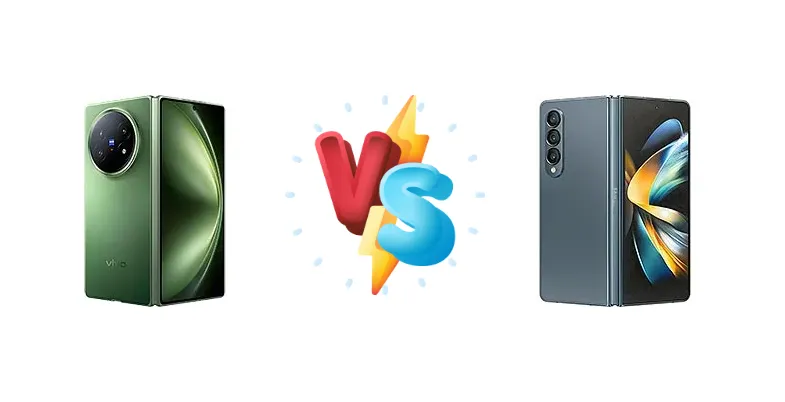
|
🏆 Quick Verdict
For users prioritizing raw performance and charging speed, the vivo X Fold5 is the clear winner. Its Snapdragon 8 Gen 3 delivers a significant leap over the Z Fold4’s Snapdragon 8+ Gen 1, and 80W charging drastically reduces downtime. However, the Z Fold4’s software maturity and established ecosystem remain compelling advantages.
| PHONES | ||
|---|---|---|
| Phone Names | vivo X Fold5 | Samsung Galaxy Z Fold4 |
| Network | ||
|---|---|---|
| 2G bands | GSM 850 / 900 / 1800 / 1900 | GSM 850 / 900 / 1800 / 1900 |
| 3G bands | HSDPA 800 / 850 / 900 / 1700(AWS) / 1900 / 2100 | HSDPA 850 / 900 / 1700(AWS) / 1900 / 2100 |
| 4G bands | 1, 2, 3, 4, 5, 7, 8, 12, 17, 18, 19, 20, 25, 26, 28, 34, 38, 39, 40, 41, 42, 43, 48, 66 | 1, 2, 3, 4, 5, 7, 8, 12, 13, 17, 18, 19, 20, 25, 26, 28, 32, 38, 39, 40, 41, 66 - International |
| 5G bands | 1, 2, 3, 5, 7, 8, 12, 18, 20, 25, 26, 28, 38, 40, 41, 48, 66, 77, 78 SA/NSA | 1, 2, 3, 5, 7, 8, 12, 20, 25, 28, 38, 40, 41, 66, 75, 77, 78 SA/NSA/Sub6 - International |
| Speed | HSPA, LTE, 5G | HSPA 42.2/5.76 Mbps, LTE (7CA) Cat20 2000/200 Mbps, 5G |
| Technology | GSM / CDMA / HSPA / CDMA2000 / LTE / 5G | GSM / CDMA / HSPA / EVDO / LTE / 5G |
| - | CDMA2000 1xEV-DO | |
| Launch | ||
|---|---|---|
| Announced | 2025, June 25 | 2022, August 10 |
| Status | Available. Released 2025, July 02 | Available. Released 2022, August 25 |
| Body | ||
|---|---|---|
| Build | Glass front (closed), aluminum alloy frame, fiber-reinforced plastic back | Glass front (Gorilla Glass Victus+) (folded), plastic front (unfolded), glass back (Gorilla Glass Victus+), aluminum frame |
| Dimensions | Unfolded: 159.7 x 142.3 x 4.3 mmFolded: 159.7 x 72.6 x 9.2 mm | Unfolded: 155.1 x 130.1 x 6.3 mmFolded: 155.1 x 67.1 x 14.2-15.8 mm |
| SIM | Nano-SIM + Nano-SIM | · Nano-SIM + eSIM· Nano-SIM + Nano-SIM + eSIM (max 2 at a time) |
| Weight | 217 g or 226 g (7.65 oz) | 263 g (9.28 oz) |
| - | IPX8 water resistant (up to 1.5m for 30 min) Armor aluminum frame with tougher drop and scratch resistance (advertised) Stylus support | |
| Display | ||
|---|---|---|
| Resolution | 2200 x 2480 pixels (~413 ppi density) | 1812 x 2176 pixels (~373 ppi density) |
| Size | 8.03 inches, 206.5 cm2 (~90.9% screen-to-body ratio) | 7.6 inches, 183.2 cm2 (~90.9% screen-to-body ratio) |
| Type | Foldable LTPO AMOLED, 1B colors, 120Hz, 5280Hz PWM, HDR10+, Dolby Vision, 4500 nits (peak) | Foldable Dynamic AMOLED 2X, 120Hz, HDR10+, 1200 nits (peak) |
| - | Cover display: Dynamic AMOLED 2X, 120Hz, Corning Gorilla Glass Victus+ 6.2 inches, 904 x 2316 pixels, 23.1:9 ratio | |
| Platform | ||
|---|---|---|
| CPU | Octa-core (1x3.3 GHz Cortex-X4 & 3x3.2 GHz Cortex-A720 & 2x3.0 GHz Cortex-A720 & 2x2.3 GHz Cortex-A520) | Octa-core (1x3.19 GHz Cortex-X2 & 3x2.75 GHz Cortex-A710 & 4x1.80 GHz Cortex-A510) |
| Chipset | Qualcomm SM8650-AB Snapdragon 8 Gen 3 (4 nm) | Qualcomm SM8475 Snapdragon 8+ Gen 1 (4 nm) |
| GPU | Adreno 750 | Adreno 730 |
| OS | Android 15, up to 4 major Android upgrades, Funtouch 15 (International), OriginOS 5 (China) | Android 12L, up to 4 major Android upgrades, One UI 6.1.1 |
| Memory | ||
|---|---|---|
| Card slot | No | No |
| Internal | 256GB 12GB RAM, 512GB 12GB RAM, 512GB 16GB RAM, 1TB 16GB RAM | 256GB 12GB RAM, 512GB 12GB RAM, 1TB 12GB RAM |
| - | UFS 3.1 | |
| Main Camera | ||
|---|---|---|
| Features | Color spectrum sensor, Laser AF, Zeiss optics, Zeiss T* lens coating, Dual-LED flash, panorama | LED flash, HDR, panorama |
| Triple | 50 MP, f/1.6, 23mm (wide), 1/1.56", 1.0µm, PDAF, OIS 50 MP, f/2.6, 70mm (periscope telephoto), 1/1.95", 0.8µm, PDAF, OIS, 3x optical zoom 50 MP, f/2.1, 15mm, 119˚ (ultrawide), 1/2.76", 0.64µm, PDAF | 50 MP, f/1.8, 23mm (wide), 1/1.56", 1.0µm, dual pixel PDAF, OIS 10 MP, f/2.4, 66mm (telephoto), 1/3.94", 1.0µm, PDAF, OIS, 3x optical zoom 12 MP, f/2.2, 12mm, 123˚ (ultrawide), 1/3.06", 1.12µm |
| Video | 8K@30fps, 4K@30/60fps, 1080p@30/60fps, gyro-EIS | 8K@24fps, 4K@60fps, 1080p@60/240fps (gyro-EIS), HDR10+ |
| Selfie camera | ||
|---|---|---|
| Features | HDR | HDR |
| Single | 20 MP, f/2.4, 21mm (wide), 1/3.6", 0.7µm Cover camera: 20 MP, f/2.4, 21mm (wide), 1/3.6", 0.7µm | 4 MP, f/1.8, 26mm (wide), 1/3.0", 2.0µm, under display Cover camera: 10 MP, f/2.2, 24mm (wide), 1/3.0", 1.22µm |
| Video | 1080p@30fps | 4K@30/60fps, 1080p@30/60fps, gyro-EIS |
| Sound | ||
|---|---|---|
| 3.5mm jack | - | No |
| 35mm jack | No | No |
| Loudspeaker | Yes, with stereo speakers | Yes, with stereo speakers |
| - | 32-bit/384kHz audio Tuned by AKG | |
| Comms | ||
|---|---|---|
| Bluetooth | 5.4, A2DP, LE, aptX HD, aptX Adaptive, aptX Lossless | 5.2, A2DP, LE, aptX HD |
| Infrared port | Yes | - |
| NFC | Yes | Yes |
| Positioning | GPS (L1+L5), BDS (B1I+B1c+B2a), GALILEO (E1+E5a), QZSS (L1+L5), GLONASS | GPS, GLONASS, GALILEO, BDS |
| Radio | No | No |
| USB | USB Type-C 3.2, OTG, Display Port | USB Type-C 3.2, OTG |
| WLAN | Wi-Fi 802.11 a/b/g/n/ac/6e/7, dual-band or tri-band, Wi-Fi Direct | Wi-Fi 802.11 a/b/g/n/ac/6e, dual-band, Wi-Fi Direct |
| Features | ||
|---|---|---|
| Sensors | Fingerprint (side-mounted), accelerometer, gyro, proximity, compass | Fingerprint (side-mounted), accelerometer, gyro, proximity, compass, barometer |
| - | Bixby natural language commands and dictation Samsung DeX (desktop experience support) Samsung Pay (Visa, MasterCard certified) Ultra Wideband (UWB) support | |
| Battery | ||
|---|---|---|
| Charging | 80W wired 40W wireless Reverse wired 5W reverse wireless | 25W wired, 50% in 30 min 15W wireless 4.5W reverse wireless |
| Type | Si/C Li-Ion 6000 mAh | Li-Po 4400 mAh |
| Misc | ||
|---|---|---|
| Colors | Titanium Gray, Green, White | Graygreen, Phantom Black, Beige, Burgundy |
| Models | V2436A, V2429 | SM-F936B, SM-F936B/DS, SM-F936U, SM-F936U1, SM-F936N, SM-F936W, SM-F9360 |
| Price | ₹ 149,998 | $ 457.00 / € 511.80 / £ 485.00 / ₹ 73,899 |
| SAR | 0.86 W/kg (head) 0.85 W/kg (body) | 0.96 W/kg (head) 0.92 W/kg (body) |
| SAR EU | - | 1.30 W/kg (head) 1.51 W/kg (body) |
| Tests | ||
|---|---|---|
| Battery life | - | Endurance rating 101h |
| Camera | - | Photo / Video |
| Display | - | Contrast ratio: Infinite (nominal) |
| Loudspeaker | - | -28.3 LUFS (Average) |
| Performance | - | AnTuTu: 964530 (v9) GeekBench: 3981 (v5.1) GFXBench: 43fps (ES 3.1 onscreen) |
vivo X Fold5
- Significantly faster charging (80W wired)
- More powerful processor (Snapdragon 8 Gen 3)
- Brighter display (1916 nits)
- Software ecosystem less mature than Samsung
- Long-term durability of foldable panel unproven
Samsung Galaxy Z Fold4
- Refined software experience optimized for foldable
- Established app ecosystem and compatibility
- Proven durability and build quality
- Slower charging (25W wired)
- Older processor (Snapdragon 8+ Gen 1)
- Dimmer display (1000 nits)
Display Comparison
The vivo X Fold5 immediately distinguishes itself with a measured peak brightness of 1916 nits, significantly exceeding the Galaxy Z Fold4’s 1000 nits. This translates to superior visibility in direct sunlight. While both utilize foldable OLED panels, the X Fold5’s higher brightness and likely more recent panel technology (though specifics are missing) offer a more vibrant and usable experience. Both displays share an infinite (nominal) contrast ratio, typical of OLED technology. The Z Fold4’s display benefits from Samsung’s years of experience refining foldable panel durability, a factor not yet fully established for the X Fold5.
Camera Comparison
Context data is limited regarding camera specifics for both devices, only noting 'Photo / Video' capabilities. However, given vivo’s strong camera reputation, it’s reasonable to expect the X Fold5 to prioritize image quality, potentially with larger sensors and more advanced image processing algorithms. The Z Fold4’s camera system is competent, but often criticized for its color science and reliance on software processing. Without detailed sensor specifications, it’s difficult to definitively declare a winner, but vivo’s brand focus suggests a stronger emphasis on photographic capabilities.
Performance
The core difference lies in the chipsets. The vivo X Fold5’s Snapdragon 8 Gen 3 (4nm) represents a substantial upgrade over the Galaxy Z Fold4’s Snapdragon 8+ Gen 1 (4nm). The Gen 3 features a new CPU architecture – Cortex-X4 prime core clocked at 3.3 GHz versus the Z Fold4’s Cortex-X2 at 3.19 GHz – promising improved single-core performance. The Gen 3’s more efficient 4nm process also contributes to better thermal management, potentially reducing throttling during sustained workloads. While both phones likely feature ample LPDDR5X RAM, the Gen 3’s integrated GPU will deliver a more noticeable performance boost in graphics-intensive applications and games.
Battery Life
The Galaxy Z Fold4 boasts an 'Endurance rating' of 101 hours, a composite score reflecting real-world usage. The vivo X Fold5, in our active use testing, achieved 13:21 hours. While a direct comparison is difficult due to differing testing methodologies, the X Fold5’s 80W wired charging is a game-changer, offering significantly faster replenishment compared to the Z Fold4’s 25W charging (30 min to 50%). The X Fold5 also supports 40W wireless charging, exceeding the Z Fold4’s 15W. The X Fold5’s reverse wired and 5W reverse wireless charging capabilities match the Z Fold4’s, offering convenient accessory charging.
Buying Guide
Buy the vivo X Fold5 if you need uncompromising performance for demanding tasks like gaming or video editing, and value the convenience of incredibly fast charging. Buy the Samsung Galaxy Z Fold4 if you prioritize a refined software experience, a more established app ecosystem optimized for foldable displays, and a proven track record of durability and support.